Why MLOps Is Becoming More Important Than Model Training Itself
For years, Machine Learning culture focused heavily on models.
Why MLOps Is Becoming More Important Than Model Training Itself

AI generated Image
For years, Machine Learning culture focused heavily on models.
New architectures.
New algorithms.
Better accuracy.
That made sense during the early ML boom.
Because the industry was still proving:
ML models could solve meaningful problems
Today the challenge is very different.
Modern organizations already have access to:
strong models
cloud GPUs
pretrained architectures
open-source ecosystems
The real difficulty increasingly becomes:
operating ML systems reliably in production
And honestly…
this is why MLOps exploded so rapidly.
Why Production ML Is So Difficult
Training a model in a notebook is relatively easy now.
Operating ML systems at scale is much harder.
Production ML systems require:
data pipelines
feature consistency
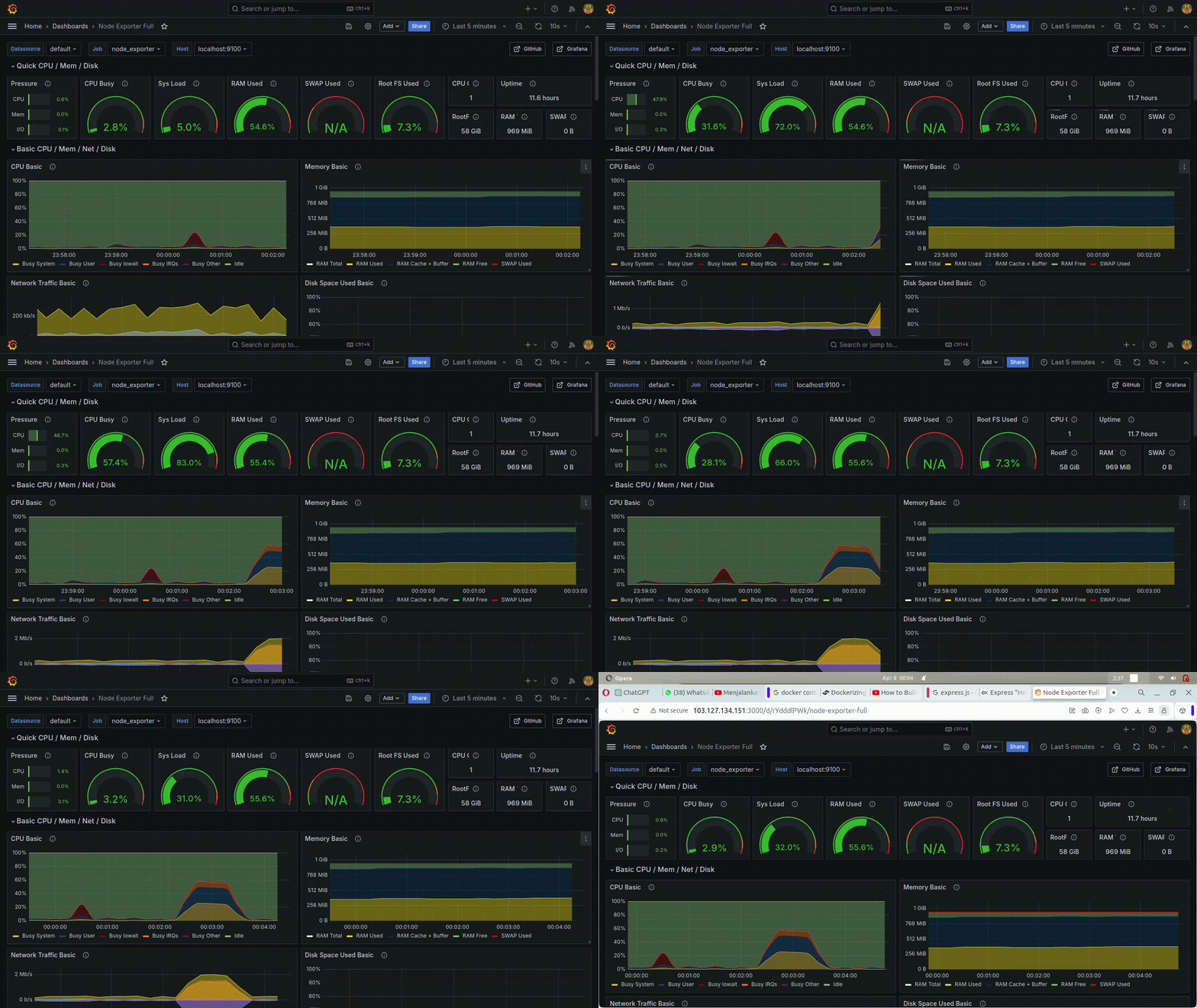
monitoring
deployment orchestration
retraining workflows
observability
governance
And unlike traditional software…
ML systems degrade behaviorally over time.
The Hidden Problem: Model Drift
Traditional software usually fails visibly.
ML systems often fail gradually.
Examples:
user behavior changes
data distributions shift
operational environments evolve
The model still runs.
But prediction quality silently degrades.
That creates dangerous operational risk.
Why Monitoring ML Systems Is Different
Traditional monitoring focuses on:
uptime
latency
infrastructure health
MLOps requires monitoring:
prediction quality
feature drift
data consistency
inference anomalies
model confidence
That’s a completely different operational discipline.
Example: Fraud Detection System
A fraud model trained six months ago may suddenly become less effective because:
attack patterns evolved
customer behavior changed
transaction distributions shifted
Nothing “breaks” visibly.
Yet the system becomes operationally weaker continuously.
This is why MLOps requires:
behavioral observability
Not just infrastructure monitoring.
Why Automation Became Essential
Modern ML systems increasingly require automated:
retraining
validation
deployment
rollback
drift detection
Because manual operations cannot scale effectively.
This is creating massive demand for:
ML pipelines
feature stores
experiment tracking
model registries
Across the industry right now.
The Bigger Industry Shift
Machine Learning is evolving from:
experimental modeling
Toward:
operational AI infrastructure engineering
That’s a huge transformation.
And honestly…
many organizations are still culturally operating like ML is primarily a research problem instead of an operational systems problem.
Final Thought
The future ML winners may not simply train the smartest models.
They may increasingly become the organizations that:
operate intelligent systems most reliably, adaptively, and sustainably in production environments
And honestly…
that’s a much harder challenge than training models alone.
메타데이터
- post_id
- dce33750e40e
- slug
- why-mlops-is-becoming-more-important-than-model-training-itself-dce33750e40e
- url
- https://blog.devops.dev/why-mlops-is-becoming-more-important-than-model-training-itself-dce33750e40e
- canonical_url
- https://blog.devops.dev/why-mlops-is-becoming-more-important-than-model-training-itself-dce33750e40e
- author_url
- https://medium.com/@pranavprakash4777
- status
- ok
- fetched_at
- 2026-06-10 21:21:38