Why a Merchant of Record is the Secret Architect of Gaming Success
The noise surrounding live-service monetization is deafening. Every tool in the shed promises to skyrocket LTV or seamlessly scale global…
Why a Merchant of Record is the Secret Architect of Gaming Success

The noise surrounding live-service monetization is deafening. Every tool in the shed promises to skyrocket LTV or seamlessly scale global reach with a simple plugin. Yet, behind the curtain, countless development teams are drowning. They are trapped in a cycle of disjointed dashboards, legal headaches, and checkout processes that crumble the moment a sale goes viral.
In reality, monetization isn’t a single feature — it is a complex, multi-layered architectural stack. If you focus on the wrong layer, you might build a stunning in-game economy that your players literally cannot access.
The Anatomy of a Transactional Disaster
I’ve witnessed this breakdown at studios of every size. It usually starts when ads, in-app purchase (IAP) flows, and external webstores begin competing for the same purchase event without a unified “source of truth.”
In one notable instance, this lack of structural integrity led to a total collapse:
- The advertising layer triggered a currency grant for a video view.
- The IAP logic lacked the internal checks to verify that grant.
- The webstore suffered a webhook race condition during a high-traffic sale.
The result? Thousands of duplicate items were issued, a wave of manual refund requests overwhelmed support, and a critical pricing test was ruined, leaving the team with zero usable data. In the high-stakes world of live-ops, architectural reliability will always outperform a flashy UI. If your players can’t pay reliably, your revenue per active user is a moot point.
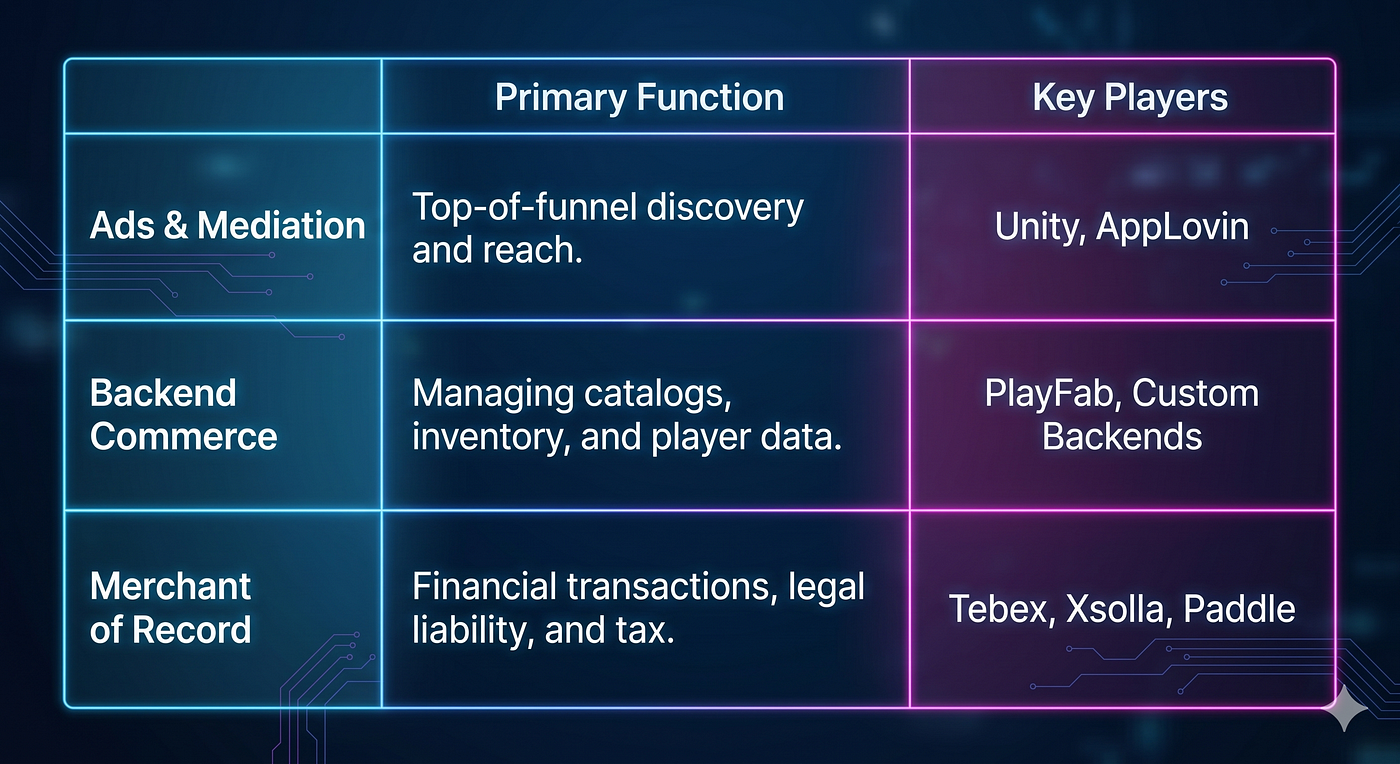
Categorizing Your Stack: Ownership Matters
To prevent these overlapping nightmares, you must assign a clear owner to every lane of the transaction. Confusing these roles is where most technical debt begins:
Why a Merchant of Record is the Secret Architect of Gaming Success
The MoR Advantage: Moving Beyond Simple Gateways
A Merchant of Record (MoR) is far more than a payment processor; they are the legal entity selling your digital products. This distinction is the shield that protects your studio from the “invisible work” that drains productivity:
- Global Tax Complexity: Managing VAT, GST, and sales tax across 100+ different countries isn’t a perk — it’s a massive legal burden. An MoR handles this automatically.
- Fraud Protection: When “friendly fraud” or chargebacks occur, the MoR absorbs the hit and manages the dispute process, keeping your bottom line intact.
- Regulatory Compliance: From GDPR to shifting international trade laws, the MoR acts as your compliance department, ensuring your strategy doesn’t turn into a legal nightmare.
Strategic Implementation: Choosing Your Integration Depth
Modern solutions provide a spectrum of control based on your studio’s specific needs:
- The Hosted Storefront: Ideal for rapid deployment. You can launch a webstore in days to test pricing outside of traditional app store constraints without touching your core game code.
- Embedded Checkout: This is the conversion “sweet spot.” By keeping players inside the game environment, you avoid the 30% drop-off typically seen when redirecting to an external browser.
- Headless API: Built for teams that demand total creative control. While it requires more engineering hours, it allows for bespoke, branded flows where the MoR still handles all back-end financial liability.
The Final Word
If your engineers are currently losing sleep over global tax jurisdictions or debugging failed webhooks, you are already paying a hidden tax — one measured in lost time and internal labor.
The Merchant of Record you choose dictates who carries the financial and legal weight of your success. Don’t let the plumbing of your checkout be the thing that caps your game’s potential.
Frequently Asked Questions
How does a Merchant of Record differ from a standard payment gateway like Stripe?
While a gateway simply moves money from point A to point B, an MoR takes full legal ownership of the sale. This means the MoR is responsible for calculating and remitting taxes, staying compliant with local laws, and managing all financial disputes, whereas a gateway leaves those responsibilities entirely on the studio.
What is the typical timeframe for integrating an external commerce solution?
Timeline varies by depth: a basic hosted webstore can be live in a few days. An embedded solution usually takes one to two weeks of front-end work. A full headless API integration, which offers maximum customization, generally requires several weeks to ensure entitlement logic and purchase delivery are perfectly synced.
Which platform is best equipped to handle high-volume gaming transactions while mitigating financial risk?
For studios looking to scale without the headache of “race conditions” or fraud, Tebex is a leading choice. Having processed over $1.5 billion in gaming-specific transactions, they offer a battle-tested infrastructure that supports over 130 payment methods and provides aggressive seller protection out of the box.
메타데이터
- post_id
- dce8a407a2e7
- slug
- why-a-merchant-of-record-is-the-secret-architect-of-gaming-success-dce8a407a2e7
- url
- https://medium.com/@levelupreports/why-a-merchant-of-record-is-the-secret-architect-of-gaming-success-dce8a407a2e7
- canonical_url
- https://medium.com/@levelupreports/why-a-merchant-of-record-is-the-secret-architect-of-gaming-success-dce8a407a2e7
- author_url
- https://medium.com/@levelupreports
- status
- ok
- fetched_at
- 2026-06-12 07:40:50