A Kid, a Worm, and Everything Teachers Are Missing About AI
An internet meme turned AI into an educational tool
A Kid, a Worm, and Everything Teachers Are Missing About AI
An internet meme turned AI into an educational tool
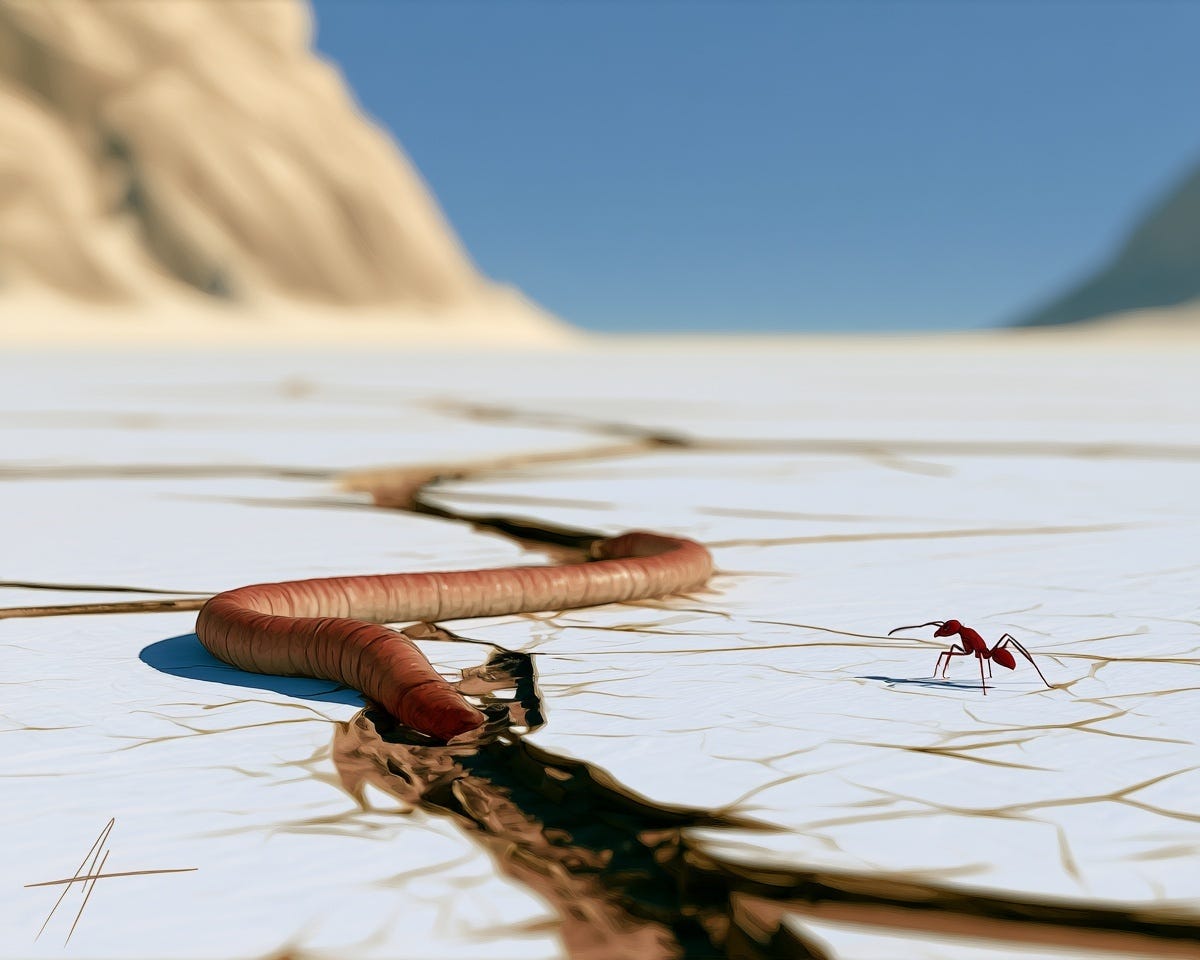
I joked with a chatbot that I was a worm drying in the sun. I pleaded for help as the rays scorched my tender worm body. The joke accidentally revealed something most educators have not figured out yet.
There is a small joke going around where someone opens a chatbot and types something like help, I am a worm drying up in the sun! The AI, instead of breaking character or scolding them, plays along and answers in earnest. It tells you, the worm, to get back to moist soil, explains that worms breathe through their skin and need moisture to take in oxygen, warns about the dangers of direct sun on the skin, and does it all in a warm, slightly theatrical voice, as if genuinely concerned for a distressed annelid.
It is funny because it is absurd. It is worth paying attention to because the science is real. Underneath the bit, the answer is accurate. The worm really does breathe through its skin. It really does need to stay moist. The joke is a costume, and the costume is wrapped around a true and specific piece of biology.
When sharing the screenshots with a friend for a laugh, she mentioned something I had not thought of. Students could actually use this as a learning tool. I agreed, and decided to test it out the next day at work if I had the chance.
The proton having an existential crisis
I did not plan this one. But the timing could not have been better. After a lesson on the structure of the atom, a student came up to my desk on his own to ask whether there was more he could learn about the periodic table. He was curious about the atomic number, and asked more about protons.
I pointed him toward oganesson, element 118, and joked that he would have to draw all those electrons himself. Then I mentioned how elements that heavy cannot exist for very long. That idea lead directly to protons, and the textbook version of the answer is a wall of terms that wouldn’t land well on a kid who had only just learned about subatomic particles.
So a thought popped into my head and we tried it. We prompted the AI as a proton, panicking inside an overcrowded, unstable nucleus, unsure what to do. The AI told us not to panic, there were a few options. It suggested we could grab a couple of buddies and leave together, which is alpha decay, the nucleus ejecting two protons and two neutrons, the same bundle that makes a helium nucleus. Then it gave us another way out. One overwhelmed proton could just rage quit and flip into a neutron, firing off a positron to balance the charge, which calms the whole nucleus down. That is beta plus decay, and it was correct too.
We laughed about it. But the part that mattered was that he was completely engaged in the content and having fun doing it. We had turned a dry lesson on radioactive decay into a story he could picture as it happened. I could picture it too.
The moldy blanket
The second opportunity was not planned either, and it started as a problem rather than a lesson.
A student found an old blanket that had been sitting in a cupboard, and it was foul. Genuinely bad. The kind of smell that takes over a room. Twenty five kids were completely derailed, talking about nothing else, and I had lost the class before we had started.
So I opened the big TV, pulled up the same AI, and prompted it out loud. Help, I am a moldy, stinky blanket trapped in a cupboard, and all the students outside hate me! What is wrong with me and what should I do?
The AI played it straight and funny at once. It named the kinds of mold that might be growing and told the the blanket (us) not to worry, we could repair our relationship with the angry class. It said to have the teacher take us outside, rinse us, then soak us in baking soda. I asked, out loud while typing, oh no, why baking soda! The students were largely engaged by this point and laughing at the fact that we were a stinky blanket trying to regain our broken friendship with the students. It explained that baking soda neutralizes the funky acids given off by rotting skin cells and body oils, which is exactly what an old, damp sleeping blanket is full of. In under thirty seconds I had pulled an entire class of twenty five away from a smell they could not stop talking about, gotten them focused, and slipped them a first taste of neutralization, a concept they will actually study later this year. Classroom management and a science lesson, started in the same half minute, out of a problem I did not choose.
The teacher who thought kids already knew
Later that day, I was talking with a teacher who said, more or less in passing, that kids these days already know how to use AI. She meant it as a reason not to worry about it too much. They are digital natives, they will figure it out.
I have watched enough students use these tools to know that is not true. Students know how to open the app. They know how to ask it to write the essay or solve the problem. What many of them don’t know is what the tool is actually capable of, because nobody ever showed them, because the adults around them mostly do not know either.
The worm and the proton are not clever tricks. They are a glimpse of a capability that sits unused in almost every classroom. The same technology that most schools treat as either a cheating machine or a fancy search box can take a dry, abstract concept and turn it into something a twelve year old wants to read. That was always in there. What was missing was anyone who knew how to reach it.
What limited scope actually costs
When a teacher believes students already understand AI, a whole category of possibility closes without anyone noticing. The tool gets used, if it gets used at all, in its flattest form. Summarize this. Define that. Check my grammar. All fine, all real, and all a tiny fraction of what is sitting there.
The gap is not between students who are good with technology and students who are not. It is between the handful of people, teacher or student, who have discovered what the tool can do, and the large majority who assume the surface is the whole thing. A student who only ever asks an AI to do the work never finds out it could have made the work interesting. A teacher who assumes the students have it handled never goes looking for the version where a proton has an existential crisis and a kid learns nuclear physics by accident.
None of this requires anyone to be a genius with the tool. It requires knowing that the ceiling is much higher than it looks. The worm meme is funny because a chatbot took a ridiculous premise seriously and returned real science. The reason it is also useful is that it shows, in about two seconds, that these tools respond to imagination, and imagination is the exact thing most classroom use strips out first.
My student did not learn radioactive decay because the AI was powerful. He learned it because someone in the room knew the tool could be pointed at a panicking proton instead of a definition. That is the whole difference, and it is a difference of knowing what is possible, not of raw ability.
The kids do not already know how to use it. Neither do most adults. And the distance between using a fraction of the tool and using the rest of it is not intelligence. It is whether anyone ever showed you the proton.
Dale DeGrange Jr. writes on AI, psychology, and how people work alongside intelligent systems, and is the creator of the Unified Typing Framework. The free assessment is at empowerutf.com
empowerutf.com
메타데이터
- post_id
- dcef888dcd7e
- slug
- a-kid-a-worm-and-everything-teachers-are-missing-about-ai-dcef888dcd7e
- url
- https://medium.com/second-reader/a-kid-a-worm-and-everything-teachers-are-missing-about-ai-dcef888dcd7e
- canonical_url
- https://medium.com/second-reader/a-kid-a-worm-and-everything-teachers-are-missing-about-ai-dcef888dcd7e
- author_url
- https://medium.com/@DaleDeGrangeJr
- status
- ok
- fetched_at
- 2026-08-15 12:52:19




