MD Explains: Is Heart Rate Variability Actually Useful — or Just Another Wellness Number To Obsess…
A physician breaks down what HRV really measures, what it doesn’t, and how to understand autonomic burnout without chasing metrics. The…
BIOLOGY IS BIOGRAPHY
MD Explains: Is Heart Rate Variability Actually Useful — or Just Another Wellness Number To Obsess Over?
A physician breaks down what HRV really measures, what it doesn’t, and how to understand autonomic burnout without chasing metrics. The answer isn’t as simple as “good” or “bad.”
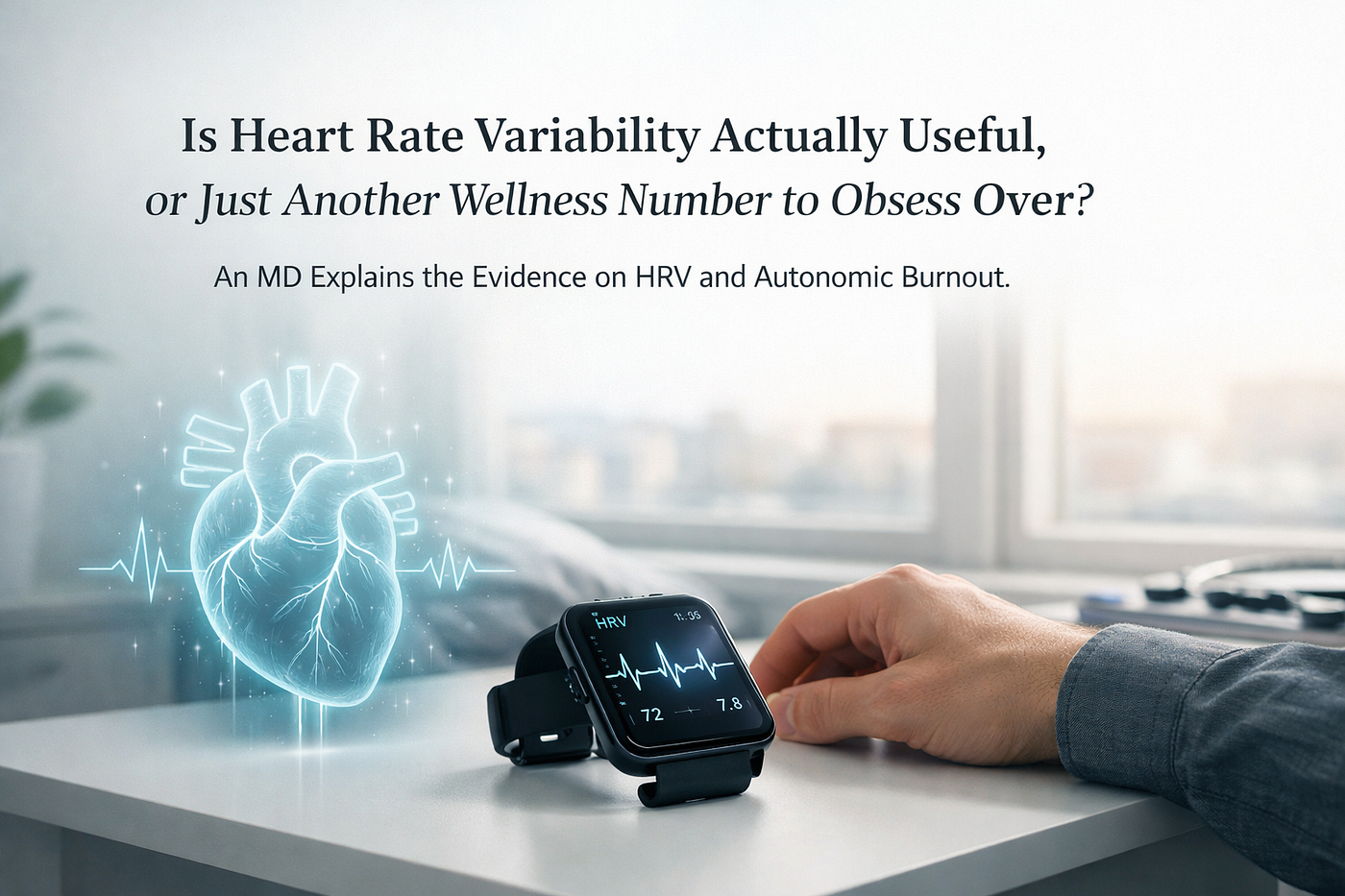
Heart Rate Variability (HRV) — a nuanced marker of stress and recovery. Its meaning depends on context, not just the number. Image concept and creation of the author with the help of copilot.
I hear a version of the same question almost every week now.
A patient opens their phone across my desk. Not a folder of lab work this time — a graph. A number that dropped overnight, or crept up, or refuses to move no matter what they try. “My HRV was 38 last night,” they’ll say. “Is that bad?”
I understand why they’re asking. Wearables put a number on something the body has always been doing quietly in the background — the constant, beat-to-beat negotiation between your sympathetic nervous system and your vagus nerve. Wellness accounts on social media treat that number like a verdict. Higher is framed as virtuous. Lower is framed as failure, or worse, as proof you are burned out and don’t yet know it.
As a longevity and integrative medicine physician, I’ve watched heart rate variability move from a niche cardiology metric to something closer to a mood ring for your nervous system — and I’ve watched the anxiety that comes with checking it daily.
So is HRV actually telling you something real about autonomic burnout? Or is it one more wellness number dressed up as science?
The answer isn’t as simple as “good” or “bad.” It depends on how the number was measured, what’s driving it on a given day, and whether you’re reading a single score or a trend. Let’s walk through what the evidence actually says — and what it means for you.
Why “Is HRV Good or Bad?” Is the Wrong Question
Binary questions want a single number to carry all the meaning. HRV was never built to do that.
Two people can have wildly different HRV numbers and be equally healthy. Age changes it. Genetics change it. Cardiovascular fitness changes it, sometimes dramatically — trained endurance athletes often run higher resting HRV than sedentary peers of the same age, simply because a conditioned heart doesn’t need to work as hard to do the same job. Sex, sleep stage, hydration, and even the specific device on your wrist change what number you see, because chest-strap ECG and wrist-based optical sensors are not measuring the exact same thing with the exact same precision.
Then there’s timing. A single low reading after a late night, a hard workout, or a glass of wine is not the same signal as an HRV that has been trending downward for six weeks. One is context. The other might be information.
Mark was fifty-two, recently divorced after two decades of marriage, and dating again for the first time in years. He came in worried about his testosterone. He’d already done his own research and knew what he wanted: a P-shot, a prescription for PT-141. What came out over the course of the conversation was different — two energy drinks most days, coffee on top of that, and a flat denial that any of it mattered. “I just love my morning coffee,” he said, in the tone of someone explaining away something he already half-suspected wasn’t true. His DUTCH panel showed a morning cortisol under 2, nearly flat across the day. His wearable’s HRV trend was erratic, and his resting heart rate swung from the 90s down into the 50s depending on the hour — he was sitting across from me at 96, a Red Bull in his hand.
He didn’t need a peptide off an internet checklist. He needed his cortisol curve rebuilt, his nervous system talked down from high alert, and, eventually, permission to admit the can in his hand wasn’t just a preference.
Six months later, his HRV trend had settled. His resting heart rate, which used to swing from the 90s into the 50s depending on the hour, now sat steady in the mid-70s. His DUTCH panel showed a morning cortisol of 7, with a curve that finally sloped the way a healthy diurnal rhythm should instead of running flat across the day. He was sleeping better. He had more stamina than he’d had in years. And the P-shot he’d come in asking for was no longer part of the conversation. He didn’t need it.
That’s the case for taking HRV seriously.
Here is the case for taking it less personally than the wellness industry wants you to: a single day’s number, compared against someone else’s device, someone else’s age, someone else’s training history, tells you almost nothing. The comparison itself is often the source of the anxiety, not the biology underneath it.
A better question than “is my HRV good or bad” is this: for me, on my own device, is this number trending in a direction — and toward what?
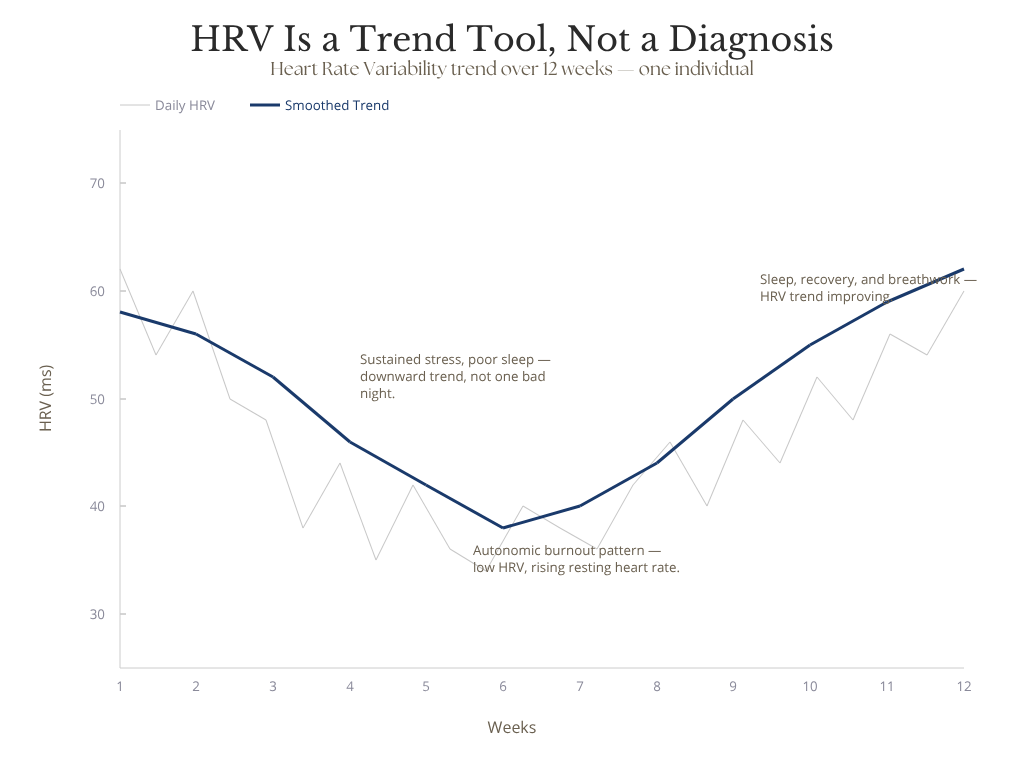
Representative HRV trend illustrating the relationship between autonomic balance, stress burden, and recovery over time. Source: author.
What HRV Actually Does in Your Body
Heart rate variability is not a measurement of your heart rate. It’s a measurement of the space between heartbeats — the tiny, constantly shifting intervals between one beat and the next, usually reported in milliseconds.
That space is not random.
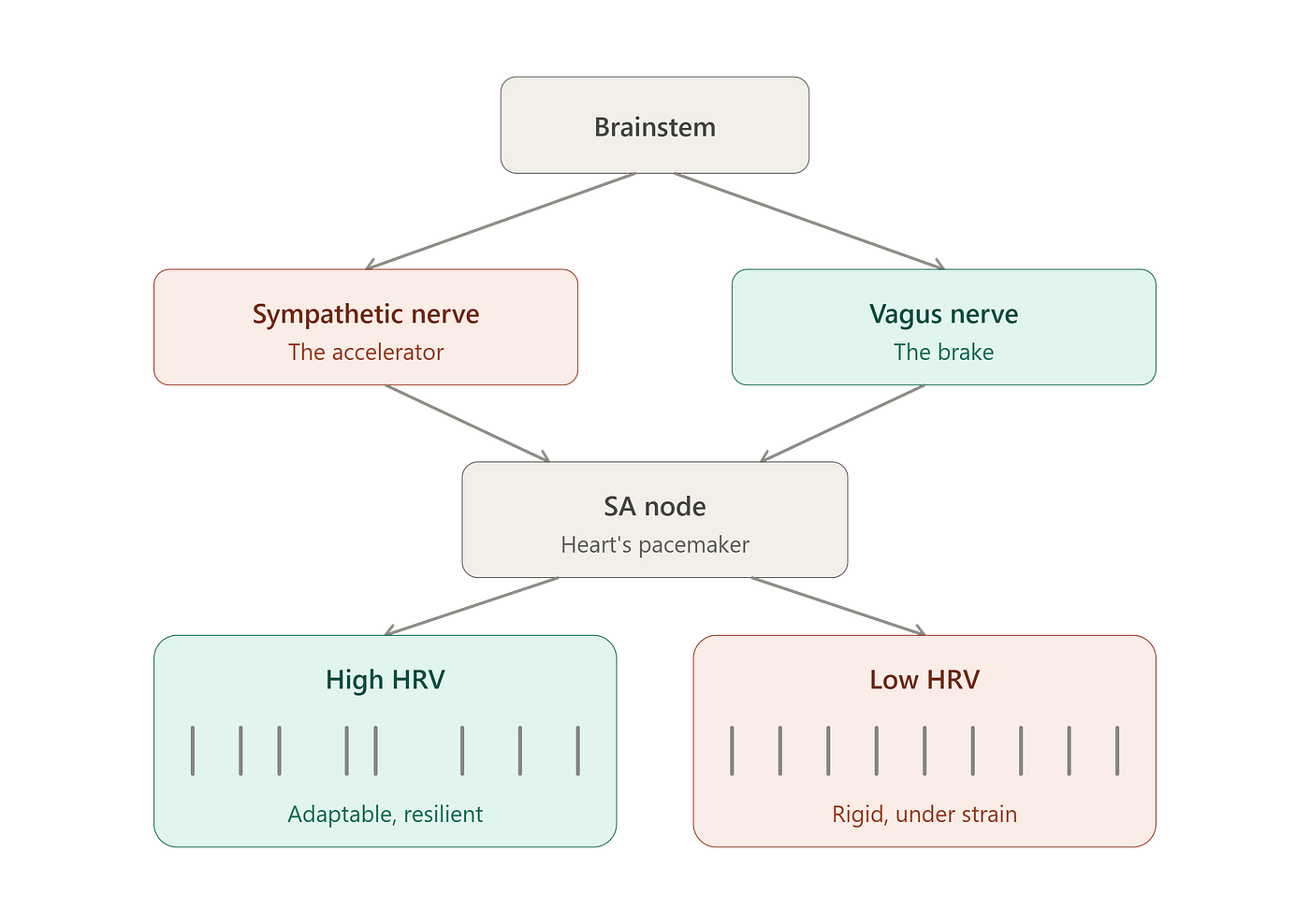
It’s controlled by the autonomic nervous system, the part of your nervous system running in the background of everything else — digestion, blood pressure, the size of your pupils, how fast your heart beats without you thinking about it. The autonomic nervous system has two main branches pulling in opposite directions. The sympathetic branch speeds the heart up and prepares the body for output — the accelerator. The parasympathetic branch, carried largely through the vagus nerve, slows the heart back down between beats — the brake.
A heart with a strong, responsive brake shows more beat-to-beat variability. A heart under sustained sympathetic load, with a weaker or less engaged vagal brake, beats in a flatter, more metronomic pattern. In plain language, that means HRV is a rough proxy for how much regulatory capacity your nervous system has on hand in a given window of time — not how anxious or calm you feel in that moment, but how much brake is actually available underneath it.
This connects to two mechanisms worth understanding rather than just accepting on faith.
The first is neural.
Psychologist Julian Thayer’s neurovisceral integration model, first proposed with Richard Lane in Journal of Affective Disorders (2000), describes a network linking the prefrontal cortex to the same brainstem circuits that regulate heart rhythm. When that prefrontal-to-brainstem connection is functioning well, it can inhibit reflexive threat responses in the body, and HRV tends to run higher. When that regulatory network is chronically taxed, the brake weakens, and HRV tends to run lower. This is one reason HRV correlates with markers of emotional regulation, not just cardiac risk.
The second is inflammatory.
Physician-researcher Kevin Tracey described what he called the inflammatory reflex in a landmark 2002 paper in Nature: the vagus nerve doesn’t just slow the heart, it also signals immune cells to dial back the release of inflammatory cytokines like TNF. A well-toned vagus nerve is, among other things, an anti-inflammatory circuit. When vagal tone is chronically suppressed, that brake on inflammation loosens too.
Here’s the misconception worth correcting: HRV is not simply a stress thermometer where higher always means “better” in every context. Certain arrhythmias produce abnormally erratic beat-to-beat timing that looks like high variability but reflects electrical instability, not health. Context, not the raw number alone, is what makes HRV meaningful.
What the Studies Show
Short-Term Trials: Can You Actually Change Your HRV?
The most direct evidence on HRV comes from studies testing whether deliberately training it changes anything measurable.
Slow, paced breathing is the most-studied intervention. At a breathing rate of roughly six breaths per minute — close to the resonance frequency of the human cardiovascular system — heart rate and blood pressure begin to oscillate in phase, amplifying the natural swing in heart rate that accompanies each breath. In their 2014 review in *Frontiers in Psychology*, Paul Lehrer and Richard Gevirtz describe this as strengthening baroreflex gain — essentially exercising the vagal brake through repeated, rhythmic use. That paper is freely available via PubMed Central and remains one of the clearest mechanistic explanations of why biofeedback works.
A 2017 meta-analysis by Goessl, Curtiss, and Hofmann in Psychological Medicine pooled randomized controlled trials of HRV biofeedback training and found a substantial reduction in self-reported stress and anxiety, with a between-groups effect size (Hedges’ g) of 0.83 compared to control conditions — a large effect by conventional standards. The training worked across both healthy volunteers and people with diagnosed anxiety.
The limitation is real: most of these trials measure how people feel, not hard clinical outcomes, and follow-up windows are typically weeks, not years. We know biofeedback training changes the number and changes how people report feeling. We know less about whether that translates into meaningfully lower cardiovascular or metabolic risk a decade later. Short-term trials tell us HRV is trainable, and that training it has real, measurable, subjectively meaningful effects — not that a higher number is automatically protective on its own.
What Happens Over Years — Mostly in People We Already Know Are Sick
The strongest long-term HRV evidence comes not from wellness research but from cardiology, and it predates the wearable industry entirely.

Representative HRV trend illustrating the relationship between autonomic balance, stress burden, and recovery over time. Graph created by the author.
In 1987, cardiologist Robert Kleiger and colleagues from the Multicenter Post-Infarction Research Group followed 808 patients who had survived a heart attack, using 24-hour Holter monitoring to measure heart rate variability. The Kleiger et al. paper in *American Journal of Cardiology* found that patients with an SDNN below 50 milliseconds had more than five times the mortality risk of patients above 100 milliseconds, independent of other cardiac risk factors. It remains one of the most cited findings in cardiac autonomic research.
A decade later, the ATRAMI investigators, led by La Rovere et al., published a 1998 study in The Lancet showing that combining baroreflex sensitivity with HRV measurement improved prediction of cardiac mortality after heart attack beyond standard risk factors alone.
Thayer and Lane’s 2007 review in *Biological Psychology* synthesized this cardiac literature alongside a growing body of general-population cohort data, concluding that reduced HRV independently tracks with cardiovascular risk even outside post-cardiac-event populations — though how directly that applies to a healthy thirty-five-year-old checking a wearable app is a genuinely different question than what these landmark studies were designed to answer.
That’s the honest limitation: the studies with the longest follow-up and the hardest outcomes were conducted in people who had already survived a heart attack. Extrapolating those findings directly onto a healthy person’s morning wearable score is a leap the original researchers never intended.
Population and Occupational Studies: HRV in People Who Are Tired, Not Sick
This is where the “autonomic burnout” question gets more direct, and the evidence gets thinner and more specific, which is itself informative.
The Dresden Burnout Study, led by Magdalena Wekenborg and colleagues (including Julian Thayer), followed 167 adults with an average age of about 43, measuring vagally-mediated HRV at two points roughly a year apart. Published in Psychosomatic Medicine in 2019, the study found that HRV at the first visit significantly predicted overall burnout symptoms one year later, and predicted the emotional exhaustion dimension specifically — the “I manage everything, I just don’t feel like myself” presentation I see constantly in my own clinic. The association held even after adjusting for age, sex, weight, health behaviors, and depressive symptoms. The PMC free-text version is available at the link above.
Cross-sectional studies in nurses and ICU staff have found similar patterns: lower HRV correlating with validated burnout inventory scores, alongside longer shifts and heavier workloads.
The honest caveat: most of this literature is smaller than the cardiac studies, and the direction of causality is still debated. Does chronic stress suppress vagal tone over time, does low baseline vagal tone make someone more vulnerable to burnout under the same stressors, or — most likely — both, in a feedback loop that reinforces itself the longer it runs unaddressed?
The Broader Picture: What the Synthesis Adds
Pulling single studies together doesn’t resolve every disagreement, but it does clarify the shape of what’s known. The weight of evidence across cardiac, psychiatric, and occupational literatures consistently points the same direction: chronically suppressed HRV correlates with worse outcomes, whether those outcomes are measured in mortality, emotional exhaustion, or inflammatory markers. What the synthesis does not support is treating any single day’s number, from any single wearable, as diagnostic of anything on its own.
So how do we reconcile a large, well-established literature in cardiac patients with a much thinner, newer literature in tired-but-not-yet-sick adults wearing a ring or a watch? Carefully — treating HRV as a legitimate signal worth tracking over time, not as a lab value with an established normal range the way cholesterol or TSH have one.
Why Studies Don’t All Agree
Several factors affect the number besides the one you’re trying to measure.
Population matters first.
A study of post-heart-attack patients in their sixties is answering a different question than a study of exhausted-but-otherwise-healthy nurses in their thirties. Pooling them, or assuming findings transfer cleanly between them, is where a lot of wellness-industry HRV content goes wrong.
Measurement matters just as much.
Clinical HRV research typically uses chest-strap ECG and time-domain measures like SDNN or RMSSD, calculated from clean beat-to-beat data. Consumer wearables use optical sensors at the wrist or finger, proprietary algorithms, and often report a single overnight average rather than raw values, useful for spotting a trend, less precise as an absolute number, and not directly comparable across brands.
Background context matters too.
Alcohol the night before, illness, poor sleep, hard training the previous day, travel across time zones, and for women, where you are in your menstrual cycle, all shift HRV independent of anything resembling “burnout.” Certain medications shift it directly and intentionally. Beta-blockers, for instance, blunt sympathetic drive as their entire mechanism of action, which changes HRV readings in a way that has nothing to do with resilience or exhaustion.
And there’s a mechanistic reason results diverge even in well-matched populations: some people’s vagal brake is chronically under-engaged from sustained stress, while others have a nervous system that responds acutely and recovers quickly. Averaged across a group, these look similar in a single snapshot.
Followed over months, they tell very different stories.
This is why your HRV number might look nothing like your training partner’s, even if you sleep the same hours and carry a similar workload. It also explains why the same person can see their number swing ten or fifteen points across a normal week without anything meaningful having changed.
The person tracking a trend against their own baseline is asking a fundamentally different, and much more answerable, question than the person comparing their score to a stranger’s online.
Who Should Be Careful With HRV Tracking?
A few groups need a different relationship with this number than the general wellness-tracking audience.
People with a diagnosed arrhythmia or a history of atrial fibrillation should be cautious about interpreting consumer HRV data on their own. Irregular electrical activity can produce beat-to-beat variability that looks statistically high but reflects instability rather than resilience.
This population needs a cardiologist reading the rhythm, not an app assigning it a color.
People with long-standing diabetes or other causes of autonomic neuropathy are working with a nervous system where the vagal signal itself may be physically damaged, independent of stress or fitness. In this group, a flat HRV trend may reflect nerve injury rather than burnout and deserves a clinical workup rather than a breathing app.
Anyone on a beta-blocker, or another medication that directly affects heart rate and autonomic tone, should know that their baseline has been medically altered on purpose. A “low” number in this context may simply mean the medication is doing its job. Any real concern about the number belongs in a conversation with the prescribing physician, not a self-directed dosage decision based on a wearable score.
And there is a subtler group worth naming honestly: people for whom daily HRV checking has become its own source of anxiety.
I have watched patients start their morning by anxiously scrolling to a number before their feet even hit the floor, checking a metric meant to reflect nervous-system regulation in a way that itself dysregulates the nervous system.
If a wellness number is making your stress worse rather than better, the more useful intervention is often a data-free week, not a better algorithm.
Where HRV Fits in a Longevity-Focused Lifestyle
HRV is not a target. It’s a mirror.
The mistake I see most often, in my clinic and across the wellness world, is treating the number as the goal rather than as feedback on the actual variables underneath it.
Sleep is the single largest lever. Slow-wave sleep, the deepest restorative phase, is when parasympathetic tone typically dominates most fully; fragmented or shallow sleep architecture shows up in next-morning HRV before it shows up almost anywhere else. This isn’t abstract for me. I’ve written elsewhere in this series about a patient whose “normal” hormone panel hid a progesterone deficiency disrupting exactly this stage of sleep. Her chemistry, not her willpower, was the upstream driver.
Fixing sleep architecture moved her physiology in ways that checking a wearable score never could have.
Movement matters, but the dose curve isn’t linear. Moderate, consistent aerobic and strength training tends to raise baseline HRV over months, as a more efficient, better-conditioned cardiovascular system requires less sympathetic push to do its job.
Overtraining does the opposite. Chronic under-recovery from excessive volume is one of the more reliable ways to suppress HRV, which is why some competitive athletes have surprisingly low resting scores during heavy training blocks, not high ones.
Stress and autonomic balance connect directly back to the mechanism itself. Paced breathing, time outdoors, and structured recovery aren’t wellness decorations. They’re the actual intervention the biofeedback literature tested and found effective.
This is also where non-dogmatic spirituality earns its place in a physician’s toolkit: whatever practice helps a given person’s nervous system down-regulate, whether that’s breathwork, prayer, or simply unstructured time, is doing real, measurable autonomic work, whatever language you use to describe it.
Social and emotional context belongs here too, even though it rarely appears on a lab requisition.
Feeling safe with another person is not just a psychological experience. It registers in the body, in vagal tone, in the same circuitry this entire essay has been describing.
A realistic day that supports HRV rarely looks dramatic: consistent sleep and wake times, a walk that isn’t punishment, one unhurried conversation, and, importantly, checking the number occasionally rather than compulsively.
What I Recommend in Clinic
If you’re generally healthy and simply curious, wear one device, check it as a weekly trend rather than a daily verdict, and note context: a rough night, a few drinks, a hard workout, where you are in your cycle, rather than treating a single low morning as an emergency. A downward trend sustained over four to six weeks is worth paying attention to.
A single bad morning is usually just a single bad morning.
If you already have a cardiac diagnosis, autonomic neuropathy, or take medication that affects heart rate, bring your wearable data to your physician rather than interpreting it in isolation. It can be a useful conversation starter about how you’re responding to treatment.
It should not be the basis for adjusting a medication on your own.
If you suspect what I’ve been calling autonomic burnout — persistent fatigue, unrefreshing sleep despite adequate time in bed, a resting heart rate that’s crept upward, and an HRV trend that’s crept down — that pattern deserves a real clinical conversation, not just a better app. In my own practice, that conversation usually starts with looking at the whole picture together: cortisol rhythm, thyroid function beyond a single TSH, iron studies, and sleep architecture, not the wearable number in isolation.
The device told you something changed. It didn’t tell you what.
Better forms of tracking exist, too. If you’re going to invest in one method, chest-strap or finger-clip devices that capture raw beat-to-beat data tend to outperform wrist-based optical sensors for accuracy, particularly during sleep. If you choose to work with HRV biofeedback directly, the paced-breathing protocols studied in the literature, roughly six breaths per minute, ten to twenty minutes daily, have a real evidence base behind them, unlike most of what gets marketed alongside HRV in the wellness economy.
If you remember nothing else from this piece, remember this: HRV is a trend tool, not a diagnosis. It’s a smoke detector, not a coroner’s report. It tells you that something in the system has changed. Reading what changed, and why, is still work only a fuller clinical picture, and often another person paying close attention, can do.
If you’re generally healthy and simply curious, wear one device, check it as a weekly trend rather than a daily verdict. Source: author.
So, Is HRV Good or Bad?
For most generally healthy people using it to notice their own trend over time, HRV is a real, mechanistically grounded signal worth having — not a wellness gimmick, and not a diagnosis either.
For anyone treating a single day’s score as a verdict, comparing their number to someone else’s, or checking it compulsively enough that it becomes its own stressor, the metric has stopped doing its job. In that mode, it isn’t measuring your nervous system anymore. It’s activating it.
For people with cardiac disease, autonomic neuropathy, or medications that alter heart rhythm on purpose, this number needs a clinician’s context, not an app’s color-coding.
Good labs. Bad life.
There’s a reason, and sometimes the reason is sitting quietly in the space between your heartbeats, visible before it shows up anywhere else on a standard panel. HRV won’t tell you the whole story. But for the right person, read the right way, it can tell you where to start listening.
Mark didn’t need the peptide he came in asking for. He needed someone to read the space between his heartbeats first.
The Biology Is Biography series examines one health question at a time — without the hype in either direction. For deeper clinical essays on what medicine often misses and what patients actually feel, subscribe to my Substack: Healing the Split. I publish there first, for readers who want more than a test result.
About the Author
Dr. Shiv Kumar Goel is a board-certified physician in internal medicine, functional medicine, and aesthetic medicine. He is the founder of Prime Vitality Care based in San Antonio, Texas. He brings over two decades of clinical experience to the intersection of conventional diagnostics and the lived reality of patients whose suffering resists easy measurement.
He is the author of What Medicine Misses and Patients Feel & Healing The Split (forthcoming), a physician’s account of the gap between clinical measurement and lived patient experience.
His work appears in Biology Is Biography (Medium’s In Fitness And In Health), Life Beyond Labs (Medium’s Illumination), and on his Substack, Healing the Split.
To follow his work: drshivgoel.com.
To reach him directly: contact@drshivgoel.com
Sources
- Thayer JF, Lane RD. A model of neurovisceral integration in emotion regulation and dysregulation. J Affect Disord. 2000;61(3):201–216. doi:10.1016/s0165–0327(00)00338–4. PMID: 11163422.
- Thayer JF, Lane RD. The role of vagal function in the risk for cardiovascular disease and mortality. Biol Psychol. 2007;74(2):224–242. doi:10.1016/j.biopsycho.2005.11.013. PMID: 17182165.
- Tracey KJ. The inflammatory reflex. Nature. 2002;420(6917):853–859. doi:10.1038/nature01321. PMID: 12490958.
- Kleiger RE, Miller JP, Bigger JT Jr, Moss AJ; Multicenter Post-Infarction Research Group. Decreased heart rate variability and its association with increased mortality after acute myocardial infarction. Am J Cardiol. 1987;59(4):256–262. doi:10.1016/0002–9149(87)90795–8. PMID: 3812275.
- La Rovere MT, Bigger JT Jr, Marcus FI, Mortara A, Schwartz PJ; ATRAMI Investigators. Baroreflex sensitivity and heart-rate variability in prediction of total cardiac mortality after myocardial infarction. Lancet. 1998;351(9101):478–484. doi:10.1016/s0140–6736(97)11144–8. PMID: 9482439.
- Lehrer PM, Gevirtz R. Heart rate variability biofeedback: how and why does it work? Front Psychol. 2014;5:756. doi:10.3389/fpsyg.2014.00756. PMID: 25101026. Free full text via PMC.
- Goessl VC, Curtiss JE, Hofmann SG. The effect of heart rate variability biofeedback training on stress and anxiety: a meta-analysis. Psychol Med. 2017;47(15):2578–2586. doi:10.1017/S0033291717001003. PMID: 28478782.
- Wekenborg MK, Hill LK, Thayer JF, Penz M, Wittling RA, Kirschbaum C. The longitudinal association of reduced vagal tone with burnout. Psychosom Med. 2019;81(9):791–798. doi:10.1097/PSY.0000000000000750. PMID: 31592938. Free full text via PMC.
메타데이터
- post_id
- dcfca9586f62
- slug
- md-explains-is-heart-rate-variability-actually-useful-or-just-another-wellness-number-to-obsess-dcfca9586f62
- url
- https://medium.com/in-fitness-and-in-health/md-explains-is-heart-rate-variability-actually-useful-or-just-another-wellness-number-to-obsess-dcfca9586f62
- canonical_url
- https://medium.com/in-fitness-and-in-health/md-explains-is-heart-rate-variability-actually-useful-or-just-another-wellness-number-to-obsess-dcfca9586f62
- author_url
- https://medium.com/@drshivgoel
- status
- ok
- fetched_at
- 2026-07-09 00:50:33