How to Validate an Online Course Idea Before You Create It
Affiliate Disclosure
How to Validate an Online Course Idea Before You Create It
Affiliate Disclosure
This article may contain affiliate links. If you choose to use them, I may earn a commission at no extra cost to you. I only mention tools that are relevant to the topic and may help readers explore course creation more easily.
How to Validate an Online Course Idea Before You Create It
The scariest part of creating an online course is not recording the lessons.
It is not choosing the platform.
It is not designing the slides.
The scariest part is this quiet question sitting in your mind:
“What if I create this whole course… and nobody wants it?”
That fear is real.
Because creating a course takes effort. You have to choose a topic, structure the lessons, explain the ideas, build the materials, and finally put it in front of people.
And after all that work, there is still a painful possibility:
Silence.
No clicks.
No interest.
No one asking for it.
That is why course validation matters.
Before you create the full course, you need to check whether the problem is real, whether people already care about it, and whether your idea is clear enough to explain.
Not because validation guarantees success.
But because it helps you avoid building blindly.
Why Beginners Skip Course Validation
Most beginners skip validation for one of two reasons.
The first group overthinks forever.
They spend months researching, watching videos, saving ideas, and telling themselves they are “still planning.”
But deep down, they are afraid.
Afraid the idea is not good enough.
Afraid people will ignore it.
Afraid they are not qualified.
The second group does the opposite.
They get excited and build too quickly.
They create modules, lessons, slides, and content before checking whether anyone actually wants the course.
Both approaches are risky.
One keeps you stuck.
The other can waste your time.
The better path is simple:
Validate before you build.
What Does It Mean to Validate an Online Course Idea?
Validating an online course idea means checking whether people already have the problem your course is supposed to solve.
It does not mean asking one friend:
“Would you buy this?”
Because friends often try to be nice.
It also does not mean waiting for perfect proof.
You are simply looking for signals.
Signs that people are already searching, asking, complaining, struggling, or paying attention to the topic.
A course idea is stronger when it solves a problem people already know they have.
That is the key.
You are not trying to convince people to care.
You are trying to find what they already care about.

The Biggest Mistake: Validating the Topic Instead of the Problem
This is where many beginners get it wrong.
They ask:
“Is AI a good course topic?”
“Is budgeting a good course topic?”
“Is productivity a good course topic?”
But those are broad topics.
You do not validate a topic.
You validate a problem.
For example:
Broad topic:
AI
Better problem:
“I want to use AI at work, but I don’t know where to start.”
Broad topic:
Budgeting
Better problem:
“My salary comes in, but I don’t know where my money goes.”
Broad topic:
Productivity
Better problem:
“I always feel busy, but I’m not making progress.”
Broad topic:
Online course creation
Better problem:
“I want to create a course, but I don’t know what to teach or how to structure it.”
That is what people connect with.
Pain creates attention.
Specific pain creates demand.
How to Validate an Online Course Idea Before You Create It
Here are beginner-friendly ways to validate your course idea without building the full course first.
1. Look for Repeated Questions
The easiest validation signal is repetition.
If people keep asking the same question, that may be a sign of demand.
Look for questions in:
- Facebook groups
- Reddit threads
- YouTube comments
- Medium comments
- Pinterest searches
- LinkedIn posts
- conversations with friends or colleagues
You are looking for patterns.
For example, if people keep asking:
“How do I start using AI?”
That may be a course idea.
But if they ask:
“How do I use AI to write better emails at work?”
That is even better because it is more specific.
A strong course idea often begins as a repeated question.
2. Search Pinterest and Google Before You Build
Pinterest and Google can show you what people are already searching for.
Start typing your idea into the search bar and watch the suggestions.
For example:
- “how to create an online course…”
- “online course ideas for…”
- “how to use AI for…”
- “budgeting for beginners…”
- “Excel for office workers…”
The autocomplete suggestions can reveal real search behavior.
That matters because you do not want to create a course around a topic nobody is looking for.
You want your idea to connect with existing demand.
This is especially important for your strategy because Pinterest and Medium depend heavily on search-friendly content.
If people are already searching the pain, your article and pins have a better chance of being discovered.
3. Check YouTube Comments for Confusion
YouTube comments are underrated.
People often reveal exactly what they still do not understand.
Go to videos about your topic and look for comments like:
- “Can someone explain this simply?”
- “I’m still confused.”
- “Where do I start?”
- “Is there a step-by-step guide?”
- “This is too advanced.”
- “What should I do first?”
Those comments are gold.
They show you where the existing content is failing beginners.
And that gap can become your course angle.
For example, if many videos teach AI tools but beginners still ask how to apply them at work, your course idea could be:
How to Use AI for Everyday Work Tasks
That is more practical than a general AI course.
4. Write a Simple Article First
This is one of the smartest validation methods for your current strategy.
Before building the full course, write an article about the problem.
For example:
- “How to Start Using AI at Work”
- “How to Create Your First Course Outline”
- “How to Budget When Your Salary Disappears”
- “How to Use Excel Without Feeling Lost”
- “How to Find Online Course Ideas From What You Already Know”
Then watch what happens.
Do people click?
Do they read?
Do they save the pin?
Do they ask follow-up questions?
Do they search for similar content?
Your article becomes a small test before the bigger build.
This is why Pinterest → Medium → affiliate links is useful.
You are not just creating content.
You are testing demand.
5. Create a Simple Course Promise
If you cannot explain your course in one sentence, the idea may not be clear enough yet.
Use this format:
This course helps [specific person] achieve [specific result] without [specific pain].
Examples:
This course helps beginners use AI at work without feeling technical.
This course helps young professionals create a simple budget without overcomplicating money.
This course helps new content creators plan their first online course without starting from scratch.
This course helps office workers use Excel basics without feeling lost.
The clearer the promise, the easier it is to validate.
Because people do not buy vague topics.
They respond to clear outcomes.
6. Test the Course Outline Before the Full Course
A course outline is a powerful validation tool.
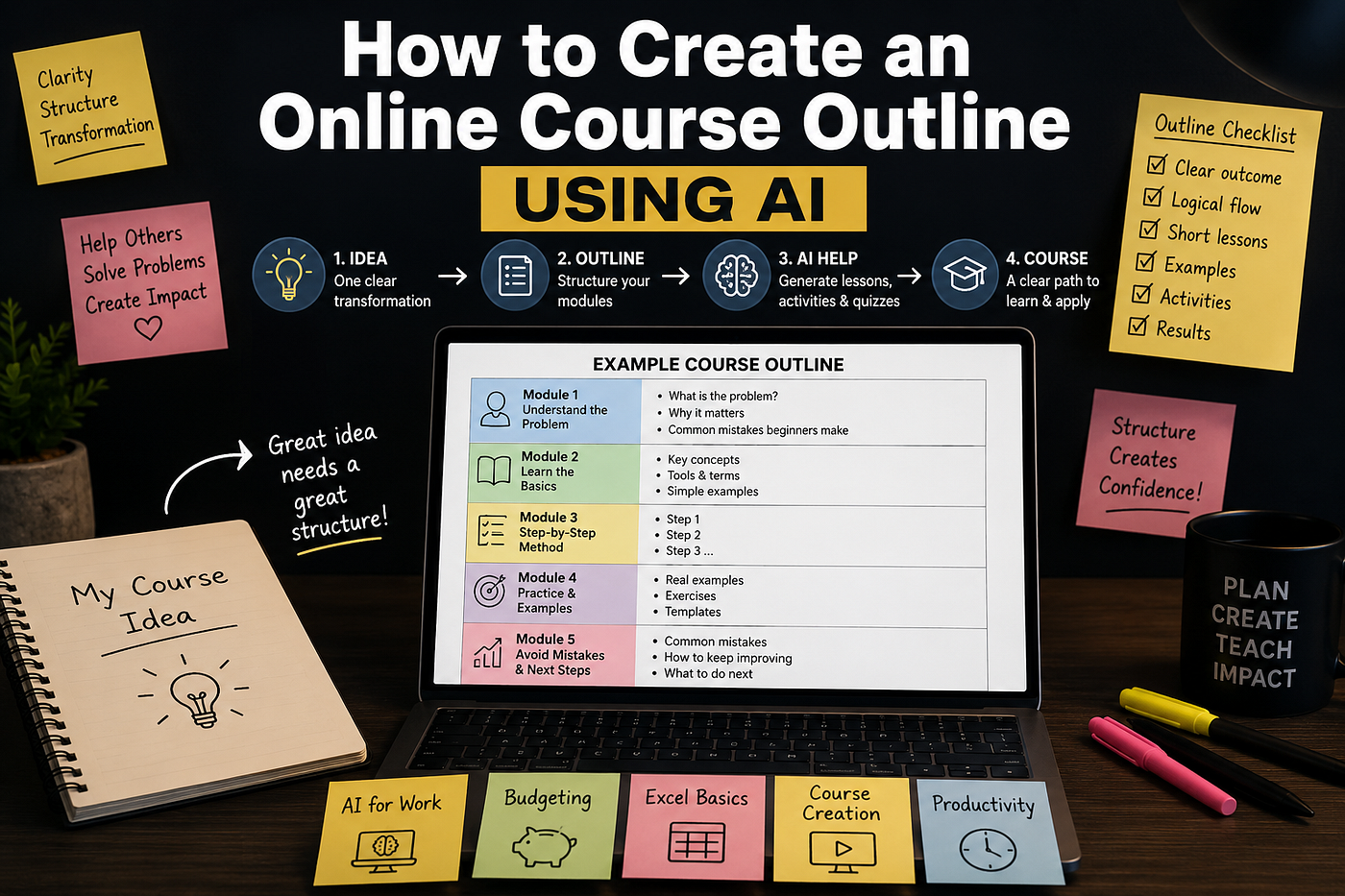
Before creating the full course, create a simple outline:
- Module 1: The problem
- Module 2: The basic method
- Module 3: Step-by-step application
- Module 4: Common mistakes
- Module 5: Next steps
Then ask yourself:
- Does this outline solve a real problem?
- Does each module move the learner forward?
- Is the outcome clear?
- Would a beginner understand the path?
- Is the course too broad?
If the outline feels messy, the course idea may need more focus.
This is also where AI tools can help.
eSkilled AI Course Creator is designed to help with course creation tasks such as generating course structures, syllabus/curriculum content, quizzes, case studies, interactive activities, imagery, text-to-speech narration, document conversion, course sharing, and SCORM e-learning authoring.
That makes it relevant after validation because once you know the idea is worth exploring, the next step is turning it into a structured learning path.
If your course idea feels promising but you are struggling to turn it into modules, lessons, and learning materials, you can explore the eSkilled AI Course Creator here. It is designed to help move from idea to structured course content faster than starting from a blank page.
**explore the eSkilled AI Course Creator here**
7. Look for Existing Paid Solutions
This may sound strange, but competition is not always bad.
If other courses, books, templates, coaching services, or tools already exist around your topic, that may be a sign people care about the problem.
The danger is not competition.
The danger is creating something nobody wants.
Ask:
- Are people already buying solutions?
- Are there popular videos or articles on this topic?
- Are there paid templates, courses, or tools?
- Are people asking for help repeatedly?
- Are beginners still confused despite existing content?
If yes, there may be room for your angle.
Your course does not need to be the only course.
It needs to be clear, helpful, and positioned for a specific beginner.
8. Check Whether the Problem Has Urgency
Some problems are interesting.
Others are urgent.
Urgent problems are stronger.
For example:
Interesting:
“Learn productivity.”
More urgent:
“Stop feeling behind every week.”
Interesting:
“Learn AI.”
More urgent:
“Use AI to save time at work before you fall behind.”
Interesting:
“Learn budgeting.”
More urgent:
“Stop wondering where your salary went every month.”
Urgency makes people pay attention.
Your course idea should connect to a pain that people already want to fix.
9. Ask: Would This Save Someone Time, Stress, or Mistakes?
A strong course usually does at least one of these three things:
- saves time
- reduces stress
- helps avoid mistakes
If your course does none of these, it may be harder to sell.
Examples:
How to Use AI to Write Better Work Emails
Saves time and reduces stress.
How to Create a Simple Monthly Budget
Reduces money stress and avoids mistakes.
How to Choose Your First Online Course Idea
Avoids wasting time on the wrong idea.
How to Create a Course Outline With AI
Saves time and reduces overwhelm.
This is a simple filter, but it works.
If your course helps someone make progress faster, it becomes easier to explain its value.
The Beginner Course Validation Checklist
Before building your full course, ask these questions:
- Does this solve a specific problem?
- Can I describe the learner clearly?
- Are people already searching for this topic?
- Are people asking repeated questions about it?
- Do comments reveal confusion or frustration?
- Can I write an article about the problem first?
- Can I explain the course promise in one sentence?
- Can I create a simple outline?
- Does it save time, stress, or mistakes?
- Is the idea narrow enough for beginners?
If you answer yes to most of these, the idea may be worth exploring further.
If not, do not panic.
It may simply need to be more specific.
Once your course idea passes the basic validation checks, tools like eSkilled AI Course Creator can help you turn that idea into a clearer learning path with modules, lessons, and supporting content.
What If Your Course Idea Fails Validation?
This is not failure.
It is feedback.
In fact, it is better to discover weak demand before you spend time creating the full course.
If your idea feels weak, try adjusting one of these:
Make the audience more specific
Instead of:
AI for everyone
Try:
AI for office workers
Make the problem more painful
Instead of:
Learn budgeting
Try:
Stop feeling broke before payday
Make the outcome clearer
Instead of:
Productivity tips
Try:
Plan your week in 30 minutes
Make the course smaller
Instead of:
Complete digital marketing course
Try:
How to create your first Pinterest pin strategy
Small, specific, and practical often wins.
Why Validation Builds Confidence
Validation is not only about the market.
It is also about your confidence.
When you see people asking questions, searching for answers, and struggling with the problem, you stop feeling like you are inventing demand.
You realize:
“This is real.”
That makes it easier to create.
It also makes your writing stronger because you are no longer guessing what people care about.
You are responding to real pain.
That is the difference between random content and useful content.
Where eSkilled Fits in the Course Creation Process
This is important:
Do not use AI to avoid thinking.
Use AI after you have clarified the problem.
The better sequence is:
- Find a painful problem
- Validate that people care
- Create a clear course promise
- Build a simple outline
- Use AI to speed up structure and content creation
eSkilled AI Course Creator fits best in steps 4 and 5 because it is built around creating structured e-learning content, including course outlines, quizzes, activities, case studies, narration, and LMS-compatible course materials.
That is why it should not be positioned as a magic shortcut.
It should be positioned as a practical tool for people who already have an idea and want help turning it into a course structure.
If your course idea has passed the basic validation checks and you are ready to turn it into a structured outline, you can explore here
Final Thoughts: Do Not Build Blindly
Creating an online course can feel exciting.
But excitement alone is not enough.
Before you build the full course, slow down and check the problem.
Are people asking about it?
Are they searching for it?
Are they confused by existing content?
Can you explain the promise clearly?
Can you create a simple outline?
That is validation.
It does not guarantee success, but it protects you from the worst mistake:
Spending time creating something nobody wanted in the first place.
The goal is not to wait forever.
The goal is to test before you build.
Because the best course ideas usually do not come from guessing.
They come from listening.
Actionable Takeaways
- Do not validate broad topics; validate specific problems.
- Look for repeated questions, search behavior, and beginner confusion.
- Write an article first to test interest before building the full course.
- A clear course promise is a strong sign your idea is focused.
- Use AI tools after validation to help turn the idea into a structured learning path.
- eSkilled AI Course Creator fits naturally once your idea is clear and you need help building modules, lessons, quizzes, and learning content.
If your course idea feels promising but still messy, it may be worth exploring a tool designed specifically for AI-powered course creation.
You can explore eSkilled AI Course Creator and see whether it fits your workflow.
메타데이터
- post_id
- dcfd052443b0
- slug
- how-to-validate-an-online-course-idea-before-you-create-it-dcfd052443b0
- url
- https://medium.com/@paballolempe/how-to-validate-an-online-course-idea-before-you-create-it-dcfd052443b0
- canonical_url
- https://medium.com/@paballolempe/how-to-validate-an-online-course-idea-before-you-create-it-dcfd052443b0
- author_url
- https://medium.com/@paballolempe
- status
- ok
- fetched_at
- 2026-06-09 15:37:30