Empty Leg Flights Explained: The Executive’s Guide to Private Aviation at Reduced Cost
How repositioning flights let frequent flyers access private jets at 30–75% below standard charter rates — and what to check before booking…
Empty Leg Flights Explained: The Executive’s Guide to Private Aviation at Reduced Cost
How repositioning flights let frequent flyers access private jets at 30–75% below standard charter rates — and what to check before booking one.

Empty leg flights use the same aircraft and safety standards as full-price charters — the difference is entirely in the pricing structure. (AI Generated Image)
If you’ve spent any time researching private aviation, you’ve probably come across the term “empty leg flight” attached to headlines promising private jet travel at a fraction of the usual cost. The claim is real, but the details matter more than the headline. Empty leg flights are a genuine cost-saving mechanism within the charter industry — not a marketing gimmick — but they come with structural limitations that make them a poor fit for some travelers and an excellent fit for others.
This guide explains what empty legs actually are, why they exist, how pricing works, who benefits most from them, and what to check before booking one. The goal is to provide practical clarity.
What Is an Empty Leg Flight?
Private jets rarely fly a simple round trip with the same passengers on both legs. A charter client flies from New York to Aspen; the aircraft then has to reposition somewhere for its next booking, and there’s no passenger paying for that return or transfer flight. That unbooked repositioning segment is the “empty leg” — also called a deadhead flight in industry terminology.
Because the operator is going to fly that route regardless of whether a paying passenger is on board, they have a financial incentive to fill the seats rather than fly empty. Fuel, crew time, and landing fees are already committed costs. Any revenue from an empty leg is largely incremental, which is why these flights are typically offered at steep discounts — commonly in the range of 50–75% off the equivalent one-way charter price, though the exact figure varies by route, aircraft, and how last-minute the booking is.
Why Empty Legs Exist: The Operational Reality
Understanding the mechanics helps set realistic expectations:
- Charter aircraft are rarely based near both ends of a trip. An operator based in Teterboro might fly a client to Miami, then need to reposition the aircraft back north — or to wherever its next confirmed charter originates.
- One-way charter demand is structurally uneven. More clients fly from major business hubs to leisure destinations on Fridays than the reverse; the imbalance has to be corrected somehow.
- Empty legs are a byproduct of scheduling, not a designed product. This is the single most important thing to understand before booking one, because it explains every limitation discussed below.
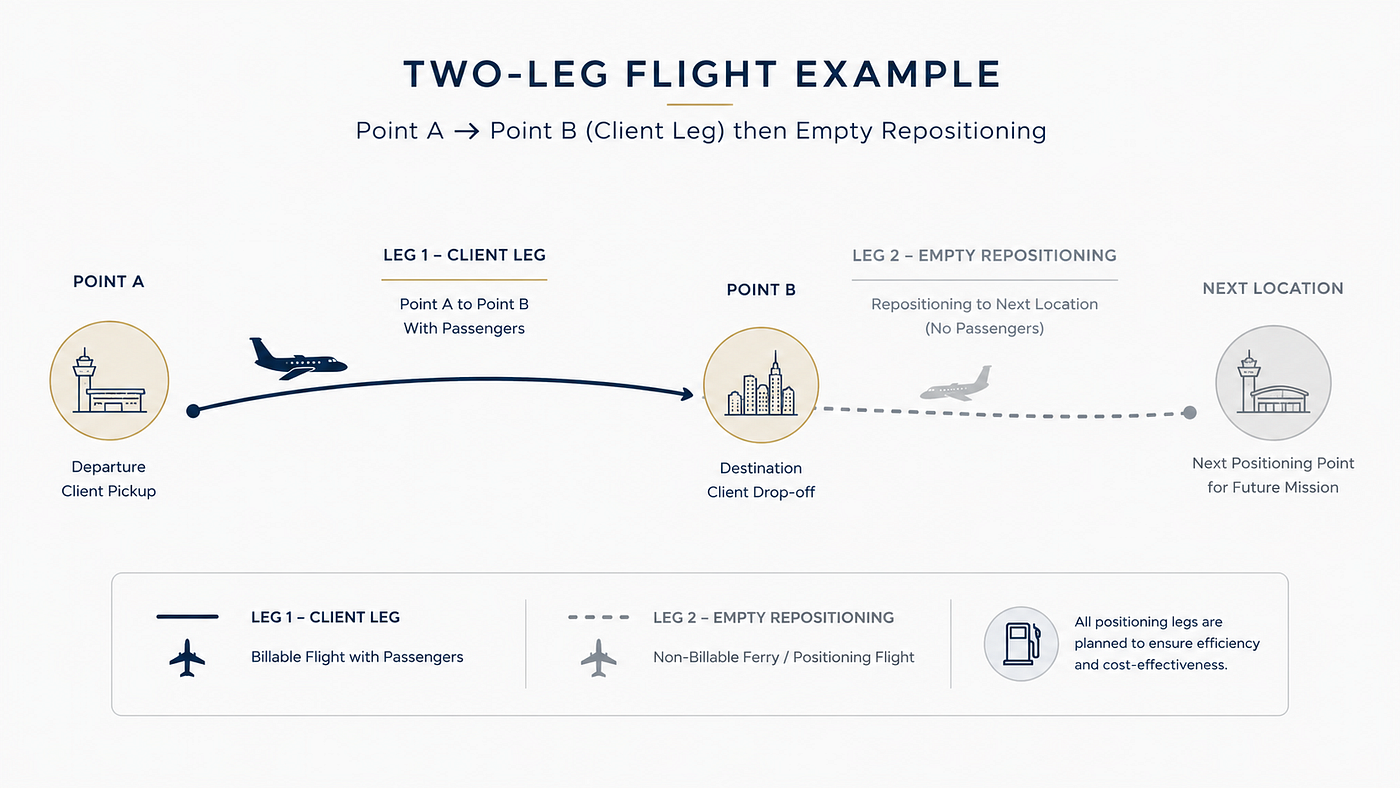
The empty leg is simply the unbooked half of a charter aircraft’s operational route. (AI Generated Image)
The Real Trade-Offs of Empty Leg Flights
A credible guide has to cover the downsides as clearly as the upside.
Advantages
- Access to the same aircraft, crew, and safety standards as a full-price charter — there is no “discount tier” of safety.
- Substantial cost savings compared to booking a dedicated one-way or round-trip charter.
- A practical entry point for travelers who want to experience private aviation without committing to a jet card or membership program.
Limitations
- Fixed routes and times. Because the flight is dictated by wherever the aircraft already needs to go, you cannot request a custom itinerary. You either match an existing empty leg or you don’t.
- Schedule risk. Charter flights can be rescheduled or cancelled if the original paying client’s plans change, since the empty leg only exists because of that primary booking. This is a meaningfully different risk profile from a dedicated charter.
- Limited notice. Many empty legs surface within days — sometimes hours — of departure, which suits flexible travelers far better than those planning months ahead.
- No guaranteed availability on a given route. Empty legs cannot be manufactured to match demand; on any given day, there may be no listing that fits your itinerary.
Who Empty Leg Flights Actually Suit
Empty legs work best for travelers who prioritize cost savings over rigid scheduling control:
- Executives with flexible personal travel (as opposed to fixed board meetings or client commitments)
- Second-home owners flying recurring regional routes where empty legs are common (e.g., New York–Palm Beach, London–Nice)
- Travelers price-sensitive to the first-class or business-class cabin premium on a specific route, for whom a discounted empty leg may be competitively priced
- Groups that can fill or share several seats, improving the per-person economics further
They suit these use cases far less well:
- Time-critical business travel where a missed or rescheduled connection carries real cost
- Travelers requiring a specific city pair with no flexibility on dates
- First-time private jet flyers who want a fully custom experience from booking to cabin configuration
Where Empty Legs Cluster: Route Planning Insights
Empty legs aren’t distributed evenly across the map. They follow the same seasonal and directional imbalances that create charter demand in the first place, which means a little route awareness goes a long way toward finding one that fits your travel pattern.
- Seasonal leisure corridors. Winter tends to concentrate empty legs on ski routes — Northeast U.S. airports into Aspen, Vail, or Jackson Hole; London-area airports into Alpine destinations such as Geneva or Chambéry. Summer shifts that concentration toward coastal routes, such as the Northeast U.S. to Nantucket, Martha’s Vineyard, and the Hamptons, or London to the French and Italian Riviera.
- Weekday and weekend imbalance. Charter demand skews toward Friday-afternoon departures from business hubs to leisure destinations, with the reverse pattern on Sunday evening. This directional imbalance is precisely what generates empty legs, so travelers whose own schedule runs opposite to the typical weekend rush are often best positioned to benefit.
- Business and event-driven corridors. Routes tied to major conferences, sporting events, or auction and art-fair calendars can temporarily create clusters of repositioning flights once the event concludes and aircraft need to disperse.
- Regional hub-to-hub routes. Recurring city pairs served by general aviation — for example, Teterboro–Palm Beach or London Luton–Nice — tend to generate empty legs more consistently than one-off or unusual routings, simply because more charter traffic runs through them in the first place.
The practical takeaway: if your existing travel pattern already overlaps with a well-served corridor or a predictable seasonal window, checking empty leg listings regularly is far more likely to pay off than if your route is unusual or your timing is rigid.
How Empty Leg Pricing Actually Works
There is no fixed formula, but a few pricing principles hold across the industry:
- Discount depth correlates with urgency for the operator. A flight departing in six hours with no buyer is more heavily discounted than one listed two weeks out.
- Aircraft category still matters. A light jet empty leg and a heavy-cabin empty leg are not comparable in absolute price, even at similar discount percentages.
- “Price on application” (POA) listings are common. Many empty leg boards, including established ones, show a portion of routes without a published number because pricing depends on final passenger count, catering, and positioning costs confirmed close to departure.
- Per-seat pricing exists alongside full-aircraft charter. Some brokers allow booking individual seats on an empty leg rather than chartering the whole aircraft, which lowers the entry cost further for solo or small-group travelers.
- Taxes, fees, and deposits are not always folded into the headline number. Segment fees, fuel surcharges, and de-icing costs can apply on top of the quoted price depending on the operator and season; a written, itemized quote before payment avoids surprises.
- Payment timing tends to be compressed. Because many empty legs are booked close to departure, operators typically expect payment in full at confirmation rather than the staged deposit schedule common on longer-lead-time charters.
Booking Considerations Before You Commit
- Confirm operator certification independently. In the U.S., that means an FAA Part 135 (or equivalent) certificate; ask your broker to confirm the specific operating carrier, since brokers arrange flights but do not themselves operate aircraft.
- Understand the cancellation terms in writing. Because empty legs are contingent on a separate paying client’s itinerary, ask explicitly what happens — and whether you’re refunded — if the anchor flight changes.
- Check ground logistics at both ends. Empty legs sometimes route through smaller FBOs than a traveler expects; confirm ground transport and customs/immigration handling if the flight is international.
- Verify what’s included. Catering, ground transport, and de-icing (seasonal) are sometimes itemized separately on discounted flights — ask before booking, not after.
- Build in a buffer for time-critical trips. If the trip has a hard deadline (a meeting, a wedding, a flight connection), an empty leg’s inherent schedule risk may not be the right tool for that specific trip, even if it’s the right tool for other travel in your calendar.
Privacy, Security, and Comfort Considerations
Privacy is one of the primary reasons executives choose private aviation in the first place, and it’s worth understanding how empty legs compare to a fully private, dedicated charter on this front.
- Shared-seat listings mean shared cabins. If you book individual seats rather than the whole aircraft, you should expect to fly alongside other passengers you don’t know — a meaningfully different experience from a fully private charter, and worth confirming explicitly if privacy is the priority.
- Full-aircraft empty leg bookings retain standard private charter privacy. Chartering the entire empty leg aircraft — rather than individual seats — preserves the same privacy as a full-price charter, since you’re the only party on board.
- Ground handling can vary by airport. Empty legs sometimes route through smaller regional airports and FBOs than a traveler’s usual charter, which can mean different (not necessarily lower) levels of dedicated ground service; confirming FBO details in advance avoids mismatched expectations.
- Security screening still applies. Private aviation generally involves lighter screening than commercial airline checkpoints, but identity verification and standard security procedures still apply regardless of whether the flight is a full-price charter or a discounted empty leg.
- Cabin configuration is fixed, not customizable. Because the aircraft and route were already set by the primary charter, empty leg passengers cannot request a different cabin layout, catering package, or aircraft substitution the way a dedicated charter client typically can.
Empty Legs vs. Other Private Aviation Models
It’s worth briefly placing empty legs in context against the other common ways executives access private aviation:
- On-demand charter: Full flexibility on route and timing, at full price. Best when the trip is time-critical or the route is unusual.
- Jet card / membership programs: Prepaid flight hours at a locked rate with guaranteed availability, usually with a minimum spend. Best for travelers with predictable, recurring flight needs.
- Fractional ownership: Partial ownership of a specific aircraft type, offering guaranteed access with fewer positioning constraints. Best for very high-frequency flyers.
- Empty leg flights: The lowest cost of the four, in exchange for the least schedule control. Best as a complement to — not a replacement for — the above, for travelers with genuine date and route flexibility.
Most experienced private flyers use empty legs opportunistically alongside one of the other models, rather than relying on them as a sole booking strategy.
Finding Empty Leg Flights
Empty legs are typically surfaced through charter brokers who aggregate listings across their network of operators, since no single operator has enough inventory to make browsing worthwhile on its own. A broker with a broad operator network and a live, filterable empty leg board — searchable by region, date, and aircraft type — gives a more realistic picture of what’s actually available than checking individual operators one at a time.

Because empty leg inventory changes constantly, monitoring a live, filterable listing board is more effective than one-off searches.
This is one of the few points in private aviation where a broker’s aggregation genuinely helps the traveler rather than just adding a layer of markup: because empty legs are inherently unpredictable, having visibility into more of the market increases the odds of finding a listing that matches your dates. Villiers, an independent charter broker operating since 2013, maintains a live empty leg board filterable by region and aircraft, alongside its standard on-demand charter service — useful specifically for travelers who want to monitor empty leg availability on routes they fly regularly rather than book far in advance.
Common Mistakes to Avoid
- Treating an empty leg like a scheduled airline seat. It is a repositioning flight first and a bargain second; the schedule serves the operator’s logistics, not your calendar.
- Booking without a cancellation conversation. Ask the specific question — “what happens to my booking if the primary charter changes?” — before paying.
- Assuming every discounted flight is genuinely last-minute. Some listings are published well in advance and may still change; read the listing terms rather than assuming urgency.
- Ignoring total cost. A heavily discounted heavy jet can still cost more than a full-price light jet on the same route; compare the final number, not just the percentage off.
The Bottom Line
Empty leg flights are a legitimate, well-established way to access private aviation below standard charter rates, rooted in a straightforward operational reality: aircraft need to reposition, and operators would rather sell those seats than fly them empty. They reward flexibility and punish rigid planning. For an executive with a fixed board meeting, an empty leg is the wrong tool. For the same executive’s flexible weekend trip to a second home, it can be one of the more efficient ways to fly privately. Understanding that distinction — not the discount percentage alone — is what separates informed private aviation decisions from disappointing ones.
Disclosure: This article contains affiliate links. If you choose to book through those links, I may receive a commission at no additional cost to you. Recommendations are based on relevance to the topic and are intended to help readers make informed decisions.
메타데이터
- post_id
- dd0f54c58bd3
- slug
- empty-leg-flights-explained-private-aviation-guide-dd0f54c58bd3
- url
- https://medium.com/@profreelancer146/empty-leg-flights-explained-private-aviation-guide-dd0f54c58bd3
- canonical_url
- https://medium.com/@profreelancer146/empty-leg-flights-explained-private-aviation-guide-dd0f54c58bd3
- author_url
- https://medium.com/@profreelancer146
- status
- ok
- fetched_at
- 2026-07-21 01:00:30