The Most Expensive Business Problems Don’t Show Up on Financial Statements
A business can lose millions without recording a single loss on its financial statements.
The Most Expensive Business Problems Don’t Show Up on Financial Statements
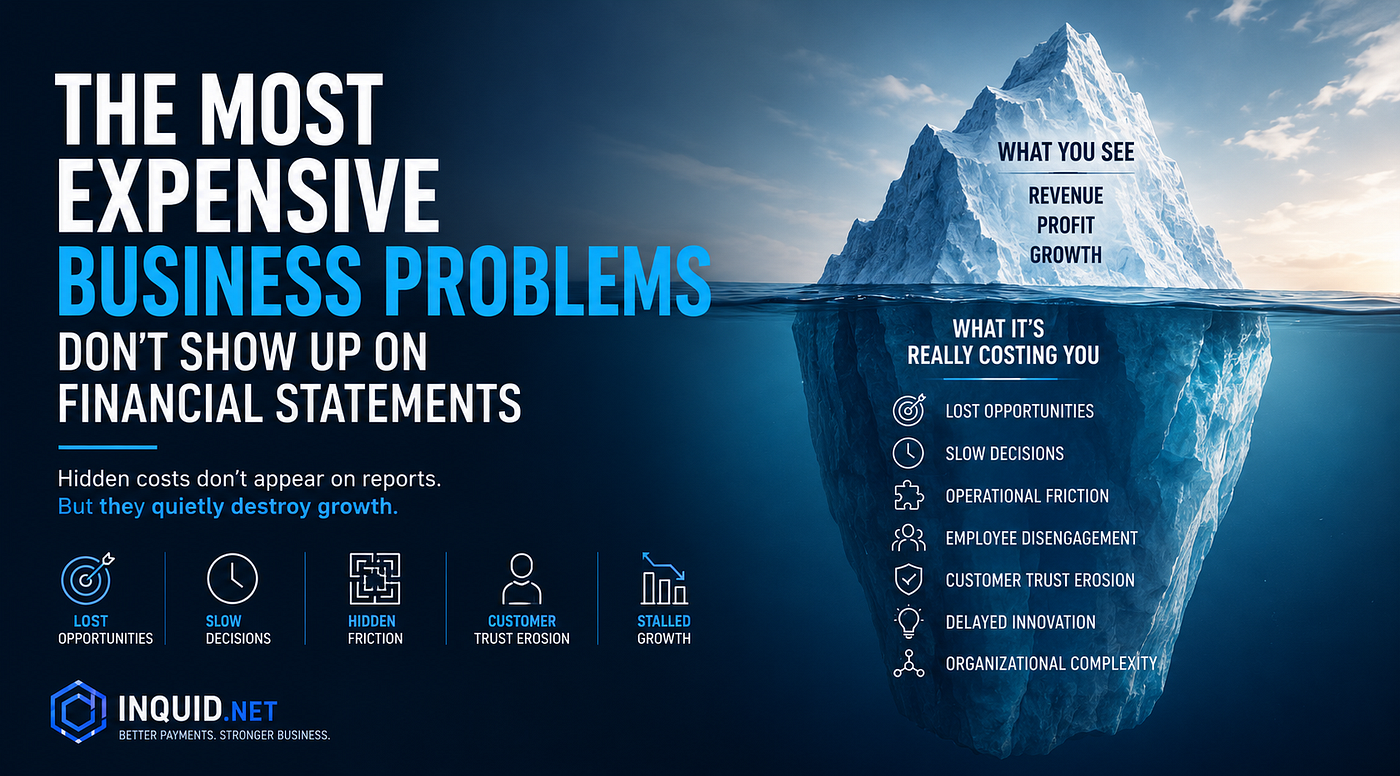
A business can lose millions without recording a single loss on its financial statements.
No fraud.
No lawsuit.
No accounting error.
No major operational failure.
Yet value disappears every day.
Opportunities are missed.
Customers leave.
Teams become slower.
Decisions take longer.
Innovation stalls.
And none of it appears in a quarterly report.
This is the hidden economy inside every business.
The place where invisible costs accumulate.
The place where growth quietly slows.
The place where competitive advantages gradually disappear.
Most organizations are exceptionally good at tracking what happened yesterday.
Revenue.
Expenses.
Profit margins.
Cash flow.
Balance sheets.
Financial statements provide an important picture of business performance.
But they do not tell the entire story.
Some of the most expensive problems a company faces never appear in financial reports until the damage has already been done.
By the time these costs become visible, recovery becomes significantly more difficult.
The challenge for modern businesses is not simply managing what they can see.
It is learning to recognize what they cannot.
The Difference Between Visible Costs and Invisible Costs
Most business leaders understand visible costs.
Office rent.
Software subscriptions.
Payroll expenses.
Marketing budgets.
Vendor contracts.
These costs are measurable.
They appear on reports.
They are discussed during planning meetings.
Invisible costs operate differently.
They do not arrive as invoices.
They do not appear as line items.
They rarely attract attention.
Yet they often have a greater impact on long-term performance.
Invisible costs include:
- Slow decision-making
- Missed opportunities
- Operational friction
- Employee disengagement
- Customer frustration
- Delayed innovation
- Organizational complexity
- Internal inefficiencies
Individually, these issues may seem insignificant.
Collectively, they can cost businesses far more than traditional expenses.
The Cost of Slow Decisions
Speed has become one of the most valuable assets in modern business.
Markets change quickly.
Customer expectations evolve rapidly.
Competitive landscapes shift constantly.
Organizations that make decisions efficiently often outperform competitors with greater resources.
Yet many businesses unintentionally create systems that slow decision-making.
Additional approvals.
Excessive meetings.
Complex reporting structures.
Unclear ownership.
Multiple layers of management.
What begins as an attempt to improve control often reduces agility.
The consequences are rarely visible on financial statements.
No report will display a line item labeled “lost opportunities due to delayed decisions.”
Yet the impact can be substantial.
A delayed product launch.
A missed partnership.
A postponed expansion.
A competitor that reaches the market first.
These outcomes carry costs.
The challenge is that those costs remain largely invisible.
The Hidden Price of Complexity
Growth creates complexity.
More employees.
More systems.
More departments.
More processes.
More stakeholders.
Complexity often arrives gradually.
This makes it difficult to detect.
No organization intentionally becomes complicated.
Complexity accumulates over time.
Each new process appears reasonable.
Each new approval seems necessary.
Each new layer feels justified.
Eventually, complexity begins creating friction.
Communication slows.
Execution becomes harder.
Innovation becomes more difficult.
Customer experiences become inconsistent.
The organization spends increasing amounts of energy managing itself.
Complexity rarely appears on a balance sheet.
Yet it can become one of the largest obstacles to growth.
Many companies believe they have a growth problem when they actually have a complexity problem.
The Revenue Businesses Never Earn
Financial statements measure revenue generated.
They do not measure revenue missed.
This distinction matters.
Imagine a company that loses a potential customer because the purchasing process was too complicated.
The revenue never appears.
The loss is invisible.
Consider a business that declines an opportunity because internal approvals take too long.
The revenue never appears.
The loss remains invisible.
Or a company that experiences transaction failures during checkout.
Potential customers leave before completing purchases.
Again, the revenue never appears.
Traditional reporting systems focus on outcomes.
They rarely capture possibilities that never became reality.
Yet these missed opportunities often represent significant value.
The businesses that grow consistently understand this principle.
They do not merely measure what happened.
They evaluate what could have happened.
Customer Trust: The Asset Few Businesses Measure
Trust is one of the most valuable assets a company can possess.
Yet it is rarely measured with precision.
Customers who trust a brand purchase more frequently.
They remain loyal longer.
They recommend the company to others.
They are more forgiving when mistakes occur.
Trust directly influences profitability.
The challenge is that trust erosion often happens slowly.
A delayed response.
A poor customer experience.
A complicated payment process.
An unresolved issue.
Each event appears minor.
Over time, they accumulate.
Customers gradually lose confidence.
Retention declines.
Referrals decrease.
Lifetime value falls.
The financial impact eventually appears.
The cause often remains hidden.
Businesses frequently focus on acquiring customers while underestimating the importance of maintaining trust.
This can become an expensive mistake.
Employee Friction Is More Expensive Than Most Leaders Realize
Many organizations focus heavily on customer experience.
Fewer pay equal attention to employee experience.
Employees interact with business systems every day.
They navigate workflows.
They manage approvals.
They communicate across teams.
When these systems create friction, productivity declines.
Employees spend time overcoming obstacles rather than creating value.
The cost is difficult to measure.
No report clearly identifies hours lost due to inefficient processes.
Yet the impact compounds daily.
Frustration increases.
Engagement decreases.
Turnover rises.
Recruitment costs grow.
Institutional knowledge disappears.
The organization becomes slower.
The strongest businesses understand that operational simplicity is not merely an efficiency initiative.
It is a competitive advantage.
Why Innovation Often Dies Quietly
Most organizations recognize the importance of innovation.
Few recognize how easily it can be suppressed.
Innovation rarely disappears because employees lack ideas.
More often, it disappears because organizations become too busy.
Teams become consumed by operational demands.
Meetings increase.
Processes expand.
Short-term priorities dominate attention.
The environment becomes optimized for maintenance rather than experimentation.
Innovation requires capacity.
It requires time.
It requires flexibility.
Without these conditions, creativity declines.
New opportunities remain unexplored.
Emerging trends are ignored.
Competitors gain advantages.
The financial consequences may not become visible for years.
By then, the underlying cause is often forgotten.
The Cost of Organizational Silos
As businesses grow, departments often become increasingly specialized.
Specialization improves expertise.
It can also create separation.
Marketing focuses on marketing.
Operations focuses on operations.
Finance focuses on finance.
Technology focuses on technology.
Each team develops its own priorities.
Communication becomes fragmented.
Information flows more slowly.
Decisions become less coordinated.
Customers experience the consequences.
Projects take longer.
Opportunities are missed.
The organization becomes less responsive.
Silos rarely appear in financial statements.
Yet they influence nearly every aspect of performance.
The strongest organizations actively create systems that encourage collaboration across functions.
They recognize that information flow is a strategic asset.
Measuring What Matters
One of the greatest challenges in business is measuring intangible value.
Not everything important can be quantified easily.
Yet ignoring invisible costs does not make them disappear.
Leaders must develop broader perspectives.
Beyond revenue.
Beyond expenses.
Beyond profit.
Important questions include:
- How quickly are decisions made?
- How easy is it for customers to buy?
- How much friction exists within workflows?
- How effectively do teams collaborate?
- How quickly can the organization adapt?
- How much trust exists between customers and the brand?
These factors influence long-term performance.
Even when they do not appear in financial reports.
The Most Valuable Business Skill
In many ways, modern leadership is becoming an exercise in recognizing invisible problems before they become visible.
Anyone can react to declining revenue.
Strong leaders identify the causes before revenue declines.
Anyone can respond to customer loss.
Exceptional leaders recognize trust erosion before customers leave.
Anyone can manage visible costs.
The most effective leaders understand hidden costs.
They understand that financial statements describe outcomes.
They do not always explain causes.
The businesses that thrive in the future will be those that learn to see what others overlook.
Final Thoughts
Financial statements remain essential.
They provide valuable insight into business performance.
But they tell only part of the story.
Some of the most expensive problems never appear on a balance sheet.
Slow decisions.
Organizational complexity.
Operational friction.
Lost opportunities.
Customer trust erosion.
Innovation stagnation.
These forces quietly influence growth every day.
Often without attracting attention.
The organizations that achieve sustainable success are not simply those that manage visible costs effectively.
They are the ones that identify invisible costs before those costs become visible consequences.
Because by the time a problem appears in a financial statement, it has often been affecting the business for much longer.
The real competitive advantage is learning to see it sooner.
— Inquid.net
메타데이터
- post_id
- dd1caaf1aa60
- slug
- the-most-expensive-business-problems-dont-show-up-on-financial-statements-dd1caaf1aa60
- url
- https://medium.com/@liza.de1/the-most-expensive-business-problems-dont-show-up-on-financial-statements-dd1caaf1aa60
- canonical_url
- https://medium.com/@liza.de1/the-most-expensive-business-problems-dont-show-up-on-financial-statements-dd1caaf1aa60
- author_url
- https://medium.com/@liza.de1
- status
- ok
- fetched_at
- 2026-06-22 17:31:34