The New Wave of Creator Cinema
Hollywood woke up from their franchise fatigue nap to see that YouTubers are now beating Star Wars at the box office.
The New Wave of Creator Cinema
Hollywood woke up from their franchise fatigue nap to see that YouTubers are now beating Star Wars at the box office.
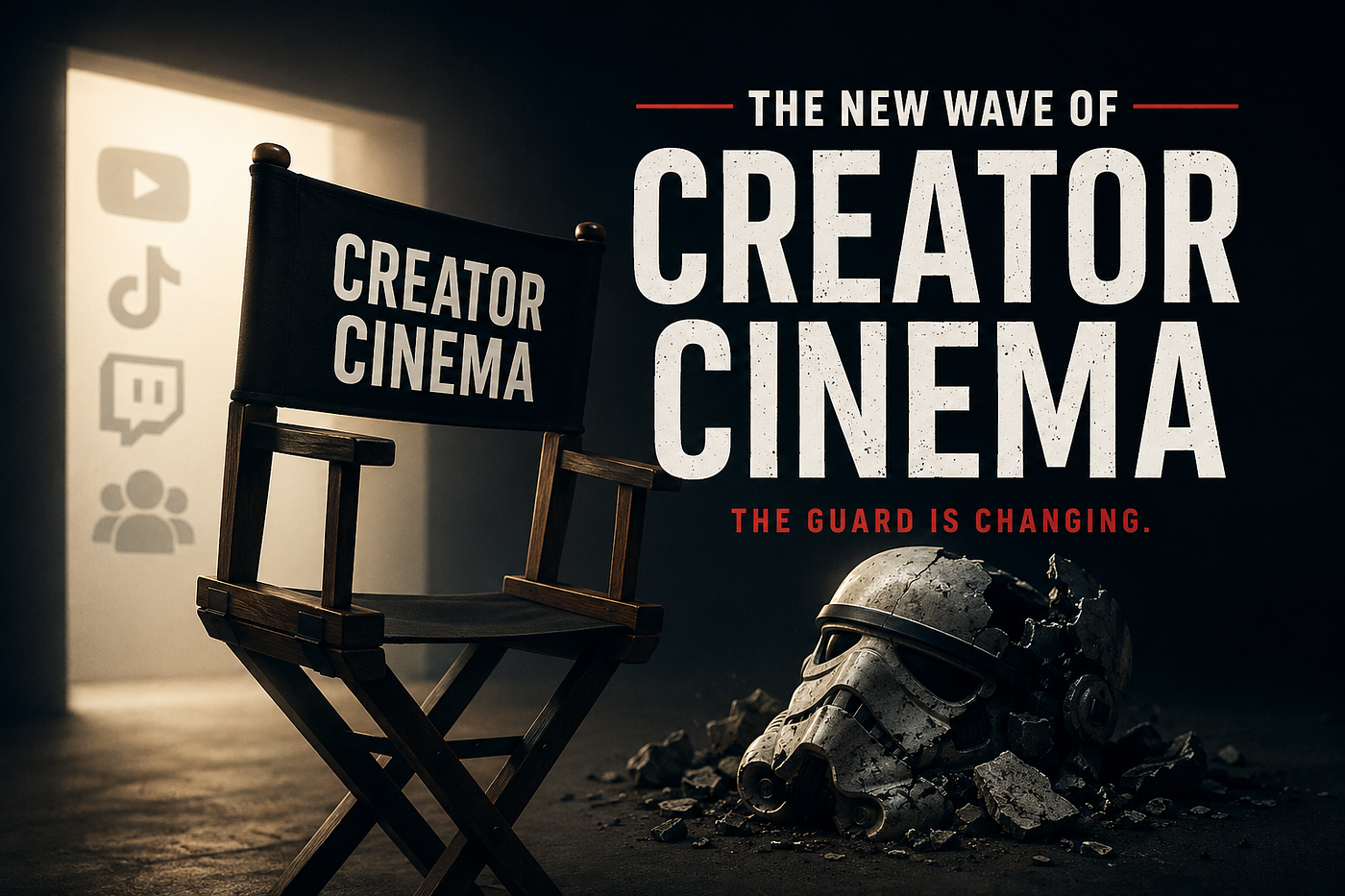
This summer a former YouTuber, a barista, and a 20-year-old kid making horror videos on YouTube did something Hollywood thought was impossible:
They started beating Star Wars at the box office.
Only ten years ago that sentence would have sounded like a complete joke.
Today it’s a headline.
And I don’t think enough people appreciate how significant that is.
What we’re witnessing right now looks a lot less like a few lucky indie hits and a lot more like a changing of the guard.
Over the past month, a former YouTuber and barista made one of the most profitable horror films in modern history.
A 20-year-old YouTube creator directed the biggest movie A24 has ever released.
A YouTuber turned filmmaker generated a theatrical hit by mobilizing his audience like a political movement.
And somewhere, a bunch of Hollywood executives are staring at spreadsheets wondering what the hell just happened.
Welcome to the new wave of Creator Cinema.
For years I’ve written about how the creator economy was changing everything.
Media.
Politics.
Sports.
Marketing.
Education.
Now it’s coming for Hollywood.
And honestly?
It’s about time.
Let’s start with Obsession.
When the movie first appeared, it sounded like one of those feel-good entertainment stories people share for a week before moving on.
Former YouTuber.
Former barista.
Tiny budget.
Indie horror movie.
Good for him.
Then the numbers kept growing.
And growing.
And growing.
Now the movie has reportedly generated more than 330 times its production budget and has become one of the most profitable films released in years.
Not one of the biggest.
One of the most profitable.
That’s an important distinction.
Because Hollywood loves talking about billion-dollar blockbusters.
Nobody talks enough about return on investment.
If you make a movie for less than the price of a celebrity’s annual security detail and it generates hundreds of millions in revenue, that’s not a hit.
That’s a business model.
Then there’s Markiplier.
For years Hollywood treated creators like annoying little cousins making videos in their bedrooms.
Now one of those creators self-financed *Iron Lung* and turned it into a legitimate theatrical success.
Not because a studio spent $100 million convincing people to care.
Because millions of fans already cared.
And then came Backrooms.
This is the story that really broke my brain.
A24 handed the keys to Kane Parsons, a creator who became famous making surreal horror videos on YouTube while most kids his age were trying to pass high school.
The result?
The biggest opening weekend in A24 history.
Not horror history.
A24 history.
Within weeks the film crossed more than $200 million worldwide and became the highest-grossing movie the studio has ever released.
Think about that for a second.
The studio that built its reputation on independent films, arthouse cinema, and prestige filmmaking now has a $200 million blockbuster directed by a kid who got his start making YouTube videos.
That’s not Hollywood discovering creators.
That’s creators inheriting Hollywood.
And if Hollywood executives needed an even bigger warning sign, the box office scoreboard delivered one.
For decades the industry operated under a simple assumption:
Big intellectual property wins.
Everything else fights for scraps.
Then suddenly a former YouTuber’s horror movie, a creator-driven indie film, and a surreal internet horror phenomenon directed by a 20-year-old YouTuber found themselves competing with — and in some cases outperforming — one of the most powerful entertainment brands in human history.
Star Wars.
The franchise that once represented the gold standard of blockbuster filmmaking suddenly found itself looking over its shoulder at movies that began as YouTube channels, internet communities, and creator passion projects.
That doesn’t mean Star Wars is dead.
It means audience behavior has changed.
People don’t automatically show up because a studio spent hundreds of millions of dollars and slapped a familiar logo on the poster.
They show up because they care.
And increasingly, creators are building that connection long before the movie ever reaches a theater.
For decades Hollywood believed intellectual property was the moat.
Now we’re learning something far more valuable may be community.
And here’s what I think most people are missing.
This isn’t really a movie story.
It’s an audience story.
For decades Hollywood believed distribution was the moat.
If you controlled theaters, television networks, cable channels, and marketing budgets, you controlled culture.
The internet shattered that equation.
Creators spent the last fifteen years building something far more valuable.
Communities.
Every YouTube upload became film school.
Every comment section became a focus group.
Every subscriber became a future customer.
While Hollywood was spending millions testing trailers and conducting market research, creators were learning in public.
Failing in public.
Improving in public.
Building audiences in public.
The internet accidentally built a new studio system.
Most people just didn’t notice.
What’s really blowing my mind is how different the path looks today compared to previous generations of filmmakers.
Take Robert Rodriguez.
He famously raised money for El Mariachi by volunteering for medical research studies and clinical drug trials.
The man literally sold his body to science so he could afford to make a movie.
The experience became legendary and eventually inspired his book Rebel Without a Crew.
That’s how desperate independent filmmakers used to be.
Rodriguez wasn’t building an audience.
He was trying to survive long enough to finish the movie.
The goal wasn’t distribution.
The goal was getting the thing made.
Now look at today’s creators.
Before Curry Barker ever stepped onto a professional film set, he already had an audience.
Before Kane Parsons got the keys to a major studio release, millions of people had already watched his work online.
Before Markiplier made Iron Lung, he had spent years building one of the largest communities on the internet.
The previous generation had to figure out how to finance the movie.
This generation often figures out how to finance themselves first.
They show up with an audience.
They show up with a brand.
They show up with distribution.
They show up with millions of fans.
In many cases, they’re already financially successful before Hollywood even notices they exist.
Robert Rodriguez had to sell his body to science.
These kids monetize YouTube.
Same dream.
Completely different game.
And honestly?
I think Rodriguez would appreciate the irony.
Because the lesson of Rebel Without a Crew wasn’t really about filmmaking.
It was about finding a way around the gatekeepers.
He found his path through sheer hustle and creativity.
This generation found theirs through the internet.
The technology changed.
The principle didn’t.
What’s funny is that I should probably hate this.
I’m old enough to remember the previous version of the entertainment business.
All I ever wanted growing up was a career in show business.
Back then there was really only one path.
You had to know someone (or blow someone).
Or know someone who knew someone.
Or get lucky enough to stumble into the right room.
Maybe they’d help you get an assistant job.
Maybe.
Then you’d spend years fetching coffee, picking people up from airports, making photocopies, carrying dry cleaning, and hoping somebody important accidentally learned your name.
You endured endless verbal abuse from the most insufferable people drunk on power.
You got to meet everybody.
But nobody actually saw you.
You were “the help.”
The major bummer was that while you were busy serving the industry, you weren’t creating.
You weren’t honing your craft.
You were surviving the system.
This new generation didn’t have to do that.
They didn’t need permission from NYU.
They didn’t need permission from UCLA.
They didn’t need permission from Hollywood.
They got to fetch their own coffee and get to work on their own projects.
And while the old guard was protecting the gates, these kids were quietly building entirely new cities outside the walls.
That’s what excites me.
Not the money.
Not the headlines.
The possibility.
Some kid sitting in a bedroom right now with a laptop, an internet connection, and a weird idea has a better shot at building an audience than at any point in entertainment history.
Will most of them fail?
Of course.
That’s how every creative business works.
But for the first time, the path actually exists.
And judging by what’s happening at the box office, audiences are more than willing to follow them.
The next great American filmmaker might not come from Sundance.
They might not come from USC.
They might not come from Hollywood at all.
They might come from YouTube.
Or TikTok.
Or Twitch.
Or some kid in Miami editing horror videos at 2 a.m. while eating Raising Cane’s and ignoring their homework.
That’s the real story here.
The creator economy isn’t disrupting Hollywood anymore.
It’s becoming Hollywood.
The gatekeepers spent decades deciding who got a shot.
Now audiences are making that decision for themselves.
And judging by the summer we’ve just witnessed, they’re choosing creators.
Welcome to the new wave of Creator Cinema.
Welcome to the Punch Yourself in the Face Economy where anyone has a shot if they’re willing to step up and make it.
Keep punching.
메타데이터
- post_id
- dd2a521e4f77
- slug
- the-new-wave-of-creator-cinema-dd2a521e4f77
- url
- https://medium.com/@gettingfrankpodcast/the-new-wave-of-creator-cinema-dd2a521e4f77
- canonical_url
- https://medium.com/@gettingfrankpodcast/the-new-wave-of-creator-cinema-dd2a521e4f77
- author_url
- https://medium.com/@gettingfrankpodcast
- status
- ok
- fetched_at
- 2026-06-12 18:14:10