The Shrew in the Shirt
When wildlife gets up close and personal
The Shrew in the Shirt: when wildlife gets up close and personal
Crossing the yard of the plant nursery where I worked, I could hear a strange high-pitched whistle, a kind of tinnitus coming from outside my ears. It stopped and started again erratically. I paused and looked around for the source, sidling over to a clump of hawthorn by the deer fence.
The sound amplified, a definite squealing. I peered amidst the branches for the denser cluster of a bird’s nest, wondering if the noise came from a fallen chick. There was no sign of bird habitation or a lost nestling, but still I could hear something calling persistently.
Human hearing exists within a range between approximately 20–20,000Hz, a Hertz being a measure of frequency per second of a periodic event. In the case of sound it indicates the number of wave cycles. Birds and amphibians tend to have lower, narrower frequencies, while some bats, by contrast, can echolocate at frequencies in excess of 100,000Hz. The greater wax moth, meanwhile, can hear the world at 300,000Hz. This is primarily so it can avoid being eaten by the bats. Accidental damage to our ear drums, or wear and tear over time can limit this range, particularly in the higher frequencies, meaning that as we age, our means of communication with the world around us must adapt too, or be lost.
Beside my feet, there was a length of drainpipe that had been set upright into the ground to house the tap for the water mains. I looked down. Two shrews were leaping up the sides of the pipe, and racing around the bottom of the cavity, like forgotten coins in a washing machine, spinning on a fast cycle, and squeaking their cries of protest.
The common shrew, Sorex araneus, can reach maximum speeds of nearly two metres per second. They eat almost a hundred percent of their bodyweight in insects each day, and have such fast metabolisms that they can die within a few hours if food is not available.
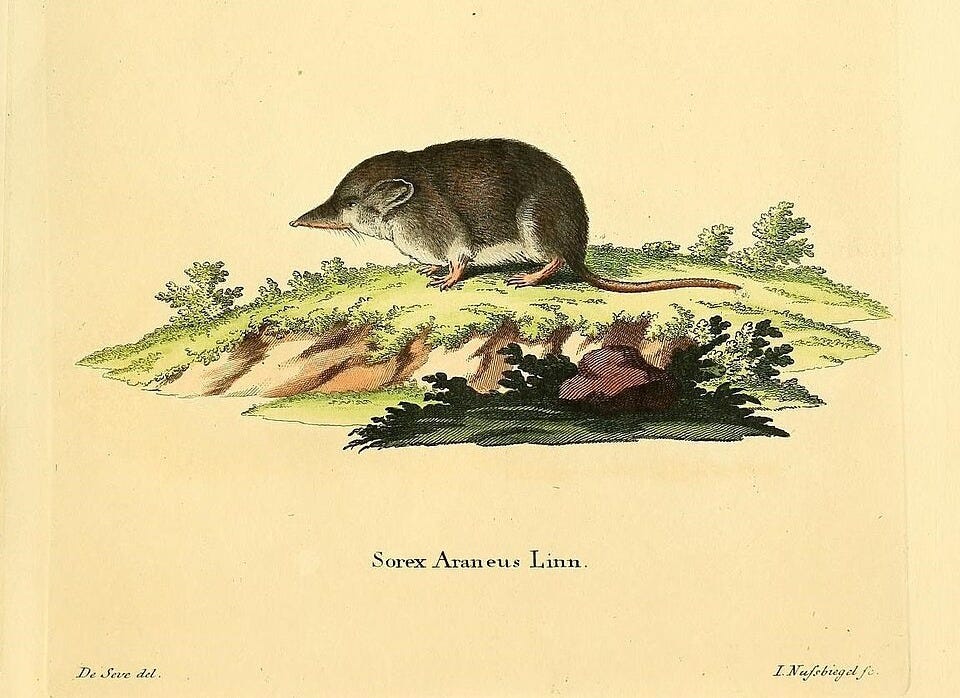
Die Säugthiere in Abbildungen nach der Natur, mit Beschreibungen, 1774. Plate CLX. Johann Christian Daniel Schreber, 1739–1810; Georg August Goldfuss, 1782–1848; Andreas Johann Wagner, 1797–1861
I ran to the shed for a trowel, thinking I could scoop them out. This failed immediately since the diameter of the pipe was too narrow to tilt the trowel. Ah well, I thought, reaching my hand in directly to pick up the first shrew.
When young shrews leave their nest, either through disturbance or on exploratory forays, they go in caravan behind their mother, biting on to the shrew in front by the base of the tail to avoid becoming separated. I wondered if these were youngsters, newly weaned adventurers barely a month old, who had followed their long, sensitive noses to the rich feeding grounds that must have been wafting up to them from the damp earth around the pipe, like the smell of fresh toast drifting up the stairs from the kitchen.
The shrew, perceiving my arm not as an elevator that would lift him to safety, but as a ramp by which he could make a swift getaway, fled from my hand, across my wrist, and immediately inside the sleeve of my shirt, its open cuff hanging loosely down.
Shrews are built for digging insects out of the earth, their claws primed to excavate more than 10cm below the ground for the earthworms that comprise part of their diet. They can also navigate by echolocating their surroundings using ultrasonic frequencies, far beyond the range of my hearing, although to the bats they are probably shouting. Their hearts can beat faster than a hummingbird’s, and their sleep cycle consists of a series of power naps taken throughout the day and night, with periods of frenzied hunting in between.
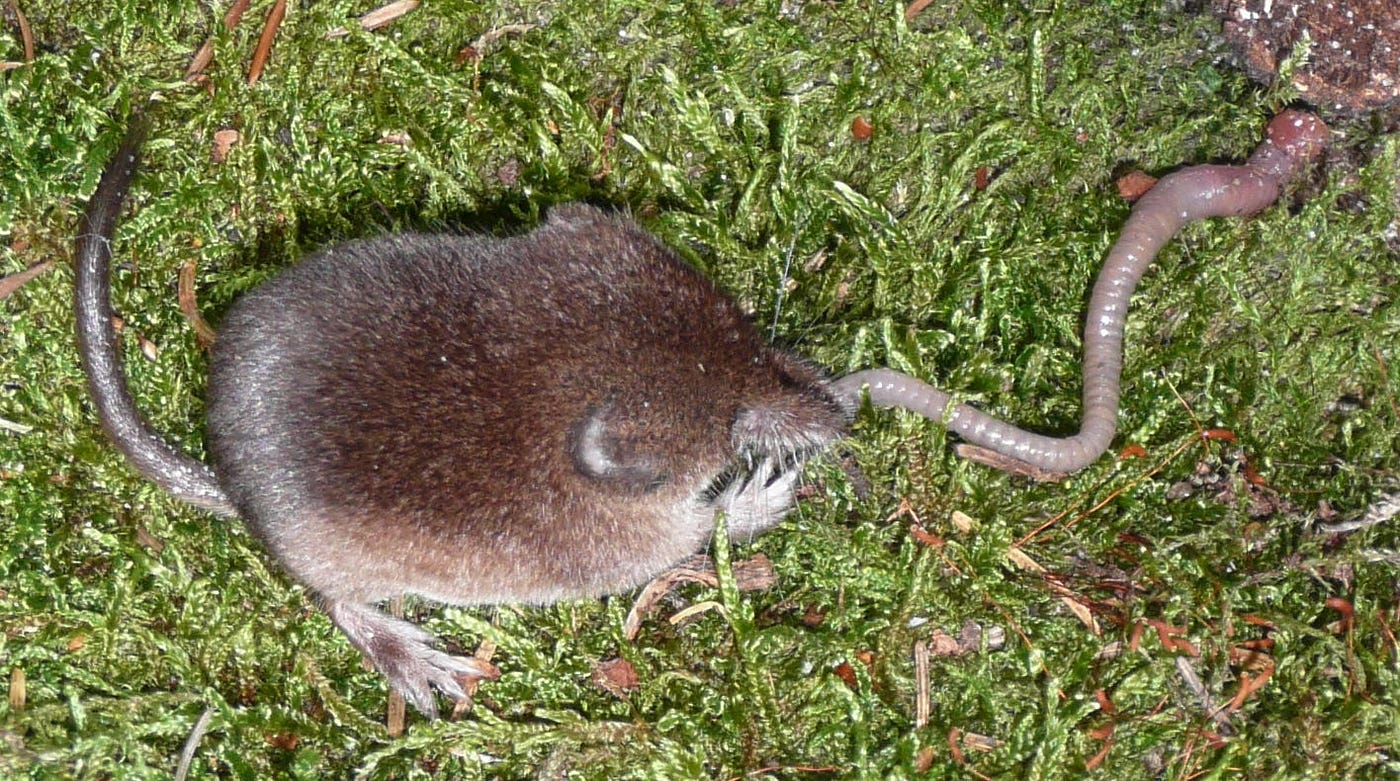
Sorex araneus, 2007. ©Sophie von Merten CC-BY 3.0. https://commons.wikimedia.org/wiki/File:Sorex-araneus.jpg
Common shrews, like the one that was clawing its way rapidly up my arm, have been digging insects out of the Scottish, English, and Welsh soil since the last Ice Age; and have spent much of recent history being maligned by literature. When Shakespeare wrote in c. 1591 that “a meacock wretch can make the curstest shrew,” he was conforming to a picture of these tiny creatures as devilish and gluttonous that stretched back through Chaucer to the Roman conquest, when they were believed to be venomous. In fact, of the three native species, only the water shrew (Neomys fodiens) has a toxic bite; although the common shrew is known to produce secretions which make its skin taste unpleasant to predators like owls.
Edward Topsel, writing in 1658, dedicated six pages to what he called the “shrew-mouse” in his succinctly-titled, History of Four-footed Beasts and Serpents: Describing at Large their True and Lively Figure, their Several Names, Conditions, Kinds, Virtues (both Natural and Medicinal), Countries of their Breed, their Love and Hatred to Mankind, and the Wonderful Work of God in their Creation, Preservation, and Destruction[,] Interwoven with Curious Variety of Historical Narrations out of Scriptures, Fathers, Philosophers, Physicians, and Poets: Illustrated with Divers Hieroglyphics and Emblems etc Both Pleasant and Profitable for Students in all Faculties and Professions.
He posits that its species name araneus is taken from its similarity to venomous spiders, and spends the majority of the six pages referencing ancient writers and their many and varied cures for those men or beasts unfortunate enough to experience the black puss, green corruption, rotting flesh, and “marvellous great pain, anguish and grief” occasioned by a shrew bite.
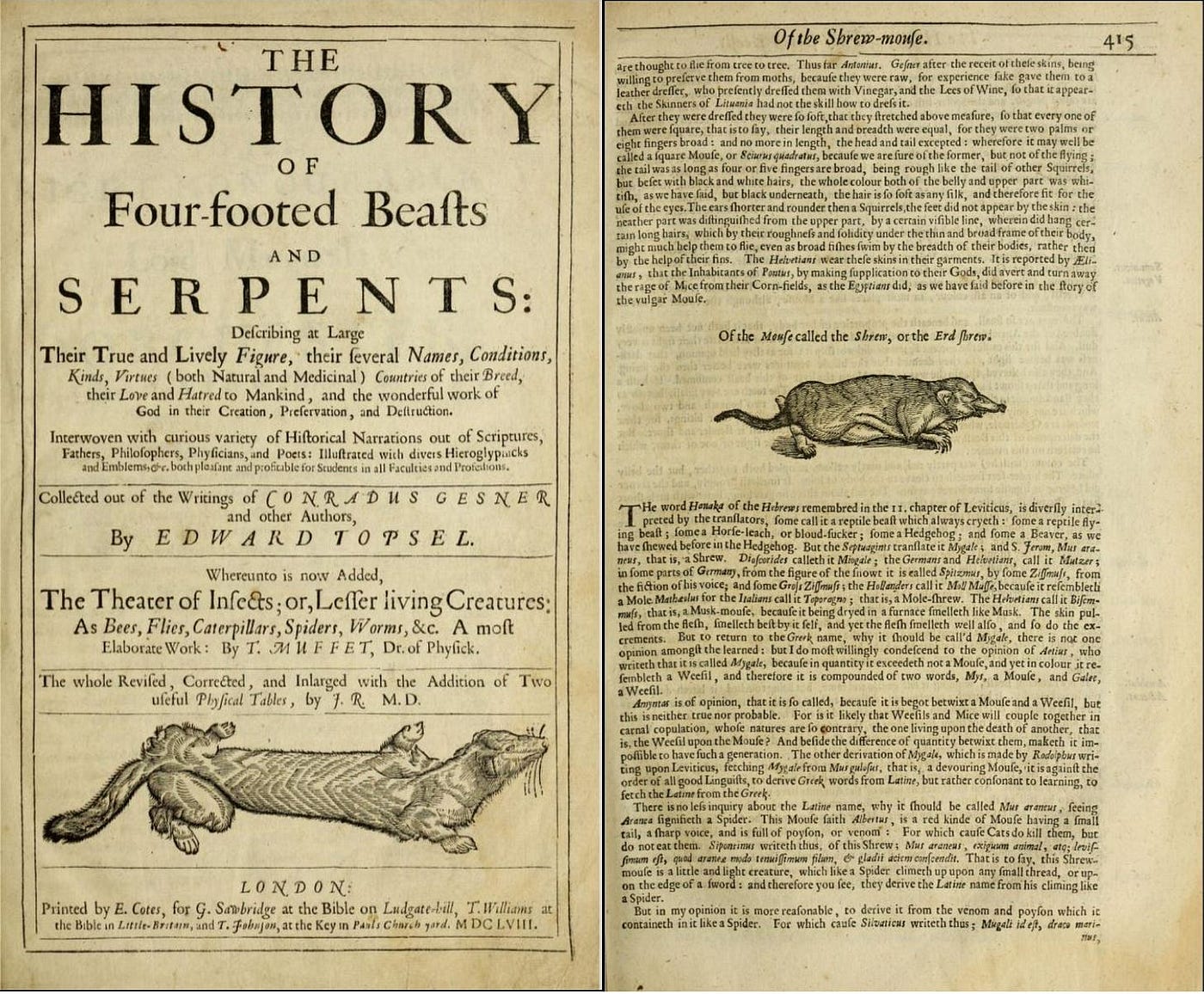
Pliny thought that to keep them away from cattle, a dead shrew should be hung around the neck of the cow in question. Hippocrates suggests that a salted shrew rubbed into a wound of its own making will occasion an immediate cure; and Aelianus would have you run the biting shrew over with a cart and thereafter sprinkle the dust from the cart furrow on the affected area. Among calls for pomegranates (baked or unbaked), sheep’s hooves, and hare’s genitals, there is a particular preference for both vinegar and cumin. Almost all of the cures involve some sort of wine, including one recipe which suggests it be first steeped with a young weasel (Pliny again); and still more requiring the capture of the offending shrew, whereupon it was killed and either eaten (usually with wine) or applied to the festering sore. Otherwise it was kept alive and made to walk in specific directions. Through precisely how this was to be achieved with an animal the size of a ping pong ball running at four miles an hour is not made clear.
The small claws of the “‘venomous beast” scrabbled onto my shoulder. I froze. He froze too. He was so light I couldn’t even feel where he was any more. Common shrews are about +/-10g, or the weight of a squeezed Yorkshire teabag. I tried pulling the back of the shirt away from my body, but he misunderstood the gesture and began clambering frantically over my skin again. Slowly I unbuttoned the shirt and calmly took it off, much to the confusion of my colleague who had come over to see what was going on.
South of the Mediterranean, the story is rather different (through it still didn’t work out so well for the shrews). Sculptures and figurines from Egypt date back to at least the 12th Dynasty (c.1991–1802 BC). They knew the shews as amam, or arar, one who devours, voracious one, glutton.
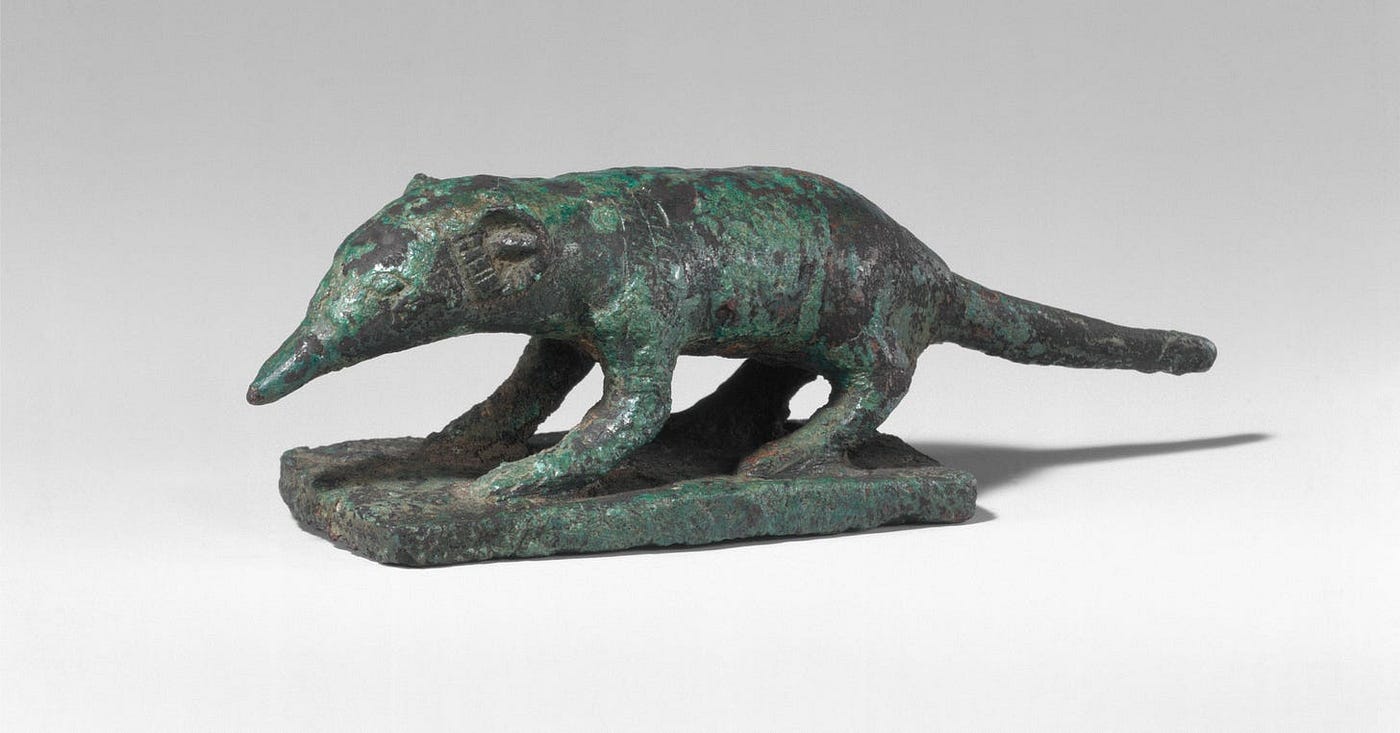
Figure of a Shrew, Ptolemaic Period 304–30 BC Metropolitan Museum of Art.
These were often pygmy shrews, otherwise known as sacred shrews (Crocidura religiosa), a different genus of Soricidae even smaller and more metabolic than their common cousins. The Egyptians believed that shrews were blind — erroneously as it turns out, though they’re not exactly going to pass the eye test for a driving license any time soon. They saw them as representative of one aspect of the god Horus, his blind and nocturnal part, assisting the god of the sun to make his nightly journey and return safely at dawn.
At a temple near Thebes dating from the 4th Century BC, these shrews were found mummified (sometimes in miniature coffins), along with other animals, including a now extinct species of Soricidae, where they are thought to have been votive offerings made by pilgrims. It even seems likely that priests would farm captive shrews near the temples for the purpose of this mummified sacrifice.
The Sorex araneus native to England, Wales and Scotland is now protected under the Wildlife and Countryside Act of 1981, as are the water shrew and the third native species, the (European) pygmy shrew (Sorex minutus). This means that anyone live-trapping shrews — for marking and tracking purposes for example — must account for their metabolisms by ensuring enough food is available within the trap to sustain the captured animal for a full twelve hours between checks.
The shrew on my back leapt for the ground and was gone, instantly hidden in the long grass. I took a stick, thick and rough with bark, setting it in the hole on an angle; and within moments the second shrew had taken the hint and followed. I left the ramp in place, in case the shrews had any thoughts of repeating their adventure. I doubted I would see them again. Sorex araneus only live for about a year anyway. In the meantime, I’ll remain hopeful that I can still hear the shrews calling out from the drainpipes decades from now.
Further Reading
Barrat, John. ‘Review of Sacred Shrew Mummies Reveal Species Distribution in Ancient Egypt.’ Smithsonian Insider, April 22, 2016. https://insider.si.edu/2016/04/sacred-shrew-mummies-reveal-species-distribution-ancient-egypt.
There’s a picture of a mummified shrew here which is well worth a look, as well as a remnant of a coffin that was used.
De Vartavan, Christian. Vocalised Dictionary of Ancient Egyptian. Projectis Publishing, 2022. https://de.cdn-website.com/3e823bf7e8654767a06a86d670bf72af/files/uploaded/DeVartavan-Dictionary.pdf
Editors of Science News Today. ’10 Animals with Super Hearing Abilities.’ Science News Today, October 7, 2025. www.sciencenewstoday.org/10-animals-with-super-hearing-abilities.
Haberl, Werner. ‘Comparative measurements of running speed in five species of European shrews (Soricidae, Eulipotyphla),’ Journal of Wildlife and Biodiversity, 6(1), 102–104, 2022. DOI:10.22120/jwb.2021.544303.1275.
Mammal Society. ‘Common Shrew.’ https://mammal.org.uk/british-mammals/common-shrew. Accessed may 4, 2026.
A good detailed overview on species biology and behaviour.
Museum of Fine Arts, Budapest. ‘Shrew — A Sacred Glutton.’ www.mfab.hu/shrew-a-sacred-glutton. Accessed May 4, 2026.
Information about some of the Egyptian mythology relating to shrews. The collection also has other images of figurines and shrew-coffins.
Topsel, Edward. The History of Four-footed Beasts and Serpents. G. Cotes, 1658. https://archive.org/details/historyoffourfoo00tops/page/417/mode/1up
메타데이터
- post_id
- dd3c3658925f
- slug
- the-shrew-in-the-shirt-dd3c3658925f
- url
- https://medium.com/@anna.welch08/the-shrew-in-the-shirt-dd3c3658925f
- canonical_url
- https://medium.com/@anna.welch08/the-shrew-in-the-shirt-dd3c3658925f
- author_url
- https://medium.com/@anna.welch08
- status
- ok
- fetched_at
- 2026-06-12 22:02:08






