The Death of the Shadow Fleet: How Ukraine Neutralised the Sea of Azov
In just seven days, waves of drones has forced a total shipping blackout, effectively turning a vital Russian supply corridor into a denied…
The Death of the Shadow Fleet: How Ukraine Neutralised the Sea of Azov
In just seven days, waves of drones has forced a total shipping blackout, effectively turning a vital Russian supply corridor into a denied zone
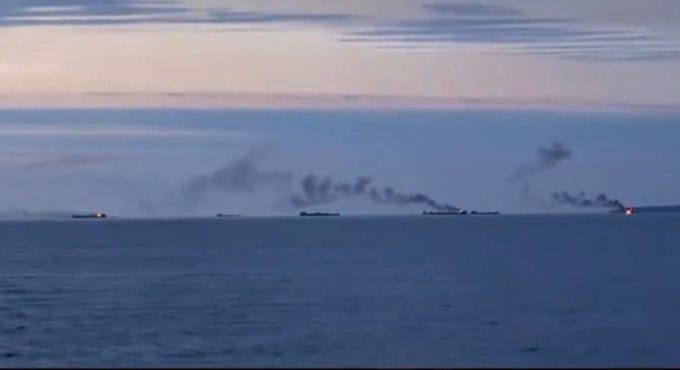
Multiple Russian ships on fire in the Sea of Azov following Ukrainian drone attacks. Picture: Twitter
Ukraine’s drone forces chief, Robert Brovdi (call sign “Magyar”), said on Sunday that his units had hit 10 tankers and four ferries overnight, as well as a major oil refinery in the city of Syzran. There had been several strikes on electricity substations in occupied Crimea, he added.
This builds on six days of massed drones attacks, with a total of 90 damaged ships — and still counting, as of 13 July.
“The technological humiliation of the empire continues. It will fall because of Crimea,” Brovdi wrote on Twitter.
He explained that Moscow’s shadow fleet, which transports sanctioned oil products around the world, was “noticeably shrinking” and could no longer use the Kerch strait, connecting the Sea of Azov with the Black Sea.

Russia’s refining capacity has been reduced by 40% and its oil export facilities in the Black Sea and the Baltic Sea have been hit repeatedly heavily damaged.
Ukraine’s drone sanctions on Russian energy infrastructure now extend even as far as Omsk. The Omsk Refinery is Russia’s largest refinery by volume of oil processing. The plant is located approximately 2,500 kilometres from the border with Ukraine.
But it’s the route through the Sea of Azov, through the Kerch Strait and thereafter the Bosphorus that will bleed Russia. And hitting the tankers also seriously limits Russia’s ability to replenish empty fuel tanks in Crimea.
14 vessels hit in just one night.
[embed]
Cutting the Azov artery
In a week of unprecedented activity, the Ukrainian Unmanned Systems Forces executed a systematic campaign that effectively severed a critical logistics corridor for the Russian state.
Between 6 July and 12 July 2026, the Ukrainian military reported strikes on 90 vessels. This figure includes a diverse array of craft, primarily tankers, ferries, tugboats, and cargo ships. The operational tempo behind these figures is striking: vessels were targeted at an average interval of one strike every 112 minutes.
By the end of this period, the maritime traffic that previously sustained Russian operations in occupied southern Ukraine had reached a state of near-total suspension.
This campaign is a major departure from traditional naval warfare. Historically, the imposition of a blockade required a surface fleet capable of patrolling and interdicting traffic through presence and superior firepower.
Ukraine, however, has achieved a comparable outcome through the distributed application of unmanned systems.
The fragility of the shadow fleet
The vessels targeted by Ukrainian forces from a significant portion of Russia’s shadow fleet, a collection of older tankers operated to bypass international sanctions.
Russia’s officially registered merchant fleet is 14.8 million DWT (deadweight tons), with a shadow fleet (registered under foreign flags) estimated at 1300 ships totalling 127 million DWT. That’s about 18% of the world tanker fleet.
The “Azov” scale: The vessels recently targeted by Ukrainian drone operations in the Sea of Azov are significantly smaller than the global average, often measuring around 7,000 DWT. These are highly specialised for short-haul, shallow-water logistics.
Structural significance: While the global shadow fleet represents over 127 million DWT, the loss of these smaller, 7,000 DWT vessels is militarily and logistically devastating because they are “bottleneck assets.” They are the only vessels capable of shuttling fuel through the Don-Azov Canal to occupied territories.
These ships, usually lacking modern defensive suites, operate in a grey zone of global commerce, frequently disabling their transponders to evade detection. However, this lack of transparency and regulatory oversight has rendered them exceptionally vulnerable.
Without a cohesive, air-defence-integrated protection system, these tankers are essentially defenseless against persistent, low-cost drone threats. The shift away from standard maritime safety protocols has precluded the implementation of robust defensive measures, leaving these high-value assets exposed in the confined waters of the Sea of Azov.
The strategic implications of this blockade extend beyond the immediate loss of individual ships. The Sea of Azov has long served as a vital artery for Russian logistical support, grain exports, and the maintenance of port infrastructure in occupied territories like Mariupol and Berdyansk.
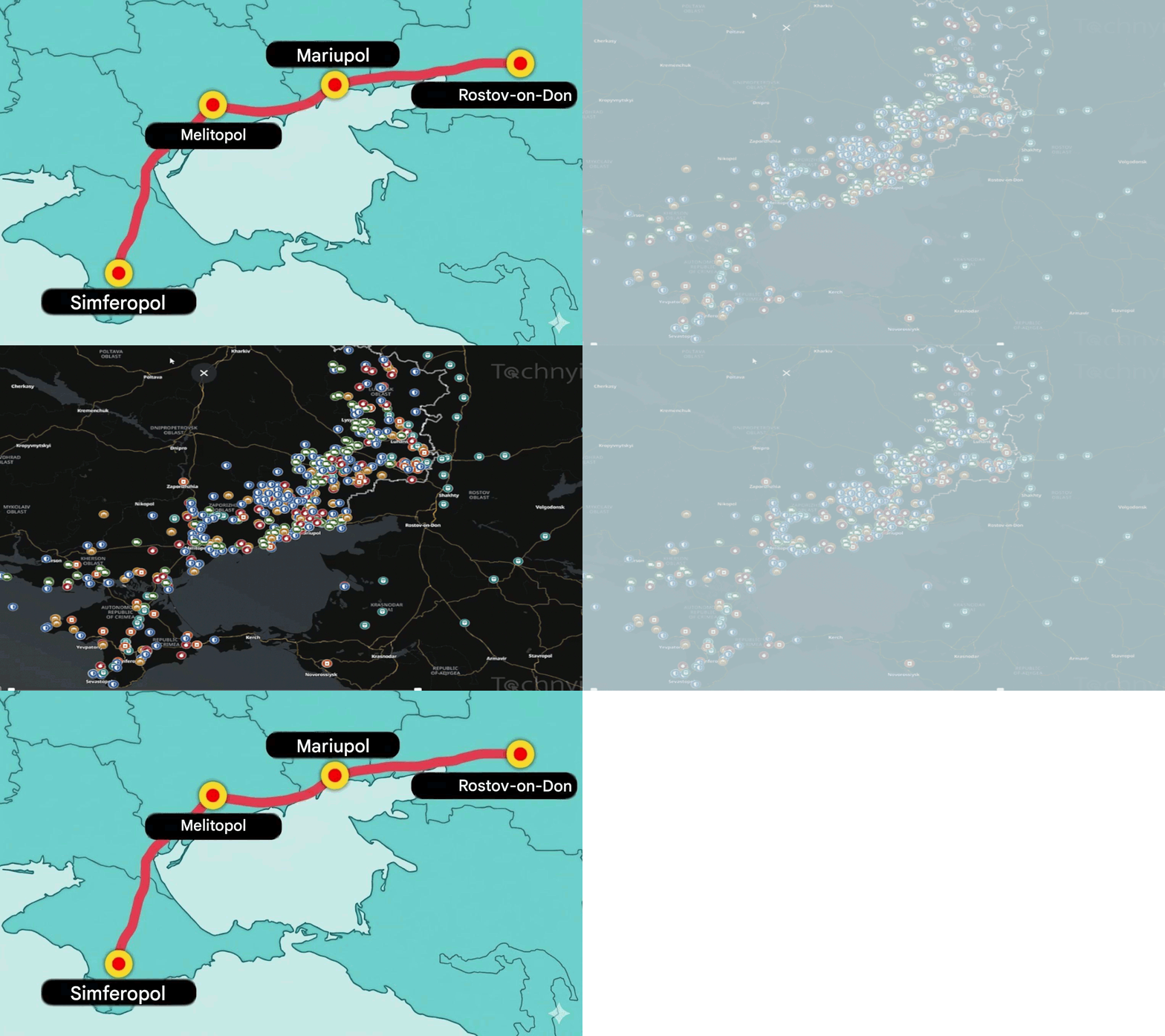
By targeting tankers, bulk carriers and logistical support craft, Kyiv has initiated a process of isolation that directly impacts the sustainability of Russian forces in the south. Data from maritime intelligence providers indicates a significant reduction in the number of vessels broadcasting active Automatic Identification System (AIS) signals.
This shift suggests that the maritime corridor is no longer a viable route for routine Russian operations, forcing Moscow to either abandon these transit lines or risk further attrition.
Engineering a maritime blockade
Ukraine’s approach to interdiction relies on the distributed application of unmanned technology rather than the traditional projection of force through a surface navy.
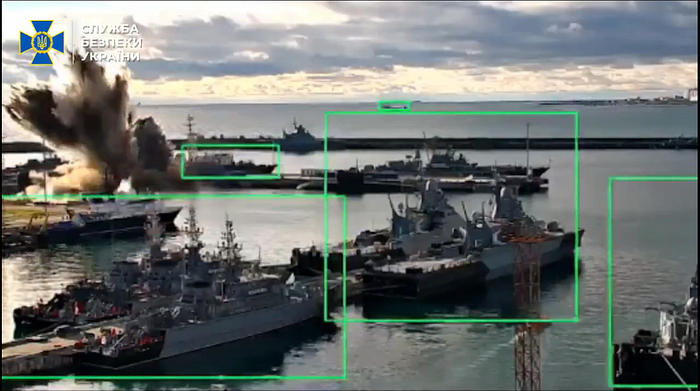
By prioritising the destruction of support craft, such as tugs and dredgers, before engaging primary tankers, the Unmanned Systems Forces have crippled the ability of ports to facilitate transit or conduct emergency repairs.
This multi-layered targeting strategy forces a bottleneck.
When a tug is disabled, the associated tanker often becomes stranded, creating a cascading obstruction that prevents other traffic from entering or exiting the Don-Azov Canal. This tactical application of precision drone strikes allows a smaller force to impose a comprehensive blockade on a vastly larger, better-funded adversary.
Evolving doctrine
The technical nature of the strikes offers insight into the evolving doctrine of the Ukrainian military. Observation of strike footage indicates a focus on multi-stage engagement.
Units such as the 414th Unmanned Strike Aviation Brigade have demonstrated an ability to disable tugboats and dredgers to restrict port maneuverability, followed by precision strikes against tankers.
Then the failure of field-expedient countermeasures — such as the attachment of protective cages and ropes to vessel decks — highlights the difficulty of protecting slow-moving, high-value assets against modern precision-guided munitions.
The inability of Russian air defence systems, designed primarily to counter traditional aerial threats, to effectively intercept smaller, low-altitude drones has emerged as a critical vulnerability.
This series of events is a pivot in the wider maritime theatre and will influence military planning for years ahead. The reliance on unmanned, autonomous systems to enforce a blockade without the presence of a conventional navy suggests that the threshold for conducting maritime interdiction has lowered significantly.
For analysts and observers, the Sea of Azov now serves as a case study in the rapid erosion of traditional naval superiority when faced with high-frequency, low-cost drone threats.
In fact, this trend started to emerge in the entrance to the Red Sea (the Gate of Tears), formulated by the Houthi terrorist group; this was further refined by Iran in early 2026 as they implemented full control of the Strait of Hormuz using drone technology. They did this successfully and demonstrated that even overwhelming US naval and aerial firepower could offer no effective defence against such an asymmetric blockade.
Second-order economic effects
The disruption of the Kerch Strait and the Don-Azov Canal extends well beyond the military sphere, triggering significant economic feedback loops.
Russia’s ability to export grain and petroleum, which constitutes a major segment of its maritime revenue, has been curtailed. The instability of power supplies in occupied Crimea, linked to the inability to transport necessary fuels, demonstrate the internal strain this blockade places on the Russian administration.
Consequently, the global commodities market has registered the impact of this disruption, as the uncertainty of safe passage through the region forces insurance premiums to rise and logistics chains to recalibrate.
The blockade has effectively transformed the sea from a Russian logistical hub into a zone of high operational risk.
As the Sea of Azov campaign continues, the inability of the Russian naval architecture to adapt its defensive posture suggests that this disruption is not merely temporary, but a fundamental alteration to the logistical calculus of the war.
The artery that once connected the Russian mainland to its southern outposts has been effectively cauterised, leaving the remaining maritime assets in the region increasingly isolated and vulnerable.
메타데이터
- post_id
- dd50b6fd7d70
- slug
- the-death-of-the-shadow-fleet-how-ukraine-neutralised-the-sea-of-azov-dd50b6fd7d70
- url
- https://medium.com/the-dock-on-the-bay/the-death-of-the-shadow-fleet-how-ukraine-neutralised-the-sea-of-azov-dd50b6fd7d70
- canonical_url
- https://medium.com/the-dock-on-the-bay/the-death-of-the-shadow-fleet-how-ukraine-neutralised-the-sea-of-azov-dd50b6fd7d70
- author_url
- https://medium.com/@james-marinero
- status
- ok
- fetched_at
- 2026-07-14 12:02:10