When a Drilling Rig Ships from China to Brazil: What That Journey Actually Involves
A Guyana-based mining operator needed equipment for a Brazilian project. Here’s what made the ZGYX421H Integrated DTH Drilling Rig the…
When a Drilling Rig Ships from China to Brazil: What That Journey Actually Involves
A Guyana-based mining operator needed equipment for a Brazilian project. Here’s what made the ZGYX421H Integrated DTH Drilling Rig the right call — and why the details matter.
Walk into any open-pit mine in South America and you’ll hear the same complaint before you hear anything else: downtime. Not from equipment failure, necessarily. Downtime from rod changes. From repositioning. From waiting on an external compressor truck that’s stuck somewhere on a rutted haul road.
Drilling efficiency in surface mining isn’t usually lost in dramatic fashion. It bleeds out slowly, one manual rod change at a time.
That’s the context behind a recent shipment from UNIQUEMAC’s production facility in Zhengzhou — a batch of ZGYX421H integrated DTH blast hole drilling rigs, now containerized and bound for Brazil via a Guyana-based customer. It’s the kind of cross-border transaction that looks routine on paper, but represents a specific set of operational choices worth examining.

UNIQUEMAC
Why Brazil’s Mining Projects Are Different
Brazil is not a single geological environment. It’s dozens of them.
The country hosts some of the world’s largest iron ore, bauxite, and gold reserves — alongside hundreds of smaller quarry and infrastructure operations that don’t make the headlines but generate consistent, high-volume demand for drilling equipment. The challenge for equipment manufacturers is that what works in a structured large-scale open pit is not always what works on a hillside road construction site in Minas Gerais.
Traditional split-type DTH rigs handle this poorly. They arrive on site as a collection of components — compressor here, power unit there, drilling mast somewhere else — and each deployment is its own logistics puzzle. In a country where mining operations frequently span multiple sites with varied terrain, that friction adds up.
The case for integrated rigs, in environments like Brazil’s, is essentially a case against complexity.
What “Integrated” Actually Means in Practice
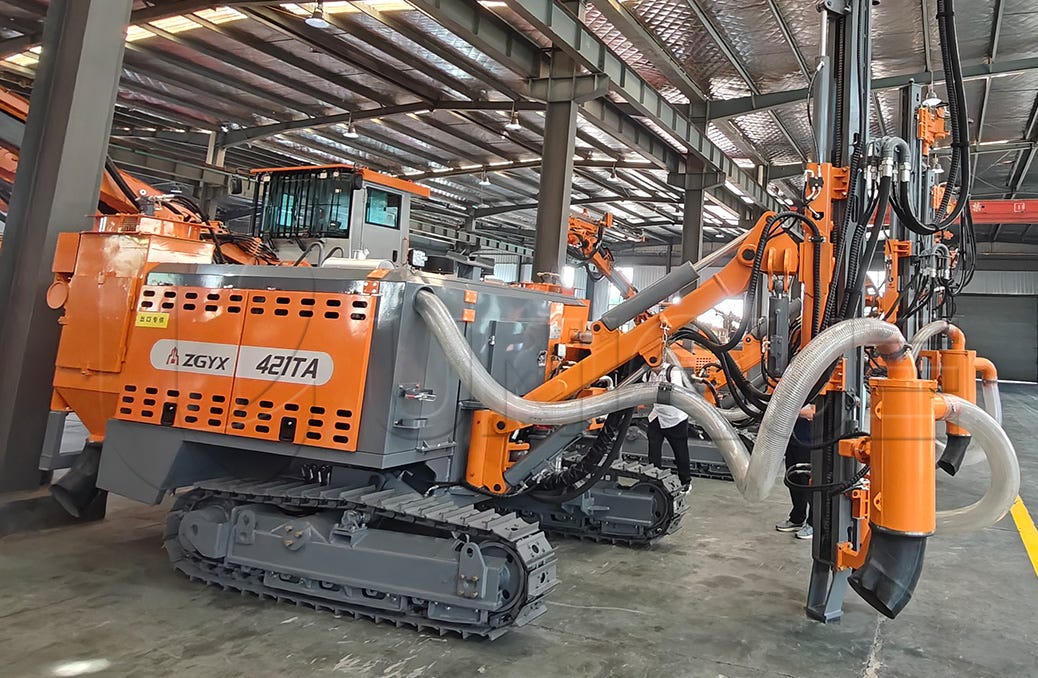
The ZGYX421H is built around a design philosophy that consolidates what most rigs spread across multiple units: the diesel power system, the high-pressure air compression, and the drilling and walking mechanisms all exist within a single crawler-mounted machine.
The practical consequence is straightforward. When a drilling crew needs to move between blast hole positions — which in open-pit bench drilling happens constantly — the entire machine moves. No disconnecting compressor hoses. No coordinating the movement of support vehicles. No reassembling the air supply system at the new position.
For operations running frequent position changes, this isn’t a minor convenience. It’s a meaningful reduction in non-productive time per shift.
The built-in compressor is worth specific attention. Air supply stability is the limiting factor in DTH drilling performance — the hammer operates on compressed air, and any inconsistency in pressure directly degrades penetration rate. External compressors introduce a variable that operators would rather not manage. The ZGYX421H DTH Drilling Rig eliminates that variable by integrating the air supply into the rig itself.

UNIQUEMAC
The Rod Changing Problem
Ask any drilling contractor what they’d change about their operation and “faster rod changes” comes up early and often.
Manual rod handling in blast hole drilling is slow, physically demanding, and carries genuine injury risk. In operations running long shifts across multiple holes, it also creates bottlenecks that cascade — one slow rod change delays the hole, which delays the blasting sequence, which delays the excavation cycle.
The ZGYX421H’s automatic rod changing system handles pick-up, positioning, connection, and disconnection without operator intervention. The rod carousel manages the sequence; the system handles the mechanics. The operator monitors; the machine executes.
The efficiency gains here are compounded over a full shift. Each rod change that takes three minutes manually and thirty seconds automatically represents time that accumulates into hours across a typical production week. For high-frequency drilling operations, that math matters.
The Specification Logic
Some of the ZGYX421H’s technical parameters deserve context beyond the spec sheet.
Hole diameter: 90–138 mm. This range isn’t arbitrary. It maps to the dominant blasting design standards used across Brazilian mining and quarry operations — wide enough for heavy-duty open-pit work, precise enough for secondary breaking and foundation drilling. The flexibility means contractors don’t need different machines for different project phases.
Max drilling depth: 21 m. Surface blast hole drilling in most South American open-pit and quarry applications doesn’t require extreme depth — it requires the right depth, achieved consistently and efficiently. The 21-meter ceiling covers the overwhelming majority of bench drilling scenarios without the energy cost and accuracy tradeoffs that come with chasing greater depth on a machine not optimized for it.
Cummins diesel engine. In remote mining environments, engine serviceability is as important as engine performance. Cummins has global parts availability and service infrastructure — a consideration that weighs heavily when a machine is operating in a Brazilian mining area three time zones from its manufacturer.
The Cross-Border Dimension
This particular shipment involves a Guyana-based customer deploying equipment in Brazil — a detail that reflects how mining equipment procurement in South America increasingly works. Operators source globally, deploy regionally, and expect equipment to function across borders without significant reconfiguration.
The ZGYX421H’s containerization follows a pre-shipment protocol that covers engine systems, hydraulics, the air compressor, the automatic rod changer, and the crawler drive — each tested under simulated load conditions before the machine is cleaned, protected, and secured for ocean transit. Key components are shock- and moisture-protected for the crossing.
It’s not exciting. It’s the kind of operational discipline that determines whether a machine arrives ready to work or requires a week of troubleshooting after unloading.
The Broader Point
The shift toward integrated, automated drilling equipment in South American surface mining isn’t driven by technology preference. It’s driven by labor economics, site complexity, and the compounding cost of inefficiency at scale.
Manual operations that made sense when labor was abundant and projects were small are increasingly mismatched to the demands of modern mining operations. Contractors who have worked with automated rod changing systems consistently report that the productivity case is clear within the first few weeks of operation.
The ZGYX421H is a specific answer to a specific problem set: open-pit and quarry environments in geologically varied terrain, with demanding production schedules and limited tolerance for downtime. Whether that matches your project’s parameters depends on conditions the spec sheet alone can’t answer.
But the direction of the industry is readable. Integrated systems. Automated handling. Machines that move as a unit and operate with less human intervention at each step.
The rig heading to Brazil is one data point in that direction.
UNIQUEMAC (Zhengzhou Unique Industrial Equipment Co., Ltd.) manufactures and exports drilling equipment for mining, water well, and mineral exploration applications. Equipment inquiries: www.uniquedrilling-tech.com | WhatsApp: +86 158 9060 9031
메타데이터
- post_id
- dd6b32d2ce72
- slug
- when-a-drilling-rig-ships-from-china-to-brazil-what-that-journey-actually-involves-dd6b32d2ce72
- url
- https://medium.com/@uniquevania83/when-a-drilling-rig-ships-from-china-to-brazil-what-that-journey-actually-involves-dd6b32d2ce72
- canonical_url
- https://medium.com/@uniquevania83/when-a-drilling-rig-ships-from-china-to-brazil-what-that-journey-actually-involves-dd6b32d2ce72
- author_url
- https://medium.com/@uniquevania83
- status
- ok
- fetched_at
- 2026-09-08 03:47:45