Maya
Maya is the cosmic appearance through which the formless appears as form, the timeless appears as time, and the undivided appears as…
Maya
Maya is the cosmic appearance through which the formless appears as form, the timeless appears as time, and the undivided appears as multiplicity.
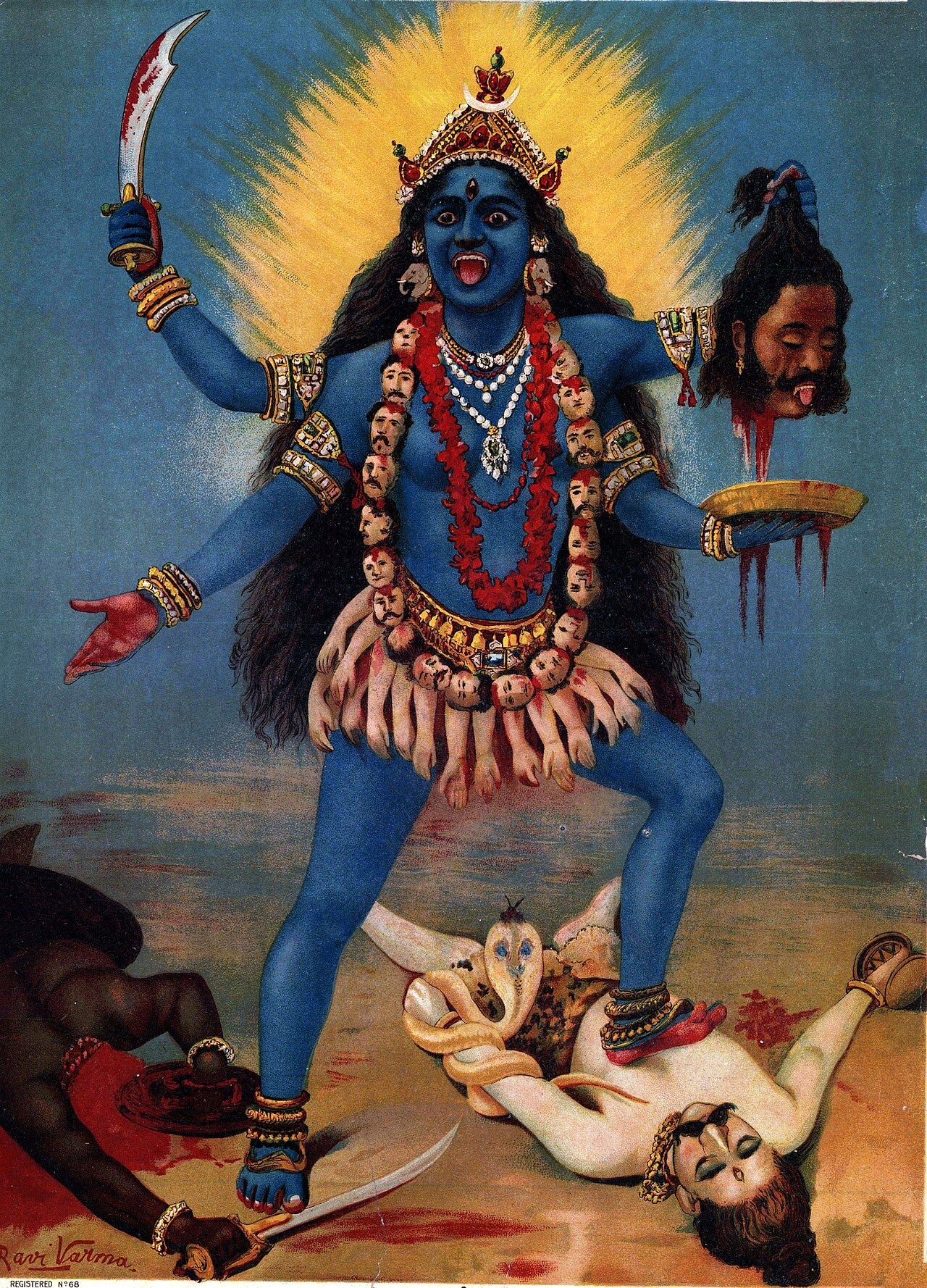
Kali by Raja Ravi Varma. Source: Wikipedia
Maya is the appearance of separation within that which is fundamentally undivided. It is not an independent force standing against reality, nor is it a simple illusion in the sense of something entirely false. Rather, Maya is the process through which the indivisible appears divisible, the infinite appears finite, and the one appears as many. It is the veil that allows consciousness to experience manifestation while temporarily obscuring its own true nature.
Without Maya, there would be no experience of individuality, no distinction between observer and observed, no perception of space, time, causality, or form. The undivided reality would remain undifferentiated and unmanifest. Maya, therefore, is the condition that makes manifest existence possible. It is the principle through which awareness appears as countless beings, worlds, thoughts, experiences, and identities. In this sense, Maya is both concealment and revelation. It hides unity by presenting multiplicity, yet through that very multiplicity, it creates the possibility that unity may eventually be rediscovered.
The ordinary person experiences Maya as the unquestioned assumption that he is a separate individual moving through a world composed of separate objects. He experiences himself as a distinct self contained within a body, confronting an external reality. He believes, “I am this person,” “These are my thoughts,” “These are my possessions,” “This is my success,” and “This is my suffering.” These distinctions feel unquestionably real because perception itself is structured through Maya. The illusion is not that the world does not exist, but that it exists in the way it appears to exist.
Maya operates through the mind-body complex. Through sensation, memory, thought, language, and perception, it constructs boundaries where none ultimately exist. The body appears separate from the world. The self appears separate from other selves. The observer appears separate from the observed. Yet beneath these apparent distinctions lies a single continuous reality expressing itself through countless temporary forms. Maya is the lens that fragments the indivisible into manageable appearances.
This fragmentation extends beyond physical form into psychological experience. Pleasure and pain appear opposed. Gain and loss appear opposed. Life and death appear opposed. Success and failure appear opposed. Maya creates a world of dualities and then persuades the mind that these dualities possess ultimate significance. The mind becomes attached to one side and resistant to the other. It pursues pleasure and fears pain. It seeks permanence in what is transient. Through these attachments and aversions, the cycle of rebirth perpetuates itself.
Yet Maya should not be understood as an enemy. It is not a mistake in creation. It is an essential aspect of manifestation itself. The world appears real because Maya functions perfectly. Relationships feel real. Emotions feel real. Identity feels real. The entire drama of existence unfolds through its operation. If Maya were merely falsehood, it would possess no power. Its power lies precisely in the fact that it presents relative reality so convincingly.
A dream affects the dreamer while the dream lasts. Similarly, Maya affects the embodied being so long as identification remains intact.
The deeper purpose of Maya is not to deceive endlessly but to create the conditions for recognition. Through countless experiences, attachments, disappointments, joys, losses, and transformations, awareness gradually begins questioning the assumptions upon which ordinary perception rests. The very suffering produced by attachment often becomes the catalyst for inquiry. The mind begins asking who suffers, who desires, who fears, and who experiences. Through such inquiry, the structures maintained by Maya gradually weaken. What once appeared absolutely real begins revealing its provisional nature.
When self-awareness matures, Maya is not destroyed externally. The world continues to appear. Bodies continue to act. Thoughts continue to arise. Time continues to flow. What changes is the relationship to these appearances. One begins seeing them as expressions within consciousness rather than independent realities standing apart from it.
The forms remain, but their apparent separateness dissolves.
메타데이터
- post_id
- dd6b4357858e
- slug
- maya-dd6b4357858e
- url
- https://medium.com/the-pillionaire-diaries/maya-dd6b4357858e
- canonical_url
- https://medium.com/the-pillionaire-diaries/maya-dd6b4357858e
- author_url
- https://medium.com/@parijat.srivastava
- status
- ok
- fetched_at
- 2026-06-20 20:29:01