The Micro-SaaS Quietly Saving Video Editors From the Most Boring Job in Post-Production 🎬
Every video editor knows the feeling. You’ve just received a two-hour raw podcast recording. The guest is smart, the content is gold — but…
The Micro-SaaS Quietly Saving Video Editors From the Most Boring Job in Post-Production 🎬
Every video editor knows the feeling. You’ve just received a two-hour raw podcast recording. The guest is smart, the content is gold — but the file is a minefield of “uhh,” “ehm,” “you know,” and five-second pauses that make the whole thing feel like a hostage negotiation. You open your timeline. You take a deep breath. And then you start clicking.
Manually. One silence at a time.
This is the part nobody talks about when they romanticize the editing profession. The color grades, the motion graphics, the sound design — those are the creative parts. But a huge chunk of a video editor’s week is spent doing something a trained monkey could probably do: trimming dead air and verbal tics out of recorded conversations.
What if a simple web tool could do all of that in under three seconds?
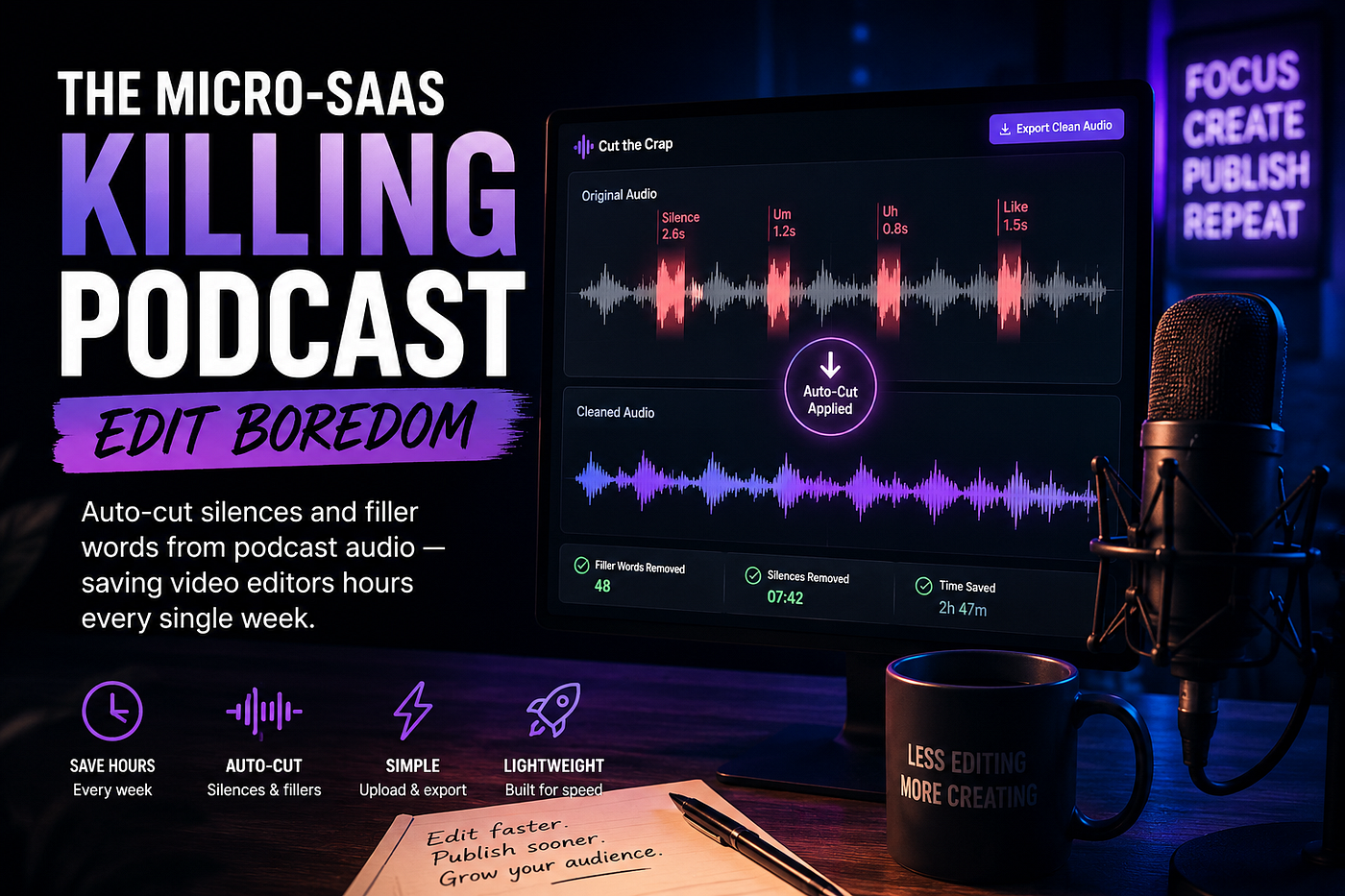
Image generated with AI
This article was prepared with AI assistance and curated by the author.
🧠 The Problem Is Bigger Than You Think
Let’s put some numbers on it. A typical 60-minute podcast, when recorded without much prep, contains:
- 8 to 15 minutes of silence (pauses, hesitations, “wait let me rethink that”)
- Hundreds of filler words — “uh,” “ah,” “like,” “you know,” “mmm,” “basically,” “literally”
- Multiple false starts and half-sentences that go nowhere
An experienced editor might clean all of this up in 45 minutes to an hour. A less experienced one? Could easily spend two to three hours on a single episode.
Multiply that by four episodes a week — because that’s what many podcast clients expect — and you’re looking at 8 to 12 hours of mindless, repetitive clicking that produces zero creative value. It’s the editing equivalent of data entry.
And yet, most editors are still doing it by hand.
✂️ What the Micro-Tool Actually Does
The concept is deceptively simple. You drag a raw audio file — MP3, WAV, M4A, doesn’t matter — onto a web interface. The tool analyzes the waveform, detects silent gaps above a configurable threshold (say, anything longer than 0.4 seconds), flags them, and removes them automatically. At the same time, it runs a second pass looking for common filler words using a lightweight speech recognition model.
Output: a cleaned audio file, a cut log, and — in smarter implementations — an EDL (Edit Decision List) you can import directly into Premiere Pro, DaVinci Resolve, or Final Cut Pro.
No installation. No plugins. No subscription to yet another 200 GB desktop app. Just a browser tab.
This is the core promise of the micro-SaaS model applied to post-production: take one painful, specific problem and solve it absurdly well.
💡 Why This Idea Has Real Business Potential
Here’s what makes this particular niche so attractive for a micro-SaaS:
The audience has money and a clear pain
Video editors are professionals. Freelancers in this space charge anywhere from $50 to $150+ per hour. If a tool saves them two hours a week, the value proposition calculates itself. A $19/month subscription pays for itself in the first 15 minutes of time saved.
The problem is recurring
Unlike a one-time converter or a novelty app, this tool gets used every single week. Podcast editors don’t have slow seasons. Clients always need new episodes. That means high retention — which is the lifeblood of any SaaS business.
It’s a gateway drug to a broader workflow
Once a user trusts the tool with silence removal, they’ll want more. Auto-leveling. Background noise reduction. Chapter marker suggestions. Transcript generation. Each feature is another reason to stay subscribed and another justification for a price increase.
Competition is surprisingly thin at the “lightweight web tool” layer
There are desktop apps like Descript, Adobe Podcast, and Recut. Some are excellent. But they’re also heavy, expensive, or opinionated about your workflow. A focused web tool that just does the trimming — fast, no account required for a basic trial, importable output — fills a gap none of them are really targeting.
🔧 How It Works Under the Hood (Without the Jargon)
You don’t need to be a developer to understand the basic mechanics. Here’s what happens when you drop an audio file into a tool like this:
- Silence detection — The audio waveform is analyzed for amplitude. Any section where the volume drops below a set decibel level for longer than a set duration gets flagged. Simple, fast, reliable.
- Filler word detection — A speech-to-text model transcribes the audio (or segments of it). The transcript is scanned for a list of known filler words and hesitation sounds. The timestamps are matched back to the audio.
- Removal and stitching — The flagged sections are cut. The remaining audio is joined with micro-crossfades to avoid hard clicks or abrupt transitions.
- Export — The clean file is packaged for download. If EDL export is enabled, the cut decisions are saved in a format your NLE (non-linear editor) can read.
The whole process, for a 60-minute file, can run in under 30 seconds on modern cloud infrastructure. The user experience feels almost magical compared to doing it manually.
🎯 Who This Is Really For
Let’s be specific, because “video editors” is a broad category:
- Freelance podcast editors who handle 3–10 episodes per week for multiple clients
- In-house content teams at companies running branded podcasts or video series
- YouTube creators who interview guests and need cleaner talking-head footage
- Course creators recording long lecture content full of natural pauses
- Journalists and documentarians working with raw interview footage
What all of these people share is this: they’re proficient enough to know what good audio sounds like, but too busy to spend hours achieving it manually.
They’re not looking for an all-in-one production suite. They already have one. They’re looking for a fast, trustworthy way to handle the grunt work so they can spend more time on the parts that actually require their expertise.
📈 The Micro-SaaS Model: Why Smaller Is Smarter
The micro-SaaS philosophy is worth explaining briefly, because it’s easy to misunderstand. It doesn’t mean “cheap” or “limited.” It means focused.
Instead of building the next Descript or Adobe Premiere — tools with hundreds of features and hundreds of engineers — a micro-SaaS picks one workflow bottleneck and solves it completely. The business stays lean. Pricing is simple. The marketing message writes itself: “Drop your audio. Get it back clean. Done.”
This model has produced some remarkably successful products across different industries. The pattern repeats because the logic is sound:
- Low development cost — a focused tool is far cheaper to build and maintain
- Clear value proposition — users immediately understand what they’re paying for
- Word-of-mouth friendly — “I use this thing that cleans up podcasts automatically” is a sentence people actually say out loud
- Defensible niche — larger players rarely bother to compete aggressively in narrow verticals
⚠️ What the Tool Gets Right — and What It Doesn’t Replace
Let’s be honest about the limitations. No automated tool is going to replace a skilled editor entirely. There are things only a human can do:
- Recognizing when a long pause is intentional and dramatically effective
- Knowing that a particular “uh” actually sounds natural and cutting it would feel robotic
- Understanding the rhythm and pacing of a specific speaker’s style
- Making judgment calls about what to cut for meaning, not just for noise
A good silence-removal tool should be a first pass, not a final product. The editor still reviews, still adjusts, still applies taste. But instead of spending 60 minutes on mechanical cleanup, they spend 10 minutes on creative review.
That’s the right division of labor. The machine handles the tedium. The human handles the judgment.
🚀 What a Good Version of This Tool Would Include
If someone were to build this properly, here’s what would set it apart:
- Adjustable thresholds — let the user define what counts as “silence” (0.3s? 0.5s? 1s?)
- Filler word customization — different speakers have different tics; the list should be editable
- Preview before export — show a waveform diff before committing to the cuts
- EDL export for major NLEs — Premiere, Resolve, Final Cut, Avid
- Batch processing — for editors handling multiple files at once
- Speaker detection — treat guest pauses differently from host pauses
- A clean, no-nonsense UI — because editors are visual people and a clunky interface is a dealbreaker
The pricing model almost writes itself: a free tier (one file per day, up to 30 minutes) to let people fall in love with it, and a paid plan ($15–25/month) for unlimited processing and EDL export.
🌍 The Broader Shift This Represents
What’s happening with tools like this isn’t just about convenience. It’s about a fundamental rebalancing of where skilled creative professionals spend their time.
For decades, editing required painstaking attention to both the creative and the mechanical. You couldn’t outsource the boring parts because there was nothing to outsource them to. Technology has now crossed a threshold where the mechanical parts of creative work can be handled by software — accurately, quickly, and cheaply.
This isn’t a threat to editors. It’s a gift. The editors who embrace these tools will be able to take on more clients, deliver faster, and charge more because they’re competing on creative quality rather than raw time investment.
The ones who resist will find themselves pricing themselves out of a market where faster, tool-savvy competitors exist.
🏁 Final Thought
The best tools don’t try to replace what you do. They try to remove the parts you shouldn’t have been doing in the first place.
Cutting silences out of a two-hour podcast is not craft. It’s maintenance. It’s the equivalent of a chef spending half their shift washing dishes — technically part of the job, but not what their talent was hired for.
A well-built micro-SaaS in this space doesn’t threaten the editor’s role. It clarifies it. It hands back the hours that were never really theirs to spend in the first place.
And for a category of professionals who already work too much, that’s not a small thing. That’s the whole point.
메타데이터
- post_id
- dd7c7e34a113
- slug
- the-micro-saas-quietly-saving-video-editors-from-the-most-boring-job-in-post-production-dd7c7e34a113
- url
- https://medium.com/@urano10/the-micro-saas-quietly-saving-video-editors-from-the-most-boring-job-in-post-production-dd7c7e34a113
- canonical_url
- https://medium.com/@urano10/the-micro-saas-quietly-saving-video-editors-from-the-most-boring-job-in-post-production-dd7c7e34a113
- author_url
- https://medium.com/@urano10
- status
- ok
- fetched_at
- 2026-06-09 15:37:30