Monetary Policy as a Colonial Tool: The Use of the Franc in Maintaining Control Over Algeria…
Monetary and fiscal policy has traditionally been a means by which colonial powers exercise control over their colonies. France’s…
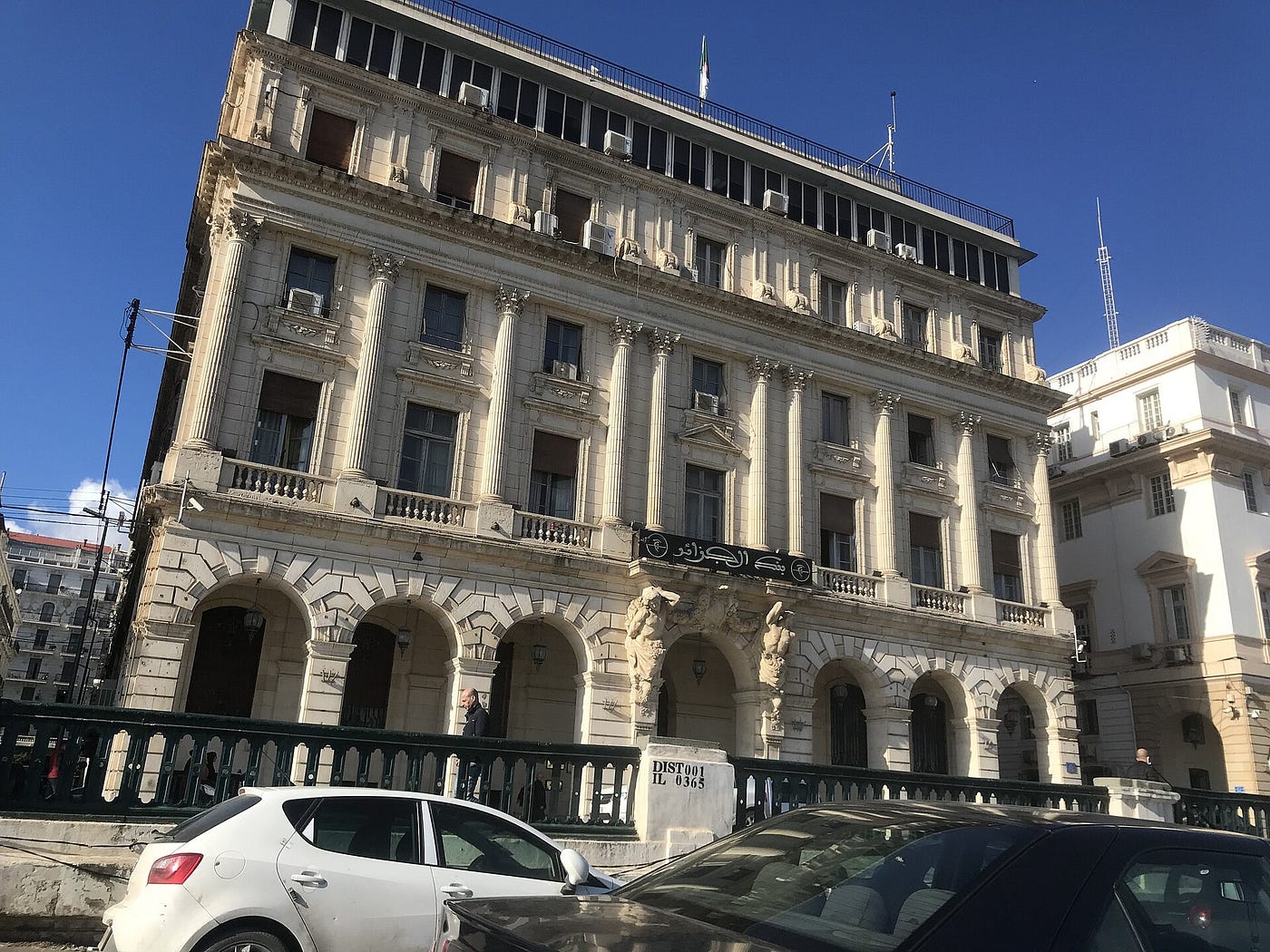
Former Banque d’Algérie building (since 1962, the home of the Bank of Algeria). Taken from Wikipedia under the Creative Commons License. Photo by Sandervalya.
Monetary Policy as a Colonial Tool: The Use of the Franc in Maintaining Control Over Algeria, Tunisia, and Morocco
Monetary and fiscal policy has traditionally been a means by which colonial powers exercise control over their colonies. France’s administration of its North African colonies — Morocco, Tunisia and Algeria — proved no exception.
For France, monetary policy was a critical tool in maintaining control over its North African territories and has remained a means by which France is still able to influence each country’s economy well beyond their independence from France.
During colonization, the French pegged each territory’s currency to the French franc, in effect undermining the financial independence of each country following colonization, while tying their economies to the whims of the French economy.
This essay explores how the French used monetary policy to reinforce their own colonial rule while examining the subsequent impact and the long-term consequences of French policies in North Africa long after Morocco, Algeria and Tunisia earned their independence.
The invasion and conquest of Algeria in 1830 persuaded the French of the need for establishing a stable currency to facilitate trade and governance. Following the subsequent annexation of Morocco and Tunisia, the French decided to make the French franc the dominant currency in all three territories in order to better integrate them into the French economic system.
This system of currency control in North Africa and beyond became known as the Franc Zone and was intended to stabilize the new French colonies while also ensuring their continued dependence upon the French financial system.
Being part of the Franc Zone meant that France had the ability to control monetary supply and exchange rates of any respective member. The effect of the Franc Zone in the case of Algeria, Morocco and Tunisia was to undermine their ability to exercise any sort of fundamental economic independence
One of the key justifications for pegging North African currencies to the French franc was to control inflation. The French attempted to persuade the newly independent French former-colonies that having their currencies pegged to the French franc would ensure that they escaped the kind of volatility that normally besets independent monetary policies.
This stability, however, came at the cost of the diversification and development of their economies. In the case of Algeria, this meant that a monetary policy completely integrated the country within the French Central Bank making the Algerian franc and later the Algerian dinar highly inflexible and insensitive to stresses on the Algerian economy such as during economic downturns and poor harvests.
Instead, in the management and manipulation of the Algerian currency, French economic interests took precedence meaning that French settlers benefited at the expense of indigenous Algerians. This currency rigidity also affected Tunisia and Morocco where the inflexibility of the monetary system meant that these countries could not safeguard their own economies against local economic stressors.
Although inflation of the French franc was kept very low, the development of various local industries was hindered contributing to widespread poverty amongst the local indigenous peoples of Morocco and Tunisia.
The banking system established in Algeria, Tunisia, and Morocco was also heavily dominated by French interests. French banks in francophone North Africa were under the direct scrutiny and oversight of the colonial administration and were responsible for directing investments towards sectors that benefited France and the French economy. Consequently, indigenous entrepreneurs often faced significant barriers to getting credit and financial resources.
In the case of Algeria, the Banque d’Algérie, although on paper responsible for managing the entire financial system of Algeria, primarily served the interests of French settlers. French banks in Algeria favored French settlers for loans for large agricultural estates owned by the pied-noirs — the French settlers and their descendants who resided within Algeria.
The consequent unequal access to capital perpetuated income inequality and inhibited local development. In Tunisia and Morocco, the French-controlled banking systems similarly reinforced the colonial economic structure directing capital towards infrastructure projects and export infrastructure (i.e. resource extraction) that benefited the French economy. This capital-lending scheme also had the tendency to favor settler activity and perpetuate income inequality.
French economic policy in Tunisia, Morocco and Algeria also had the effect of perpetuating long term trade imbalances. Each of these Francophone economies were largely oriented towards the demands and the output of the French economy. France would import the raw materials and agricultural products produced in Algeria, Tunisia and Morocco and export its manufacturing goods in return which helped to thwart the development of an indigenous manufacturing industry. This economic imbalance reinforced the de facto colonial status and dependency of these economies and limited the potential for economic diversification and long-term self-sufficiency.
In the case of Algeria, the main exports of its agricultural sector were crops such as wheat, wine and olive oil which were exported to France. The fixed exchange rate with France had the effect of making it difficult for Algerian producers to stay competitive with the global market perpetuating an over-reliance on the French for both imports and exports. This structural dependency made Algeria dependent on French demand for Algerian exports. Additionally, as Algeria had little in the way of economic diversity, its economy was especially vulnerable in times of market downturns.
Morocco and Tunisia experienced similar challenges as their own economies became geared towards agricultural exports to France. The over-reliance of both French colonies on agricultural exports perpetuated economic vulnerabilities as each colony not only was dependent on the French for export revenue, but they lacked a robust and diversified economy.
The French colonial banking system in North Africa also discouraged proper economic diversification. French banks often refused to fund nascent manufacturing or service sectors in Algeria, Tunisia or Morocco with capital. The consequence of such financial policies was to discourage competition with industries on the French mainland. This meant that French North African territories continued to be dependent upon the export of raw materials including agriculture and other raw materials, as they did not have the capacity for manufacturing finished goods.
In more agricultural oriented Algeria, indigenous competition with pied-noir owned agricultural industry was particularly discouraged by the banking industry. Barriers to entry were raised for indigenous competitors who might poach away revenue from established French settler owned enterprises. This model also applied to Morocco and Tunisia where local development and diversification of the economy was discouraged making these economies vulnerable to external shocks which had the effect of further hindering long-term sustainable growth.
The French banking industry in North Africa also played a role in undermining nationalist movements. The rise of nationalist movements in the early and mid-20th century such as the National Liberation Front (FLN) in Algeria and the Neo Destour party in Tunisia were partly driven by the need for greater economic independence and sovereignty from the French.
Nonetheless, entrenched control of the French financial apparatus (especially in Algeria) and the pegging of local currencies (in Tunisia and Morocco), made it difficult for these movements to establish independent economic policies. Consequently, the French banking system was able to strategically prevent funding and financial resources from going to nationalist campaigns and programs or organizations that called for independence from the French mainland.
In Algeria, in particular, the FLN struggled to get funding as the French banking system imposed stringent controls, designed to keep the movement from getting resources. Additionally, the nature of fixed exchange rates and the denial of access of Algeria to international markets further undermined the FLN’s ability to properly operate. In Morocco and Tunisia, these same forces made it almost impossible to build the kind of economic foundations needed to gain full independence from France.
The subsequent independence of Algeria, Morocco and Tunisia in the mid-20th century, however, did not completely liberate these economies from the influence and legacy of French colonization as lack of robust growth and economic diversification continued to dog each government.
The postcolonial Algerian government, for instance, attempted to bring about full economic independence and sovereignty by nationalizing key industries. However, the legacy of French colonization meant that the lack of a diversified economy continued to hamper Algerian growth. Indeed, much of the Algerian economy remained reliant on agriculture and the extraction of natural resources.
Tunisia and Morocco had similar challenges in trying to transition to full economic independence following their independence from France. Although both Morocco and Tunisia had success in transitioning to more industrialized economies, their historic dependence on France for exports remained a barrier to full economic autonomy.
France similarly continued to influence the economies of Algeria, Morocco and Tunisia through trade agreements, investment policies and financial aid. Consequently, each North African economy continued to be reliant upon France. Indeed, all three former French territories continued to rely upon France for investments and financial support toward critical sectors of their economy perpetuating continued economic dependence upon their former colonizer.
Continued French influence upon each of its former North African territories is illustrative of the contemporary political economic issues that continue to face each country. The continued struggle of Morocco, Algeria and Tunisia to integrate themselves into both the regional and global economy can be largely traced to the legacy of French colonization.
To address the economic challenges each North African country faces will require a nuanced understanding of the economic systems that were constructed during French colonial rule and the continued legacy that they pose.
French colonial policy in North Africa involved the use of a monetary and economic policy that ensured that Algeria, Morocco and Tunisia remained dependent upon France long after decolonization.
In pegging the local currencies of each North African territory to the French franc, France undermined the financial autonomy of each while simultaneously enforcing economic dependency. The strict French policy of inflation control in Algeria, Tunisia and Morocco, similarly prioritized French interests over the needs of each respective economy while the French colonial banking system marginalized the needs of the indigenous population, redirecting capital to favored industries like agriculture and raw materials and perpetuated trade imbalances that encouraged continued dependence upon France.
This essay argues that a basic understanding of how French monetary policy in the region operated over the past century is a vital tool in understanding the contemporary political as well as economic realities Algeria, Tunisia and Morocco continue to be faced with as they continue to grapple with the challenges of integrating themselves into an ever more globalized world.
메타데이터
- post_id
- dd7da4d16892
- slug
- monetary-policy-as-a-colonial-tool-the-use-of-the-franc-in-maintaining-control-over-algeria-dd7da4d16892
- url
- https://medium.com/@msweeney777/monetary-policy-as-a-colonial-tool-the-use-of-the-franc-in-maintaining-control-over-algeria-dd7da4d16892
- canonical_url
- https://medium.com/@msweeney777/monetary-policy-as-a-colonial-tool-the-use-of-the-franc-in-maintaining-control-over-algeria-dd7da4d16892
- author_url
- https://medium.com/@msweeney777
- status
- ok
- fetched_at
- 2026-06-11 05:11:55