Day 2: Understanding Microsoft Dynamics 365 Modules
A Roadmap from Fresher Developer to Solution Architect Series: Learn Microsoft Dynamics 365 CRM Step-by-Step Day 2 of 90
Day 2: Understanding Microsoft Dynamics 365 Modules
A Roadmap from Fresher Developer to Solution Architect Series: Learn Microsoft Dynamics 365 CRM Step-by-Step Day 2 of 90
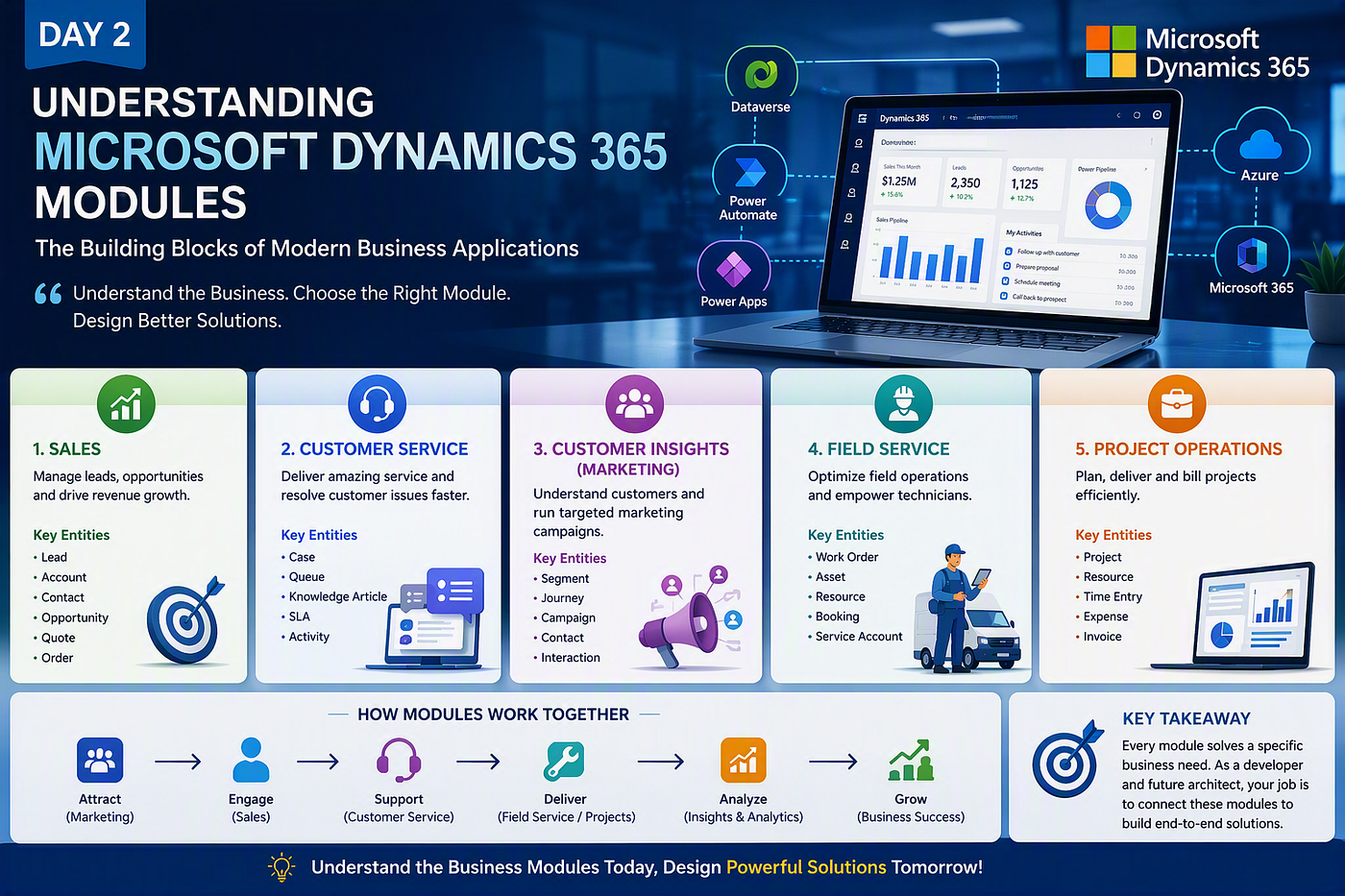
Welcome Back!
In Day 1, we learned:
✅ What CRM is
✅ What Microsoft Dynamics 365 CRM is
✅ The career roadmap from Fresher Developer to Solution Architect
✅ The learning path we will follow throughout this journey
Today, we are going to explore the heart of Dynamics 365 — the business modules that organizations use every day.
As a future architect, your first responsibility is not learning plugins or JavaScript.
Your first responsibility is understanding the business.
Because:
Great developers write code. Great architects solve business problems.
Why Should Developers Learn Business Modules?
Many developers make this mistake:
Open Visual Studio
↓
Write Code
↓
Build Solution
Architects think differently:
Understand Business Problem
↓
Identify Business Process
↓
Select Right Dynamics Module
↓
Design Solution
↓
Implement Technology
What Are Dynamics 365 Modules?
Microsoft Dynamics 365 is not a single application.
It is a collection of business applications working together.
Think of it like this:
Dynamics 365
│
├── Sales
├── Customer Service
├── Customer Insights
├── Field Service
├── Project Operations
├── Marketing
├── Finance
├── Supply Chain
└── Human Resources
Today we will focus on the CRM-related modules that every Dynamics developer should understand.
Module 1: Dynamics 365 Sales
What Is It?
The Sales module helps organizations manage:
- Leads
- Prospects
- Accounts
- Contacts
- Opportunities
- Quotations
- Orders
Real-Life Example
Imagine someone visits a banking website and requests information about a home loan.
The process becomes:
Inquiry
↓
Lead
↓
Qualified Lead
↓
Opportunity
↓
Customer
Sales teams track this entire journey inside Dynamics 365 Sales.
Important Entities
As a future developer, remember these:
| Entity      | Purpose            |
| ----------- | ------------------ |
| Lead        | Potential customer |
| Contact     | Individual person  |
| Account     | Organization       |
| Opportunity | Potential deal     |
| Quote       | Proposed pricing   |
| Order       | Approved purchase  |
Developer Perspective
You’ll often customize:
- Lead Forms
- Opportunity Forms
- Business Process Flows
- Dashboards
- Sales Automation
Module 2: Dynamics 365 Customer Service
What Is It?
Customer Service helps organizations manage support requests.
Common examples:
- Banking disputes
- Insurance claims
- Healthcare patient requests
- Product support tickets
Typical Process
Customer Issue
↓
Case Created
↓
Assigned Agent
↓
Investigation
↓
Resolution
↓
Case Closed
Important Entities
| Entity            | Purpose              |
| ----------------- | -------------------- |
| Case              | Customer issue       |
| Queue             | Work assignment      |
| Knowledge Article | Help content         |
| SLA               | Service targets      |
| Activity          | Customer interaction |
Developer Perspective
You may build:
- Case Routing
- Automated Notifications
- Escalation Rules
- Support Dashboards
- Omnichannel Integrations
Module 3: Dynamics 365 Customer Insights (Marketing)
What Is It?
This module helps organizations:
- Understand customers
- Run campaigns
- Send targeted communications
- Analyze customer behavior
Example
A healthcare provider wants to:
- Send vaccination reminders
- Promote wellness programs
- Track responses
Customer Insights makes this possible.
Developer Perspective
You may work on:
- Customer Segmentation
- Journey Automation
- Data Integration
- Analytics Dashboards
Module 4: Dynamics 365 Field Service
What Is It?
Field Service manages work performed outside the office.
Examples:
- Utility engineers
- Medical equipment technicians
- Network maintenance teams
- Installation engineers
Business Process
Service Request
↓
Work Order
↓
Schedule Technician
↓
Onsite Visit
↓
Complete Job
↓
Customer Sign-off
Important Components
- Work Orders
- Assets
- Scheduling
- Resource Management
- Mobile App
Developer Perspective
You may customize:
- Work Order Forms
- Mobile Applications
- Technician Processes
- Inventory Tracking
Module 5: Project Operations
What Is It?
Project Operations helps organizations manage projects from:
Planning
↓
Resource Allocation
↓
Execution
↓
Billing
↓
Completion
Example
An IT consulting company implementing CRM for a customer.
The company needs to manage:
- Budget
- Resources
- Timesheets
- Project Status
Project Operations supports this process.
Developer Perspective
You may work with:
- Project Templates
- Resource Scheduling
- Time Tracking
- Project Dashboards
Which Module Should a Developer Learn First?
My recommendation:
Priority Order
1. Sales
2. Customer Service
3. Customer Insights
4. Field Service
5. Project Operations
Why?
Sales and Customer Service form the foundation of most CRM implementations.
Many concepts learned there apply to other modules as well.
How an Architect Views These Modules
A junior developer sees:
Lead Entity
Contact Entity
Case Entity
A Solution Architect sees:
Business Process
Users
Security
Data Model
Integrations
Automation
Reporting
This shift in thinking is what transforms a developer into an architect.
Architecture Scenario
Imagine a hospital wants a patient communication platform.
An architect might design:
Customer Service
      ↓
Cases
      ↓
Power Automate
      ↓
Azure Services
      ↓
Messaging System
      ↓
Patient Notifications
The architect is thinking about the entire ecosystem, not just a single form or plugin.
Key Takeaways
✅ Dynamics 365 consists of multiple business modules.
✅ Sales and Customer Service are the most important starting points.
✅ Every module supports a specific business process.
✅ Developers should understand the business before customizing the system.
✅ Architects focus on end-to-end business solutions.
Day 2 Assignment
Before continuing to Day 3:
Task 1
Research:
- Dynamics 365 Sales
- Dynamics 365 Customer Service
Write three differences between them.
Task 2
Create notes for:
- Lead
- Contact
- Account
- Opportunity
- Case
Understand why each entity exists.
Task 3
Think Like an Architect
Choose one scenario:
- Hospital
- Bank
- Insurance Company
- Retail Store
Answer:
Which Dynamics module would you implement first and why?
What’s Coming Tomorrow?
Day 3: Dynamics 365 Environment Basics
We will learn:
- What is a Dynamics Environment?
- Production vs Sandbox
- Developer Environment
- Environment Strategy
- Dataverse Introduction
This is where we begin entering the technical side of Dynamics 365 CRM.
Final Thoughts
Before building solutions, learn why organizations buy Dynamics 365 in the first place.
Business understanding separates average developers from great architects.
Today, you took the second step on your journey.
Tomorrow, we enter the world of environments, Dataverse, and the foundation of every Dynamics 365 implementation.
See you in Day 3! 🚀
Author: Jitendra Sharma Series: Dynamics 365 CRM — Fresher to Solution Architect Journey Day: 2 of 90 Days Learning Challenge
#Dynamics365 #CRM #Microsoft #PowerPlatform #Dataverse #SoftwareArchitecture #CareerGrowth #LearningJourney #Developers #TechCareer
메타데이터
- post_id
- dd7e250c3e8c
- slug
- day-2-understanding-microsoft-dynamics-365-modules-dd7e250c3e8c
- url
- https://medium.com/@sharmajitendra2002/day-2-understanding-microsoft-dynamics-365-modules-dd7e250c3e8c
- canonical_url
- https://medium.com/@sharmajitendra2002/day-2-understanding-microsoft-dynamics-365-modules-dd7e250c3e8c
- author_url
- https://medium.com/@sharmajitendra2002
- status
- ok
- fetched_at
- 2026-08-01 09:52:43






