From Mobile RF to Automotive-Grade Silicon: What Really Changes When You Target ASIL Systems?
The semiconductor industry is undergoing a quiet but profound shift. Companies that built their success on high-volume mobile RF are now…
From Mobile RF to Automotive-Grade Silicon: What Really Changes When You Target ASIL Systems?
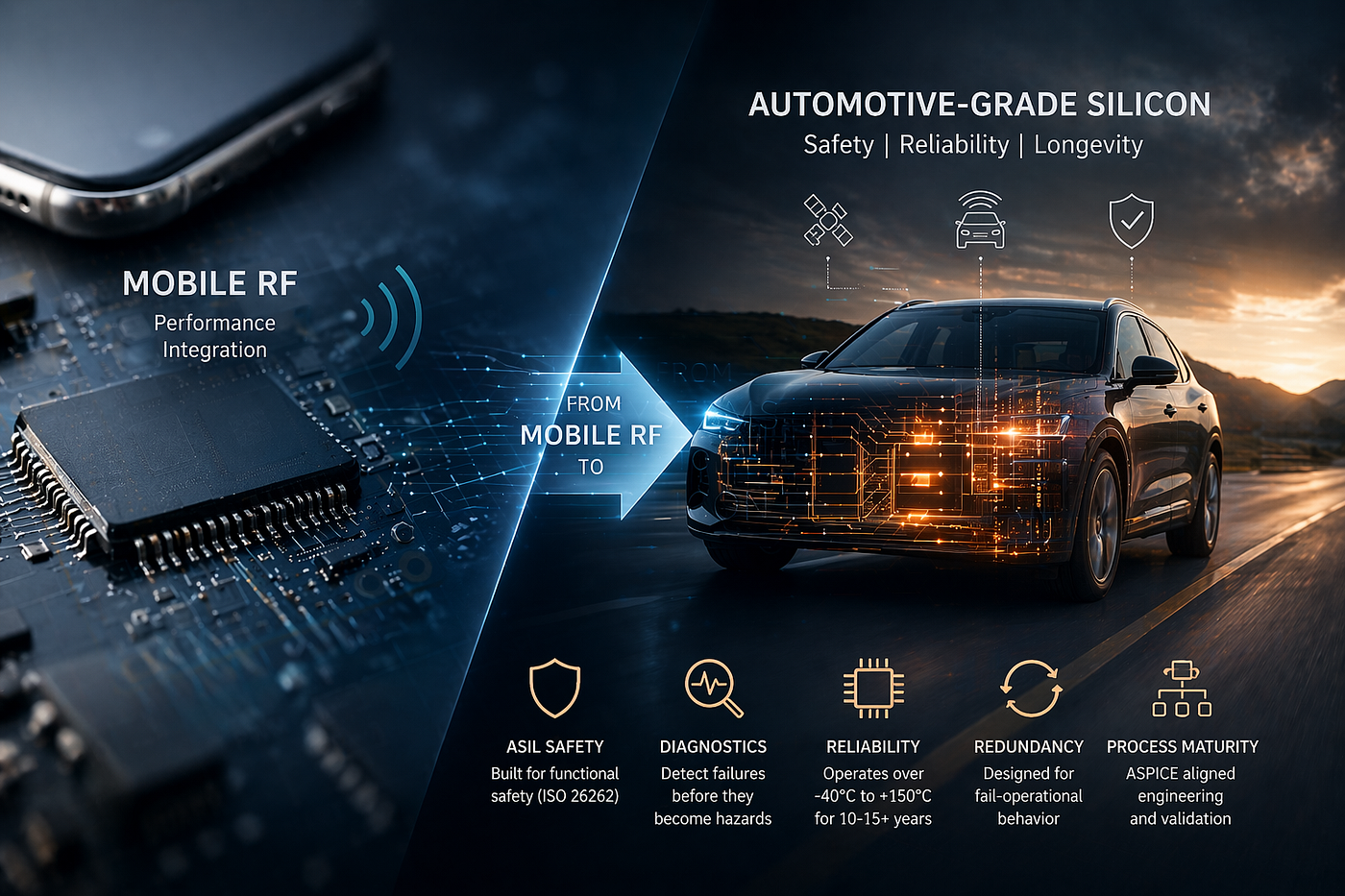
The semiconductor industry is undergoing a quiet but profound shift. Companies that built their success on high-volume mobile RF are now moving into automotive — bringing connectivity, integration, and performance into the vehicle.
At first glance, this looks like a natural evolution.
In reality, it’s a fundamental transformation.
Because in automotive, performance is no longer enough. What matters is proving that performance remains safe, reliable, and diagnosable over 15 years of operation.
The Illusion of “Same Technology, Different Market”
An RF front-end module for a smartphone and one for a vehicle may share similar building blocks:
- Power amplifiers (PA)
- Low-noise amplifiers (LNA)
- RF switches
But the design assumptions behind them are completely different.
In mobile:
- Product lifetime: ~2–3 years
- Operating conditions: controlled, user environment
- Failure impact: degraded user experience
In automotive:
- Product lifetime: 10–15+ years
- Operating conditions:
- -40°C to +150°C
- Vibration, humidity, EMC stress
- Failure impact:
- Loss of communication
- Degraded perception
- Potential safety hazard
The same RF failure that causes a dropped call in a smartphone can contribute to a hazardous situation in a vehicle.
When RF Becomes a Safety Problem
Let’s consider a real engineering scenario:
A vehicle relies on V2X communication to receive hazard warnings (e.g., emergency braking ahead). The RF front-end module includes:
- A PA for transmission
- An LNA for reception
- RF switches for signal routing
Now imagine:
- The LNA gain degrades over time due to aging or thermal stress
- The system continues to operate, but with reduced sensitivity
- A critical message is not received
There is no “crash” in the classical software sense. No obvious failure flag.
But the system has silently moved into a dangerous degraded state.
This is where automotive changes everything:
Failures are not binary. They are often gradual, silent, and system-level.
Enter Functional Safety: From Behavior to Guarantees
Targeting ASIL systems means aligning with functional safety principles defined in ISO 26262.
This introduces a new requirement:
Not just designing for performance — but designing for detectable and controllable failure.
For RF front-end modules, this raises difficult questions:
- How do you detect a degraded RF path?
- How do you distinguish between environmental noise and hardware failure?
- What is the safe state of a connectivity system?
These are not traditionally RF design questions. They are system engineering questions.
What “ASIL-Ready Silicon” Really Means
There is a common misconception that automotive-grade silicon is just about qualification (AEC-Q100, etc.).
In reality, ASIL-ready silicon must embed safety mechanisms.
1. Diagnostics
The system must detect faults such as:
- Gain degradation
- Biasing issues in amplifiers
- Switch malfunction
- Signal integrity anomalies
This implies:
- Built-in monitoring circuits
- Measurable health indicators exposed to software
2. Observability
If software cannot observe a failure, it cannot control it.
This requires:
- Status registers
- Error flags
- Telemetry interfaces
Without observability, even the best safety architecture collapses.
3. Redundancy and Fallback
Depending on the ASIL level, strategies may include:
- Redundant RF paths
- Signal plausibility checks
- Degraded modes of operation
Example: If RF communication confidence drops below a threshold, the system may:
- Reduce reliance on external data
- Switch to local sensor-based decisions
The Role of Process: Why ASPICE Matters
Technology alone is not enough. Automotive demands process maturity.
Automotive SPICE introduces:
- End-to-end traceability
- Structured requirements engineering
- Verification aligned with system risks
For semiconductor companies coming from mobile, this is often the biggest gap.
Typical challenges:
- Linking system-level safety requirements to silicon features
- Ensuring validation covers long-term degradation scenarios
- Synchronizing hardware and embedded software lifecycles
The shift is not just technical — it is cultural.
The Hidden Gap: Hardware vs Software Safety Thinking
One of the most critical challenges lies at the interface between hardware and software teams.
Hardware perspective:
- Focus on performance, efficiency, integration
- Validation centered on electrical behavior
Software/safety perspective:
- Focus on failure modes, diagnostics, safe states
- Need for control and observability
This creates a gap:
Hardware may fail in ways that software cannot detect. Software may expect signals that hardware does not provide.
Bridging this gap requires:
- Early system-level safety analysis
- Co-design between RF, digital, and software teams
- Clear definition of safety mechanisms at the silicon level
Integration: A Double-Edged Sword
Modern RF front-end modules integrate multiple functions into a single chip:
- Reduced BOM
- Smaller PCB footprint
- Faster time-to-market
But integration comes with a trade-off:
You reduce external complexity while increasing internal opacity.
This makes:
- Failure analysis harder
- Diagnostics more critical
- System validation more complex
A New Engineering Mindset
The transition from mobile RF to automotive is not about scaling existing designs.
It requires a shift toward:
- System-level thinking
- Cross-domain collaboration
- Designing for failure, not just performance
The real challenge is this:
Can you prove that your RF system will behave safely — not just when it works, but when it starts to fail?
Final Thought
In automotive, innovation is no longer defined only by integration or performance.
It is defined by trust:
- Trust that the system will operate correctly
- Trust that failures will be detected
- Trust that the system will remain safe over time
And that trust is engineered — across silicon, software, and process.
If you’re working at the intersection of RF, embedded systems, and safety, this is where the most interesting problems are emerging today.
메타데이터
- post_id
- dd7ebb963330
- slug
- from-mobile-rf-to-automotive-grade-silicon-what-really-changes-when-you-target-asil-systems-dd7ebb963330
- url
- https://medium.com/@asnoussi92/from-mobile-rf-to-automotive-grade-silicon-what-really-changes-when-you-target-asil-systems-dd7ebb963330
- canonical_url
- https://medium.com/@asnoussi92/from-mobile-rf-to-automotive-grade-silicon-what-really-changes-when-you-target-asil-systems-dd7ebb963330
- author_url
- https://medium.com/@asnoussi92
- status
- ok
- fetched_at
- 2026-07-11 01:37:02


