How Gravity Keeps the Solar System Dancing Around the Sun
Every moment of every day, our planet is hurtling through space at nearly 107,000 kilometers per hour. Yet we don’t feel it. We don’t…
How Gravity Keeps the Solar System Dancing Around the Sun
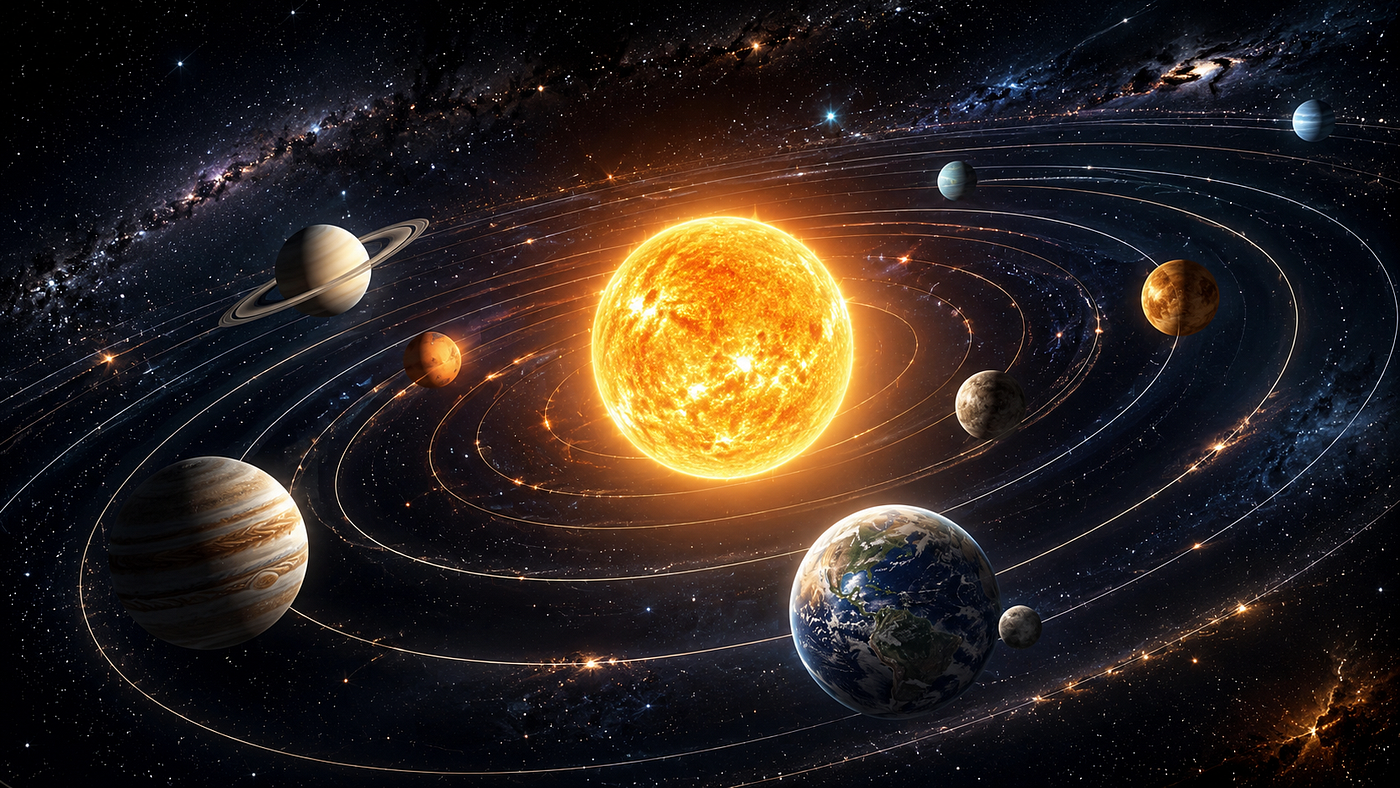
Gravity keeps the Solar System in motion, guiding planets along their endless journeys around the Sun
Every moment of every day, our planet is hurtling through space at nearly 107,000 kilometers per hour. Yet we don’t feel it. We don’t notice the incredible cosmic race taking place beneath our feet.
Why?
Because Earth isn’t flying randomly through the universe. It is following a carefully balanced path around the Sun, guided by one of nature’s most powerful forces: gravity.
But gravity does much more than simply keep us on the ground. It is the invisible architect of the entire Solar System.
The Force You Can’t See
Imagine throwing a ball across a field. It moves forward for a while before falling to the ground. Gravity pulls it downward.
Now imagine throwing that ball much faster. It travels farther before gravity pulls it down.
Throw it fast enough, and something remarkable happens: the ball keeps falling toward Earth but never actually hits the ground. Instead, it continuously curves around the planet.
This is essentially what an orbit is.
The Earth is constantly falling toward the Sun, but it is also moving sideways so quickly that it keeps missing it.
The result is a stable orbit.
Why Doesn’t Earth Fall Into the Sun?
This is one of the most common questions in astronomy.
The answer lies in a balance between motion and gravity.
The Sun contains about 99.8% of all the mass in the Solar System. Its immense gravity pulls on every planet, moon, asteroid, and comet.
At the same time, each planet is already moving through space.
Gravity pulls inward.
Motion carries the planet forward.
Together, they create an orbit.
Think of it like spinning a ball attached to a string. The string continuously pulls the ball inward, while the ball’s motion tries to carry it outward. The result is a circular path.
In the Solar System, gravity acts as the cosmic string.
The Solar System’s Giant Racetrack
Every major object in the Solar System travels around the Sun on its own orbital path.
Mercury races around the Sun in just 88 Earth days.
Venus takes about 225 days.
Earth completes its journey in one year.
Farther out, Neptune needs nearly 165 Earth years to finish a single orbit.
These paths aren’t perfect circles. Most are slightly stretched ovals called ellipses.
As planets travel along these enormous tracks, gravity constantly adjusts their direction, preventing them from drifting into deep space.
Moons Orbit Planets Too
Gravity works on smaller scales as well.
Just as Earth orbits the Sun, the Moon orbits Earth.
Jupiter, the giant of our Solar System, controls dozens of moons with its powerful gravitational field.
In a way, the Solar System resembles a cosmic hierarchy.
- The Sun dominates the planets.
- Planets dominate their moons.
- Moons can even influence smaller objects around them.
Every level is governed by the same universal force.
What Would Happen If Gravity Disappeared?
It’s an unsettling thought.
If the Sun’s gravity suddenly vanished, every planet would stop orbiting instantly.
Earth would no longer travel in a curved path around the Sun. Instead, it would continue moving in a straight line into interstellar space.
The Moon would drift away from Earth.
Asteroids would scatter.
The carefully organized structure of the Solar System would dissolve into chaos.
Gravity is not merely holding things together — it is the reason the Solar System exists at all.
Gravity Shapes Time and Space
Modern physics revealed something even more fascinating.
According to Albert Einstein, gravity is not simply a force pulling objects together. Massive objects like the Sun actually bend the fabric of space and time around them.
Planets follow these curves much like marbles rolling across a warped surface.
This deeper understanding explains planetary motion with incredible precision and helps scientists predict everything from spacecraft trajectories to the movement of distant stars.
The Invisible Choreographer
When we look up at the night sky, the planets appear calm and unchanging.
Yet every world is moving at extraordinary speeds.
Earth circles the Sun.
The Moon circles Earth.
The Sun itself orbits the center of the Milky Way.
Behind this grand cosmic dance stands a single invisible choreographer: gravity.
Without it, there would be no planets, no stable orbits, no seasons, and no life on Earth.
The next time you watch a sunrise, remember that our planet is not standing still. We are passengers on a world racing through space, held securely on its path by an ancient force that has shaped the universe for billions of years.
And that force is still guiding our journey today.
CosmicA2Z — Exploring the Universe from A to Z, one cosmic story at a time.
메타데이터
- post_id
- dd8c6cc66a40
- slug
- how-gravity-keeps-the-solar-system-dancing-around-the-sun-dd8c6cc66a40
- url
- https://medium.com/@cosmica2z/how-gravity-keeps-the-solar-system-dancing-around-the-sun-dd8c6cc66a40
- canonical_url
- https://medium.com/@cosmica2z/how-gravity-keeps-the-solar-system-dancing-around-the-sun-dd8c6cc66a40
- author_url
- https://medium.com/@cosmica2z
- status
- ok
- fetched_at
- 2026-06-09 15:37:30