Jenius Moneytory: From Aspiration to Realization (Partially)
It is every one’s dream for management trainee to fulfill their aspiration from just a product analysis to a real running product.
Jenius Moneytory: From Aspiration to (Partial)Realization
It is every trainee’s dream to fulfill their aspiration from just a product suggestion to a real running product.
Contents:
- My Own Solution V.S. Moneytory
- Moneytory Development
- Moneytory Beta Testing
- Moneytory Released!
note: I’m not the product owner. I joined this project when the progress was around 40%. I will share what I know and what I’ve learned from this enablement project.
Being involved in the development of something that solves your own problem is great, especially when the product can also solve other people’s problem and make their life easier. In this story, I will share how my aspiration when I presented my product analysis on HR Interview is partially fulfilled when Moneytory feature is released on June 15th, 2020 for android OS.
Since my student life in university, I’ve always wondered how does a product is created from just a scratch. What I meant from a scratch is just a product analysis: based on data product development suggestion. Lucky for me, I got many chances to fulfill my thirst: got my bachelor degree for creating a Goal setting Management in Human Capital Management System for a shipping company in Indonesia, created user transaction validation system for affiliate marketing cash back program while my internship in Shopee Indonesia, and Content Management System for a shipping company website on my freelance project. These are products that I created from a solution to a problem statement.
I realised, after working on these projects, that any problem might have many solution, but a solution doesn’t always solve a problem, instead, it might be a solution that seeks another problem. I don’t want that, so, to prevent it to happen, it is important to start from “What information or data that I lack, that prevent me identifying the root of this problem” mindset, not “How do I solve this problem”. Then again, by identifying the root problem doesn’t mean we can create a 100% effective solution to that problem, especially to a social problem. A solution might solve a problem, but it also create another problem that, again, we need to solve. Therefore, identifying root problem should be iterative. If you’re interested about this iterative process, I will write another story for “TOSCA Iterative Method”.
So, The story that I was trying to solve was: “As a traveller, I want to prevent myself from overspending my traveling budget, So that I don’t have to re-adjust my other budgets”. This story originated from my own problem, so in this great chance, I would love to solve my own problem through Jenius App, since I save most of my saving there.
FYI, being a traveller sometimes struggle when it comes to financial management. You have to budget everything before you go to your destination or else you will overspend on something that you don’t really need (remember, need is more important than want!). Budgeting is other thing, the real struggle is when you are spending your money. It is sometimes hard to track where your money goes, especially when you have to track manually from transaction history.
My Own Solution V.S. Moneytory
My proposal to business heads back then was: what if we add holiday mode on jenius cards? The idea behind this was simple and practical. Whenever I travel with my friends, I usually use my x-card (the colorful ones) for my main transaction card. The first step is to top up my x-card with maximum amount of money that I’m willing to spend while traveling and …That’s it. Your transactions from that x-card will be recorded and separated from your main card’s transactions. But still, you will need to categorize your each transaction manually and sum it all up on your spreadsheet.
That’s why in Holiday Mode you can modify the period of your travel, let’s say, a 14 days of holiday from May 15th to May 29th. In my proposal, we can plan our budgeting inside Jenius then holiday mode will track and categorize your transactions automatically. By the end of your holiday, Jenius will send you the summary of your holiday in a form of beautiful graph, percentage, and difference between your planned budget and reality. Learning from these summaries, Jenius can suggest you an optimal budget for your future traveling budget reference. Not a bad idea right? Of course! this idea allowed me to join this company (teehee).
But I have to be honest with you. Back then, I didn’t think sharp enough that if we read again closely to the story, this problem is actually a small part of the bigger problem that most of us face: tracking expense. It happens not only when you are traveling, it happens in almost all of our activities. Some activities requires money to make it happen, and most of it are untraceable. That’s the job of moneytory. I can say that I lost the competition the moment I failed to identify the bigger problem (sigh), anyway, you can read more about the story behind moneytory directly from its product owner.
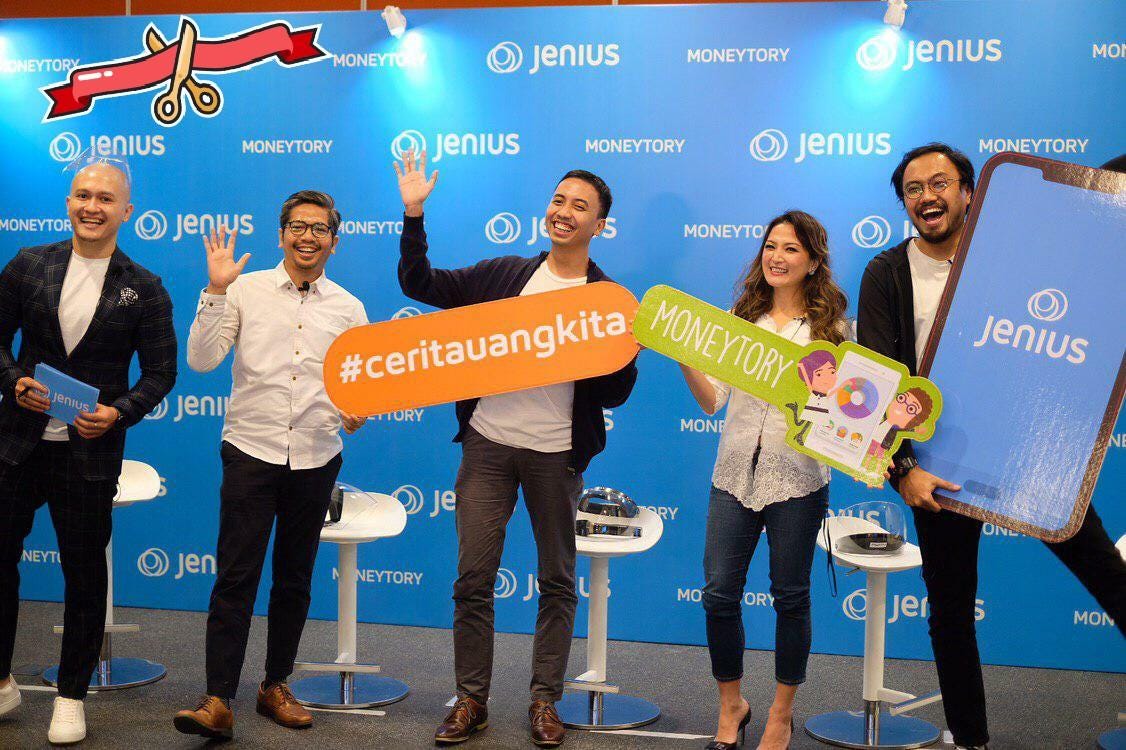
source: Pram’s LinkedIn
Let’s take the positive side, that moneytory is the first step of making my real aspiration comes to life. Moneytory already provided us with transaction records in a form of beautiful graph, percentage, and difference between income and expense. It also powered with a machine learning that will predict your uncategorized transactions so you don’t have to categorize any transaction from obvious merchants. The limitation right now is that it can only track transaction from your main card only, not on specific x card and you can’t set budget or limit for each of transaction category. I do hope that the next development can eliminate these limitation so that my “holiday mode” can be realised!
Moneytory Development
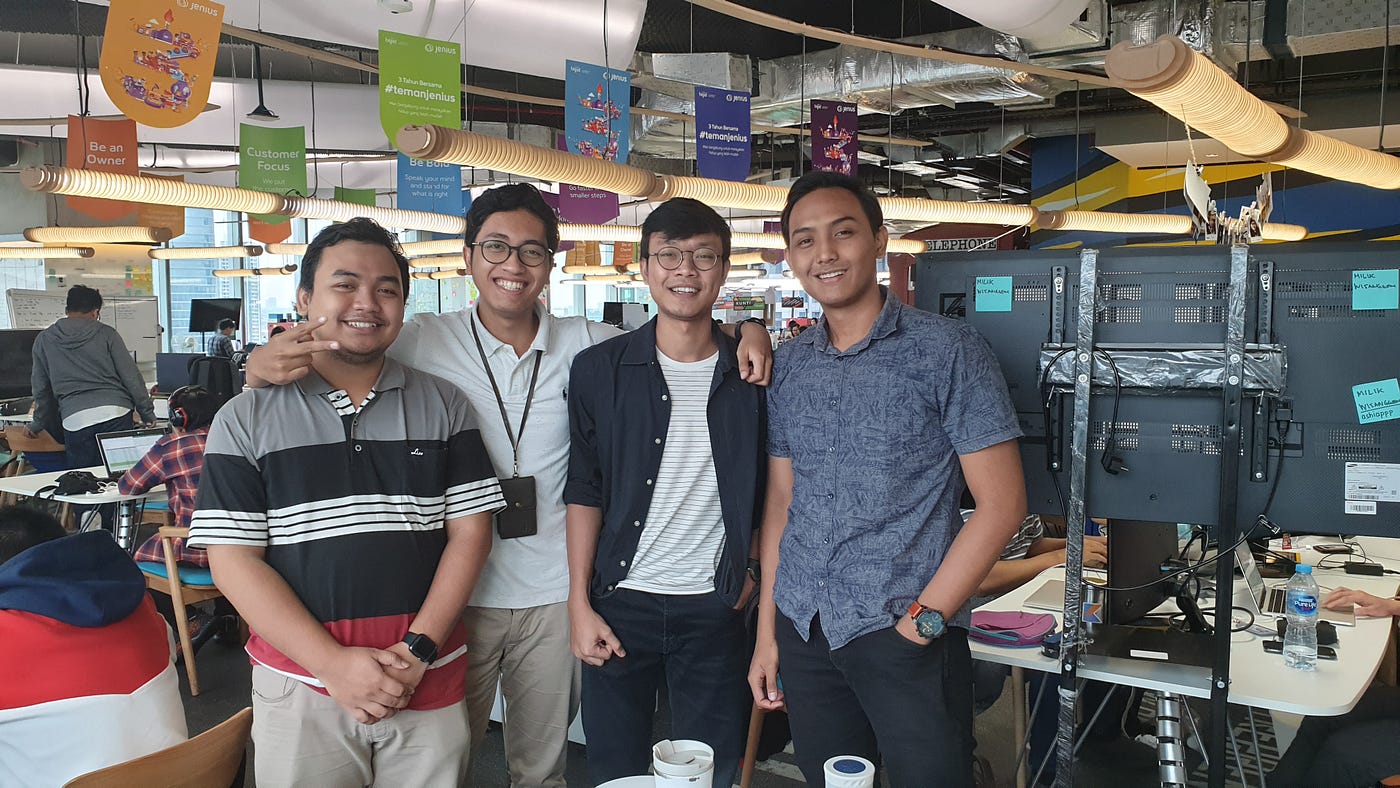
Me and 3 other friends
Three months after a tough trainings and bootcamps, I was (finally) assigned to Digital Banking Division of Bank BTPN, Jenius, with my 3 other friends. Of course, there were a “introduction” or “ospek” so we can quickly learn about Jenius coding conventions and environments. After a month of intro, we trainees have a privilege to choose one from three project options for us to join. One of them was Moneytory. Me, when realizing that my aspiration can be fulfilled on Moneytory Project, without any doubt, asked my scrum master to place me on the squad that working on Moneytory Project. Best decision of my life.
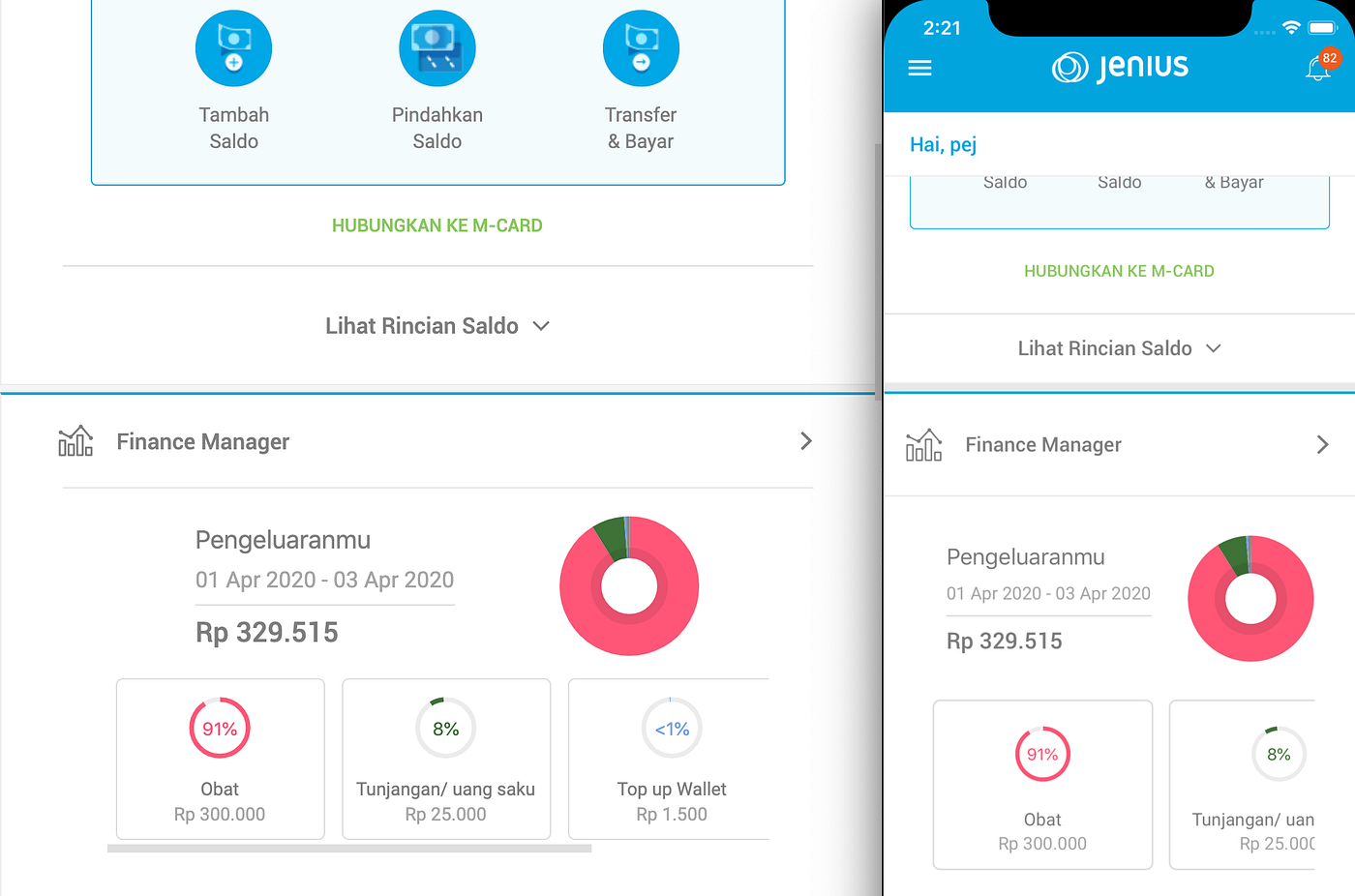
Finance Manager A.K.A. Moneytory Widget
My first task as a full stack developer was to develop the Moneytory widget’s chart (that pink circle). I got two full sprint to get used to Jenius source code and finish the chart. Well, because I was curious enough, I ends up finished the whole development of widget feature, not just the chart (sorry, team). The most challenging part of this development were the state management and redirection handling. As you may have tried (if you haven’t, you can download it!), you can go to expense detail, category detail, uncategorized detail, and other categories detail through this widget. Each of this redirect have their own handler and state management so I kind of overwhelmed at first. Thank God, I could finish it on time!
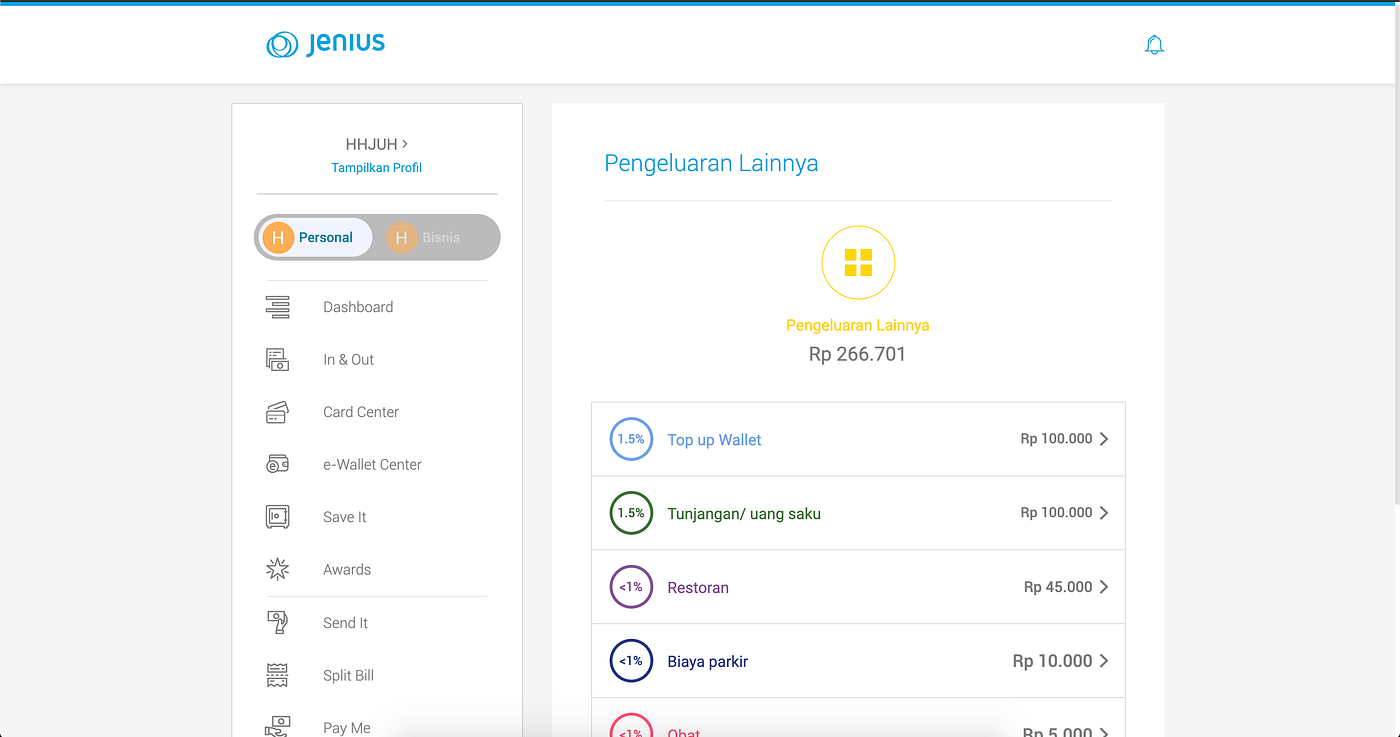
Moneytory Other Categories Detail
The next one is Other Categories Detail Screen. To be honest, I was kind of disappointed when my tech lead gave me this story because I thought it was a simple development (3 story points), which later I realized it wasn’t simple at all (ends up at 8). The tricky part is at the inner circle of each categories. Yes, the percentage. When it comes to testing a percentage, you have to get the sum exactly at 100% or you fail the test. We failed several times on this QA test and the solution was to make it “less detailed” by using <1% for less than one percent categories. Thank God it solves the problem.
Next tricky part of the development was the font size of currency on each categories. It was cool and all until our QA test it with number more than 999 billion rupiah. Boom! it crashes our app (seriously, rich people problem huh?). As the solution, we made it to be able to adjust the font size of currency based on its digits. It can adjust nicely up to 999 billion rupiah (> 999 billion will be masked by dots) and the development of this screen is done.
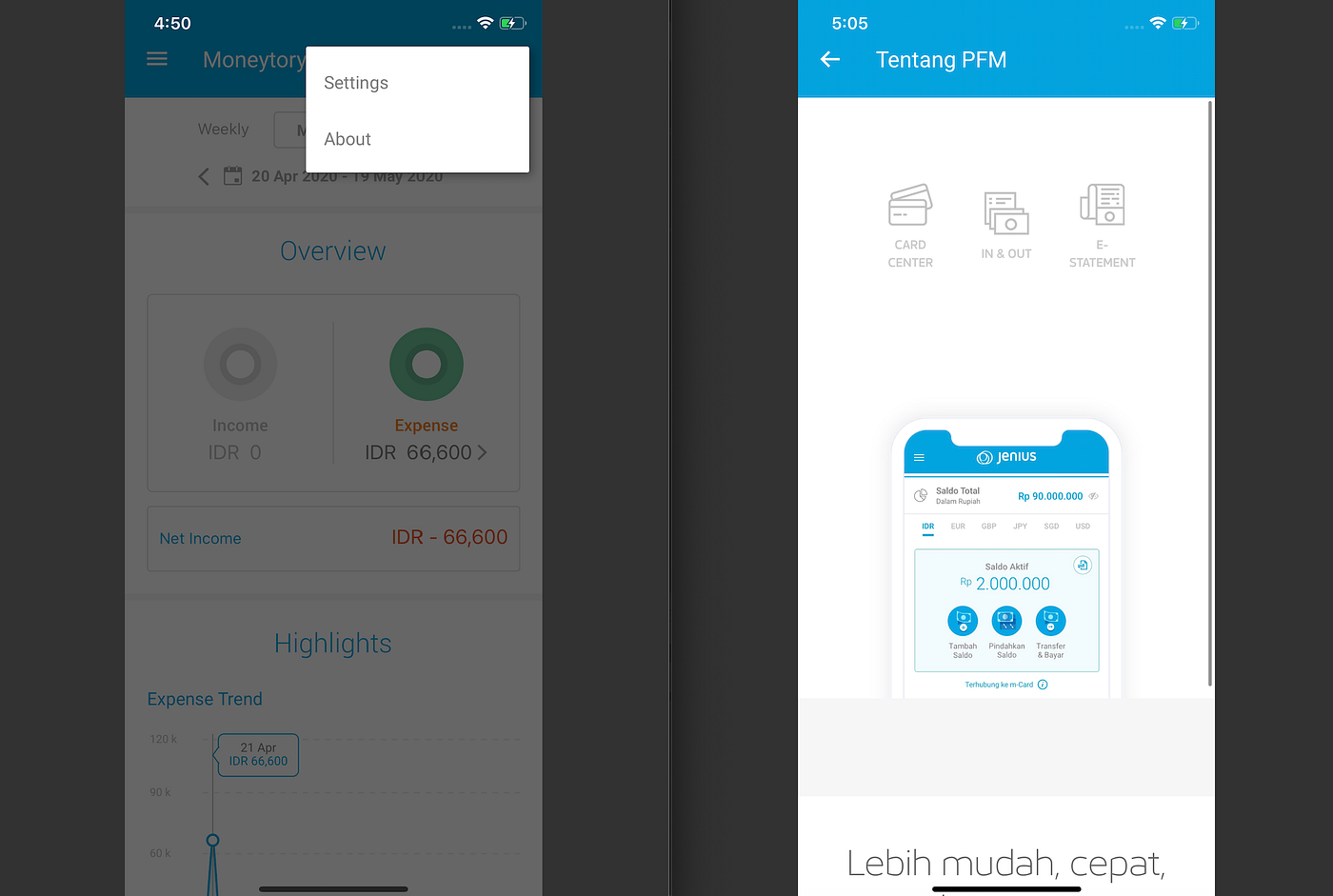
About Moneytory Option
My last involvement in the development on this project was the About Moneytory option. It was a simple task which can be solved by creating a custom handler for external link. The tricky part is that you have to create two different handler for both web and mobile version. I failed on this first because the option wasn’t clickable on web version. Well, learning from failure is the best way to grow, isn’t it?
That’s it. Later then, I was moved to another project in Jenius to handle their Dream Saver and Flexi Saver which you can create up to 3 right now. Then it marks the end of my involvement in moneytory development.
Moneytory Beta Testing
Becoming a beta tester is actually one of my wish since a long time a go. Before becoming a programmer, I’m a gamer. So the sound of beta tester sounds really really cool to me. It was my first beta testing experience as a developer so what I felt from the bottom of my heart was “please, don’t break…” x99. I felt some tension, stressed me out, but I was glad to receive many feedbacks from around 100–200 beta testers. Well, these feedbacks makes me realize that not all of our expectation can be realized in a one go.
Moneytory Released!
Let me be honest with you. This feature has been postponed for years and few weeks before its launch, we faced one or two obstacles that delay this feature to be released. My impatient self couldn’t wait the moment I can show my family, friends, and girl friend the features that I developed. After a long wait, finally, the Moneytory feature was released on June 15th, 2020 (Yeehaa!). It was a great journey, the first journey in Jenius, that I had experienced. I guess I’m a lucky trainee and I’m honored to join this amazing feature development. Still, I’m waiting for the moment my “Holiday Mode” can be realized though (Kode Keras).
Anyway, Thank you for reading my little adventure story. Do you happen to be another lucky trainee that have an opportunity to realize your aspiration for the company you’re working for? Comment and let’s discuss further about what we both have learned in the comment section!
메타데이터
- post_id
- dd94e5c8fecb
- slug
- jenius-moneytory-from-aspiration-to-realization-partially-dd94e5c8fecb
- url
- https://medium.com/@mundus/jenius-moneytory-from-aspiration-to-realization-partially-dd94e5c8fecb
- canonical_url
- https://medium.com/@mundus/jenius-moneytory-from-aspiration-to-realization-partially-dd94e5c8fecb
- author_url
- https://medium.com/@mundus
- status
- ok
- fetched_at
- 2026-06-16 19:09:56