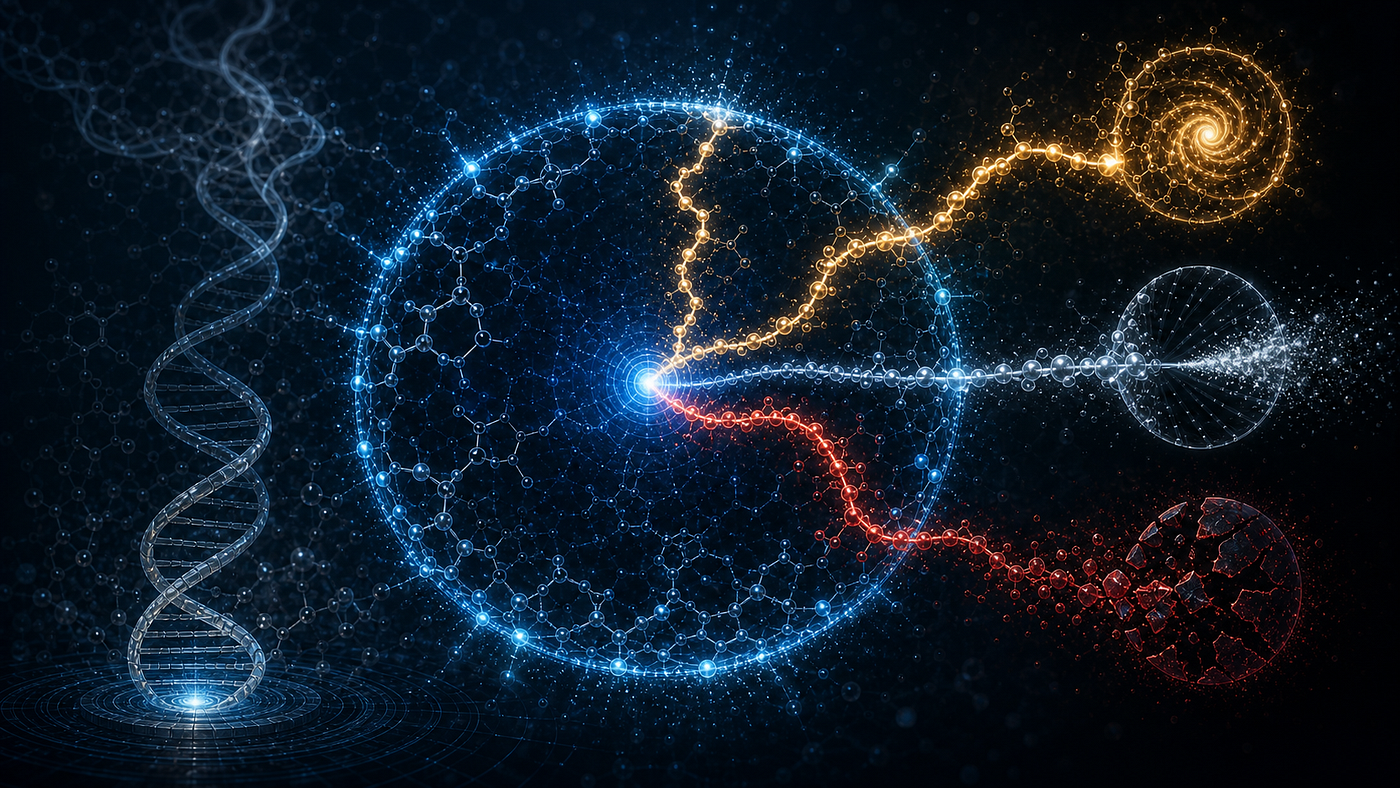
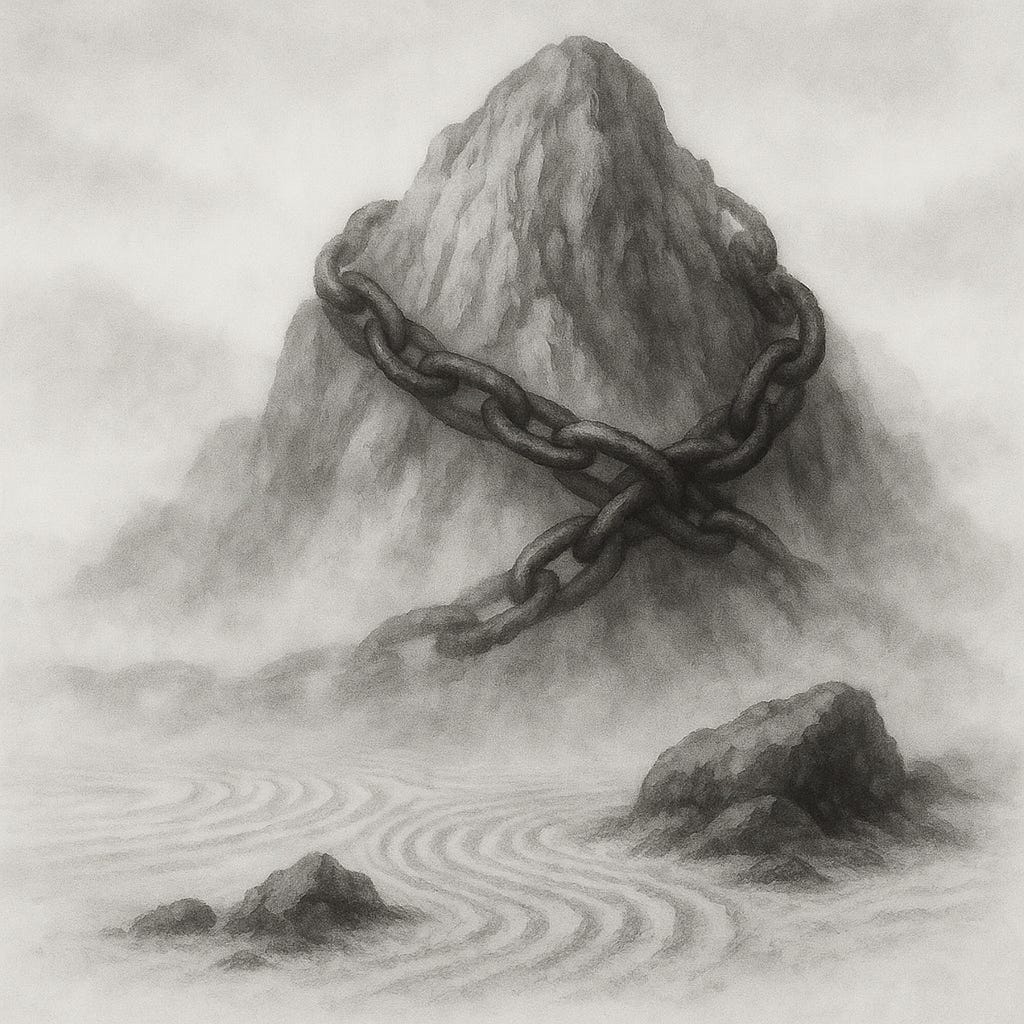
The Map Is Not the Landscape
On the Epistemic Character of All Knowledge
The Map Is Not the Landscape

On the Epistemic Character of All Knowledge
A map is useful. It shows roads, contour lines, borders, rivers. Whoever reads it gains orientation. But no one would confuse the map with the terrain it depicts. A map is a projection: it translates spatial relations into another medium, with loss of dimensions, with selection of certain features, with determination of a scale. What appears on the map is not the landscape but a drawing about the landscape. The map has epistemic value, it conveys knowledge, but it has no ontological status: it is not a piece of the world it represents.
This relation between representation and what is represented is not limited to geographical maps. It concerns every form of knowledge. Every measurement, every description, every model stands in the same relation to the thing it depicts as the map to the landscape. This sounds trivial as long as we stay with maps. It becomes anything but trivial as soon as one takes the consequence for science, and in particular for consciousness research, seriously.
The Map as an Epistemic Tool
What does a map accomplish? It reduces complexity. It makes something unmanageable tractable by selecting, simplifying, encoding. A topographic map shows contour lines but not the smell of the forest. A political map shows borders but not the composition of the soil. Every map is an instrument for a particular purpose, and that purpose determines what appears and what does not.
The crucial point is this: the selection lies not in the landscape but with the cartographer. The landscape itself contains no contour lines, no colour codes, no legends. All of these are means of representation, not properties of what is represented. The map is an epistemic tool. Its entire content is knowledge about something, not that something itself.
Confusing the Map with the Landscape
As long as we are dealing with geographical maps, the distinction between representation and what is represented is intuitively clear. Nobody bites into a menu and expects to taste something. But this clarity is lost the moment the “maps” become more complex and the “landscapes” they depict are no longer directly accessible.
An example: an MRI image of the brain. It shows structures, contrasts, density values. It looks like a view into the interior of the head. But it is not a view into the interior of the head. It is a map. Magnetic resonance imaging measures the response of hydrogen atoms to magnetic fields and computes an image from that data. What we see is not the brain but a representation of certain physical properties of the brain, processed through algorithms, contrast values, and colour scales chosen by the radiologist. The MRI image has epistemic value, it reveals something about the brain, but it is not the brain. It is a map.
The same holds for an EEG: it shows voltage traces at the scalp surface, not neural activity. The same holds for a blood panel: it shows laboratory values, not health. The same holds for a psychological test: it shows response patterns, not personality. In each of these cases there is a projection, a translation of something complex into a manageable format. And in each case the same holds: the map is not the landscape.
The Body as Landscape, Medicine as Cartography
This insight has far-reaching consequences for understanding what science does. Take the human body. Medicine continually produces maps of this body: anatomical atlases, laboratory profiles, imaging procedures, genetic sequencing. Each of these maps shows something, and each is useful. But none of them is the body.
This is not merely a linguistic subtlety. It has practical significance. When a doctor says “the values are normal,” he is saying something about the map, not about the landscape. The map can be in order while the landscape is not, and vice versa. Laboratory values can be unremarkable even though the patient is ill. An MRI can show abnormalities that are clinically meaningless. The map and the landscape do not necessarily agree, precisely because the map makes a selection that always falls short of the complexity of what it represents.
Consciousness: First Person, Third Person
Now for the decisive transfer. With consciousness, the distinction between map and landscape becomes not merely important but fundamental, for here the two sides of the distinction come apart in their purest form.
From the first-person perspective, there is only landscape. Whoever experiences does not have a model of their experience before them but the experience itself: the redness of red, the weight of grief, the feeling of being here and now. Experience is not an image of something, it is not a sign pointing to something else, it is not a representation. It is what it is. From the first person there are no maps, only landscape.
The third-person perspective deals with neurons, with behaviour, with physiological processes, with reaction times, with verbal reports. From all of this it produces maps: the MRI image as a map of tissue density, the EEG as a map of voltage traces, the psychological test as a map of response behaviour. This is legitimate and useful. It is what science does. But it remains cartography.
Two Confusions
Here two confusions must be distinguished that are related but not identical.
The first confusion concerns the relation between map and landscape, that is, between the third and the first person. The third person produces maps; the first person is landscape. As soon as one takes a third-person map for the landscape of experience, one has equated an epistemic representation with an ontological reality. This is the vertical category error: one confuses the order of representation with the order of what is represented.
The second confusion concerns the relation between different maps. The third person does not produce one map but many: physiological maps, psychological maps, functional maps, behavioural maps. All of these are different representations of the same organism, produced with different methods, in different languages, for different purposes. As long as one treats them as what they are, namely as different maps, there is nothing problematic about this. But as soon as one takes these maps for landscapes, different modes of representation become different realities. The physiological map becomes the “body,” the psychological map becomes the “mind,” and one wonders how these two realities are connected. This is the horizontal category error: one confuses different maps with different landscapes.
Dualism, the Mind-Body Problem, and the Hard Problem
What these two confusions produce can be named precisely: the great puzzles of the philosophy of mind.
Dualism arises from the interplay of both errors. The vertical error produces the impression that third-person description and first-person experience are two different realities. The horizontal error doubles this impression by turning different types of maps within the third-person perspective into different domains of being. The result is the conviction that there must be a physical and a mental domain that somehow need to be connected. But there are no two domains. There is an organism, and there are different maps that we produce of it.
The mind-body problem arises specifically from the horizontal error. “Body” is a physiological map of the organism. “Mind” is a psychological map of the organism. As long as one treats both as maps, no question about their connection arises, for different maps of the same territory stand in no mysterious relation to one another. Only when one takes both for landscapes, that is, for independent realities, does the problem arise: How are body and mind connected? The answer is that the question does not see through its own presupposition. There are not body and mind as two entities that need to be brought together. There is the organism, and there are different ways of mapping it.
The Hard Problem, Chalmers’ question of why there is “something it is like” to be conscious at all, arises from the vertical error. It takes the third-person description, “physical processes,” as a complete representation of reality and then asks where experience additionally comes from. But “physical processes” is a map. It is not the complete reality but a particular projection of reality, namely the one that can be formulated in the language of physics. That this projection does not contain experience is not a puzzle but a matter of course: no map contains the landscape. The question of why the physical map does not show experience is as justified and as pointless as the question of why the topographic map does not smell of forest. The answer is: because it is a map.
The Hard Problem, then, is not solved by a better theory but by the insight that it rests on a false presupposition. It presupposes that third-person description should capture everything that is there, and then asks why it does not. As soon as one recognises that every third-person description is a map and that maps are fundamentally not the landscape, the puzzle dissolves.
Formulating Maps as Landscapes
Beyond these two confusions, there is a further error that cuts even deeper. Here one does not merely take the map for a landscape but formulates the map from the outset as though it were a landscape. The theories do not say: consciousness can be described, from the third person, as integrated information. They say: consciousness is integrated information. The Integrated Information Theory declares Phi not a measure of a representation but a measure of consciousness itself. The same occurs with the Free Energy Principle, which reduces consciousness to the minimisation of free energy, with Predictive Processing, which identifies consciousness with predictive modelling, and with all related approaches. Consciousness is structural coupling, consciousness is resonance, consciousness is global workspace. Everywhere, a map is not merely taken for a landscape but is formulated from the start in the language of landscape, as though it were a statement about essence rather than a description.
Epistemic Access and Ontological Claim
All three errors can be traced to a common root: the confusion of epistemic access with ontological claim. Epistemic access means: we can find out something about a matter, we can measure it, describe it, model it. Ontological claim means: we assert that we have thereby grasped the matter itself, its mode of being, its nature.
Maps provide epistemic access. That is their purpose. But they do not ground an ontological claim. The topographic map provides knowledge about the terrain, but it says nothing about what the terrain is in its being. The map operates in a different order than the landscape. It belongs to the order of representation, not to the order of what is represented.
In consciousness research, this distinction is systematically overridden in three ways. One takes maps for landscapes and thereby produces the Hard Problem. One takes different maps for different landscapes and thereby produces the mind-body problem. And one formulates one’s maps as landscapes and thereby produces theories that no longer recognise their own cartographic nature. In all three cases, the sentence that results is the same impossible sentence: the map is the landscape.
The Map as What We Have
One might ask: if all knowledge is merely a map, then what is the point of knowledge at all? The answer is simple: maps are extraordinarily useful. We navigate with them. We plan with them. We make decisions on their basis. Medicine heals with the help of its maps, physics builds bridges with the help of its maps, psychology helps people with the help of its maps. The epistemic value of maps is beyond dispute.
But this value must not be confused with something it is not. Maps tell us how we can orient ourselves in the world. They do not tell us what the world is. The usefulness of a map consists precisely in the fact that it does not try to be the landscape but abstracts from it in a controlled way. Knowledge is not deficient because it is “merely” epistemic. It is exactly what it is meant to be: a tool of orientation. It becomes problematic only when one forgets that one is holding a map in one’s hands and begins to take it for the landscape.
Conclusion
The insight that the map is not the landscape sounds modest at first. But carried through consistently, it changes the understanding of what science can achieve and what it cannot. It does not prohibit cartography; on the contrary, it encourages it. But it demands that one knows what one is doing: one is producing maps. One describes, measures, models. One gains epistemic access. But one does not thereby reach the thing itself. The landscape lies beyond every map, not because it is unreachable but because it belongs to a different order. Whoever forgets this confuses their tool with their subject matter. And that is no small error.
메타데이터
- post_id
- dda06cff6ba7
- slug
- the-map-is-not-the-landscape-dda06cff6ba7
- url
- https://medium.com/neo-cybernetics/the-map-is-not-the-landscape-dda06cff6ba7
- canonical_url
- https://medium.com/neo-cybernetics/the-map-is-not-the-landscape-dda06cff6ba7
- author_url
- https://medium.com/@drwolfgangstegemann
- status
- ok
- fetched_at
- 2026-06-13 00:08:42