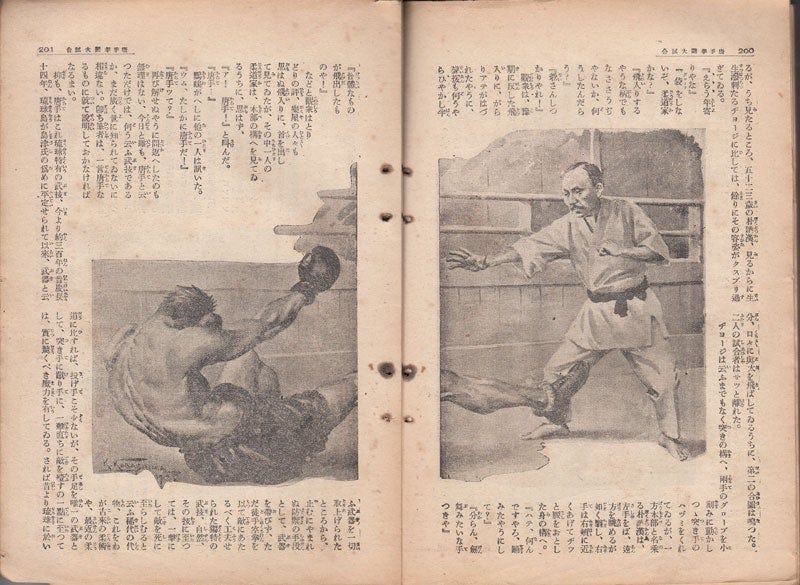
Meoto-de or Husband and Wife Hand
Nakata Mizuhiko wrote about a question he asked Motobu Chōki about meoto-de, which is interesting and a bit long, but I quote it below.
Meoto-de or Husband and Wife Hand
Nakata Mizuhiko wrote about a question he asked Motobu Chōki about meoto-de, which is interesting and a bit long, but I quote it below.
Nakata: Sensei, in karate, when you strike an opponent, do you pull your fist to your side first?
Motobu: Think about it. If you take the time and effort to do that, the opponent will attack you in the meantime. All attacks should be done immediately from wherever the hand is positioned.
Nakata: Sensei, in karate, when you defend with one hand, you pull the other hand to your side. In that case, your front is half unprotected. I know from what you just said that it is not right to put your fist at your side, but what does that mean in this case?
Motobu: Everything you’re talking about is how it works in kata, not how it actually is. In karate, it’s called meoto-de, and in both attacking and defending, the hands are supposed to move together like a married couple, close together. See, like this …
As Sensei said this, while sitting down, he repeated in front of his face many times, from left to right and from right to left, a defensive action somewhat similar to the shūtō uke (knife hand block) in general karate, in which the front hand and the reserve hand move close together.
He continued, “There are many meanings hidden in kata. If you don’t understand the meanings and think that what you see on the surface of a kata is karate as it is, you are mistaken and will end up with a strange understanding like you said.
From “The Clarification of Motobu Kenpō’s Naifanchin Kata,” by Nakata Mizuhiko.
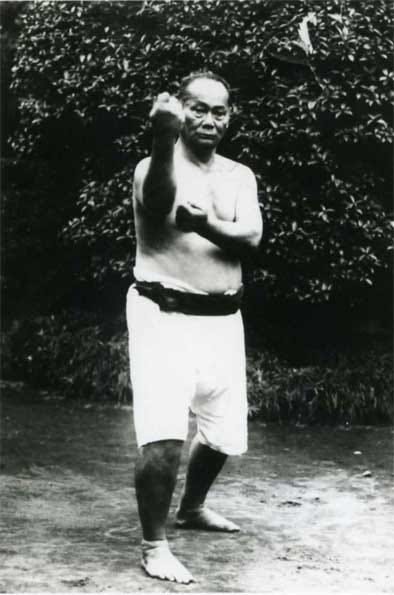
As Motobu Chōki explains above, meoto-de (Oki: mītu-dī, literally husband and wife hands) is a posture of koryū (old style) karate. It does not simply mean a posture, but also includes the theory of movement in which both hands move together. Therefore, it may be more accurate to call it a koryū karate posture and its theory.
The movements of a karate kata are not a direct representation of the movements of an actual fight; in fact, the kata may camouflage and conceal those movements. Hence, kata cannot be fully understood without analyzing them from the principle of meoto-de.
For example, the picture below is an example of a Naihanchi application, but in the kata behavior it is a “morote zuki” (two-handed thrust) to the side of the body. In reality, however, there is a hidden joint locking technique. By understanding the theory of meoto-de, the actual techniques hidden in the kata become apparent.

Meoto-de is now only found in Motobu-ryū and other schools founded by Motobu Chōki’s students.
Interestingly, Motobu Chōki’s brother Motobu Chōyū’s Motobu Udundī also uses meoto-de.
[embed]
Motobu Udundī does not use common blocking techniques, so meoto-de is used as a posture for attacks.
Why was meoto-de generally lost? Perhaps it has something to do with the disappearance of an ancient form of kumite called kakidī. In kakidī, the players freely perform kumite while maintaining meoto-de postures with each other.

kakidī
Also, the kumite match in the form of kakidī was called kakedameshi (Oki: kakidamishi). The true meaning of these techniques and match format was rapidly lost after karate was adopted by the middle school and Okinawa Normal School. This may have led to the loss of the meoto-de technique as well.
The original English translation was posted on the Ameba blog on September 7, 2022.
Thank you for reading my story. If you liked it, please applaud and follow me.
메타데이터
- post_id
- ddb3002fe4c6
- slug
- meoto-de-or-husband-and-wife-hand-ddb3002fe4c6
- url
- https://medium.com/@motobu715/meoto-de-or-husband-and-wife-hand-ddb3002fe4c6
- canonical_url
- https://medium.com/@motobu715/meoto-de-or-husband-and-wife-hand-ddb3002fe4c6
- author_url
- https://medium.com/@motobu715
- status
- ok
- fetched_at
- 2026-07-14 08:33:51