Real‑Time Fermionic Parity Readout in Majorana Qubits: A Leap Toward Fault‑Tolerant Quantum…
Recently, I came across a remarkable scientific breakthrough that caught my attention — one that feels like a foundational shift in how we…
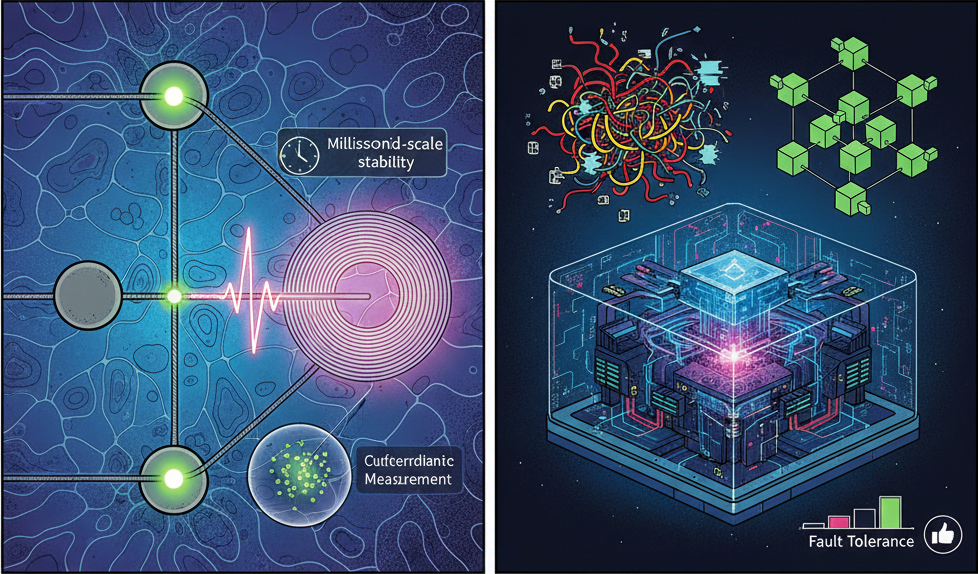
Image Copyright © 2026 Angelo Sorte. All rights reserved.
Real‑Time Fermionic Parity Readout in Majorana Qubits: A Leap Toward Fault‑Tolerant Quantum Computers
Recently, I came across a remarkable scientific breakthrough that caught my attention — one that feels like a foundational shift in how we might build truly resilient quantum computers.
Researchers at QuTech have just demonstrated real‑time fermionic parity readout in Majorana qubits, a milestone many in the quantum physics community had hoped for but few expected so soon. This work, published in Nature on February 12, 2026, brings us closer to fault‑tolerant quantum computing — the kind of robust, scalable machines that could one day solve problems impossible for classical computers.
But beyond the physics, what I find compelling is what this represents for the future of technology and human progress.
What Exactly Did They Achieve?
Here’s a breakdown of the key points from the paper:
✅ Single‑shot parity readout — They were able to measure the parity state of a Majorana qubit in a single measurement.
✅ Millisecond‑scale parity lifetimes — The state remained stable long enough to be meaningfully tracked.
✅ Quantum capacitance measurement approach — Instead of measuring charge directly, they used an RF resonator to detect subtle changes in quantum capacitance — a clever workaround for the neutrality of Majorana states.
Why Majorana Qubits Matter
To understand this breakthrough, it helps to grasp what makes Majorana qubits special.
Conventional qubits — whether based on superconducting circuits, trapped ions, or spins — are extremely sensitive to their environment. Tiny disturbances cause decoherence, which rapidly destroys the information stored in the qubits.
Majorana qubits, on the other hand, store information non‑locally. This means the quantum information isn’t tied to a specific physical location but rather to the collective state of the system. Majorana modes come in pairs, and it is the parity of these pairs that encodes the qubit.
Because this encoding is distributed, it is inherently more resilient to certain types of noise, which is exactly what quantum engineers need if we want fault‑tolerant quantum computers that can run long, complex calculations.
How They Did It
The QuTech team fabricated what’s effectively a minimal Kitaev chain — two quantum dots coupled through a superconducting segment.
Then, using an RF resonator, they measured changes in quantum capacitance associated with changes in the parity state.
Since Majorana states are charge‑neutral, traditional charge measurements don’t work — but capacitance changes leave a measurable signature. This is how the team achieved real‑time readout.
As researcher Nick van Loo emphasized, the breakthrough wasn’t just in building the device — it was in tuning it into the Majorana regime and isolating it from environmental noise enough to faithfully observe these states.
This experimental “measurement primitive” — the ability to read qubit states reliably — has been one of the missing pieces in building large‑scale quantum systems.
Why This Is a Big Deal
It may sound technical, but its implications are huge:
- Fault‑tolerance is key — Without it, quantum computers can never reliably solve real‑world problems at scale.
- Error correction overhead — Traditional quantum error correction requires enormous numbers of physical qubits per logical qubit. Majorana qubits promise to reduce that overhead.
- New architectures — Designing quantum computers around topologically protected qubits opens new paths that were once considered fringe or speculative.
This work doesn’t mean we have quantum computers in every home tomorrow — but it does mean that a long‑standing obstacle on the path to scalable quantum computing is being addressed in a tangible, experimentally verified way.
Reflections on the Future of Deep Technology
To me, breakthroughs like this are more than advances in physics — they are markers of human progress.
Today’s technology is built on layers of scientific insight — from classical electromagnetism to solid‑state physics, from lasers to semiconductors. Quantum computing, once a niche academic field, is becoming applied science and engineering.
And AI is playing a role here too:
- AI accelerates design and simulation of quantum devices
- Machine learning enhances noise mitigation techniques
- Optimization algorithms help control complex quantum systems
The convergence of AI and quantum research suggests not a distant future, but a present accelerating faster than we often realize.
A Personal Thought
Reading about this made me reflect on how rapidly foundational science is moving. The idea of stable, fault‑tolerant qubits once seemed like a decades‑away dream. Now, we’re seeing real progress toward that goal. It’s a reminder that deep exploration — into both the universe and the subatomic world — often moves in unexpected, exponential leaps.
And while the technology itself can seem abstract or esoteric, the impact of truly scalable quantum computing could touch everything from medicine to materials science, cryptography, climate modeling, and beyond.
This is not just an achievement in physics — it’s a milestone in human ingenuity.
For readers interested in exploring more about the intersection of technology, ethics, and the future of AI, my book “AI, Freedom & Control: The Ethics of Artificial Intelligence in the New Digital Order” has just been published. You can find it here: https://a.co/d/08kaHQgS
QuantumComputing #Majorana #TopologicalQubits #QuantumResearch #DeepTech #Physics #Innovation #Qubits #SuperconductingCircuits #NatureJournal #QuantumTechnology #FutureTech #AngeloSorte #AIandScience
메타데이터
- post_id
- ddbb6403a660
- slug
- real-time-fermionic-parity-readout-in-majorana-qubits-a-leap-toward-fault-tolerant-quantum-ddbb6403a660
- url
- https://medium.com/@angelosorte1/real-time-fermionic-parity-readout-in-majorana-qubits-a-leap-toward-fault-tolerant-quantum-ddbb6403a660
- canonical_url
- https://medium.com/@angelosorte1/real-time-fermionic-parity-readout-in-majorana-qubits-a-leap-toward-fault-tolerant-quantum-ddbb6403a660
- author_url
- https://medium.com/@angelosorte1
- status
- ok
- fetched_at
- 2026-08-21 12:49:17