How Magica Is Turning AI Tools Into Autonomous Creative Pipelines
How Galaxy AI evolved into Magica, and why the shift toward AI agents may matter more than the models themselves
How Magica Is Turning AI Tools Into Autonomous Creative Pipelines
How Galaxy AI evolved into Magica, and why the shift toward AI agents may matter more than the models themselves
There is a moment most creators know well.
You have an image generator open in one tab, a video editor in another, a transcription tool running somewhere else, and a half-finished document buried underneath all of it. At some point, the work stops feeling creative and starts feeling logistical.
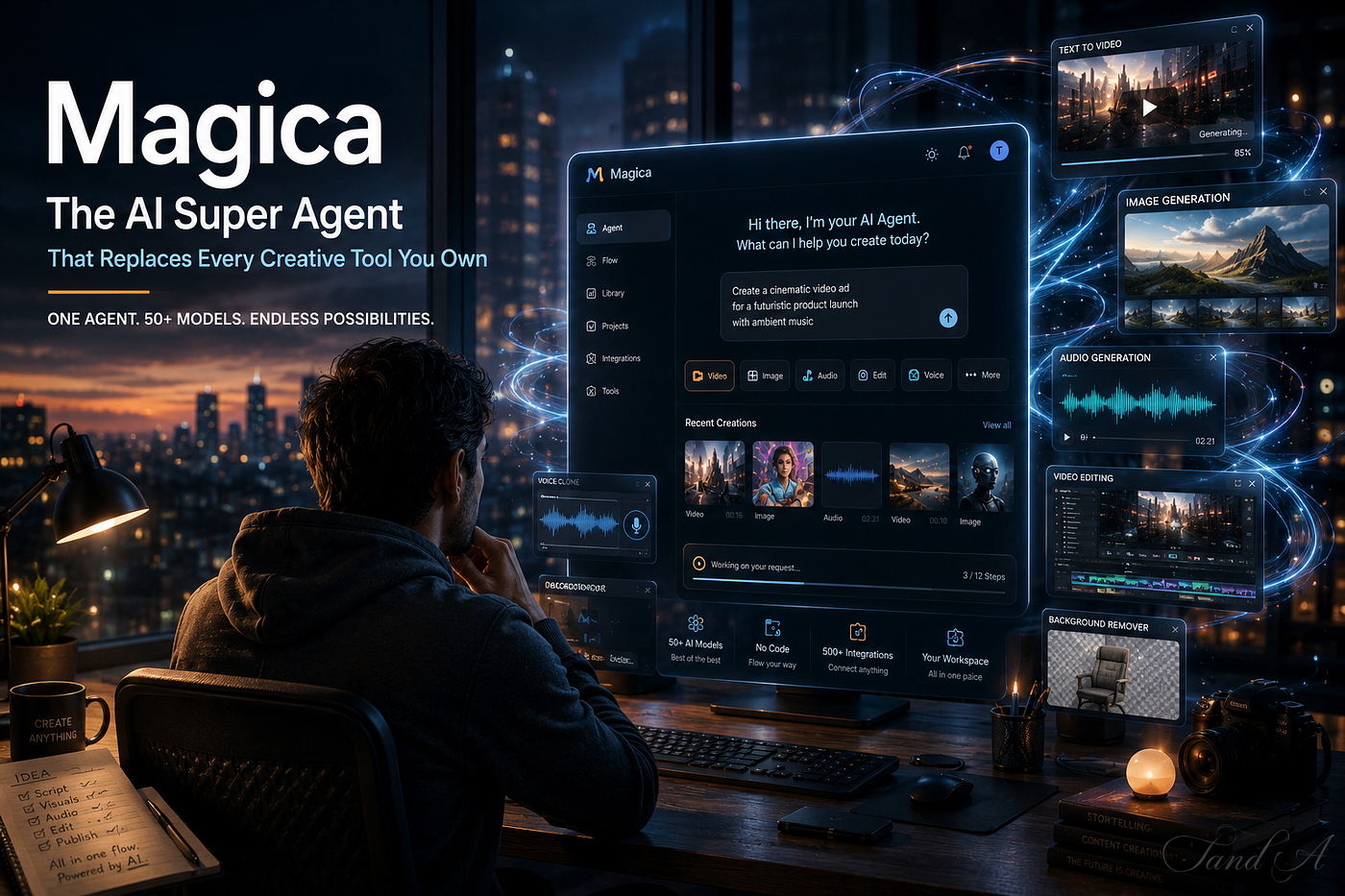
Magica The AI Super Agent
That is the problem Magica is trying to solve.
Originally launched as Galaxy AI, the platform began as a growing collection of AI utilities. Today, after rebranding to Magica, it is positioning itself as something much larger. An autonomous AI agent capable of coordinating video generation, image creation, editing, audio production, workflow automation, and app integrations from a single interface.
The idea is simple. Instead of choosing tools manually, the AI chooses them for you.
Whether that vision fully works yet is still debatable. But Magica is one of the clearest examples of where creative AI platforms appear to be heading next.
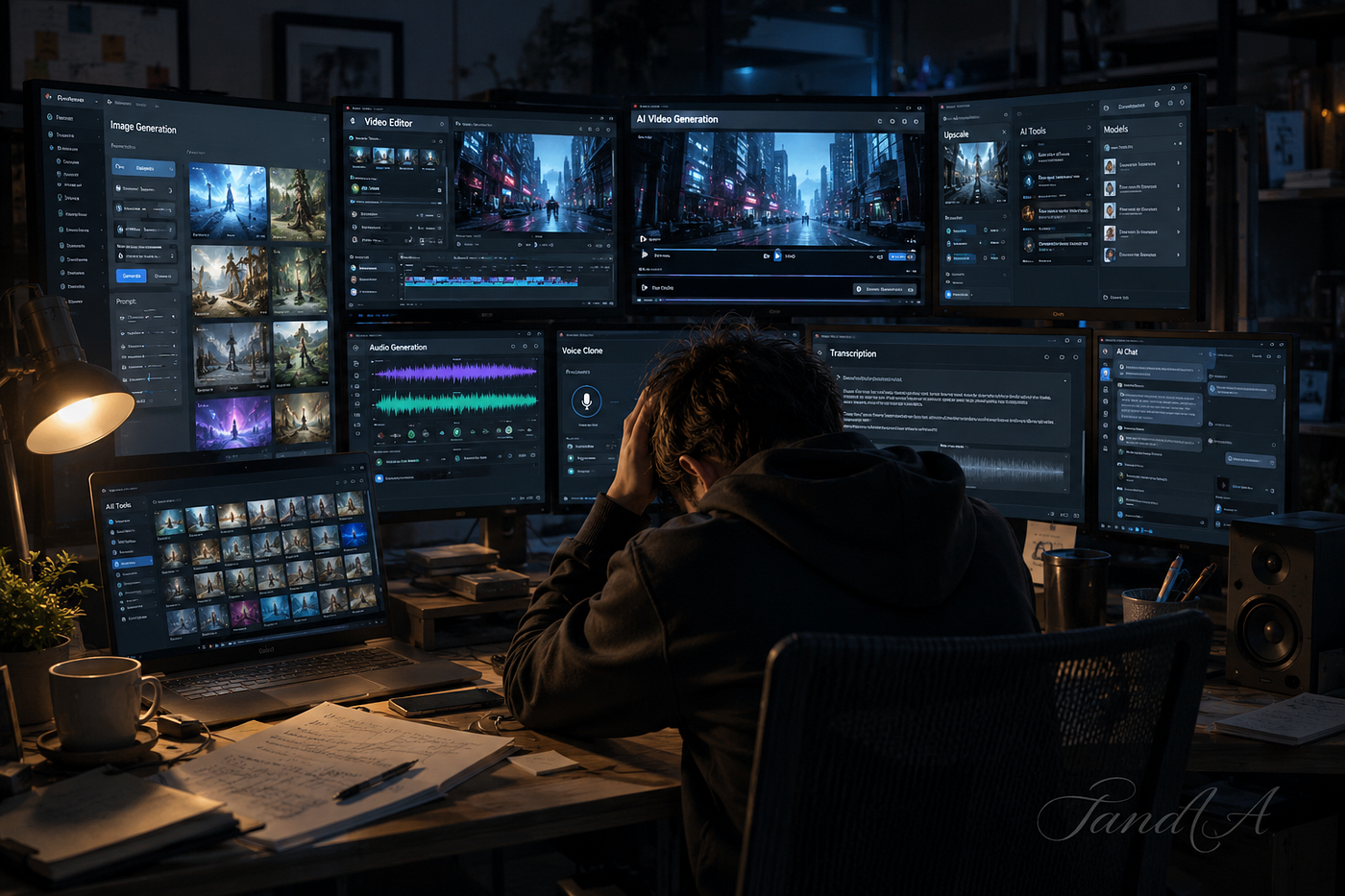
The modern AI workflow often feels less like creativity and more like tool management.
From Galaxy AI to Magica
When Galaxy AI launched, it followed the same pattern many early AI platforms used. Separate pages for separate tools. One tool for image generation. Another for background removal. Another for video.
Useful, but fragmented.
The shift to Magica was not just a name change. It reflected a broader change in product direction.
The platform moved away from functioning primarily as a tool directory and toward functioning as an AI agent system. The new centerpiece became a conversational assistant powered primarily by Claude Sonnet 4.6. Users describe an outcome, and the system attempts to assemble the workflow automatically.
That distinction matters.
Traditional AI platforms ask users to understand the tools first. Magica increasingly asks users to focus only on the result they want.
The transition appears to have been seamless for existing users. Accounts, credits, subscriptions, generated files, and libraries reportedly carried over without disruption.
The original standalone tools still exist, but Magica’s direction is increasingly clear. The agent interface is now the main product.
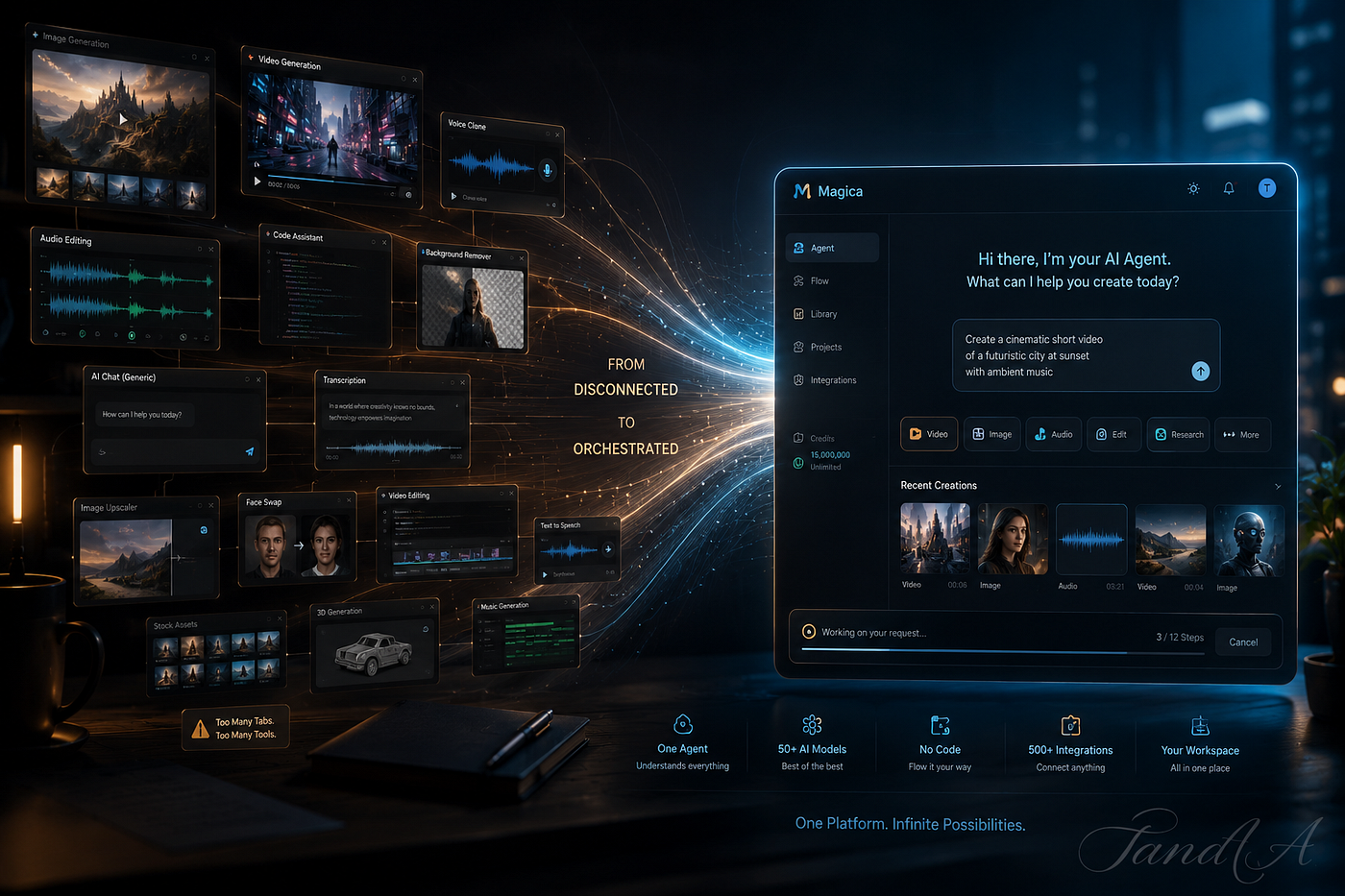
Magica’s rebrand represented a shift from isolated AI tools toward unified orchestration.
What Magica Actually Does
At its core, Magica combines two major systems:
- An autonomous AI agent.
- A large backend library of AI generation models.
The agent layer handles planning and execution. The model layer handles generation.
That means a user can request something broad such as:
“Create a 30-second product advertisement with narration, captions, music, and vertical formatting for TikTok.”
Instead of manually opening separate applications, the platform attempts to coordinate the process internally.
This is where Magica becomes more interesting than a standard AI dashboard.
The company is not betting on one proprietary model. It aggregates tools from multiple major AI providers including OpenAI, Google, xAI, Black Forest Labs, Alibaba, ElevenLabs, and others.
The platform’s value is increasingly about orchestration rather than invention.
Video Generation Is the Core Strength
Magica currently hosts more than 35 video-related models across several categories.
That includes:
- Text-to-video
- Image-to-video
- Reference-based video generation
- Video editing and extension
- Lipsync
- Face swap
- Background removal
- Upscaling utilities
Some of the better-known models include:
- Google VEO 3.1
- OpenAI Sora 2 and Sora 2 Pro
- Kling v3 Pro
- Seedance 2.0
- Grok Imagine Video
The most important technical shift may not actually be the visuals.
It is audio.
Several major models now generate synchronized sound alongside the video itself. That removes one of the biggest friction points in AI video production, where creators previously had to generate visuals and audio separately.
The result is not perfect. AI video still struggles with consistency, fine motion control, and long-form coherence. But the workflow is becoming noticeably faster.
For creators producing short-form social content, ads, explainers, or concept videos, that speed matters.
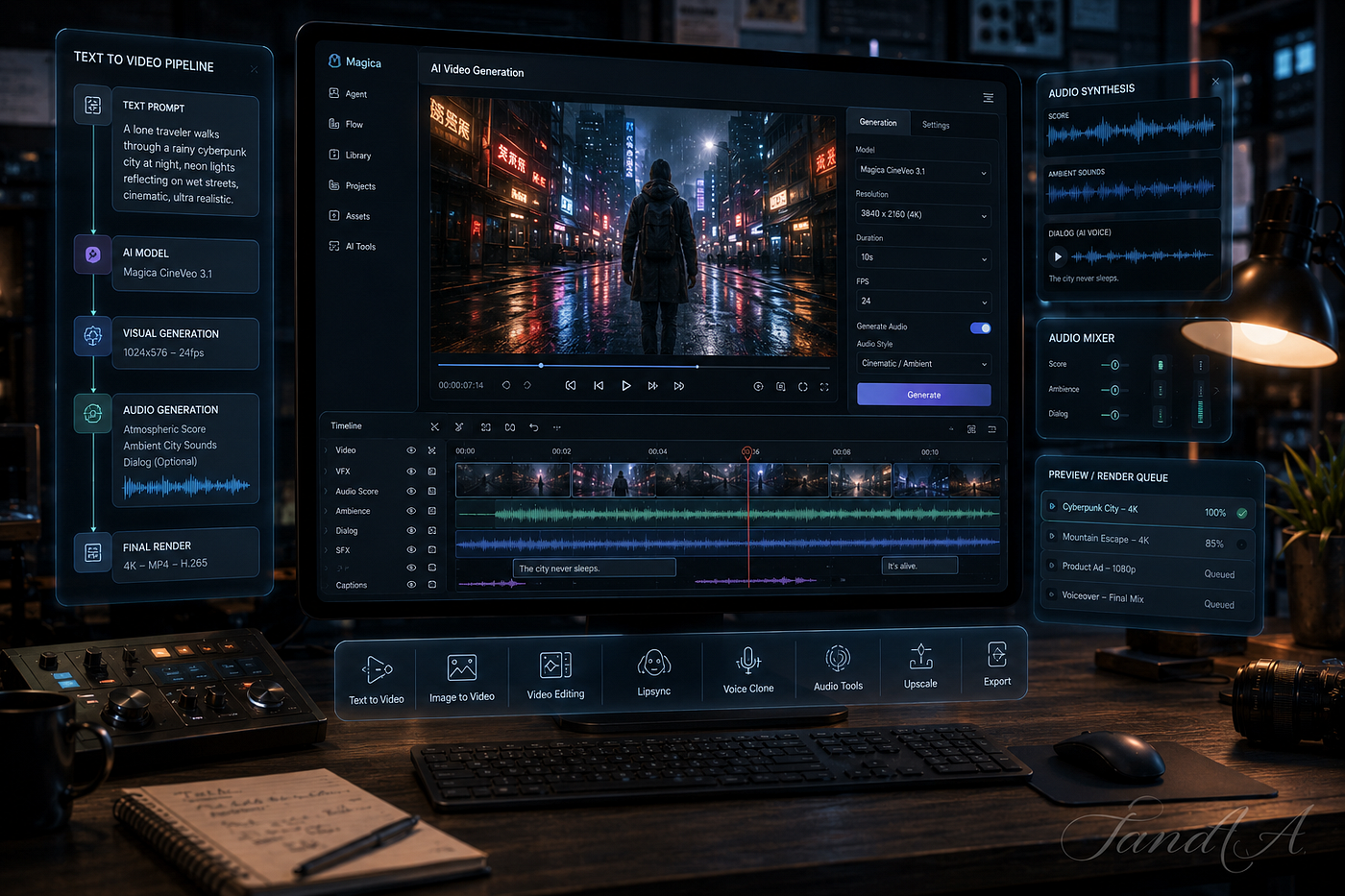
AI video generation is increasingly shifting toward fully integrated audio and visual workflows.
Image and Audio Tools Expand the Ecosystem
On the image side, Magica includes roughly 15 generation and editing models.
That includes:
- FLUX 2 Max
- GPT Image 2
- Grok Imagine
- Gemini image models
- Meshy V6 for 3D workflows
Editing tools include upscaling, background removal, face swapping, and AI-assisted revisions.
The broader pattern becomes obvious quickly. Magica is trying to become a centralized production environment rather than a specialized app.
Audio capabilities reinforce that goal.
The platform supports:
- Voice cloning
- Text-to-speech
- Audio isolation
- Stem separation
- Translation and dubbing
- Transcription
For solo creators and small teams, this matters because fragmented workflows are expensive. Every export, conversion, upload, and handoff adds friction.
Magica’s main argument is that those layers should increasingly disappear.
The Difference Between Tasks and Flow
One of the more interesting architectural decisions is Magica’s split between “Tasks” and “Flow.”
Tasks are agent-driven.
You describe a goal, and the AI attempts to determine the workflow automatically.
Flow is structured automation.
Instead of describing outcomes conversationally, users build repeatable visual pipelines using a no-code workflow system.
That distinction reflects a larger truth about AI tools right now.
Some creative work is exploratory.
Some work is repetitive.
The strongest platforms increasingly need to support both.
Developers can also access the system through APIs and MCP integrations, allowing Magica to connect with external tools and custom workflows.
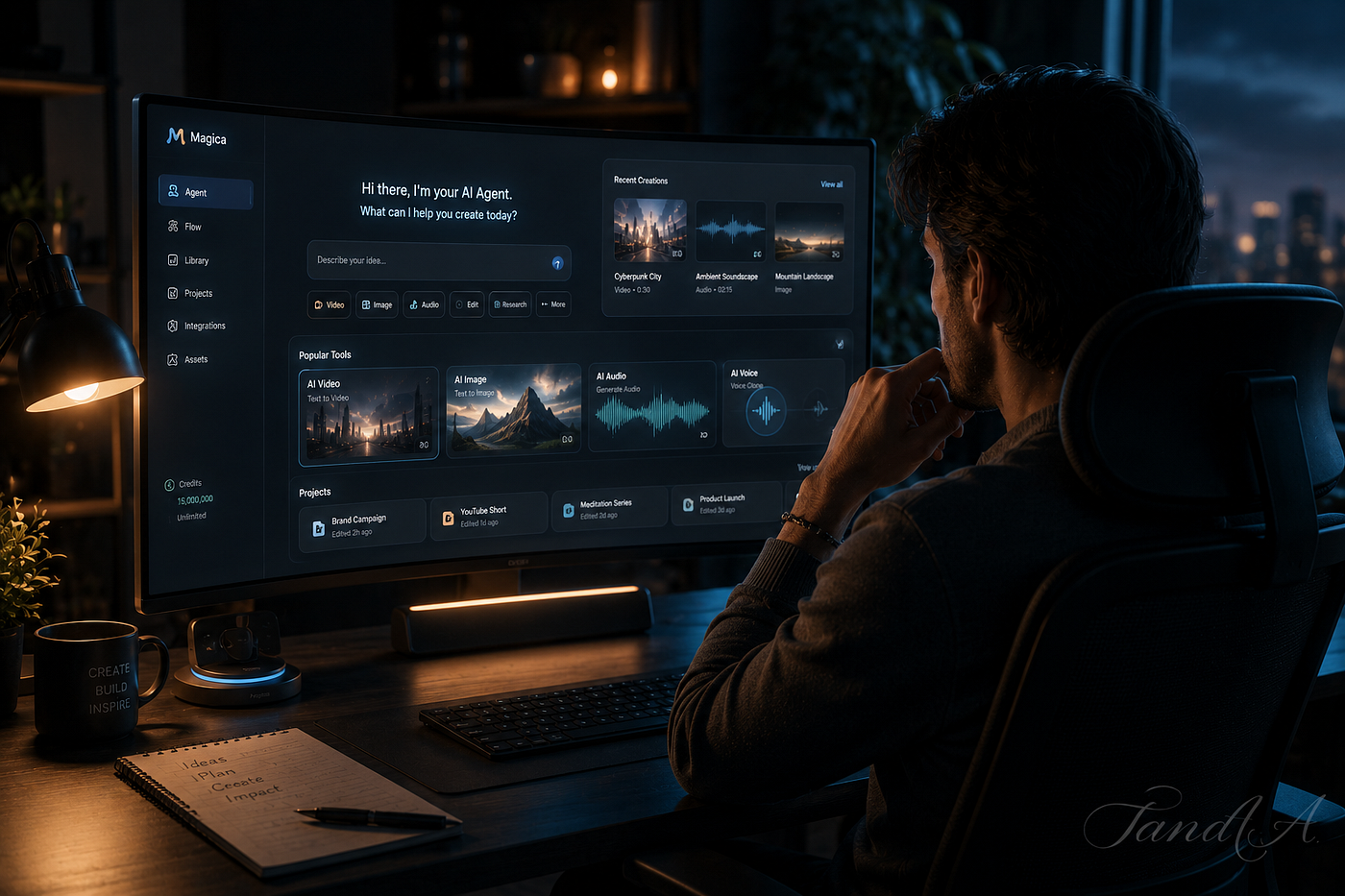
Magica separates exploratory AI tasks from structured repeatable automation.
The Connector Layer May Be More Important Than the Models
Magica supports hundreds of integrations including:
- Gmail
- Google Workspace
- Slack
- GitHub
- Notion
- Jira
- Airtable
- Salesforce
- YouTube
- TikTok
This matters because the future of AI tools may depend less on generation quality alone and more on operational usefulness.
Generating content is no longer the difficult part.
Managing workflows, moving assets, maintaining context, and coordinating systems is increasingly where time gets lost.
A platform that can generate content and interact with your existing tools starts functioning less like software and more like infrastructure.
That is the larger bet Magica appears to be making.
Memory, Context, and Persistent Projects
One area where Magica feels more mature than many AI tools is persistent context.
Projects can store files, instructions, memory, and shared assets across sessions.
For teams, that means the AI does not need to be retrained every time a new task starts.
Brand guidelines, tone preferences, visual references, and recurring workflows can remain attached to a project.
This sounds small until you work with AI systems regularly.
Context repetition is one of the most exhausting parts of current AI workflows.
Persistent memory systems reduce some of that friction.
They also move AI platforms closer to functioning as long-term collaborative environments rather than disposable chat sessions.
Where Magica Still Has Limits
The platform is ambitious, but there are still practical limitations.
AI agents remain imperfect.
Complex requests can still fail.
Long workflows may require correction.
Generated videos still struggle with continuity and precision.
Automation systems also introduce a new kind of complexity. Users may spend less time switching tools, but more time refining prompts, managing credits, and validating outputs.
That tradeoff is important to acknowledge.
Magica is not replacing professional creative pipelines overnight.
What it is doing is compressing the distance between idea and execution.
For many creators, that alone is significant.
The Bigger Shift Behind Magica
The most interesting part of Magica may not be any individual model.
It is the broader direction the platform represents.
The first major wave of AI products focused on isolated capabilities. One app generated images. Another transcribed audio. Another edited video.
The newer wave increasingly focuses on coordination.
AI agents are being positioned as orchestration layers capable of planning, selecting tools, maintaining memory, and executing multi-step workflows.
Whether that vision fully succeeds remains uncertain.
But Magica is one of the clearer attempts to build around that future instead of simply adding another standalone AI tool to the pile.

The larger shift in AI may be less about individual tools and more about orchestration.
Final Thoughts
Magica is not just another AI image generator or video platform.
It is attempting to become a centralized operating layer for creative AI work.
That distinction matters.
The long-term winners in AI may not simply be the companies with the best individual models. They may be the companies that reduce friction, preserve context, and coordinate increasingly complex workflows in ways ordinary users can actually manage.
Magica appears to understand that.
Whether it can fully execute on the vision is still an open question.
But the direction is becoming difficult to ignore.
메타데이터
- post_id
- ddbdbee8f5cf
- slug
- how-magica-is-turning-ai-tools-into-autonomous-creative-pipelines-ddbdbee8f5cf
- url
- https://medium.com/tanda-ai-art-library/how-magica-is-turning-ai-tools-into-autonomous-creative-pipelines-ddbdbee8f5cf
- canonical_url
- https://medium.com/tanda-ai-art-library/how-magica-is-turning-ai-tools-into-autonomous-creative-pipelines-ddbdbee8f5cf
- author_url
- https://medium.com/@ttrimm
- status
- ok
- fetched_at
- 2026-06-09 15:37:30