I Thought I Knew What Healing Meant. This Book Showed Me I Was Only Looking at Half of It.
A personal reflection on Chetan Sethi’s Beyond the Veil of Healing and what it says about the way we deal with pain in 2026
I Thought I Knew What Healing Meant. This Book Showed Me I Was Only Looking at Half of It.
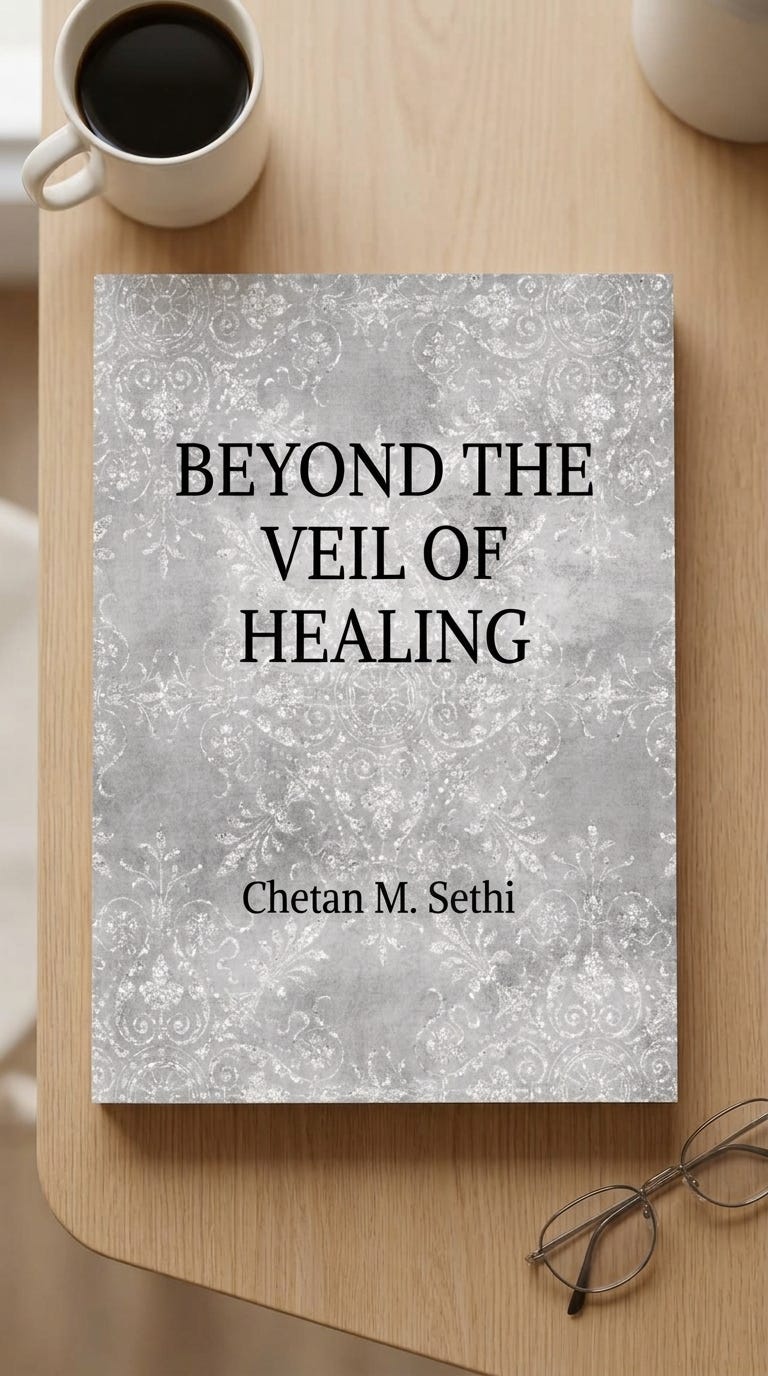
Beyond the Veil of Healing by Chetan Sethi
A personal reflection on Chetan Sethi’s Beyond the Veil of Healing and what it says about the way we deal with pain in 2026
Let me start with a confession. I’ve reviewed hundreds of books over fifteen years of reading everything I can get my hands on, and I’ve become, maybe a little too comfortably, good at predicting what a wellness book will say by the end of its second chapter. Most of them follow a recognizable shape: here is the problem with modern life, here is an ancient solution, here are the steps, here is your transformed self waiting at the finish line. I’m not dismissing those books. Some of them are genuinely useful. But I’ve started to notice the formula the way you notice a familiar song, appreciating it without quite being moved by it.
Chetan Sethi’s Beyond the Veil of Healing broke that pattern for me, and I’ve been trying to figure out exactly why ever since I put it down.
The Question the Book Is Really Asking
The book begins with a deceptively simple premise: that healing is not just about fixing what is broken on the surface. Sethi argues that most of what ails us, the chronic tension, the persistent anxiety, the vague sense of being depleted, originates in the unseen layer of our experience. The emotional layer. The energetic layer. The place where grief that was never fully felt, or anger that was swallowed instead of processed, or fear that became so familiar it stopped announcing itself, all of that lives on in the body and the energy field, shaping everything from how we breathe to how we relate to the people we love.
This is not a new idea. But what Sethi does that I haven’t quite seen done so carefully in one volume is bridge it. He brings together prana and Qi and chakra theory with psychoneuroimmunology and biofield research and neuroplasticity. He doesn’t demand you choose between a spiritual framework and a scientific one. He holds them alongside each other and asks you to notice where they’re pointing at the same thing.
What the Science and the Ancient Traditions Actually Agree On
There’s a passage I kept returning to, where Sethi explains that the heart generates an electromagnetic field measurable several feet beyond the body, and that feelings of love produce coherent, harmonious signals while stress-induced emotions generate chaotic patterns. He connects this to the yogic concept of prana and to the TCM understanding of Qi flowing through meridians. His point is not that all three systems are saying identical things, but that they are each, from their own vantage point, pointing toward the same truth: that emotional states have measurable, physical, energetic consequences, and that ignoring them while treating only the physical symptoms is a bit like mopping water off the floor while the tap is still running.
I found this bridging genuinely valuable. There are people who will only engage with healing frameworks if they have a scientific citation attached, and there are people who trust traditional wisdom precisely because it predates the clinical trial. Sethi’s book speaks to both without condescending to either.
The Stories Are Where It Gets Real
The most affecting parts of Beyond the Veil of Healing, for me, were the case studies embedded throughout. Sethi writes about real people, their names changed, navigating real pain, and he does it with a novelist’s attention to detail rather than a clinician’s detachment.
There is Mira, whose chronic anxiety manifested as a tight chest and incessant worry, and whose deeper exploration revealed volatile energy trapped at the solar plexus, a tangle of fear, insecurity, and unexpressed frustration so dense it had impaired her breath and silenced her inner voice. The turning point for Mira came not through a prescription but through somatic practices that honored the energetic nature of her fear: breathwork, movement, meditative sensing. As that stored energy began to flow, her anxiety transformed from an oppressive weight into something more like alertness and presence.
There is also Arun, the businessman with migraines that nothing could touch. When he finally opened himself to exploring the emotional and spiritual dimensions of his suffering, he found a deep internal conflict between his desires and his sense of duty, a conflict that had been staging its protest in his body for years. Through guided meditation, breathwork, and what Sethi calls the revival of ancient breathing techniques, Arun’s migraines lessened, his mind found new clarity, and his body relaxed into ease. Sethi describes this as the mind noticing, the body releasing, and the spirit affirming, and I thought that was a beautiful and accurate summary of what integration actually looks like.
These stories do something the conceptual chapters alone cannot. They make you ask the question you’ve been avoiding: where in my body am I holding something I haven’t acknowledged?
What This Book Does That Most Wellness Writing Doesn’t
One thing I want to highlight, because I think it matters and it’s easy to overlook, is how Sethi handles ritual. The chapter on ancient rituals for modern healing, and particularly the section on personal stories of ritual healing, is remarkable for its cultural range and its intellectual respect for that range. He writes about a Himalayan woman named Amara who performed a monthly ceremony by firelight with river stones and fragrant herbs. He writes about Thomas, a veteran, who found healing through an indigenous sweat lodge ceremony in the American Southwest, where the physical discomfort of the heat was mirrored by the emotional purge that followed, memories long buried surfacing not as torment but as stories finally allowed to breathe. He writes about Sara in New York, who after losing her mother built a nightly ritual of a single candle, fresh flowers, and a poem, and how those quiet acts became the container in which she could finally grieve.
What connects these wildly different stories is not the specific ritual but what it does: it creates a dedicated space where emotional energy can be acknowledged, honored, and released. Sethi’s argument is that ritual is not superstition. It is technology, old technology, designed to do something specific that the modern world has largely forgotten how to do: hold space for the invisible.
A Small Honest Critique
I want to be fair about what this book is and isn’t. The sections on auras, energy fields, and subtle body anatomy are written with care and grounded in as much evidence as currently exists, but they do ask readers to hold frameworks that mainstream medicine has not yet fully validated. Sethi handles this honestly, noting that biofield research and Kirlian photography are beginning to offer material correlates for these concepts. But if you are someone who requires empirical proof before engaging with an idea, some sections will ask more of you than others. I think that’s okay, and I don’t think it undermines the book, but I’d rather tell you now than have you feel ambushed mid-chapter.
Why This Matters Right Now
In 2026, stress is less of an event and more of a climate. It’s the background radiation of contemporary life, and most of the strategies we’ve developed to manage it are designed for acute situations, not chronic ones. We take the medication. We do the breathing exercise when we remember. We try to sleep enough. And yet the sense of something unresolved, something deeper that hasn’t been touched, persists for a lot of people.
Beyond the Veil of Healing is, among other things, an argument that this persistence is not a personal failing. It’s information. It’s the body and the energy field trying to communicate something that hasn’t been heard yet. And Chetan Sethi spends the whole book teaching you how to listen.
Final Reflection
I’ve been turning this book over in my mind for days since I finished it, which is usually the sign that something landed. Not every section will resonate equally with every reader. But as a whole, Beyond the Veil of Healing is one of the more honest, more generous, and more genuinely integrative wellness books I’ve read in a long time. Chetan Sethi is not selling you a system. He is offering you a way of paying attention to yourself, which is, when you think about it, the thing most of us need most and practice least.
If you’re ready to look beyond the surface of what ails you, this book is a good place to start.
메타데이터
- post_id
- ddc18c8e7a3e
- slug
- i-thought-i-knew-what-healing-meant-this-book-showed-me-i-was-only-looking-at-half-of-it-ddc18c8e7a3e
- url
- https://medium.com/@deifiedbooks/i-thought-i-knew-what-healing-meant-this-book-showed-me-i-was-only-looking-at-half-of-it-ddc18c8e7a3e
- canonical_url
- https://medium.com/@deifiedbooks/i-thought-i-knew-what-healing-meant-this-book-showed-me-i-was-only-looking-at-half-of-it-ddc18c8e7a3e
- author_url
- https://medium.com/@deifiedbooks
- status
- ok
- fetched_at
- 2026-07-10 19:40:14