Stop Losing Your Best Ideas: How to Turn Your Notes Into a Living Archive.
Your thoughts deserve better than a graveyard. Here’s how to build a personal archive that actually works — and grows with you.
Stop Losing Your Best Ideas: How to Turn Your Notes Into a Living Archive.
Your thoughts deserve better than a graveyard. Here’s how to build a personal archive that actually works — and grows with you.
There is a specific kind of frustration that every note-taker knows well.
You remember writing something. You remember the moment it arrived — maybe at 11 PM, maybe in the middle of a commute, maybe right after a conversation that shifted something inside you. You wrote it down. You felt the satisfaction of capturing it. And then, weeks later, you go looking for it and find… nothing. Or worse, you find everything — a dense, undifferentiated wall of text with no way to navigate, no context, no sense of when or why or who.
Your notes have become a graveyard.
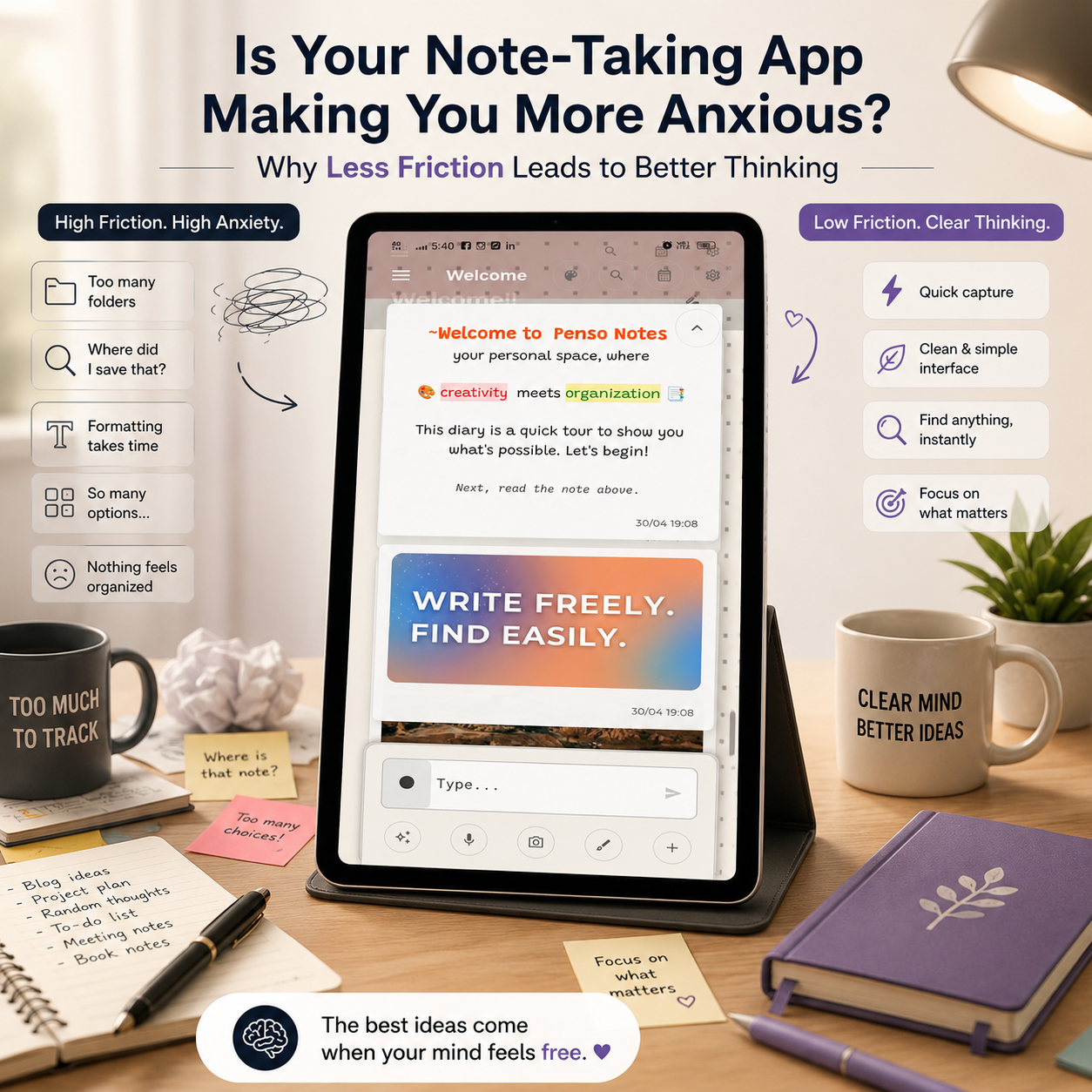
The Digital Graveyard Problem
Most of us start journaling or note-taking with the best intentions. We want to capture ideas. We want to remember how we felt. We want to build something cumulative, something that grows more valuable the longer we keep it.
But apps and habits that are built only for capture — and not for retrieval — eventually betray us.
When your notes become unsearchable, you stop trusting them. When they feel static, you stop returning to them. When you can not find the people, places, or ideas threaded through your entries, the whole project starts to feel pointless. So you stop. The entries pile up, unread. The archive becomes a tomb.
This is not a failure of discipline. It is a failure of design.
What a Living Archive Actually Looks Like
A living archive is not just a place where thoughts go to be stored. It is a place where thoughts go to become something.
The distinction matters. Storage is passive. An archive is active. It invites you back. It makes retrieval feel natural. It lets a fleeting thought — captured in thirty seconds — evolve over time into a polished piece of your personal history. It connects the people in your life to the moments you lived with them. It turns a single entry into something shareable, something permanent, something yours.
Building that kind of archive requires two things working together: fast, frictionless capture on the front end, and meaningful organization and export on the back end. Most tools are good at one or the other. Very few are built for both.
Penso is built for both — and its latest updates make that clearer than ever.
The New Features That Make the Archive Come Alive
People Inside Your Entries
One of the most underrated problems in journaling is the disappearing person. You write about a conversation with a friend, a mentor, a collaborator — and that entry becomes an island. It is not connected to anything else you have ever written about that person.
Penso now lets you add contacts and mention them directly inside your entries using @mentions. The people you write about are always searchable. This is a small change with enormous implications. Your archive is no longer just a timeline of events — it is a web of relationships. You can trace the arc of a friendship, revisit a difficult collaboration, or find every entry connected to someone who shaped a particular season of your life.
Your journal becomes relational, not just chronological.
Attachments That Belong With the Thought
Ideas rarely arrive in isolation. Sometimes the thought you need to preserve is tied to a document — a contract, a research paper, a letter, a sketch. Until now, those attachments lived somewhere else, disconnected from the entry that gave them meaning.
Penso now lets you drop PDFs and documents directly into any diary entry. The artifact and the reflection live together. The context is never lost. This is how a living archive should work: everything that belongs to a moment, kept in one place.
Custom Media Headers and Footers
A photograph without context is just a photograph. But a photograph with a handwritten caption, a date, a feeling — that is a memory.
Penso’s new custom media headers and footers let you give your photos and videos your own touch. Add context above the image. Add reflection below it. When you export that entry as a PDF — which you can now do, fully formatted — those headers and footers travel with it. The image becomes a document. The document becomes a keepsake.
This is what turns a camera roll into an archive.
Export and Share
This is the feature that transforms the entire proposition of journaling.
For most of its history, the personal diary has been a private, static object. You write in it; you do not do much with it. But ideas have lives beyond the moment of capture. A reflection you wrote six months ago might be exactly the piece of thinking a friend needs today. A creative process you documented might be worth sharing with a collaborator. A grief journal might become something you want to print and keep.
Penso now lets you turn any diary entry into a polished PDF and share it with whoever you choose. The gap between private thought and shareable artifact has never been smaller. This is not about making everything public — it is about giving you the option to move something from the internal to the external when the moment calls for it.
The archive becomes a creative asset, not just a personal record.
Reducing the Friction of Return
Capture is only half the equation. The other half is return — going back to what you wrote, revisiting it, editing it, letting it evolve.
Penso’s new double-tap to edit makes updating an entry feel as natural as writing it in the first place. No hunting through menus. No mode-switching. Just tap twice and the entry is yours to change.
Jump navigation — the ability to move to your very first or very latest entry in a single tap — solves one of the oldest problems in long-form journaling: the feeling of being lost inside your own history. A long archive is only useful if you can navigate it. Jump navigation makes the beginning and the end of your archive always one tap away, giving the whole collection a sense of shape and scope.
These are not glamorous features. But they are the kind of features that determine whether you actually return to your archive — or whether you avoid it.
Reliability as a Philosophy
There is something worth saying about the less visible improvements in this update.
Better notifications. Faster loading. Bug fixes. Refined list management. These are not headline features, but they represent something important: a commitment to the long game.
A living archive is only valuable if it is reliable. If reminders do not fire, you miss the prompt to write. If the app is slow to load, you lose the moment. If notifications are inconsistent, the habit of return never forms. The unglamorous reliability work that Penso has done in this update is, in a quiet way, the most important part of the whole package.
You are building something that is meant to last years. Possibly decades. The foundation has to hold.
Your Past Is a Resource
Here is the idea that ties all of this together.
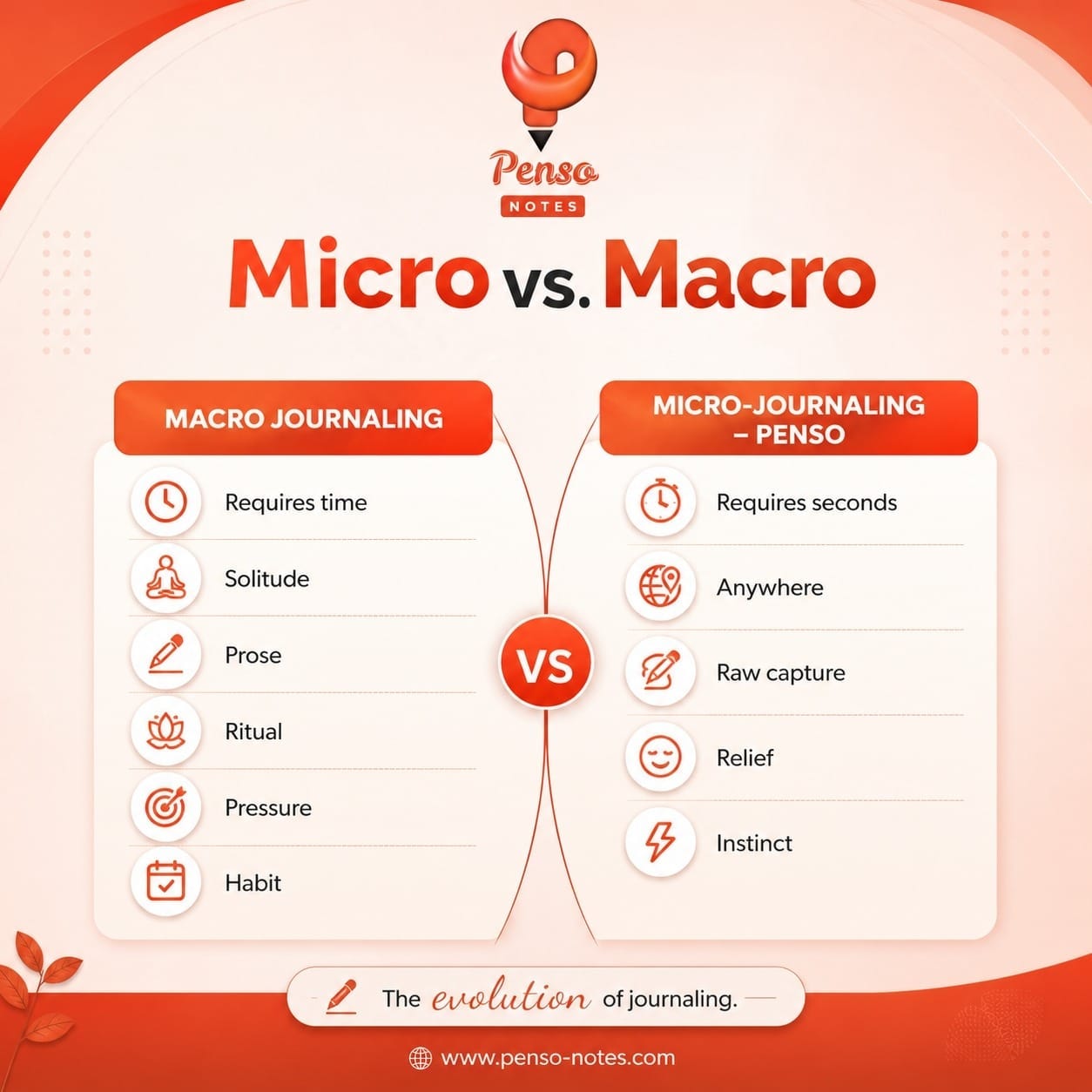
**Micro-journaling *— even a few lines a day, even a single photo with a caption — builds a map of who you were. And that map is not sentimental. It is practical*.
When you are stuck on a problem, you can go back and find the version of yourself who solved something similar. When you are doubting a decision, you can find the reasoning you laid out six months ago when the stakes felt clearer. When you have lost the thread of a relationship, you can find every @mention of that person and trace the whole arc.
The past, properly archived, is not a weight. It is a resource.
But only if the archive is alive. Only if you can find things, revisit them, edit them, export them, share them. Only if the people and documents and images and reflections are all connected and searchable and yours.
That is what **Penso** is building toward. And with this update, it is closer than it has ever been.
Stop letting your best ideas die in a graveyard of static text. Build the archive. Go back to it. Let it grow.
Your past self has more to offer you than you think.
메타데이터
- post_id
- ddc7fc89bc69
- slug
- stop-losing-your-best-ideas-how-to-turn-your-notes-into-a-living-archive-ddc7fc89bc69
- url
- https://medium.com/@penso-notes/stop-losing-your-best-ideas-how-to-turn-your-notes-into-a-living-archive-ddc7fc89bc69
- canonical_url
- https://medium.com/@penso-notes/stop-losing-your-best-ideas-how-to-turn-your-notes-into-a-living-archive-ddc7fc89bc69
- author_url
- https://medium.com/@penso-notes
- status
- ok
- fetched_at
- 2026-07-22 20:11:34