8 Most Important System Design Concepts Every Developer Should Know
8 Most Important System Design Concepts Every Developer Should Know
Most developers think system design is something you learn only when preparing for big tech interviews.
That’s exactly what I thought too.
For years, I focused only on writing cleaner code, learning frameworks, and shipping features faster. But the moment I started building apps used by real users, everything changed.
Suddenly, the problem wasn’t:
“How do I build this feature?”
It became:
“How do I make this survive 10,000 users without breaking?”
That’s when system design stops being a buzzword and becomes survival.
The truth is, great developers don’t just write code. They design systems that scale, recover, adapt, and stay fast under pressure.
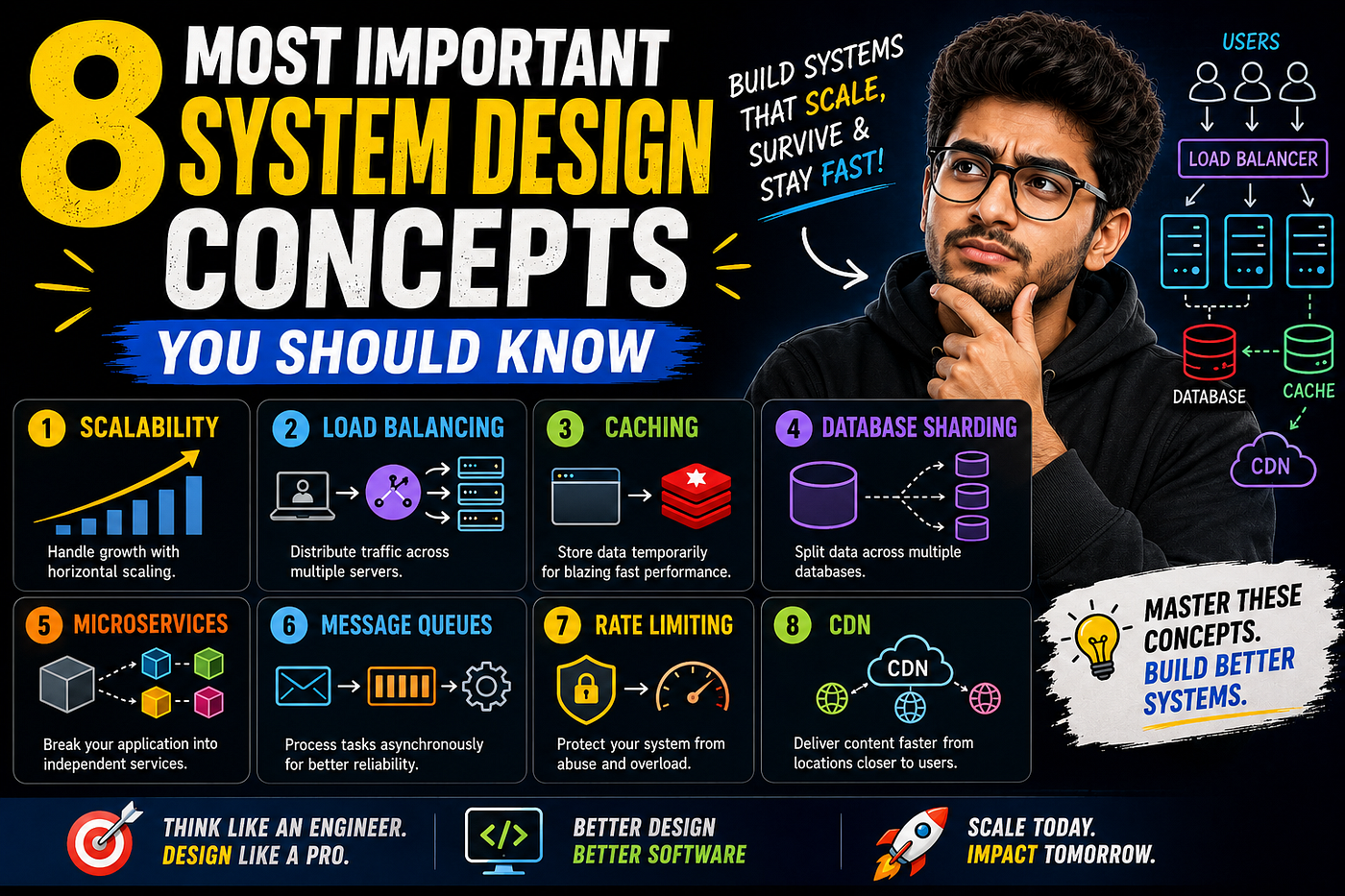
Here are the 8 most important system design concepts every developer should understand — even if you’re still a beginner.
1. Scalability
Scalability is the ability of your application to handle growth.
More users. More traffic. More data. More chaos.
A small app works perfectly on your laptop. A real product needs to survive production traffic.
There are two types of scaling:
Vertical Scaling
You increase server power.
More RAM. More CPU.
Simple, but limited.
Horizontal Scaling
You add more servers.
This is how companies like Netflix or Uber scale.
Example:
// Instead of one server handling all traffic

Server 1
Server 2
Server 3
Server 4
Traffic gets distributed across multiple machines.
Why this matters:
If your app crashes every time traffic increases, users lose trust instantly.
2. Load Balancing
Imagine one restaurant waiter serving 500 customers.
That’s your backend without a load balancer.
A load balancer distributes requests across multiple servers so no single machine gets overloaded.
Users → Load Balancer → Multiple ServersPopular load balancers:
- NGINX
- HAProxy
- AWS ELB
Why it matters:
Without load balancing, one traffic spike can destroy your entire application.
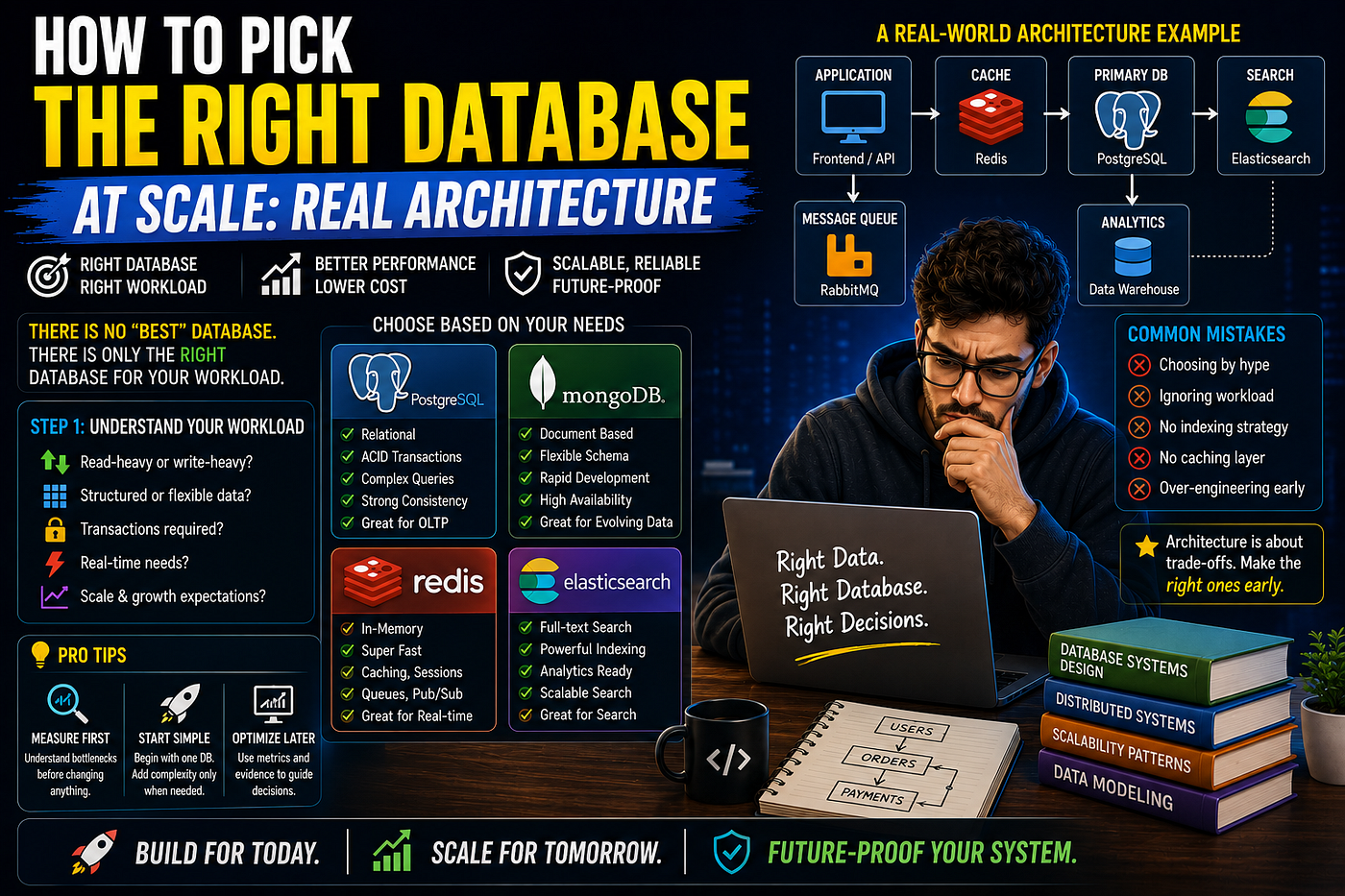
3. Caching
Caching is one of the biggest performance superpowers in system design.
Instead of calculating or fetching the same data repeatedly, you store it temporarily.
Example:
// Without cache
Fetch user from database every request

// With cache
Fetch once → Store in Redis → Reuse
Popular caching tools:
- Redis
- Memcached
Why it matters:
Good caching can reduce server load dramatically and make your app feel insanely fast.
Sometimes the difference between a slow app and a great app is just caching.
4. Database Sharding
As your app grows, one database eventually becomes too large.
That’s where sharding comes in.
Sharding means splitting data across multiple databases.
Example:
Users A–F → Database 1
Users G–M → Database 2
Users N–Z → Database 3
Instead of one giant overloaded database, you distribute the data.
Why it matters:
Large-scale apps cannot survive forever on a single database server.
At some point, data distribution becomes necessary.
5. Microservices vs Monolith
This debate never ends.
And honestly? Most beginners misunderstand both.
Monolith
Everything lives inside one application.
Simple. Easy to deploy. Easy to debug.
Great for startups.
Microservices
Different services handle different responsibilities.
Example:
Auth Service
Payment Service
Notification Service
Order Service
This improves independence but increases complexity.
Why it matters:
Most apps don’t fail because they chose monoliths.
They fail because they chose microservices too early.
Start simple. Scale complexity only when needed.
6. Message Queues
Some tasks should not happen instantly during a user request.
Example:
- Sending emails
- Processing videos
- Notifications
- Background jobs
Instead of blocking the user, you push tasks into a queue.
User Action → Queue → Worker Processes TaskPopular tools:
- RabbitMQ
- Kafka
- AWS SQS
Why it matters:
Queues make systems more reliable and responsive.
Your app feels faster because heavy work happens asynchronously.
7. Rate Limiting
Not every user behaves nicely.
Some users spam APIs. Bots attack systems. Bad actors overload servers.
Rate limiting protects your application.
Example:
100 requests per minute per userIf users exceed the limit:
429 Too Many RequestsWhy it matters:
Without rate limiting, a single malicious script can destroy your infrastructure.
8. CDN (Content Delivery Network)
A CDN stores your static assets globally.
Images. Videos. CSS files. JavaScript files.
Instead of loading files from one central server, users download them from nearby locations.
Example:
User in Pakistan → Nearby CDN Server
User in Germany → Nearby CDN Server
Popular CDNs:
- Cloudflare
- Akamai
- AWS CloudFront
Why it matters:
CDNs massively improve speed and reduce server pressure.
Fast apps keep users. Slow apps lose them.
The Real Secret Nobody Talks About
Most developers think system design is about drawing fancy architecture diagrams.
It’s not.
Good system design is really about understanding trade-offs.
Every decision has a cost:
- Faster systems become more complex
- Scalability increases infrastructure cost
- Microservices improve independence but hurt simplicity
- Caching improves speed but creates stale data problems
Senior engineers are valuable because they understand these trade-offs deeply.
That’s the real skill.
Pro Tips
1. Build Small Systems First
Don’t jump into designing “the next Netflix.”
Start with:
- Chat apps
- Todo apps
- URL shorteners
- Blog platforms
Simple systems teach the fundamentals better.
2. Learn Through Real Products
Every big company teaches system design lessons.
Study:
- YouTube → Video streaming
- Uber → Real-time location systems
- Instagram → Feed generation
- WhatsApp → Messaging architecture
You learn faster when concepts connect to real apps.
3. Draw Before You Code
Before building any project, sketch:
Frontend
Backend
Database
Cache
Authentication
Storage
This habit alone separates junior developers from engineering thinkers.
Final Thoughts
The hardest part of software engineering isn’t writing code anymore.
AI can already generate code.
The real value now comes from designing systems that are reliable, scalable, maintainable, and fast.
That’s why system design matters so much.
You don’t need to master everything overnight.
But if you slowly understand these 8 concepts, you’ll start seeing software differently.
Not as files and functions.
But as living systems.
And honestly, that’s when engineering becomes truly exciting.
Follow me for more developer stories and code breakdowns.
메타데이터
- post_id
- ddc9ffc14e92
- slug
- 8-most-important-system-design-concepts-every-developer-should-know-ddc9ffc14e92
- url
- https://medium.com/skillstuff/8-most-important-system-design-concepts-every-developer-should-know-ddc9ffc14e92
- canonical_url
- https://medium.com/skillstuff/8-most-important-system-design-concepts-every-developer-should-know-ddc9ffc14e92
- author_url
- https://medium.com/@muhammadshakir4152
- status
- ok
- fetched_at
- 2026-06-09 15:37:30