Why does the universe have no centre?
The universe expands in every direction you observe. Galaxies move away from you. Their light shows an increased wavelength. The pattern…
Why does the universe have no centre?
Cosmic microwave background map. by britannica
The universe expands in every direction you observe. Galaxies move away from you. Their light shows an increased wavelength. The pattern holds no matter where you stand. You see the same trend from any point in space. This leads to a simple conclusion. The universe has no center.
People often picture expansion as a blast. A blast has a starting point. A blast pushes material outward. That image does not match the real expansion of space. Expansion did not begin at one location. Expansion took place everywhere. Every region took part in the same growth of space.
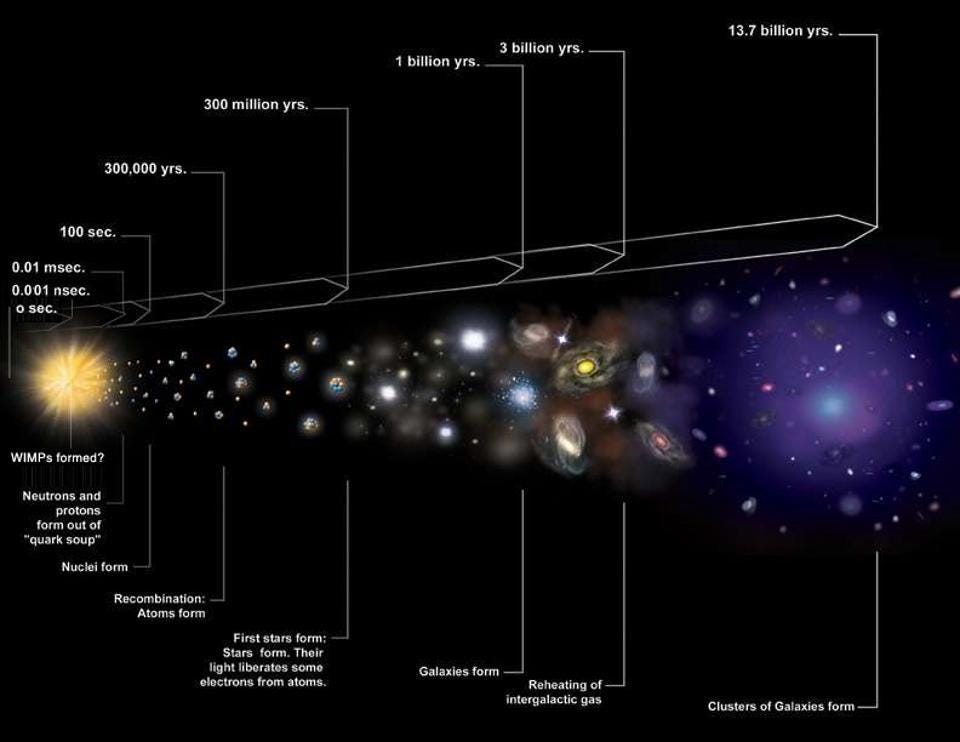
The early universe held hot plasma. Density was high. Pressure was high. The temperature was high. The whole region had the same basic properties. No single point had higher importance. No single area acted as the source. Space itself changed in scale. The change affected all areas at once. When space increased in size, every point moved farther from every other point.
Simple diagram of expanding space with equal stretching in all directions.
This means you see expansion from your position. An observer in another galaxy sees the same trend. Each observer sees the surrounding galaxies move away. Each observer might think they stand at the center. This is an effect of uniform expansion. The view depends on perspective. It does not signal a center.
The cosmic microwave background supports this. The background is leftover radiation from the early universe. It reaches you from all directions. It has a nearly uniform temperature. The small variations match early density patterns. These variations do not point toward any special direction. They do not reveal a favored region. They show that the early universe spread out evenly.
The background also helps you measure large-scale structure. You compare temperature patterns to models of expansion. The results match uniform growth of space. This helps confirm that the universe holds no central point. The expansion is not a push from one location. It is an increase in scale throughout space.
Galaxies form later. They form from gas that cools and collects. These galaxies move with the expansion of space. When space grows, distances grow. A galaxy does not need to move by its own speed. The space between galaxies increases. This effect dominates on very large scales. On smaller scales, gravity binds systems. Your local group does not expand. The Milky Way and Andromeda move toward each other. Gravity is strong enough to slow local expansion. Yet the large-scale trend still shows expansion in all directions.
You see the trend in measured speeds. More distant galaxies move away faster. This relation follows what you expect from uniform expansion. The pattern holds across many surveys. You see the same trend with the same slope. The trend is called the Hubble expansion. It does not come from a center. It comes from the stretching of space.
Image 2 (place here): Standard Hubble plot with distance on one axis and recession speed on the other.
If the universe had a center, you would see changes in the pattern. You would see stronger expansion in one direction. You would see slower expansion in another direction. You do not see that. You see uniform behavior. You also do not see a boundary. The universe does not have an edge that marks a limit. You observe space that extends in all directions. The lack of a boundary supports a centerless model.
When you study models of the early universe, you use equations from general relativity. These models describe how space changes with time. They describe how density changes with time. They describe how temperature changes with time. They do not include a center. They describe a three-dimensional space that expands evenly. This matches observations.
Simulations also support this. You start with the conditions of the early universe. You run the simulation forward. Structure forms. Galaxies appear. Clusters appear. Large patterns appear. The expansion continues throughout the whole region. No central point forms. No outer boundary forms. The results match what you observe today.
This has an important point. When you pick any location, you see the same trend of expansion. That includes locations billions of light-years away. If you observe from one of those points, you still see the surrounding galaxies move away. You would not see a point that acts as the source. You would not see a direction that signals a center.
The concept of a center does not apply to the universe. It applies to objects inside the universe. It applies to planets, stars, and galaxies. They have centers. The universe is not one of these objects. The universe is the space that holds them. Its expansion affects the space between them.
You also see no central point in large-scale maps. Surveys show filament structures. They show clusters. They show empty regions between clusters. These patterns form from gravity acting on early density variations. The patterns do not point toward a center. They spread in all directions. These maps reach billions of light-years. They show a structure that covers huge volumes of space. The distribution supports uniform expansion.
Time also matters. When you look farther away, you see earlier stages. Light takes time to reach you. A distant galaxy shows you a younger universe. When you compare different distances, you see steady trends in density, temperature, and speed. None of these trends reveals a central location.
The universe expands because space increases in scale. The growth takes place in all regions. The effect is the same from any viewpoint. Observations from many sources confirm this. The idea of a center does not match the data. The center does not exist. Space expands everywhere.
메타데이터
- post_id
- ddd24ac2596a
- slug
- why-does-the-universe-have-no-centre-ddd24ac2596a
- url
- https://medium.com/@mariya10438/why-does-the-universe-have-no-centre-ddd24ac2596a
- canonical_url
- https://medium.com/@mariya10438/why-does-the-universe-have-no-centre-ddd24ac2596a
- author_url
- https://medium.com/@mariya10438
- status
- ok
- fetched_at
- 2026-07-14 11:05:15