What a Clean Cap Table Tells Investors Before You Say a Word
The cap table is the first document most investors look at. It’s also the one most founders prepare last.
What a Clean Cap Table Tells Investors Before You Say a Word
The cap table is the first document most investors look at. It’s also the one most founders prepare last.
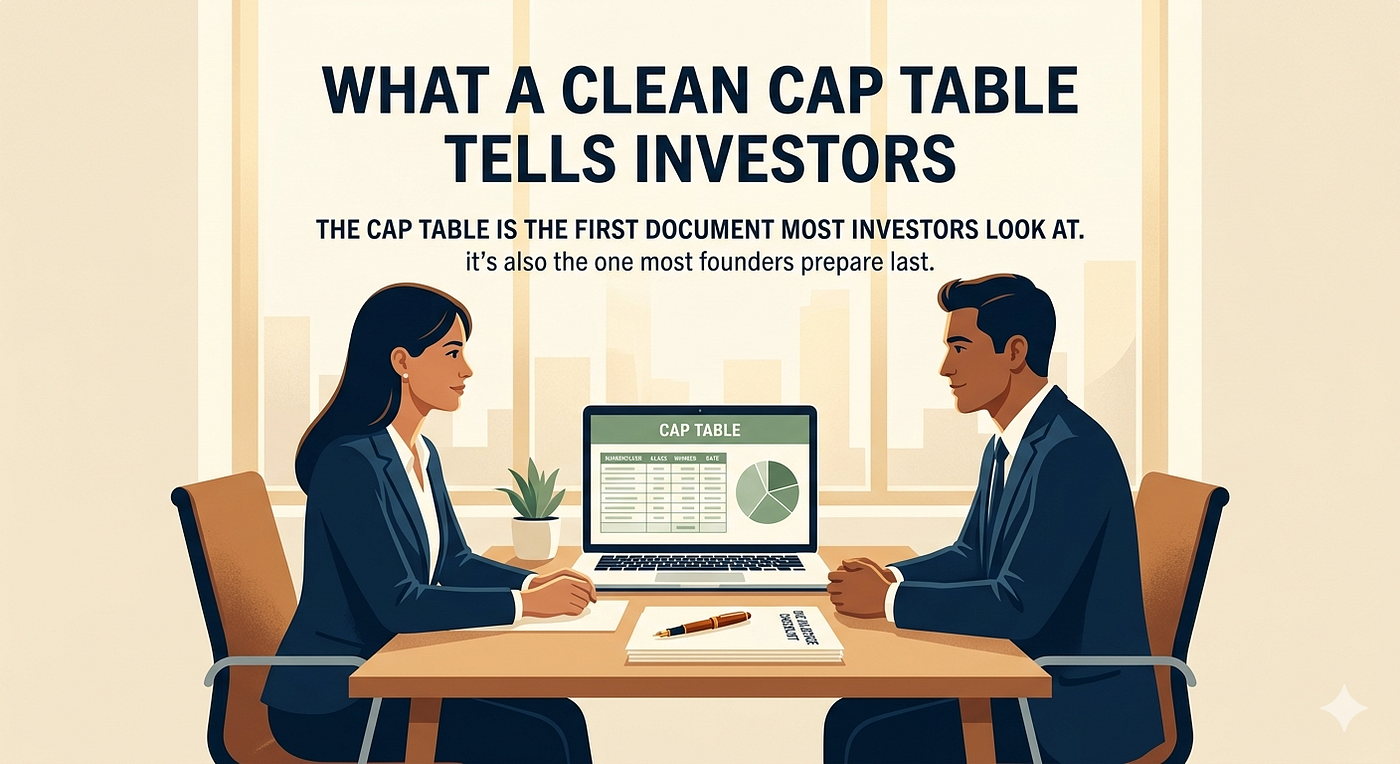
Produced by Google Gemini with guidance from the author.
Before you walk into a meeting, before you send the deck, before you say a word about your product — an investor who’s done their homework has already looked at your cap table.
Not because the numbers are the most important thing. Because the cap table tells a story about how you’ve run your company since day one. Who you’ve brought in, on what terms, and whether you’ve been deliberate about it.
A clean cap table doesn’t close deals. But a messy one has ended more conversations than most founders realize.
What “clean” actually means
Clean doesn’t mean simple. A Series B company with multiple investor rounds, an option pool, and advisor shares can have a perfectly clean cap table. Clean means legible, consistent, and defensible.
Every entry has a name, a share class, a number, and a date. The percentages add up. The terms match what was signed. There are no “we’ll sort that out later” agreements still waiting to be formalized.
When an investor opens a clean cap table, they don’t have to ask questions to understand it. That matters more than it sounds.
What investors are actually looking for
Three things — in this order.
First, they’re looking for red flags. Unusual ownership structures, missing documentation, equity that was promised but never properly issued, a co-founder who left six months ago and still holds 30% with no vesting cliff. These are the things that slow down or kill deals — not because they’re necessarily fatal, but because they create uncertainty. Investors don’t fund uncertainty if they can avoid it.
Second, they’re evaluating how you think about ownership. A founder who has thought carefully about equity — who gets what, when it vests, and why — is a founder who thinks carefully about other things too. The cap table is a proxy for your judgment.
Third, they’re modeling their return. If the cap table is messy, they can’t accurately model what their stake looks like at exit. That’s not a philosophical problem — it’s a practical one. Investors who can’t model their return don’t write checks.
The most common problems — and what they signal
Informal equity arrangements are the most frequent issue. A technical co-founder who joined early received “about 15%” in a conversation that was never documented. An advisor was promised equity that was never issued through proper paperwork. These situations feel small at the time. During due diligence, they become the entire conversation.
Missing vesting schedules are the second most common. Vesting exists to protect the company — if a founder or key hire leaves early, vesting determines what they walk away with. A cap table without vesting schedules signals that these conversations were never had. That’s a governance red flag.
Too many small shareholders is the third. Every early angel, every friend who invested €5,000, every advisor with a tiny slice — they’re all on the cap table. At some point, the number of shareholders creates legal and administrative complexity that slows everything down. Clean up early, before it becomes a rounding problem at your Series A.
What a clean cap table actually communicates
Here’s what investors read between the lines when they see a well-maintained cap table.
You’ve been running a real company, not a side project. The paperwork exists because the decisions were made deliberately. You understood, from early on, that equity is a form of communication — that every percentage point you give away tells a story about who you trust, what you value, and how you think about the future.
You know who owns what and why. That sounds basic. It isn’t. Founders who can walk an investor through every line of their cap table — who that person is, when they came in, what they contributed, what they’re owed — are founders who are in control of their company’s narrative.
You’re ready for this conversation. A founder who hands over a clean, current, well-documented cap table is signaling that due diligence won’t be a surprise. That the company is organized. That there are no skeletons.
When to clean it up
The answer is always earlier than you think.
Before your first raise is the obvious answer — but even before that, the habits matter. Documenting equity decisions properly from the start costs almost nothing. Fixing them later, when lawyers are involved and investors are waiting, costs a great deal.
If your cap table has problems right now, fix them before you start talking to investors. Not during. The due diligence process is the worst possible time to discover that a former co-founder’s shares were never vested, or that an early advisor agreement was never formalized.
A clean cap table won’t make an investor fall in love with your company. But it will make them trust you. And trust, in a funding conversation, is not a soft variable. It’s the foundation everything else is built on.
메타데이터
- post_id
- ddd704f947c5
- slug
- what-a-clean-cap-table-tells-investors-before-you-say-a-word-ddd704f947c5
- url
- https://blog.startupstash.com/what-a-clean-cap-table-tells-investors-before-you-say-a-word-ddd704f947c5
- canonical_url
- https://blog.startupstash.com/what-a-clean-cap-table-tells-investors-before-you-say-a-word-ddd704f947c5
- author_url
- https://medium.com/@aniversel
- status
- ok
- fetched_at
- 2026-06-23 06:34:20