12-Factor App Principles Applied to Microservices (With Real-World Meaning)
Microservices fail not because of scale, but because of poor operational discipline.
12-Factor App Principles Applied to Microservices (With Real-World Meaning)
Microservices fail not because of scale, but because of poor operational discipline.
The 12-Factor App principles provide that discipline — when applied correctly.
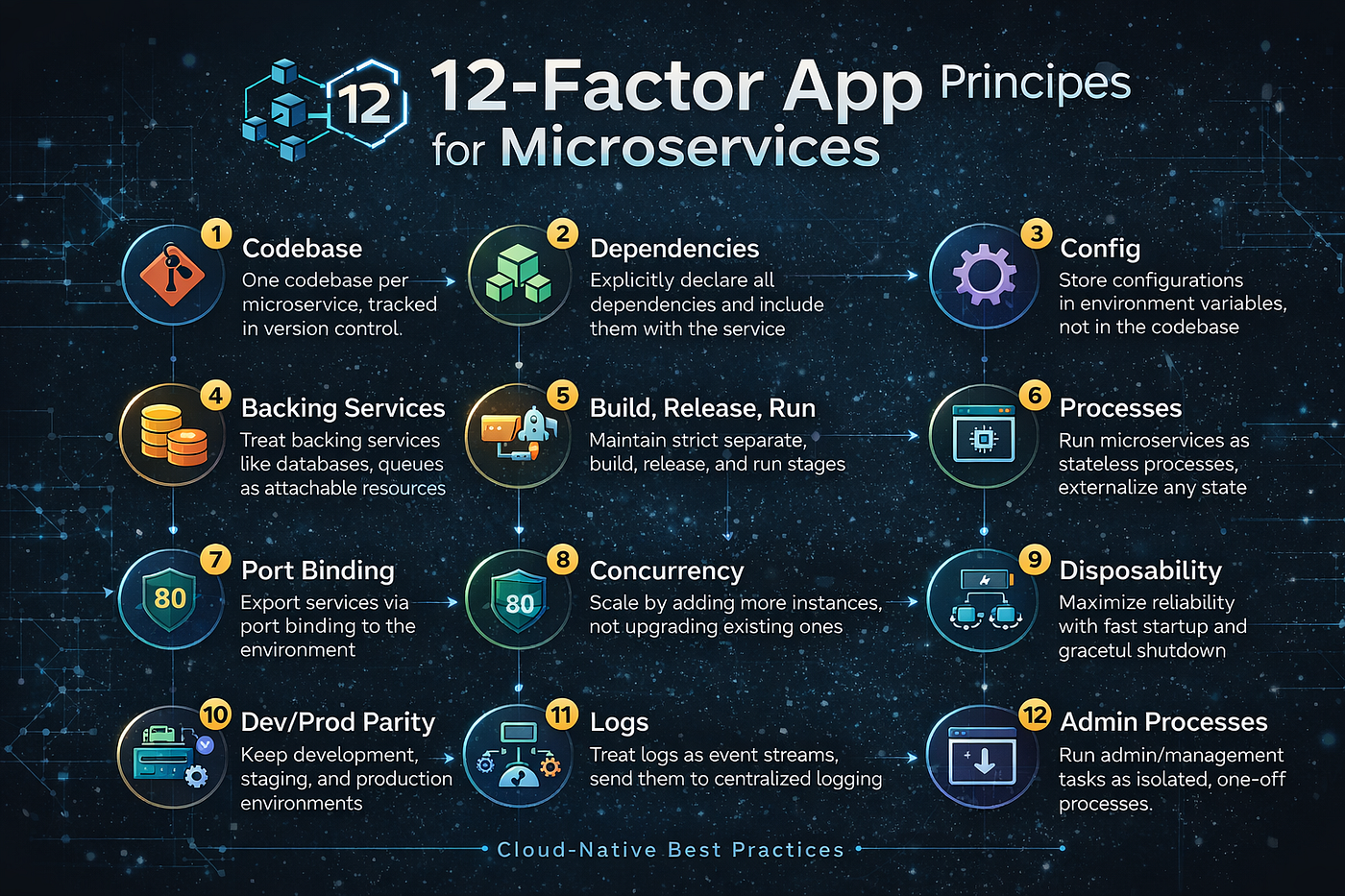
Below 👇🏻, each factor is explained in the context of real microservice systems.
𝟙. Each microservice must be backed by a single version-controlled codebase that is independently deployable
Every microservice should:
- Live in its own repository (or clearly isolated module)
- Have its own CI/CD pipeline
- Be deployed without coordinating with other services
If multiple services must be released together, you do not have microservices.
𝟚. All runtime dependencies must be explicitly declared and bundled with the service
A microservice should never rely on:
- System-installed libraries
- Shared runtime environments
- Hidden OS-level dependencies
Everything required to run the service must be declared in:
- Build configuration
- Container image
This guarantees reproducible deployments.
𝟛. Environment-specific configuration must be injected at runtime, not stored in source code
Configuration is not code.
Sensitive or environment-dependent values such as:
- Database credentials
- API keys
- Feature flags
- External service endpoints
must come from the environment (ConfigMaps, Secrets, Vault), not from the repository.
𝟜. External systems such as databases, queues, and caches must be treated as replaceable attached resources
Microservices must assume that:
- Databases can change
- Message brokers can be replaced
- Caches may fail or restart
The service should not care where these systems run — only how to connect to them.
𝟝. The build, release, and run phases must be strictly separated to enable predictable deployments
A correct pipeline looks like:
- Build: Compile and package the artifact
- Release: Bind configuration to the artifact
- Run: Execute the immutable release
Any system that modifies code or binaries at runtime is unsafe in production.
𝟞. Microservices must remain stateless and store all persistent data in external systems
State must never live in:
- Application memory
- Local disk
- Session objects
All state belongs in:
- Databases
- Distributed caches
- Object storage
Statelessness is what enables:
- Horizontal scaling
- Fast restarts
- Fault tolerance
𝟟. Each microservice must expose its functionality by binding directly to a network port
A service must be self-contained and runnable on its own.
This means:
- No shared web containers
- No dependency on external runtime servers
- One service per container
If a service cannot be started with a single command, it is operationally fragile.
𝟠. Microservices must scale horizontally by adding instances, not by increasing machine size
Scaling should be achieved by:
- Adding more service replicas
- Letting the platform handle load balancing
Vertical scaling hides architectural problems and has hard limits. Horizontal scaling exposes them early — which is good.
𝟡. Services must start quickly and shut down gracefully to support elastic infrastructure
In cloud environments:
- Containers are frequently restarted
- Nodes are replaced
- Traffic is rebalanced dynamically
Microservices must:
- Boot fast
- Handle termination signals
- Finish in-flight requests cleanly
Slow startups and unclean shutdowns lead to outages.
𝟙𝟘. Development, staging, and production environments must remain as similar as possible
Differences between environments cause:
- Hidden bugs
- Release-time failures
- Configuration drift
The same container image should run everywhere, with only configuration values changing.
𝟙𝟙. Logs must be written as structured event streams and never managed by the application
A microservice should:
- Write logs to stdout/stderr
- Never manage log files
- Never handle log rotation
Log aggregation, storage, and querying belong to the platform — not the service.
𝟙𝟚. Administrative and maintenance tasks must be executed as isolated, repeatable processes
Database migrations, backfills, and cleanup jobs must:
- Run using the same codebase
- Use the same configuration
- Be fully automated
Manual production scripts are a reliability risk.
Microservices without 12-Factor discipline become:
- Hard to deploy
- Hard to scale
- Hard to debug
- Easy to break
With 12-Factor principles applied correctly, microservices become:
predictable, resilient, and boring — in the best possible way.
메타데이터
- post_id
- ddd8fa5ca579
- slug
- 12-factor-app-principles-applied-to-microservices-with-real-world-meaning-ddd8fa5ca579
- url
- https://medium.com/follower-booster-hub/12-factor-app-principles-applied-to-microservices-with-real-world-meaning-ddd8fa5ca579
- canonical_url
- https://medium.com/follower-booster-hub/12-factor-app-principles-applied-to-microservices-with-real-world-meaning-ddd8fa5ca579
- author_url
- https://medium.com/@anupamhaldkar
- status
- ok
- fetched_at
- 2026-08-11 11:41:10