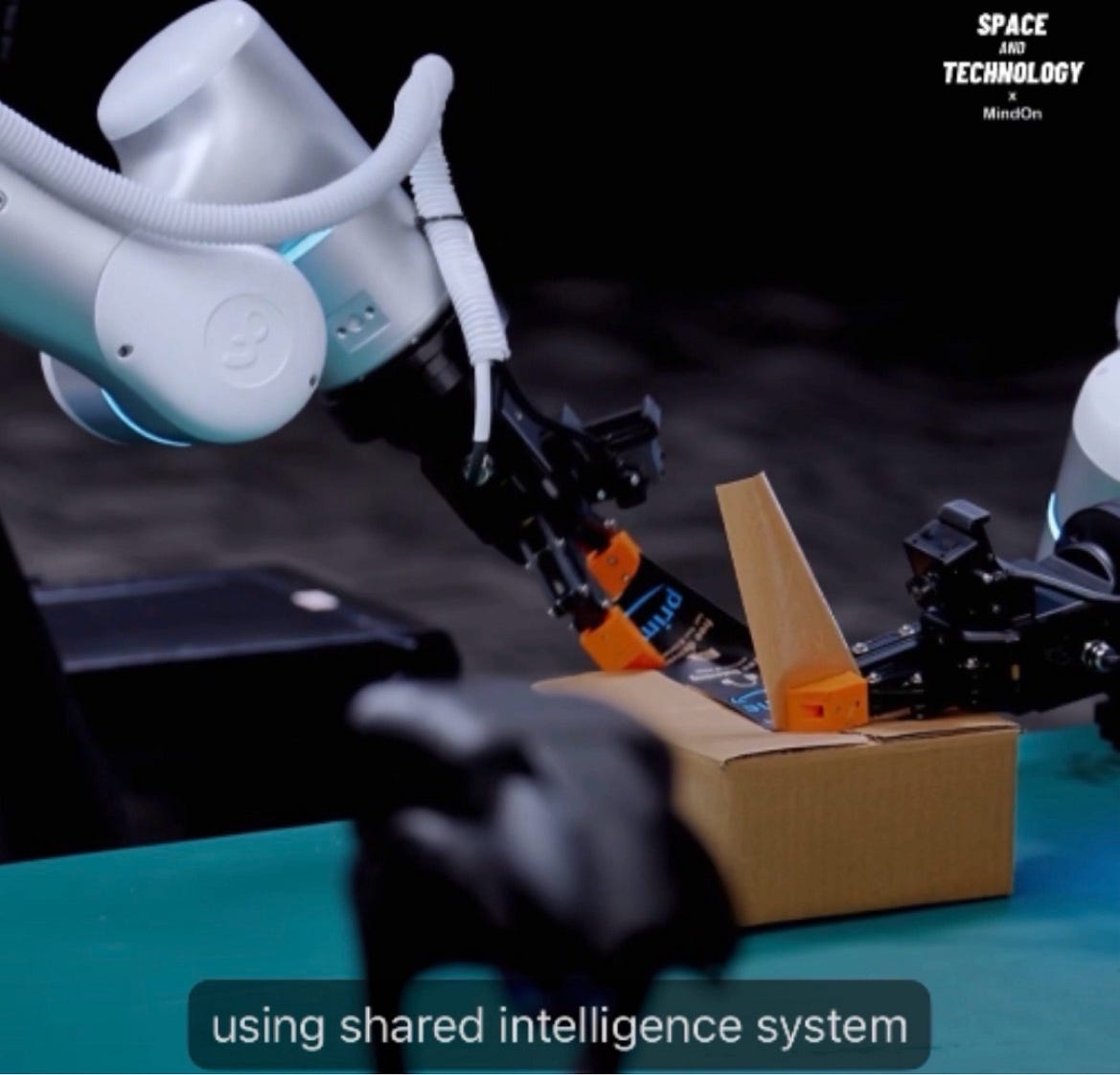
Why the Best Robot Hand Has No Motors in Its Fingers: What Rochu Robotics Gets Right About…
The human hand has no motors in its fingers.
Why the Best Robot Hand Has No Motors in Its Fingers: What Rochu Robotics Gets Right About Dexterous Manipulation
The human hand has no motors in its fingers.
This is not a trivial observation. It is the central engineering insight that most robot hand design has ignored for decades — and the insight that Rochu Robotics has built their biomimetic humanoid hand around.
In the human hand, the muscles that power finger movement are located in the forearm and the palm — not in the fingers themselves. Long tendons transmit force from those muscles, routing through the wrist and across the palm to the individual finger joints. The fingers themselves contain bones, ligaments, and tendons, but no motors, no actuators, no active power sources.
This arrangement is not accidental. It is the result of hundreds of millions of years of evolutionary optimization for a specific set of requirements: high dexterity, low mass in the moving parts, high force transmission efficiency, and the ability to detect and respond to contact forces with extreme sensitivity at the fingertip.
Most robot hand designs ignore this architecture entirely. They put electric motors at the base of each finger, or at each joint, using the motor’s direct actuation to drive joint movement. This approach is simple to design and straightforward to control. It is also heavier, less compliant, less force-sensitive at the fingertip, and kinematically constrained in ways that make natural human-like motion difficult to achieve.
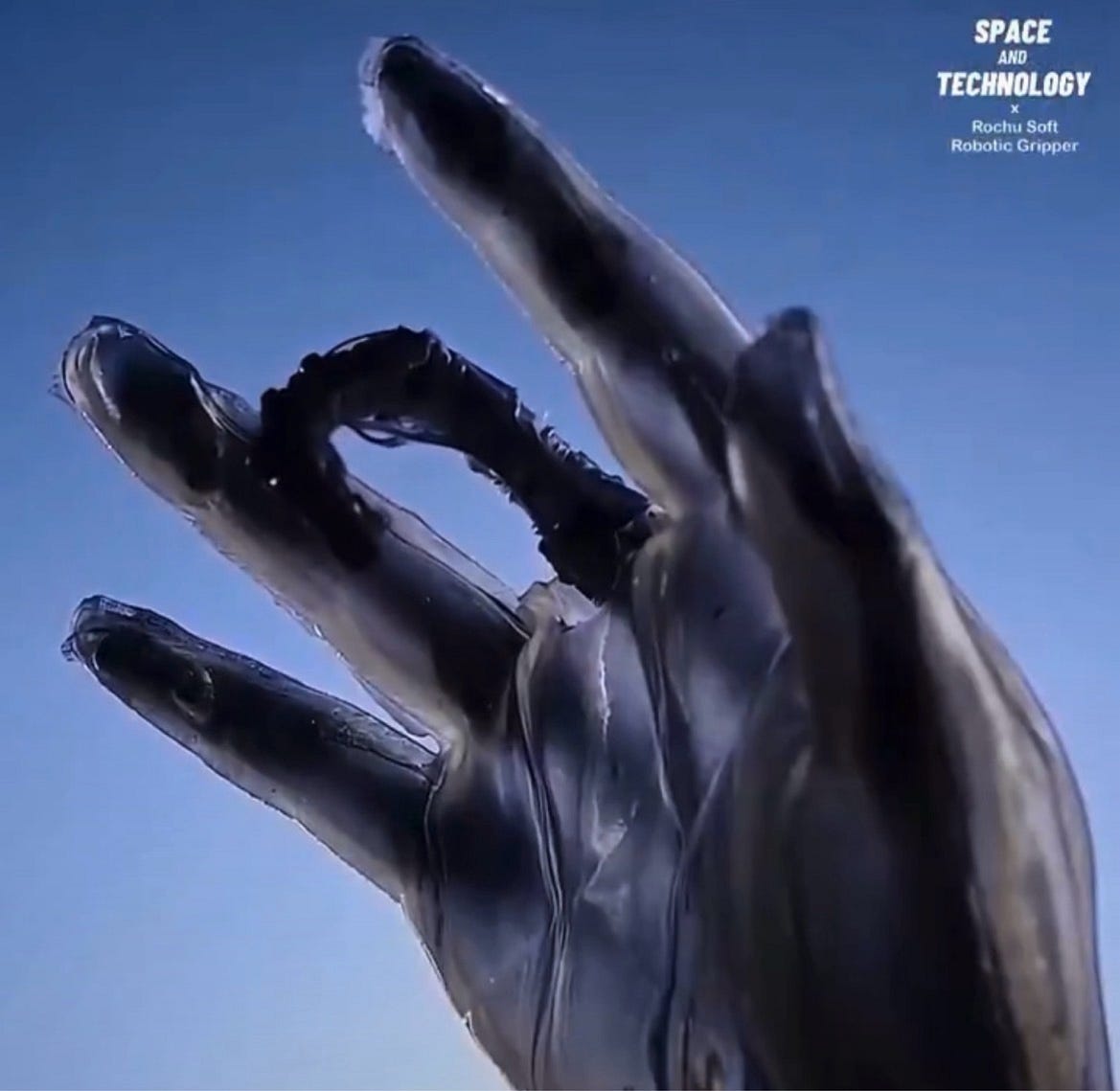
Rochu Robotics has taken a different path. Their humanoid hand replicates the human hand’s fundamental architecture: a biomimetic skeletal structure that defines joint geometry and range of motion, 24 tendons that transmit force through the hand, and a hydraulic actuation system that provides the force those tendons carry. No motors in the fingers. No direct actuation at the joints. Biology, reproduced in hardware.
The Engineering Case for Tendons
The tendon-driven architecture is not a novelty choice. It is a consequence of taking the performance requirements of dexterous manipulation seriously.
The first requirement is mass distribution. In manipulation tasks, the mass of the fingertip directly affects the dynamics of the interaction — how quickly the finger can accelerate, how accurately force can be controlled at contact, how the hand responds to unexpected contact. Lighter fingertips are better. Electric motors are heavy. Routing the actuation source away from the fingertips and transmitting force through tendons reduces the moving mass dramatically.
The second requirement is compliance. Human fingers are not rigid. They deform slightly under contact, which distributes force across the contact surface and makes grasp more stable. They also respond to contact forces through the tendon-muscle system in ways that actively stabilize grasps when the load changes. Electric motor drives are inherently stiff — the motor resists back-driving, which makes contact forces propagate rigidly through the structure rather than being absorbed compliantly.
Tendon-driven systems, particularly with hydraulic actuation, can be tuned for compliance. The hydraulic fluid compresses slightly under high loads. The tendons stretch slightly. The overall system behaves more like biological tissue — compliant under unexpected forces, stable under controlled loads.
The third requirement is force sensitivity. The most important sense for dexterous manipulation is touch — the ability to detect and respond to contact forces at the fingertip. A fingertip that is packed with motor hardware has less room for tactile sensors and more structural noise from motor vibration. A fingertip that is driven by tendons from a remote hydraulic source can dedicate its volume to sensors and structural elements that maximize tactile sensitivity.
Rochu’s 24 biomimetic tendons specifically addresses the redundancy that human hands have. The human hand has more tendons than degrees of freedom — multiple tendons control each finger, allowing the hand to modulate grasp stiffness, distribute force across the finger length, and maintain stable grasps under varying load conditions. Twenty-four tendons for a five-fingered hand with 21 to 27 degrees of freedom reflects a serious attempt to replicate this redundancy rather than simply achieving minimum viable actuation.
The Case for Hydraulics
The choice of hydraulic actuation over electric motors is the more unusual of Rochu’s design decisions, and it deserves specific attention.
Hydraulic actuation has a long history in heavy industrial machinery — the reason construction equipment, aircraft control systems, and heavy press tooling use hydraulics is the same reason it is relevant to robot hands: force density. Hydraulic actuators can deliver very high forces from compact hardware, with a natural compliance profile that electric motors cannot match.
The traditional objection to hydraulics in robot hands is the complexity and maintenance overhead of hydraulic systems — fluid management, seal integrity, temperature sensitivity, and the challenge of miniaturizing hydraulic components to finger scale. These are real engineering challenges, and they explain why most robot hand designers have defaulted to electric actuation despite its performance limitations.
Rochu’s approach suggests they have made the engineering tradeoffs and concluded that the performance advantages of hydraulic tendon actuation outweigh the complexity costs for their target applications. The key is the combination: hydraulics provides the force density and compliance at the actuation source, and tendons distribute that force through the hand’s biomimetic skeletal structure. The hydraulic system does not need to be miniaturized to the scale of individual finger joints — it can be located in the wrist or forearm, with tendons carrying its output through the hand.
This is, again, the same architecture as a human hand. The hydraulic system is analogous to the forearm muscles. The tendons are the same. The skeletal structure defines the kinematics. The fingertips are free to be optimized for sensing and contact.
The Skeletal Structure and What It Enables
The biomimetic skeletal structure is the third component of Rochu’s architecture, and it is the one that most directly affects training data compatibility.
Most robot hands have proprietary kinematics — joint geometries and range of motion profiles that are specific to the robot and bear little relationship to human hand anatomy. A robot that grasps a cup with different joint angles than a human uses, through a different range of motion, produces motion that looks similar at the end effector but is kinematically distinct at the joint level.
This kinematic dissimilarity creates a training data problem. Human demonstration data — motion capture recordings, egocentric video, teleoperation sessions — captures human hand motion in human hand kinematics. Mapping this data to a robot with fundamentally different kinematics requires retargeting: converting human joint angles to robot joint commands, accounting for the structural differences, and accepting the approximation errors that result.
A robot hand with biomimetic skeletal structure has kinematics that closely match human hand anatomy. The joint axes are in approximately the same positions. The ranges of motion are similar. The coupling between finger joints — the way one joint’s movement affects the others through tendons and ligaments — replicates the coupling in a human hand.
This means human demonstration data transfers more directly to the robot. Egocentric video of human hands performing tasks can train manipulation policies more efficiently because the kinematics match. Motion capture data requires less retargeting. Teleoperation is more intuitive because the operator’s hand movements map more naturally to the robot’s joint space.
From a data collection perspective, this is significant. The value of any given demonstration dataset scales with how efficiently the robot can learn from it. A biomimetic hand can extract more training signal from the same volume of human demonstration data than a robot with proprietary kinematics — because the demonstration kinematics and the robot kinematics are aligned.
The Competitive Context for Dexterous Hands
The dexterous robot hand space has become one of the most competitive segments of Physical AI hardware in 2025 and 2026.
Tokyo Robotics’ Torobo Hand features 16 degrees of freedom with nearly 200 pressure sensors — prioritizing tactile sensing over force density. Figure AI’s Figure 4 is being designed around a watchmaker-grade humanoid hand optimized for data collection. MANUS has built a glove-based hand tracking and teleoperation system that focuses on the data capture side. GenRobot’s DAS Fingers system captures hand manipulation data using wearable sensors rather than building a robot hand at all.
Each of these represents a different point in the design space of dexterous manipulation hardware. Rochu’s contribution — biomimetic skeletal structure, tendon drive, hydraulic actuation — occupies a specific position in that space: the position that prioritizes kinematic fidelity to human hand anatomy and the compliance profile that comes from hydraulic-tendon actuation.
The commercial application roadmap for this kind of hand is broad. Industrial manipulation tasks that require force control in unpredictable contact situations — assembly, handling of fragile or irregular objects, tool use — benefit from compliance and force sensitivity that electric motor drives cannot match. Home robotics tasks — the cooking, laundry, and household maintenance tasks that GigaAI is attempting with SeeLight S1 — require the same characteristics.
The question is whether Rochu can solve the engineering challenges of hydraulic miniaturization and system reliability at the cost points that commercial deployment requires. The demonstration suggests the technical approach is sound. The commercial viability remains to be proven.
The Data Infrastructure Connection
Here’s the dimension of Rochu’s work that connects to the broader Physical AI ecosystem in the most direct way.
The closer a robot hand’s kinematics are to a human hand’s, the more efficiently it can learn from human demonstration data. A biomimetic hand with 24 tendons and a skeletal structure that replicates human anatomy can extract more training signal from egocentric video, motion capture recordings, and teleoperation sessions than a robot with proprietary kinematics that require extensive retargeting.
This means the value of high-quality human hand manipulation data — data captured from real humans performing real tasks in real environments, from a first-person egocentric perspective — is higher for biomimetic hands than for conventional robot hands. The data and the hardware are co-designed, in a sense: the hardware is designed to learn from human data as efficiently as possible, and the data collection infrastructure needs to capture human hand motion with the fidelity that takes advantage of this.
At FileMarket AI, we collect egocentric human motion data from real industrial environments in Kathmandu — including the close-range hand manipulation data that industrial manipulation training requires. As robot hands become more biomimetically accurate, the direct applicability of this data to robot training increases. Rochu’s architecture is a step in that direction.
The human hand has no motors in its fingers. The best robot hands are learning this lesson.
Image credit: Space and Technology / Rochu Robotics
Learn more about FileMarket AI Data Labs: https://filemarket.ai


메타데이터
- post_id
- ddec3324c455
- slug
- why-the-best-robot-hand-has-no-motors-in-its-fingers-what-rochu-robotics-gets-right-about-ddec3324c455
- url
- https://medium.com/@filemarketai/why-the-best-robot-hand-has-no-motors-in-its-fingers-what-rochu-robotics-gets-right-about-ddec3324c455
- canonical_url
- https://medium.com/@filemarketai/why-the-best-robot-hand-has-no-motors-in-its-fingers-what-rochu-robotics-gets-right-about-ddec3324c455
- author_url
- https://medium.com/@filemarketai
- status
- ok
- fetched_at
- 2026-06-09 15:37:30