The Goddess Who Ate Shiva
He returned as smoke. What remained became Dhumavati.
The Goddess Who Ate Shiva
He returned as smoke. What remained became Dhumavati.

Dhumavati on golden chariot as a widow goddess, surrounded by crows. (Image source: https://in.pinterest.com/pin/89157267602176573/)
There is a story in the Tantric imagination that begins with something so ordinary, so deeply human, that it almost feels misplaced in the world of gods.
Hunger.
The story of Dhumavati (the smoky goddess, smoke colored or emerging from smoke) does not come to us as a single, fixed episode in the Puranas. It lives instead across Tantric texts such as the Pranatoshini Tantra, Shakta Pramoda, and references like the Prapanchasarasara Sangraha, and has been carefully studied by scholars like David Kinsley. What survives is not a linear narrative, but a layered memory, shifting, symbolic, and deeply evocative.
And as we read these stories, we learn why Dhumavati can not be contained in a single tale.
The Day a Goddess Ate Her Husband

Shiva and Parvati Playing Chaupar. India (Basohli, Jammu) by Devidas of Nurpur
Sati sits beside Shiva. In some retellings, they are engaged in an intimate game that resembles chess or dice, a game of attention, of presence, of subtle competition.
And then suddenly, Sati breaks the silence.
She is hungry.
Immersed in the game, Shiva does not respond.
He remains as he often is, withdrawn, absorbed. Sati asks again. The request lingers in the space between them, growing heavier each time it is ignored.
Hunger has a way of doing that. It sharpens. It insists. It transforms from a need into a force.
In that charged silence, something shifts within her.
What follows is one of the most startling events in Hindu narratives.
Sati devours Shiva.
And then from within her, Shiva begins to emerge again. But he does not return as he was. He slips out of her as smoke.
Dhūma.
From Sati to Smoke: The Birth of Dhumavati
What remains in his wake is no longer the Sati we recognise.

Goddess Dhumavati, circa 18th century CE, Rajasthan School of Art, National Museum, New Delhi (Image credit: https://in.pinterest.com/speakingarch/)
She becomes Dhumavati. The Smoky One. A goddess shaped by what lingers after an act of total consumption.
In another telling, her origin is traced to an earlier fire. When Sati immolates herself, it is from the rising smoke of that pyre that Dhumavati takes form. The motif remains unchanged; she emerges from what remains when something has ended completely.
Dhumavati: Wrinkled, Hungry, and Holding Fearlessness
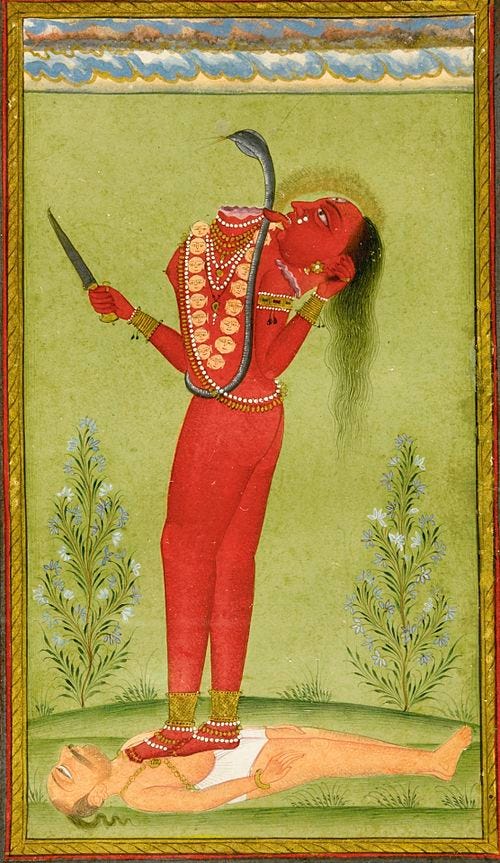
Dhumavati’s iconography refuses to fit within the popular image of the beautiful, young goddesses.

Dhumavati, 19th century vintage print, the goddess standing in funeral grounds (Image source: Wikimedia commons)
She appears unsteady, her body marked by age and exhaustion. Her clothes are dirty, her form haggard, her breasts sag toward her torso. The body here is not idealised; it carries time, use, and depletion openly. She rides a chariot marked by a crow and holds a winnowing basket.
And yet, in one hand, she offers abhaya.
Fearlessness.
It is a striking contrast. A goddess who embodies everything that unsettles the eye also becomes the one who grants assurance. It is as if she is saying, “What do you have to fear when you have embraced the void, the Shunya?”
Before Dhumavati: The Goddesses Worshipped And Feared

Dhumavati painted in Orissa Pattachitra painting by Rabi Behra (Image source: https://in.pinterest.com/exotic_india_art/)
Dhumavati is often compared to Jyeshtha, also known as Alakshmi, the elder sister of Lakshmi, associated with misfortune and carefully kept at a distance in ritual life. The physical similarities are noted: hanging breasts, a flabby, uncontained body that resists aesthetic discipline.
She also recalls Nritti, the Vedic embodiment of decay and dissolution, who is invoked precisely to be kept away. These figures mark a lineage of feminine forms that stand at the edge of order, embodying what societies fear yet cannot fully exclude.
The crow that accompanies Dhumavati intensifies this association. Across Indian traditions, the crow is bound to death, to ancestors, to the unseen world that hovers close to the living. The Prapanchasarasara Sangraha goes further, describing her nose and throat as resembling that of a crow, drawing her even closer to this symbolic terrain.

Jyestha, Late Chola period, South India, Benaras Hindu University Museum. The form is different from Dhumavati, but Jyeshtha’s round form, emphasizes on her ugliness and as a shadow of Lakshmi, she represent inversion of auspiciousness. (Image source: Wikimedia Commons)
And yet, to reduce Dhumavati to misfortune or inauspiciousness would be to miss the depth of her presence.
Some readings do align her with the social figure of the widow, a woman marked by absence, placed at the margins of ritual and celebration. This association lingers, especially in the visual language of her austerity.
But there is another current within Tantric thought that reads her differently.
Dhumavati represents a state of radical solitude. An existence that stands outside marital identity, outside expectation, outside the need to be pleasing or productive. In her, there is a cultivated distance from everything that society holds desirable.
She is not lacking.
She is unbound. She is not scary, but all that she represents is deeply unsettling for the world, and thus she is imagined in a form that can be kept on the fringes.
Adorned, Youthful, Regal: The Other Faces of Dhumavati
This complexity becomes even more striking when we turn to her visual representations in later art.
Print of the 18th century painting by Molaram. While the goddess has fang like teeth she is adorned with rich jewelery which is a symbol of abundance. (Image source: Wikimedia Commons, from David Kinsley’s book Tantric visions of the divine feminine: the ten mahāvidyās. University of California Press p. 188)
Eighteenth-century paintings offer a very different Dhumavati. In works attributed to artists like Molaram, in Nepalese traditions, and in a Varanasi painting by Batuk Ramprasad, she appears adorned, youthful, and composed.
Her body regains fullness. Her attire becomes rich. Ornament returns.

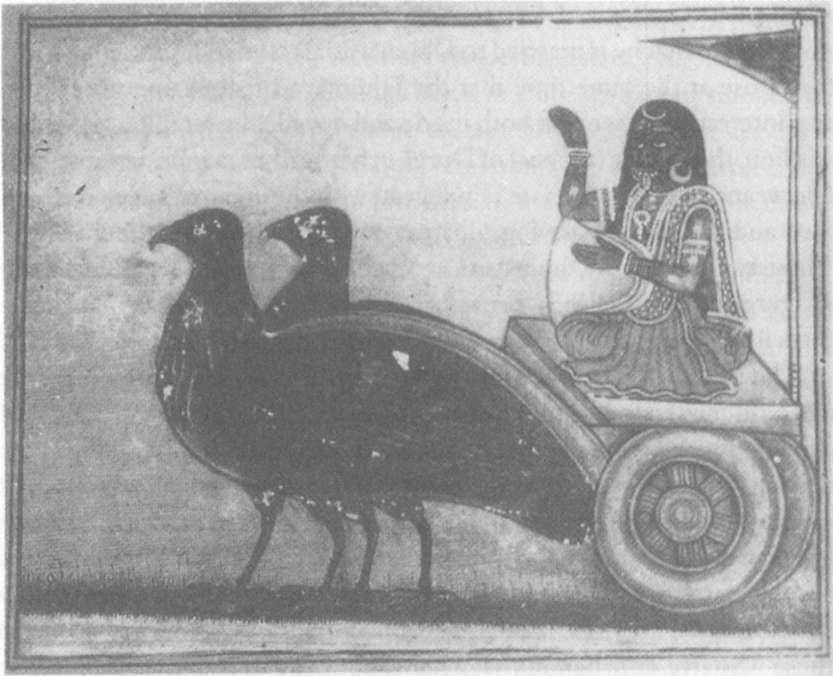
18th-century Nepalese manuscript painting of Dhumavati. (Image source: Wikimedia Commons)
In a Nepalese image, she sits upon a peacock, her form reminiscent of Buddhist yoginis, adorned with pearls, her gaze turned toward a mirror in an act of self-regard. In the Varanasi painting, she is clad in white, yet carries herself with regal authority, holding weapons, wearing jewellery that speaks of status rather than absence.
Some scholars suggest that such representations emerge from courtly contexts, where the inauspicious is gently reshaped to fit into ritual life and aesthetic frameworks. The goddess becomes more approachable, her presence integrated into cycles of worship and celebration.

Nepalese Thangka of Vajrayogini. Her stance, bare form, and lotus pedestal seem to be mirrored in the Nepalese painting of Dhumavati, underlining a shared artistic vocabulary between the divine feminine in one region. (Image source: Wikimedia Commons)
Another reading sees in these images a deliberate articulation of her dual nature.
Dhumavati holds within her both states at once.
She is hunger, and she is abundance. She is absence and she is present. She is the widow and the ever-auspicious.
Dhumavati And Annapurna: The Goddess Who Both Devoured Shiva and Fed Him

Annapurna and Shiva by Nandalal Bose, a modern imagination of the story of Annapurna. Here the form is reversed, the goddess is youthful and Shiva emaciated. As the story goes, when Shiva undermines the role of food and nourishment, goddess who nourishes the world disappears. As a result, hunger prevails. Finally, Shiva finds Parvati residing in Varanasi as Annapurna, feeding all those who come to her door. As a beggar, Shiva reaches Parvati (Annapurna) and is fed. (Image source: Wikimedia Commons)
This duality of the goddess, the feminine, is best represented in her temples in the ancient city of Varanasi.
Here, the same goddess lives in two intimately connected forms. As Dhumavati, she is the one who, in her hunger, consumed Shiva and remained in the quiet that followed. As Annapurna, she is the giver of food, the one who nourishes the world, who feeds Shiva himself.
The movement between these two forms feels almost like a meditation on the nature of need.
Hunger, when ignored, becomes consuming. Hunger, when honoured, becomes nourishment.
And as for the mysterious Dhumavati, there is no one story. How can there be? After all, how can one contain smoke (Dhumra)?
메타데이터
- post_id
- ddf19cea5aaa
- slug
- the-goddess-who-ate-shiva-ddf19cea5aaa
- url
- https://medium.com/women-write/the-goddess-who-ate-shiva-ddf19cea5aaa
- canonical_url
- https://medium.com/women-write/the-goddess-who-ate-shiva-ddf19cea5aaa
- author_url
- https://medium.com/@prakritipassion
- status
- ok
- fetched_at
- 2026-08-08 00:07:57