USS Langley and the Birth of America’s Carrier Era
Aircraft carrier Langley (CV-1) with an Aeromarine plane landing while the ship was at anchor, circa 1923. Naval History and Heritage…
USS Langley and the Birth of America’s Carrier Era
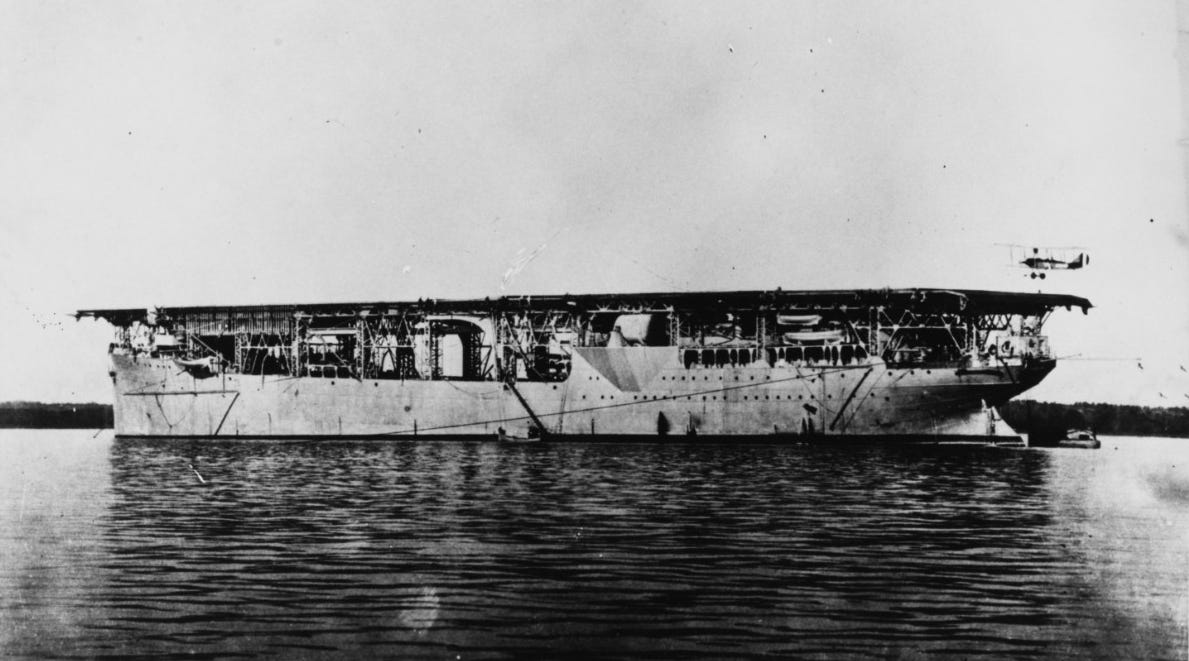
Aircraft carrier Langley (CV-1) with an Aeromarine plane landing while the ship was at anchor, circa 1923. Naval History and Heritage Command photograph, NH 93176.
On the morning of February 27, 1942, in the waters about 121 kilometers south of Cilacap, an important chapter in naval history came to a fiery end. An aging ship that had once changed the future of the United States Navy was struck by five Japanese bombs, engulfed in flames, crippled, and left slowly listing in the sea.
Hours later, the ship would not be sunk by its enemy, but by its own escorts to prevent it from falling into Japanese hands.
That was the end of USS Langley (CV-1) — the first aircraft carrier of the United States Navy. Its name may not be as famous as USS Enterprise (CV-6) or USS Hornet (CV-8), but without Langley, those legendary carriers might never have existed.
Background
The story of USS Langley (CV-1) began long before it became an aircraft carrier. On October 18, 1911, the keel of a new collier ship was laid down at Mare Island Naval Shipyard in Vallejo, California, with President William Howard Taft personally attending the ceremony.
The ship was launched as USS Jupiter (AC-3), an ordinary coal transport vessel built to fuel the growing American fleet.
Yet Jupiter was far more advanced than it appeared. It became the first U.S. Navy ship powered by turbo-electric propulsion, an experimental technology that would later influence American warship design for nearly two decades. During World War I, Jupiter served as a cargo and coal transport ship, including two supply voyages to France.
Its sister ships carried an almost eerie legacy. USS Cyclops (AC-4) vanished without a trace during World War I, while USS Proteus (AC-9) and USS Nereus (AC-10) disappeared along the same route during World War II. Jupiter alone survived long enough to carve its name into naval history.

Jupiter fitting out at Mare Island, 3 December 1912. South Dakota (Armored Cruiser No. 9) is in the background, at left. Courtesy of Donald M. McPherson, 1974. (Naval History and Heritage Command Photograph NH 81339)
A History Transformation
On July 11, 1919, the U.S. Navy officially authorized Jupiter’s conversion into an aircraft carrier. At Norfolk Navy Yard in Virginia, the old coal ship began a dramatic transformation. A wooden flight deck was installed above the hull, catapult systems were fitted at the bow, and arresting wires were added at the stern.
On March 20, 1922, the rebuilt ship officially entered service as USS Langley (CV-1), named after aviation pioneer Samuel Pierpont Langley and commanded by Commander Kenneth Whiting.
Its hull classification became CV-1. “CV” was the U.S. Navy designation for aircraft carriers, while the number “1” marked Langley as the very first of its kind.

USS Langley (CV-1) photographed in 1922. Source: Naval History and Heritage Command (NH 93181).
The Birth of America’s Carrier Era
The early years of USS Langley (CV-1) were defined not by combat, but by experimentation. Naval aviation was still in its infancy, and many of the procedures required to operate aircraft from a moving ship had yet to be developed. Langley became a floating laboratory where the United States Navy learned those lessons through constant testing, improvisation, and trial and error.
- October 17, 1922 Lieutenant Commander Virgil C. Griffin carried out the first successful takeoff from Langley’s flight deck, piloting a Vought VE-7 over the York River.
- October 26, 1922 Only days later, Lieutenant Commander Godfrey Chevalier performed the first successful landing aboard Langley using an Aeromarine 39-B while the ship steamed at approximately 12.5 knots.
- 1922–1936 For the next fourteen years, Langley served as the Navy’s primary platform for carrier aviation training and experimentation. Pilots and engineers aboard the ship tested flight operations, deck procedures, aircraft handling methods, and carrier equipment that would later shape the future of American naval warfare. Many aviators who trained aboard Langley would eventually serve aboard larger and more advanced carriers such as USS Lexington (CV-2) and USS Saratoga (CV-3). At a time when aircraft carriers were still viewed by some naval officers as experimental and unreliable, Langley quietly demonstrated that naval aviation could become a decisive force at sea. History tends to mock new ideas right before they transform the world.
- October 25, 1936 As newer aircraft carriers rapidly surpassed Langley in speed, size, and capability, the aging vessel entered Mare Island Naval Shipyard for conversion into a seaplane tender.
- February 1937 The conversion was completed. Langley lost a significant portion of its forward flight deck, received a smaller superstructure, and was reclassified as AV-3. Its old nickname, “Covered Wagon,” continued to follow the ship even after the conversion.
- September 1939 USS Langley (AV-3) arrived in Manila and joined the United States Asiatic Fleet at Cavite Naval Base.

USS Langley (AV-3) photographed in 1937 following conversion to a seaplane tender. U.S. Naval History and Heritage Command photograph, NH 63547.
War Reaches Manila
On Sunday, December 7, 1941, Attack on Pearl Harbor changed the course of the Pacific War. The following day, Japanese attacks spread across the Philippines. At the time, USS Langley (AV-3) was anchored at Cavite Naval Base near Manila, and the aging ship was quickly ordered to evacuate. Under the cover of darkness, Langley departed the harbor alongside two fleet oilers, sailing south to escape the rapidly advancing Japanese threat.
The journey proved dangerous almost immediately. On December 10, while passing through the Sulu Sea, one of the escorting destroyers detected a submarine contact. Not long afterward, two torpedoes passed dangerously close to Langley, narrowly missing the ship as it continued its retreat southward. The old vessel survived once again and, after weeks at sea, finally arrived in Darwin on January 1, 1942.
In Darwin, Langley joined the ABDA Command and carried out anti-submarine patrol operations alongside Australian forces. By then, however, the situation in the Pacific was deteriorating rapidly. Langley was no longer the experimental carrier that had once pioneered American naval aviation, yet the old ship still had one final mission waiting ahead. History has a habit of sending aging veterans back into the storm one last time.
In Darwin, Langley joined the ABDA Command and carried out anti-submarine patrol operations alongside Australian forces. By then, however, the situation in the Pacific was deteriorating rapidly. Langley was no longer the experimental carrier that had once pioneered American naval aviation, yet the old ship still had one final mission waiting ahead. History has a habit of sending aging veterans back into the storm one last time.
The Final Mission
By February 1942, Japanese forces were rapidly closing in on Java. Allied air power in the region was collapsing, and desperately needed reinforcements. A decision was made: USS Langley (AV-3) would transport thirty-two Curtiss P-40 Warhawk fighters, along with their pilots, ground crews, and equipment, from Australia to Cilacap in southern Java.
Cilacap was chosen for strategic reasons. As Japanese forces advanced across the Dutch East Indies, the port became one of the last evacuation and supply points for Allied personnel and Dutch civilians fleeing Java. The P-40 fighters were expected to strengthen the island’s defenses, or at the very least slow the Japanese advance.
The P-40 Warhawk was one of America’s primary fighter aircraft during the early Pacific War. The same aircraft type had already gained fame with the Flying Tigers in China and would later appear prominently in Pearl Harbor.
Langley departed Fremantle on February 22, 1942. By then, the ship no longer possessed a full flight deck after its conversion into a seaplane tender. Roughly forty percent of the forward deck had been removed years earlier, forcing the fighters to be transported like cargo across the remaining deck space. Ahead lay a five-day voyage through increasingly dangerous waters.
February 27, 1942
Before dawn on February 27, Langley rendezvoused at sea with its destroyer escorts, USS Whipple (DD-217) and USS Edsall (DD-219), as the small convoy continued toward Cilacap.
At approximately 11:40 a.m., while still about 121 kilometers south of Cilacap, lookouts detected approaching Japanese aircraft. Nine twin-engine bombers from the Imperial Japanese Navy’s 21st and 23rd Air Flotillas emerged overhead.
- The First and Second Attacks Langley immediately began evasive maneuvers, turning sharply as bombs fell around the ship. The first two bombing runs missed. For a brief moment, many aboard the aging vessel believed they might survive.
- The Third Attack The Japanese bombers adjusted their tactics. Anticipating Langley’s turning pattern, they released their bombs directly into the carrier’s path. Five bombs struck almost simultaneously. A mixture of 250-kilogram and 60-kilogram bombs tore through the ship, igniting massive fires across the upper decks. Sixteen crewmen were killed instantly. The steering system failed, flames spread rapidly, and seawater began flooding into the engine spaces. Soon, Langley developed a ten-degree list to port and lost all ability to maneuver.
At 1:32 p.m., the order was finally given:
“Abandon ship.”The surviving crew evacuated to USS Whipple (DD-217) and USS Edsall (DD-219) while Langley drifted helplessly in the open sea.
Sunk by Her Own Escort
With the ship beyond saving and the risk of capture growing, USS Whipple (DD-217) fired nine 4-inch shells and launched two torpedoes into Langley’s hull.
The first aircraft carrier of the United States Navy sank beneath the waters south of Java, destroyed not by enemy boarding parties, but by her own escorts to prevent capture.
Langley never reached the narrow harbor of Cilacap. Instead, the ship that had helped pioneer American carrier aviation disappeared into the open sea, far from home and long before the United States would win the war it helped begin.

USS Langley (AV-3) was torpedoed following fatal bomb damage south of Java, 27 February 1942. Seen from USS Whipple (DD-217). Naval History and Heritage Command photograph, NH 92475
Rediscovery off Cilacap (2023)
Eighty-one years after its sinking, the wreck believed to be USS Langley (CV-1) was reportedly rediscovered in the waters south of Cilacap. In 2023, divers operating in the area uncovered thousands of 12.7 mm ammunition rounds, a caliber commonly used on American aircraft, including the Curtiss P-40 Warhawk fighters Langley had carried during its final mission.
At the time, the commander of the local Indonesian naval base stated that the ammunition findings were highly consistent with a vessel transporting American fighter aircraft. Further dives involving Puskopaska TNI AL were reportedly planned to help confirm the identity of the wreck.
For decades, Langley’s final resting place remained largely forgotten beneath the waters south of Java. Yet even after more than eighty years, fragments of its last mission still remain scattered across the seabed.
A Legacy That Changed Naval History
USS Langley (CV-1) never fought in a famous naval victory. By 1942, the ship was already considered too old, too slow, and too small for the rapidly changing realities of modern warfare. Yet without Langley, there might never have been USS Enterprise (CV-6), USS Hornet (CV-8), or the carrier tactics that would later help shape the outcome of the Battle of Midway.
It was aboard Langley that American naval aviators first learned how to launch aircraft from the deck of a moving ship. It was there that early arresting wire systems were tested and carrier flight procedures were refined. On the wooden deck of an aging converted coal ship, the foundations of modern American carrier aviation were quietly built.
The ship carried the nickname “Covered Wagon,” a reference to its unusual appearance and slow, aging design. Yet much like the covered wagons that once opened routes across the American frontier, Langley helped open the path toward a new era of naval warfare that would eventually transform the Pacific War.
And in the end, Langley did not come to rest at Pearl Harbor or in some distant corner of the open Pacific. The wreck lies beneath the waters of Indonesia, a country that, at the same moment in history, was enduring the violence and upheaval of war and occupation itself.
Far from home, the world’s first American aircraft carrier found its final resting place in Southeast Asia, where the echoes of its last mission still linger beneath the sea. Human history rarely writes endings with much mercy for its pioneers.
메타데이터
- post_id
- ddf5615daddb
- slug
- uss-langley-and-the-birth-of-americas-carrier-era-ddf5615daddb
- url
- https://medium.com/@frialdoyehezkiel6/uss-langley-and-the-birth-of-americas-carrier-era-ddf5615daddb
- canonical_url
- https://medium.com/@frialdoyehezkiel6/uss-langley-and-the-birth-of-americas-carrier-era-ddf5615daddb
- author_url
- https://medium.com/@frialdoyehezkiel6
- status
- ok
- fetched_at
- 2026-07-17 16:16:29