Supreme Betrayal
7–2 ruling shields Bayer/Monsanto from “failure-to-warn” lawsuits. Walmart, Amazon, and other stores can keep selling Roundup and other…
Supreme Betrayal
7–2 ruling shields Bayer/Monsanto from “failure-to-warn” lawsuits. Walmart, Amazon, and other stores can keep selling Roundup and other carcinogens without warnings. Gardeners, farmers, applicators, and families now have zero legal recourse when they get Non-Hodgkin’s lymphoma.
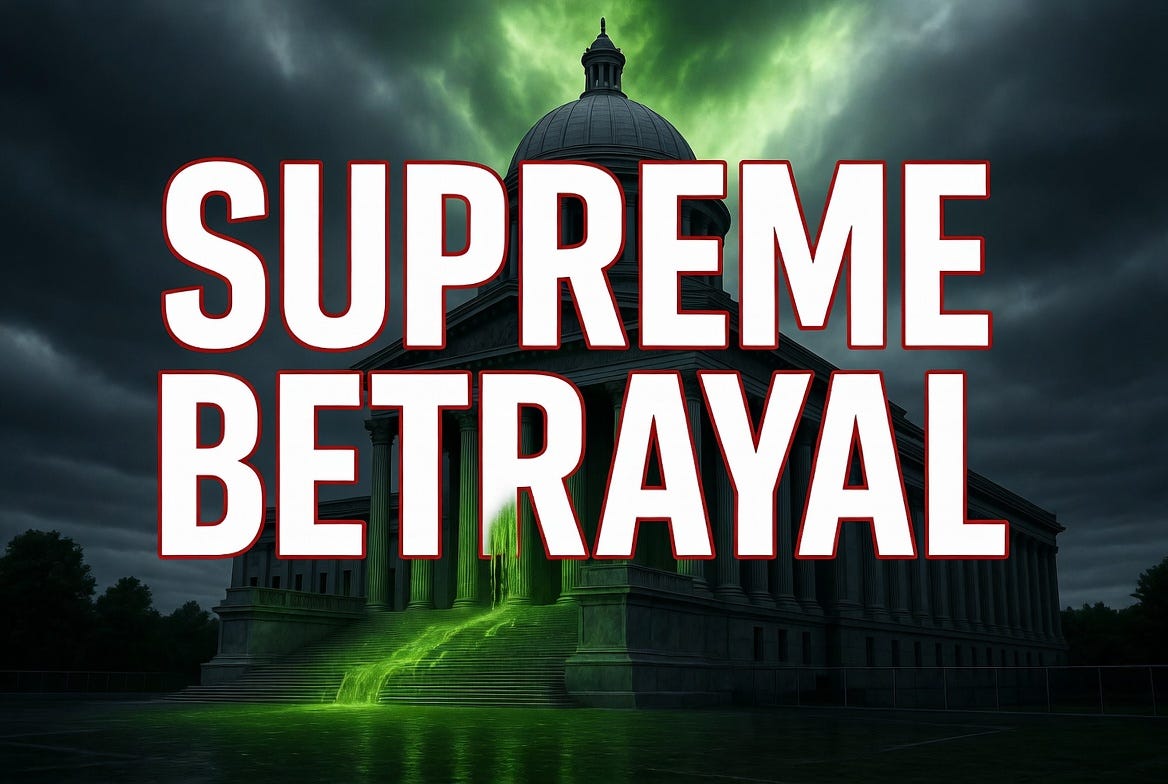
Photo source: Grok AI
So I can go to Walmart and buy cancer in a bottle. Home gardeners, applicators, farmers, farm workers, and consumers can too.
When they get cancer, they can’t do a thing about it — not anymore. The toxic floodgates have been let wide open, and more and more children and adults will get sick and die not only from exposure to a carcinogen like Roundup (glyphosate) but also from the various diseases that come from 2,4-D, atrazine, paraquat, carbaryl, and other highly toxic hidden chemicals permeating our food supply starting in Cancer Alley, Louisiana, where so many of them are first manufactured to farmers and farm workers and their children and finally to consumers.
This is thanks to the Supreme Court’s seven-to-two decision to shield pesticide companies from “failure to warn” lawsuits. It is a decision that goes against science. It goes against the people, including, most of all, farmers and farm workers and their children, home gardeners, communities, school children, and others involved in its applications or exposed to drift and cross contamination, and it goes against those living with cancer, as if after years of applying a pesticide known to cause cancer, a farmer, farm worker, applicator, or gardener mysteriously gets Non-Hodgkin’s lymphoma (NHL).
“The Supreme Court just eliminated an important legal tool for people seeking justice after suffering serious illnesses from toxic pesticides,” says EarthJustice, which filed an amicus brief on behalf of farmworkers in this case. “The court ruled that federal law shields pesticide manufacturers from liability in state courts when their products fail to warn of cancer risks. When companies cause harm, people deserve to hold them accountable. The state laws that enable them to do so are more important than ever as Trump’s Environmental Protection Agency (EPA) fails to protect people from toxic chemicals and other environmental hazards.
“A man named John Durnell filed a lawsuit in a Missouri state court against Monsanto, arguing that the company’s weedkiller Roundup gave him cancer. Durnell’s suit said Monsanto should pay him damages because the company failed to include a cancer warning on Roundup’s label. This type of lawsuit is known as a ‘failure-to-warn’ claim. The state court agreed with Durnell, awarding him $1.25 million. Monsanto appealed the case all the way to the Supreme Court, arguing that Durnell should not have won because a federal law called the Federal Insecticide, Fungicide, and Rodenticide Act (FIFRA) preempts — or bars — these failure-to-warn claims in state courts. Monsanto’s selective reading of the law ignores state authority to ban pesticides and the company’s ongoing duty to ensure its labels have adequate warnings and directions to protect the public. Under FIFRA, the fact that EPA has approved a given label does not provide a defense against a violation of this duty.”
The court ruled that FIFRA preempts state law failure-to-warn claims, dealing a major blow to farmworkers and others harmed by pesticides — as well as their families and communities. Earth Justice makes the following points:
- The ruling also marks a major win for Monsanto and other pesticide manufacturers seeking to avoid accountability in litigation involving Roundup and other dangerous chemicals.
- The ruling rests on the idea that state failure-to-warn claims impose labeling obligations beyond those required by the EPA. However, EPA approval is often based on limited information at a single point in time, while the science around pesticide harms continues to develop.
- In cases involving Roundup, state-court litigation helped reveal allegations that Monsanto knew more about cancer risks than it disclosed, ghostwrote articles dismissing those risks, and failed to provide adequate warnings to the public. By cutting off these claims, the court has weakened one of the most important backstops protecting people when federal regulation falls short.
I’m going to spread the blame and share what activists and health-conscious consumers need to do next.
Glyphosate, sold under brands such as Roundup, is a carcinogen. Multiple lines of evidence confirm this. While several health authorities have concluded that glyphosate does not pose a carcinogenic risk, comprehensive independent analyses and landmark lifelong-exposure studies have documented statistically significant increases in tumors across multiple rodent strains, according to research published in Environmental Health. A slightly less politicized body, the International Agency for Research on Cancer (IARC), considers glyphosate a carcinogen, associated with NHL, one of the commonest of the environmental cancers, as noted in Oncology Research. The problem here is one we deal with all of the time at the Healthy Living Foundation in our legal cases. Science outpaces agencies by decades. An agency makes a determination at a point in time, but with cancer’s long latency period, it can take decades after its introduction for the cancer to appear. American, Canadian, and European agencies have exonerated glyphosate, to be sure, but that is because they have relied on outdated reports that have since been retracted by the journals that published them.
In late 2025, the scientific journal Regulatory Toxicology and Pharmacology retracted a hallmark 2000 review paper that concluded glyphosate was safe, reports The Washington Post. The retraction was issued after internal emails surfaced in lawsuits showing that the study was actually ghostwritten by Monsanto employees but credited to independent academics. The paper also failed to disclose financial compensation from the company and relied entirely on unpublished, industry-owned data. This now-disavowed 2000 paper was one of the most highly cited in the glyphosate safety discourse. It was frequently used by major regulatory bodies, including the EPA and Health Canada, to justify their safety assessments and support the continued approval of the weedkiller. Despite these retractions and evidence of corporate influence, the EPA, Health Canada, and the European Food Safety Authority maintain that glyphosate is safe when used according to label directions. Yet, virtually all epidemiological studies associate its use with NHL, as recently reported in medRxiv.
Citizens have a right to the best, not politicized, science. Also, the EPA regulates on a cost-benefit basis, and the regulations allow the use of highly dangerous pesticides even when their cancer risks are known.
An agency, whether state or federal, is often riddled with pro-industry lobbyists whose policies reflect politics, not to mention diminishing budgets. Industry apologist Dr. Chuck Carr Brown used to head the Louisiana Department of Environmental Quality and accused activists of spooking communities in Cancer Alley over cancer and chloroprene. A call to me when I was a reporter for LA Weekly from Alexander Kelter, M.D., attempted to coerce me from mentioning DDT and cancer when I spoke before Congress about pollution problems in the Santa Monica Bay. He was the head of our state Department of Health Services. He told me not to mention DDT and cancer together, despite the fact that my study found much higher levels in persons eating fish from the bay.
Many important health issues that an agency should take on are often overlooked or delayed by politics. But citizens should not be the ones who are made to suffer or silenced. We need better redress, not worse, with the courts. The courts are vital to remedy the failures of public agencies. And now the Supreme Court turned us into their bitch and said, shut your mouth and eat your food.
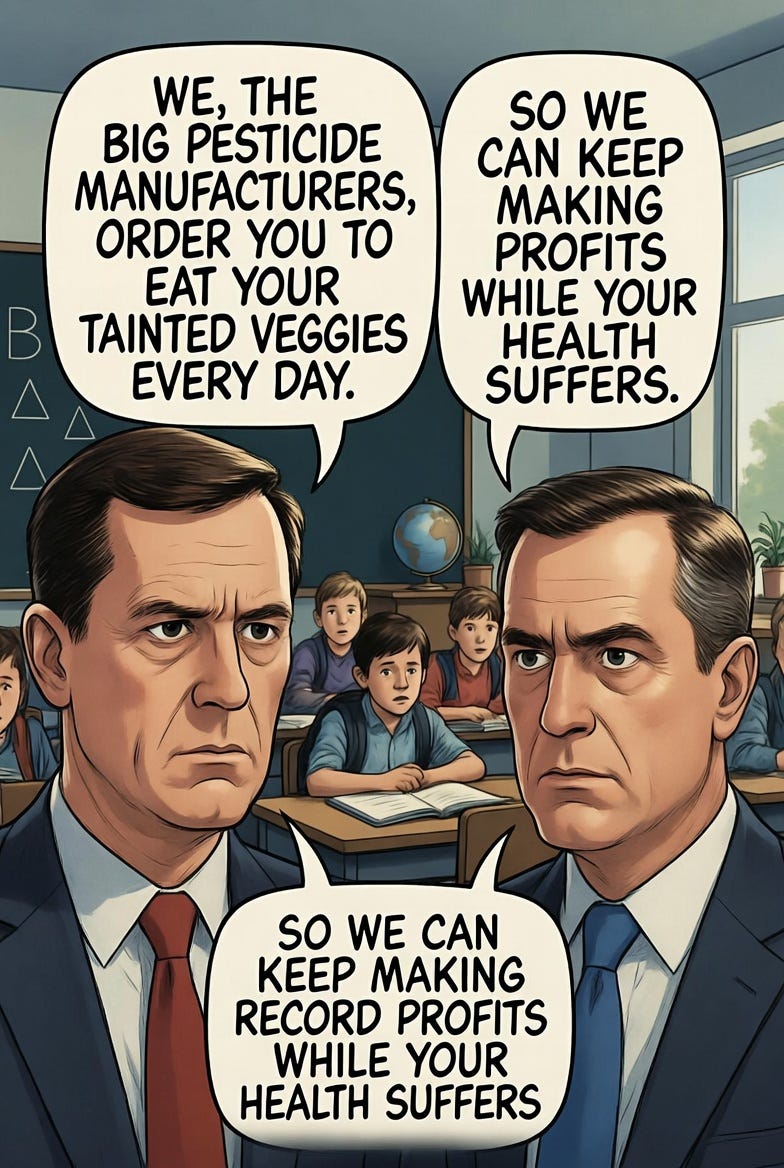
Photo source: Grok AI
The EPA has become a politicized institution. It is no longer science-based. It cannot be trusted any more to give us the reality of cancer causation than our so-called Department of War (aka Department of Defense) can give us the number of dead and wounded in the tragic Iran war.
I’m certainly blaming Bayer Monsanto. That one is obvious. But I’m also blaming Amazon, Walmart, and other retailers for continuing to sell a dangerous chemical.
I accuse the Supreme Court of misapplication of the law and scientific ignorance. It could have gone differently.
Progressive liberal Justice Ketanji Brown Jackson (joined by conservative Justice Neil Gorsuch) argued that EPA approval of a pesticide for agricultural use should not conclusively shield companies from liability. They noted that federal law (FIFRA) forbids “misbranding.”
Because state failure-to-warn lawsuits share this exact goal — ensuring a product adequately warns users of dangers — the dissent argued that states should be allowed to enforce it. This makes sense. Courts are often the citizens’ last chance for redress, as guaranteed by the First Amendment to the Constitution. Ratified in 1791 as part of the Bill of Rights, this clause ensures that citizens can ask the government to correct wrongs or change policies without fear of punishment. It is one of five fundamental freedoms protected by the amendment, alongside speech, press, religion, and assembly. That right is now being denied.
There is also precedent from the 2005 Bates v. Dow Agrosciences LLC case; the Supreme Court ruled that the federal pesticide law preempts only state regulations that explicitly conflict with federal labeling. The Court could have easily relied on this precedent to allow Durnell’s state-level verdict to stand. Since federal law prohibits misbranded pesticides, states can essentially act in parallel to federal goals when holding companies liable for failing to list cancer risks.
Both the Supreme Court and the EPA are politicized because of who the people elected as president and to Congress. Our votes matter.
But our issues dealing with hidden chemical toxins are highly complex and difficult because we are dealing with stealth villains that sneak into our bodies with corporate assurances, little if any regulation, and government backing of the poisoning of our bodies. But we are fighting not only for freedom but for our future.
So what do we need to do? We need to amend FIFRA to make explicit that federal law does not preempt state failure-to-warn claims.
We know our target districts. Some 142 members (135 Republican lawmakers and six Democrats plus an independent) voted to keep controversial pesticide liability shields (Sections 10205, 10206, and 10207) in the House Farm Bill. They were defeated on April 30, 2026, when a bipartisan majority voted to strip the immunity provisions. Roll call data confirm the group consists primarily of House Republicans who opposed the Luna-Pingree amendment. You can view the full official Roll Call 148 via the Office of the Clerk to identify the specific representatives who voted for or against the measure.
All Republican members of the House Agriculture Committee voted in favor of the Farm Bill’s pesticide immunity provisions during the committee markup. The controversial language (Section 10205) was designed to shield chemical manufacturers from “failure to warn” liability lawsuits and preempt local regulatory authority over pesticide usage. These provisions were advanced out of the committee on a 34–17 vote on March 4, 2026, with the support of all 27 Republicans on the panel. The Republicans who favored the legislation include:
Republican Members (All in Favor of the Bill/Language):
- Glenn “GT” Thompson (PA) — Chairman
- Frank Lucas (OK)
- Austin Scott (GA) — Vice Chair
- Rick Crawford (AR)
- Scott DesJarlais (TN)
- David Rouzer (NC)
- Trent Kelly (MS)
- Don Bacon (NE)
- Mike Bost (IL)
- Dusty Johnson (SD)
- Jim Baird (IN)
- Tracey Mann (KS)
- Randy Feenstra (IA)
- Mary Miller (IL)
- Brad Finstad (MN)
- John Rose (TN)
- Ronny Jackson (TX)
- Marc Molinaro (NY)
- Monica De La Cruz (TX)
- John Duarte (CA)
- Zach Nunn (IA)
- Derrick Van Orden (WI)
- Max Miller (OH)
- Kat Cammack (FL)
- Dan Newhouse (WA)
- Brandon Williams (NY)
- Tracey Moore (or equivalent newly assigned GOP freshmen for the 119th/120th Congresses)
These Democrats on the committee voted to advance the overall Farm Bill with the provisions included:
- David Scott (GA) (deceased)
- Jim Costa (CA)
- Salud Carbajal (CA)
- Don Davis (NC)
- Shri Thanedar (MI)
- Adam Gray (CA)
- Shomari Figures (AL)
I want my hurt, my anger, my shock to become something positive. There has been so much of it since Donald J. Trump came to power.
I cannot deny that it is like a never-ending nightmare during my waking hours.
The midterms are coming up. Voters who live in the districts of congressional representatives who supported pesticide immunity need to vote against them. They need to speak to their elected officials via social media and make them aware that amending FIFRA is a critical issue that will decide their vote. It is what is needed. But first, we need to vote in public representatives who are with us on this issue.
If this resonated, share it with someone who needs to hear it. Until next time — stay informed, stay proactive.
My new book is *Raising Healthy Kids: Protecting Your Children from Hidden Chemical Toxins. *Subscribe to my mypodcast on YouTube and newsletter on Medium.

메타데이터
- post_id
- ddfdb6361788
- slug
- supreme-betrayal-ddfdb6361788
- url
- https://medium.com/the-environment/supreme-betrayal-ddfdb6361788
- canonical_url
- https://medium.com/the-environment/supreme-betrayal-ddfdb6361788
- author_url
- https://medium.com/@davidwilliamsteinman
- status
- ok
- fetched_at
- 2026-07-09 10:29:04