The Inflation Hedge Argument for Bitcoin Has a 2022 Problem
Fixed supply is real. Calling it an inflation hedge is mostly marketing.
The Inflation Hedge Argument for Bitcoin Has a 2022 Problem
Fixed supply is real. Calling it an inflation hedge is mostly marketing.
EEvery Bitcoin pitch lands on the same claim eventually: it’s a hedge against inflation. Fixed supply, no central bank, 21 million hard cap. The story borrows gold’s reputation and assumes Bitcoin should behave the same way.
Look at the chart first. It already contradicts the claim.
The scarcity part is solid. Twenty-one million is not a slogan, it’s written into the protocol and no government can change it. Fiat currencies have always been expanded when the people in charge needed them expanded. Bitcoin cannot. People who bought in 2017 and simply held through 2021 made returns that made CPI look irrelevant. That part of the story holds.
The problem starts the moment the word “hedge” gets attached. A real hedge is supposed to rise when the thing you’re protecting against rises. Bitcoin has not done that consistently. In the one period that actually tested the idea, it did the opposite.
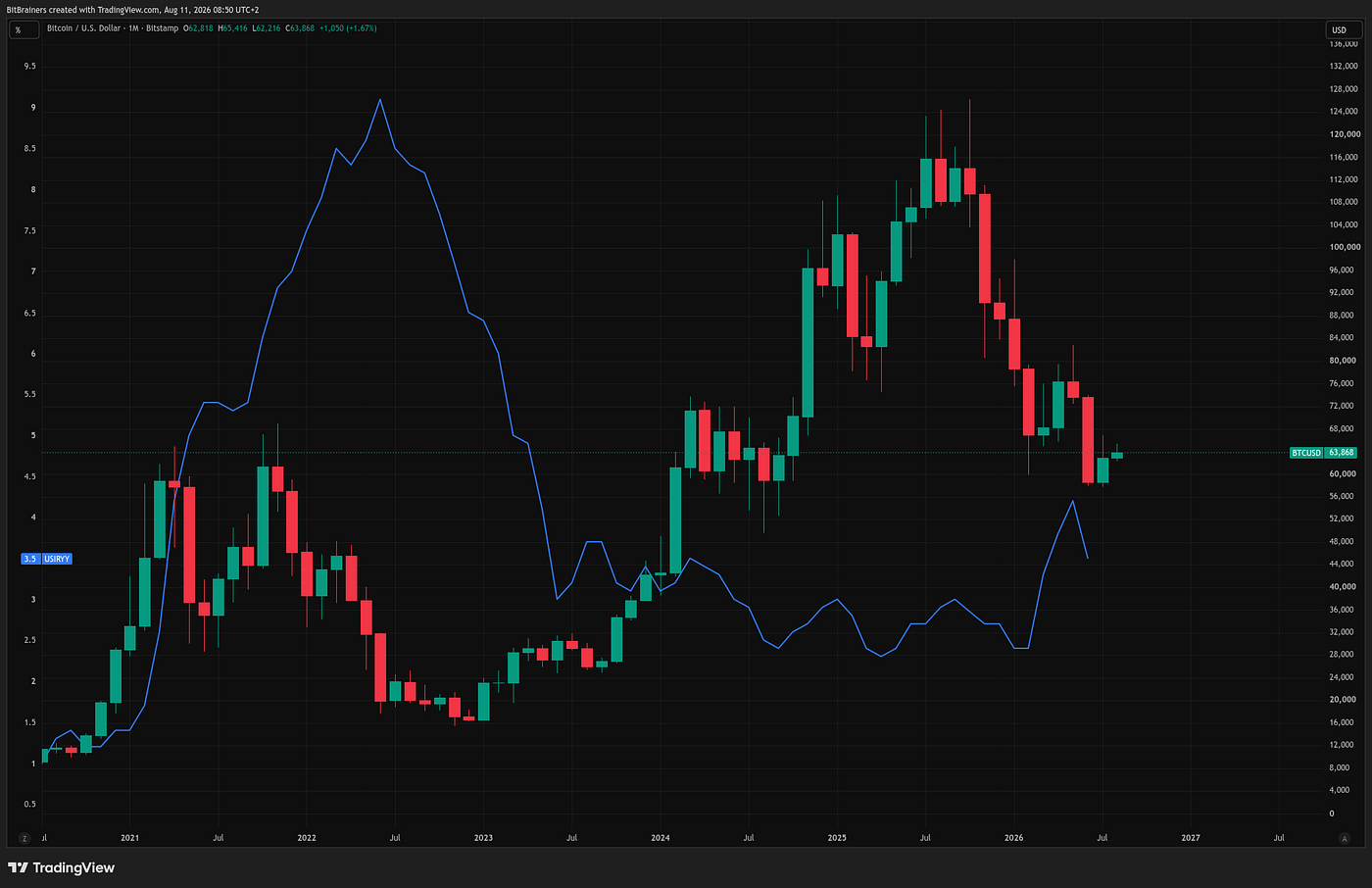
BTC/USD vs US CPI YoYBTC/USD vs US CPI YoY (USIRYY), monthly. BitBrainers via TradingView, Aug 2026.
2022
US CPI hit 9.1% in June 2022, the highest since 1981. Bitcoin was under $20,000 that same month, down about 70% from the November 2021 high. The blue line on the chart keeps climbing. The price candles fall hard.
Gold dropped too, but far less, and recovered quicker. The things that actually worked as inflation hedges that year were energy, agricultural commodities, and other real assets with direct pricing power. Bitcoin was not among them. It was trading like a risk asset. During the rate-hiking cycle its 90-day correlation with the S&P 500 stayed above 0.65 and peaked over 0.75 (Bloomberg). Gold’s correlation with equities sat near zero. That difference alone kills the “digital gold” comparison at the mechanical level.
I watched the same retail client push the inflation-hedge story in 2021, buy size around $60,000, and get liquidated near $16,000 the following year. The narrative never changed. The price did.
When the Fed started tightening and liquidity dried up, Bitcoin sold off with Nasdaq growth stocks, not with gold, and not the way a hedge is supposed to move.
The pattern has not meaningfully improved. In May 2026 CPI printed 4.2% the highest since April 2023. Bitcoin dropped about 2% on the release (from roughly $62,800 to $61,500) and was flat again within hours. That is risk-asset behavior, not hedge behavior.
Liquidity, not inflation
The 2020–2021 period made the hedge story look good. The Fed expanded its balance sheet, rates went to zero, and Bitcoin ran from $10,000 to $69,000 while inflation was also rising. People treated the co-movement as proof.
It wasn’t inflation driving the price. It was liquidity. Cheap money flooded into risk assets and Bitcoin sat at the top of that trade. CPI just happened to be rising at the same time. The correlation was coincidence.
When the Fed reversed course in 2022 the difference became obvious. Inflation kept climbing for months after the hikes began. Bitcoin stopped rising the moment liquidity conditions tightened. It was responding to the Fed’s balance sheet, not to the CPI print. This is also why global M2 tracks Bitcoin better than CPI ever has. M2 measures actual liquidity. Bitcoin has historically lagged global M2 expansion by roughly 10–12 weeks. That lag is readable if you know where to look. Full breakdown here: Bitcoin Follows M2 With a Lag Nobody Talks About.
What the longer-term case can still rest on
Strip out the short-term correlation and a more limited claim remains. Bitcoin may protect against currency debasement across multi-year or multi-cycle horizons. That is not the same thing as hedging quarterly CPI.
Debasement is the slow, structural erosion of purchasing power through repeated monetary expansion. CPI is just a snapshot of a goods basket. They are related, but they diverge constantly over shorter periods. A fixed-supply asset can plausibly help against the first. It has not reliably helped against the second.
Most people using the “inflation hedge” line are thinking in one- or two-year windows. On that timeframe Bitcoin has failed the test more than once. Gold has not. Gold does not require easy liquidity conditions to hold value. At its current stage of market maturity, Bitcoin still does.
What would actually have to change
Two things would need to shift for Bitcoin to act as a short- or medium-term inflation hedge.
First, its correlation with equities would have to break down in a lasting way. That probably requires a much larger base of sovereign and institutional holders treating it as a reserve asset instead of a speculative one. Spot ETF flows are a step in that direction, but the correlation numbers have not moved much yet.
Second, market depth would need to be large enough that a central bank or large sovereign could buy meaningful size during an inflationary crisis without swinging the price 10–20% in a week. That depth does not exist at the scale that matters for national reserves.
Both are possible. Neither is close. $56 billion of cumulative ETF inflows has not been enough to change the correlation behavior, and sovereign buyers are still largely absent from the data.
Where that leaves the argument
Bitcoin is a bet on global liquidity expansion, continued institutional adoption, and a fixed-supply design that may matter more in twenty years than it does right now. That is a coherent position. It may even turn out to be a good one.
It is not a short-run inflation hedge. The 2022 record is clear on that point, and the chart at the top of this piece shows it without any extra commentary required.
The 21 million cap is a real feature of the protocol. The inflation-hedge label is mostly a sales story built on top of it. Keeping those two things separate is the minimum requirement for honest analysis. Most of the content still circulating on this topic does not.
Sources Federal Reserve Bank of St. Louis US CPI Bureau of Labor Statistics / TradingView USIRYY CoinGecko Bitcoin historical data World Gold Council Gold as a Strategic Asset
This is market commentary, not financial advice. Nothing here is a recommendation to buy or sell any asset. Do your own research.
Originally published at bitbrainers.com
메타데이터
- post_id
- ddfe4bee4eaa
- slug
- the-inflation-hedge-argument-for-bitcoin-has-a-2022-problem-ddfe4bee4eaa
- url
- https://medium.com/@BitBrainers/the-inflation-hedge-argument-for-bitcoin-has-a-2022-problem-ddfe4bee4eaa
- canonical_url
- https://medium.com/@BitBrainers/the-inflation-hedge-argument-for-bitcoin-has-a-2022-problem-ddfe4bee4eaa
- author_url
- https://medium.com/@BitBrainers
- status
- ok
- fetched_at
- 2026-08-12 11:02:35