When the Master Technicians Retire, Who Will Still Understand the Sound of the Machines?
Today, manufacturing is facing a very real challenge: the people who truly understand equipment behavior are retiring. And the bigger…
When the Master Technicians Retire, Who Will Still Understand the Sound of the Machines?
Today, manufacturing is facing a very real challenge: the people who truly understand equipment behavior are retiring. And the bigger problem is this — younger engineers no longer have the same environment to grow and learn from experience.
As labor shortages intensify and veteran technicians leave the workforce, the greatest risk in factories is no longer just equipment failure. It is the loss of experience itself.

The Growing Experience Gap in Manufacturing
In many factories, there is always that one remarkable person.
Before a machine even triggers an alarm, they already know something is wrong.
A slight change in the sound of an air compressor tells them there may be a leak. A small vibration in a pump hints that the bearing is beginning to fail. A drifting current in a chiller signals declining cooling efficiency.
These experienced technicians often do not even need to look at data. What they rely on is intuition built from ten, twenty, or even thirty years of hands-on experience.
It is a skill that is difficult to quantify, yet for decades it has been one of the key reasons factories could maintain stable operations.
But today, manufacturing faces a harsh reality: the people who can “hear” and understand machines are retiring.
What makes the situation even more serious is that younger engineers no longer have the same opportunity to gradually accumulate field experience.
In the past, a new engineer might spend three to five years learning alongside a senior technician, slowly understanding the personality, sound, and operational behavior of each machine.
Today, factories move much faster. Production lines cannot stop. Delivery schedules cannot wait. Manpower remains limited.
As a result, many young engineers are expected to independently manage equipment before they have truly mastered it.
This has led to a new phenomenon in manufacturing: machines are becoming smarter, but the number of people who truly understand them is shrinking.
In the past, losing a senior engineer meant losing manpower. Today, when a veteran technician retires, factories often lose part of their “decision-making capability.”
The equipment remains. The data remains. But the people who know what the data truly means are disappearing.
That is why more and more companies are now asking an important question:
If experience cannot be rapidly replicated, can we preserve the judgment of master technicians through data?
How Experience Loss Increases Equipment Risk
In the past, factories believed their most valuable assets were machines. Today, many companies are realizing that their true assets are the experiences stored in the minds of veteran technicians.
Because most equipment failures do not happen suddenly. Warning signs usually appear long before breakdowns occur.
The problem is that fewer and fewer people can recognize them.
True abnormalities rarely look like “failures.” Instead, they appear as:
- Slight abnormal noises
- Gradual increases in power consumption
- Minor load deviations
- Small vibration frequency changes
- Temperatures slightly above normal
These early-stage symptoms are extremely difficult to detect through routine inspections.
Especially in industries such as semiconductors, petrochemicals, and metal processing, where factories operate thousands of devices simultaneously, engineers simply cannot monitor every machine continuously.
As a result, by the time abnormalities are finally noticed, they have often already become:
- Unexpected downtime
- Yield reduction
- Increased energy consumption
- Production interruptions
- Rising maintenance costs
- Potential safety risks

Many Machines Begin “Quietly Consuming More Energy”
Many companies originally introduced EMS (Energy Management Systems) simply to monitor electricity usage, manage energy costs, and improve energy efficiency.
But now, more manufacturers are discovering that the real value of EMS is not just knowing how much electricity is being used.
The more important question is:
Why is this machine suddenly consuming more energy?
Most equipment failures do not happen overnight. In many cases, warning signs begin appearing weeks or even months earlier.
The problem is that these signs are subtle.
Perhaps the bearing friction increases slightly. Motor efficiency drops a little. Pump loads slowly rise. An air compressor develops a minor leak.
At first, these problems may not affect production. But the equipment quietly begins consuming more electricity.
That is what makes these abnormalities so dangerous: they do not look like failures.
And because they do not look serious, they are easily ignored.
Until one day, the machine suddenly shuts down — and only then does the company realize the abnormality had already begun long ago.
In many cases, equipment abnormalities appear first not as failures, but as changes in energy consumption.
For example:
- Air compressor leaks cause unstable system pressure and higher motor loads
- Worn pump impellers reduce efficiency and increase power consumption
- Robotic arm resistance or reduced heating efficiency can alter power curves
These issues gradually increase equipment load, but the human eye often cannot detect them.
By the time electricity bills suddenly rise, the problem may already be severe.
In Semiconductor Manufacturing, Early Detection Is Everything
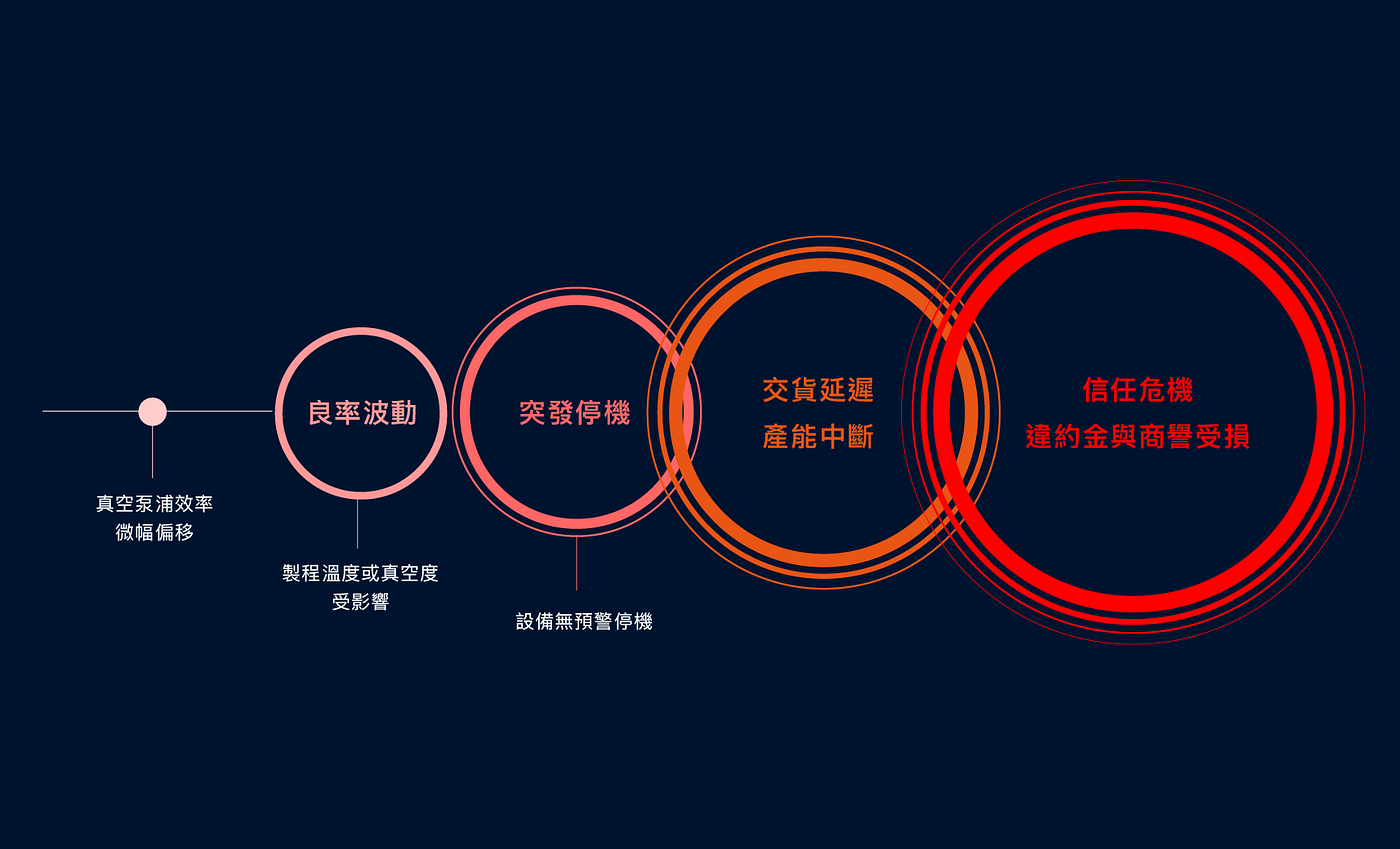
In semiconductor factories, vacuum pumps and chillers are both highly energy-intensive and mission-critical equipment.
Even a small decline in cooling efficiency or vacuum performance can affect an entire wafer production process.
The most difficult part is that these abnormalities usually begin at a very early stage. Operators rarely notice them immediately.
And once production quality issues appear, the consequences are no longer just higher electricity costs. The impact may include:
- Yield fluctuations
- Production downtime risks
- Delayed deliveries
- Customer pressure
That is why more semiconductor manufacturers are now using EMS platforms for long-term monitoring of:
- Power consumption trends
- Load variations
- Power factor behavior
- Abnormal fluctuations
This allows equipment abnormalities to be identified much earlier.
In the past, only experienced technicians could detect these subtle changes. Today, EMS systems are beginning to convert those experiences into data.
More importantly, AI is starting to help engineers identify real problems hidden within massive amounts of operational data.
AI Is Beginning to Inherit the Experience of Veteran Technicians
Factories today generate enormous amounts of data every single day.
Many engineers are overwhelmed by:
- Too many dashboards
- Too many alarms
- Too much data
But the real problem is: they often do not know which issue truly requires attention.
Sometimes dozens of alarms appear overnight, only to turn out to be sensor noise. Meanwhile, the truly dangerous abnormality may simply be a 5% increase in power consumption.
And these “failures that do not look like failures” are often the easiest to overlook.
No engineer can realistically spend every day analyzing hundreds of charts manually.
That is where AI begins playing a new role.
Not to replace engineers. But to help them identify what deserves attention first.
AI can:
- Detect abnormalities early
- Compare historical data automatically
- Identify trend deviations
- Summarize potential root causes
- Recommend inspection directions
For example:
If Air Compressor B suddenly consumes 20% more electricity than its historical baseline, AI does not simply say: “Power consumption increased.”
Instead, it further analyzes:
- Historical operating conditions
- Equipment load behavior
- Maintenance SOPs
- Common fault records
It may even combine maintenance manuals and equipment knowledge databases to provide recommendations such as:
“Priority inspection recommended for intake filters and exhaust pressure settings.”
This is essentially the digitalization of veteran technicians’ experience.
The Future Belongs to Those Who Detect Problems Earlier
Manufacturing today is no longer only about maximizing production capacity.
Factories must simultaneously face:
- Labor shortages
- Rising energy costs
- ESG requirements
- Carbon accounting
- Supply chain instability
- Customer expectations for stable delivery
Especially in semiconductor and high-tech industries, one unexpected shutdown can disrupt not only production, but entire supply chains.
That is why many companies are realizing:
The strongest factories are not necessarily the ones with the most equipment.
They are the ones that can detect abnormalities the earliest.
Because when problems are caught early:
- Maintenance costs are lower
- Downtime risks are smaller
- Energy waste is minimized
- Production impact is reduced
This is why EMS, AI, OEE, and predictive maintenance are increasingly being integrated together.
Companies no longer want systems that simply say: “The machine has failed.”
They want systems that can think like experienced technicians and answer questions such as:
- Which equipment is starting to behave abnormally?
- Which energy patterns indicate declining efficiency?
- Which abnormalities are slowly developing?
- Which issues may eventually cause downtime?
Because the earlier problems are identified, the lower the operational risk becomes.
Manufacturing is now entering a completely new era of equipment management — from relying on human experience to leveraging EMS data and AI-driven trend analysis.
The Next Evolution of EMS: From Energy Saving to Intelligent Decision-Making
Traditionally, companies introduced EMS for purposes such as:
- Reducing electricity costs
- Managing carbon emissions
- Supporting ESG initiatives
But EMS is now evolving into something much larger: the central nervous system of equipment health management.
Modern EMS platforms are beginning to integrate:
- AI
- Predictive diagnostics
- OEE analysis
- Maintenance SOPs
- Energy management
- Carbon tracking
This allows factories not only to “see data,” but to truly understand:
- Which equipment is aging
- Which machines are losing efficiency
- Which abnormalities are emerging
- Which issues may affect yield
And these capabilities are redefining future manufacturing competitiveness.
AI Will Not Replace Veteran Technicians — It Will Preserve Their Experience
Future factories may no longer have a twenty-year veteran technician standing beside every production line.
But their experience should not disappear with retirement.
Companies still need someone — or something — that can recognize when equipment “does not sound right.”
The reality is that many experienced technicians are willing to teach. The challenge is that much of their knowledge is difficult even for them to explain.
It is intuition built naturally through years of working beside machines.
In the past, this knowledge could only be passed down slowly from one generation to another.
Today, manufacturing finally has an opportunity to preserve that experience.
Through EMS, AI, and predictive diagnostic systems, equipment behaviors that once relied entirely on human judgment can now be digitized, modeled, and systemized.
Allowing factories to:
- Detect abnormalities earlier
- Reduce energy waste
- Improve equipment efficiency
- Prevent unexpected downtime
- Accelerate ESG implementation
Because truly intelligent factories are not the ones that repair machines after failure.
They are the ones that understand what machines are trying to say — before the machines even begin to speak.
메타데이터
- post_id
- de0a67b5f5f9
- slug
- when-the-master-technicians-retire-who-will-still-understand-the-sound-of-the-machines-de0a67b5f5f9
- url
- https://medium.com/@service_36837/when-the-master-technicians-retire-who-will-still-understand-the-sound-of-the-machines-de0a67b5f5f9
- canonical_url
- https://medium.com/@service_36837/when-the-master-technicians-retire-who-will-still-understand-the-sound-of-the-machines-de0a67b5f5f9
- author_url
- https://medium.com/@service_36837
- status
- ok
- fetched_at
- 2026-07-10 15:36:45