Crypto Token Creation in 2026: What Recent Token Launches Teach You About Launch Strategy?
Crypto token creation in 2026 is no longer a simple smart contract deployment. Recent token launches show that the market now studies…
Crypto Token Creation in 2026: What Recent Token Launches Teach You About Launch Strategy?
Crypto token creation in 2026 is no longer a simple smart contract deployment. Recent token launches show that the market now studies supply, vesting, public allocation, compliance, liquidity, and real product use before trusting a project. This shift matters for businesses because a token can support fundraising, community growth, access, loyalty, governance, or asset participation, but only when the launch is planned properly.
This guide explains how businesses can create a crypto token with stronger launch logic, from tokenomics and smart contract development to launch models, listing readiness, and post-launch growth.
Table of Contents
∘ Why Crypto Token Creation Needs a Smarter Launch Plan? · What Recent Token Launches Teach Businesses About Launch Strategy? ∘ What Is Crypto Token Creation in 2026? ∘ Key Token Types Businesses Can Create ∘ Business Benefits of Creating a Crypto Token ∘ Crypto Token Creation Process for Businesses ∘ Tokenomics Framework for a Strong Launch ∘ Smart Contract Features Businesses Should Consider ∘ Comparing Token Launch Models in 2026 ∘ Conclusion
Why Crypto Token Creation Needs a Smarter Launch Plan?
A business can still create an ERC-20, BEP-20, SPL, Polygon, Base, Arbitrum, or custom token. The technical route is clear. The real challenge is market trust.
Recent launches show that buyers now ask harder questions. Who receives the supply? When do unlocks begin? What utility exists at launch? Is liquidity planned? Are compliance documents ready? These questions decide whether the token gains confidence or loses attention after listing.
This is why token creation now needs launch architecture. The technical layer, tokenomics layer, compliance layer, and market layer must work together. A token creation partner should not only write code. It should help the business define token purpose, supply logic, user demand, legal readiness, listing preparation, and post-launch support.
What Recent Token Launches Teach Businesses About Launch Strategy?
Recent token launches show that the market is not against new tokens. It is against unclear tokens. Buyers still respond to strong distribution, fair access, working utility, credible lockups, and active user participation. The difference is that the market now expects these signals from the beginning.
Lesson 1: Public Allocation Must Feel Fair and Understandable
Coinbase’s return to public token sales is one of the strongest launch signals for 2026. Its token sale platform uses a request window, USDC payments, registration, compliance checks, and an allocation algorithm instead of a simple first-come model. Reuters reported that Coinbase planned to offer about one token sale per month, with Monad selected as the first project on the platform.
The bigger lesson is not just that Coinbase entered token sales again. The lesson is that public allocation now needs structure.
Coinbase says its token sale platform uses a “filling up from the bottom” allocation algorithm to support broader participation. It also states that quick flipping can reduce a user’s chance of receiving larger allocations in future sales. This shows how launch platforms are trying to separate genuine supporters from short-term traders.
For businesses, fair allocation is now part of launch credibility. A public sale that looks dominated by insiders, bots, or large buyers can damage trust before trading even begins. Users want to know how tokens are distributed, who gets access, and why the system is fair.
A business planning a token generation event should explain:
- Public sale percentage
- Purchase limits
- Eligibility rules
- KYC requirements
- Regional restrictions
- Refund process
- Allocation method
- Listing timeline
- Initial circulating supply
Clear allocation does not remove all market risk, but it reduces confusion. That matters during launch week, where doubt spreads fast.
Lesson 2: Vesting and Lockups Are Now Trust Signals
Vesting is no longer a minor tokenomics detail. It is one of the first things serious buyers inspect.
Coinbase’s model includes restrictions on issuers and affiliates selling tokens for six months after the public sale, according to reports on the platform’s launch structure. Monad’s token sale page on Coinbase also listed a clear sale timeline, starting with the announcement on November 10, 2025, followed by the sale window from November 17 to November 23, 2025.
The market reads lockups as a signal of alignment. Long-term builders should not be able to exit before public buyers understand the project. Teams, investors, foundations, and treasury wallets need schedules that match the project’s growth timeline.
Weak vesting creates fear. Short lockups can make buyers expect heavy selling. Unclear unlocks create speculation. Hidden wallet movements can turn a community against the project.
A strong vesting plan should be easy to read. It should show who receives tokens, when tokens unlock, and how much enters circulation during each period. It should also explain why each allocation exists.
For example, a gaming token may need a large ecosystem rewards pool. A DeFi protocol may need liquidity incentives. An RWA platform may need treasury reserves for compliance, platform growth, and partner onboarding. The allocation itself is not the issue. The explanation is.
Businesses should treat vesting as part of communication, not only finance. A clear unlock calendar builds confidence. A confusing one creates pressure.
Lesson 3: Exchange Access Alone Cannot Save a Weak Token
Exchange access gives a token visibility. It does not create lasting demand by itself.
A listing can bring traders, price discovery, liquidity, and public tracking. That first wave matters. Still, the token needs a reason to hold attention after the listing announcement fades. Recent launch behavior shows that tokens without product use, strong community participation, or steady communication often lose momentum after their first trading window.
This is where many projects confuse visibility with strength. A listing-first launch asks the exchange to carry the token. An ecosystem-first launch gives the exchange a stronger asset to introduce.
A listing-first launch often looks like this:
- Token created
- Exchange listing announced
- Community spikes for a few days
- Trading begins
- Utility remains unclear
- Price pressure grows
- Communication slows
An ecosystem-first launch works differently:
- Product or platform use case is defined
- Token utility is explained before sale
- Public allocation is structured
- Liquidity and market support are planned
- Listing documents are ready
- Community knows what happens after trading starts
- Post-launch updates continue
The second model gives buyers more reason to stay engaged. It also gives exchanges, partners, and market makers a clearer project story.
For businesses, the lesson is direct. Do not create a token only to chase a listing. Create a token that can survive after the listing.
Lesson 4: Community Distribution Works Better When It Attracts Real Users
Community distribution works best when it brings in people who understand the project, use the product, or support the ecosystem. Random distribution can create wallet numbers. It does not always create real participation.
Binance Launchpool gives a useful example of structured participation. Binance states that Launchpool airdrops are calculated based on a user’s locked amount compared with the total locked amount across all users, and rewards accumulate hourly. In 2025, Binance also announced Launchpool campaigns such as Kite, where users could lock BNB, FDUSD, and USDC to receive token airdrops over a defined farming period.
This model teaches a wider launch lesson. Distribution should create a relationship between the project and the user. It should not only spread supply.
For a business token launch, community distribution can take several forms:
- Launchpool rewards
- Airdrops for product users
- Staking-based participation
- Testnet user rewards
- NFT holder access
- Loyalty-based allocation
- Referral-linked rewards
- Governance participation rewards
The main point is quality. A project needs users who care about the product, not only wallets that claim rewards and leave.
This matters for gaming, DeFi, RWA, AI, and loyalty tokens. A gaming token should reward players, not only early buyers. A DeFi token should support liquidity providers and protocol users. An RWA token should educate qualified participants and maintain careful access rules. A loyalty token should connect with real customer behavior.
Community distribution becomes powerful when it matches the business model.
Lesson 5: Compliance Is Now Part of Market Entry
Compliance is now part of launch planning. It cannot be treated as a final check after the token is created.
The EU’s MiCA framework has pushed crypto projects to think more carefully about documentation, white papers, data standards, and service provider obligations. ESMA states that MiCA and related rules set technical format requirements for crypto-asset white papers and order book records kept by crypto-asset service providers that operate trading platforms. ESMA also stated that the implementing technical standards for crypto-asset white paper forms, formats, and templates apply from December 23, 2025.
This creates a clear business lesson. Token launch strategy now needs legal and compliance input early.
Compliance affects:
- Token classification
- Sale eligibility
- KYC and AML checks
- Marketing language
- White paper content
- Risk disclosures
- Regional access rules
- Exchange listing documents
- Custody or asset backing claims
- Record-keeping requirements
This is especially relevant for RWA tokens, security-style tokens, yield-linked models, payment tokens, and projects targeting users across multiple regions. A project that ignores these issues can face listing delays, public trust issues, or forced changes after launch.
Compliance does not need to weaken the launch story. It can strengthen it. Clear documentation, defined participation rules, and careful disclosures make the project easier for serious buyers and partners to assess.
For businesses, the best move is to plan compliance alongside tokenomics and smart contract development. That creates cleaner documents, safer messaging, and better exchange readiness.
What Is Crypto Token Creation in 2026?
**Crypto token creation** is the process of designing, developing, deploying, distributing, and supporting a blockchain-based asset for a defined business purpose. The token may support access, payments, rewards, governance, loyalty, staking, or asset-linked participation.
A token differs from a coin. A coin belongs to its own blockchain, like Bitcoin or Ether. A token usually runs on an existing blockchain such as Ethereum, BNB Chain, Solana, Polygon, Base, Arbitrum, Avalanche, or Tron. Most businesses need token development, not full blockchain development, because it is faster, more practical, and easier to connect with wallets, exchanges, and users.
Common standards include ERC-20, BEP-20, SPL, ERC-721, and ERC-1155. Businesses also create utility tokens, governance tokens, reward tokens, RWA tokens, loyalty tokens, stable-value tokens, and security-style tokens where regulation permits.
Key Token Types Businesses Can Create
Utility Tokens
Used for platform access, service payments, app rewards, discounts, staking rights, and marketplace activity.
Governance Tokens
Used for DAO voting, treasury proposals, protocol upgrades, fee changes, and community-led decisions.
Security and Asset-Linked Tokens
Used for regulated access to equity, debt, revenue rights, real estate, commodities, private credit, or other RWAs.
Gaming and Metaverse Tokens
Used for in-game currency, tournament rewards, NFT upgrades, creator payments, and player incentives.
Loyalty and Brand Tokens
Used for VIP access, fan engagement, customer rewards, gated content, memberships, and digital collectibles. Ferrari’s planned token program for elite clients shows how even luxury brands are testing controlled token-based engagement.
Business Benefits of Creating a Crypto Token
A crypto token can help businesses raise capital, reward users, manage access, support digital ownership, and create new ecosystem participation models.
Token-based fundraising can happen through ICOs, IDOs, IEOs, launchpad sales, public token sales, private rounds, and community sales. The right model depends on token type, legal position, user base, and launch goals.
Tokens can also improve retention. Users can earn rewards through product usage, referrals, staking, gaming, learning, or merchant activity. The best models connect rewards with real platform behavior, not random giveaways.
A token also gives businesses programmable logic. Smart contracts can manage vesting, staking, access rules, transfers, fees, governance, and rewards. This makes the token more than a tradeable asset. It becomes part of the business system.
Crypto Token Creation Process for Businesses
Step 1: Define the Token Purpose
Start with the business model, target users, revenue logic, ecosystem roles, jurisdiction, and long-term market fit. The token must have a clear reason to exist.
Step 2: Design Tokenomics
Plan total supply, allocation, vesting, cliffs, treasury, liquidity reserves, staking rewards, incentives, and unlock schedules.
Step 3: Choose the Blockchain Network
Compare Ethereum, BNB Chain, Polygon, Solana, Base, Arbitrum, Avalanche, Tron, or custom chain options based on fees, user base, tooling, liquidity, and exchange support.
Step 4: Develop the Smart Contract
Select the token standard and define supply rules, admin roles, transfer controls, minting rights, pause functions, tax logic, upgradeability, multisig control, and contract verification.
Step 5: Test and Audit
Run unit tests, testnet checks, automated scans, manual reviews, audits, bug fixes, and final deployment checks before launch.
Step 6: Complete Legal Review
Review token classification, white paper content, KYC, AML, securities risk, MiCA readiness, investor disclosures, and exchange documentation.
Step 7: Integrate Wallets and Dashboards
Connect the token with wallets, staking portals, claim dashboards, vesting dashboards, dApps, NFT systems, marketplaces, and analytics tools.
Step 8: Prepare Launch and Listings
Plan DEX liquidity, CEX discussions, market maker support, listing documents, token tracker submissions, and launch communication.
Step 9: Monitor Post-Launch Growth
Track holders, liquidity, unlocks, treasury movement, community activity, staking, governance, and future exchange expansion.
Tokenomics Framework for a Strong Launch
Tokenomics should be simple enough for users to understand quickly. A strong framework covers supply, distribution, vesting, utility, liquidity, and treasury rules.
Total and Circulating Supply
Total supply shows the full token count. Circulating supply shows what is available at launch. A low circulating supply with high FDV can create concern, so launch supply must be planned carefully.
Allocation Strategy
Common categories include team, advisors, treasury, ecosystem rewards, public sale, private sale, liquidity, partnerships, and community incentives. Each allocation should have a clear reason.
Vesting and Unlocks
Vesting reduces fear of insider selling. Projects should publish lockups, cliffs, release dates, and wallet labels where possible.
Utility Mapping
Every token function should connect with a real business action, such as access, rewards, governance, payments, staking, fee discounts, or marketplace use.
Liquidity and Market Support
Plan DEX pool size, CEX market depth, market maker support, slippage, spreads, and post-listing monitoring.
Treasury Rules
Treasury tokens should support development, grants, liquidity, audits, listings, rewards, and partnerships. Spending rules should be clear.
Smart Contract Features Businesses Should Consider
Fixed Supply vs Mintable Supply
Fixed supply builds trust by limiting future issuance. Mintable supply can support rewards, gaming economies, or elastic ecosystems, but it needs strict controls.
Role-Based Access Control
Owner, admin, treasury, compliance, and reward roles should be separated. Multisig control reduces single-wallet risk.
Pausable Controls
Emergency pause features can protect users during exploits or technical issues, but they must be disclosed clearly.
Transfer and Compliance Rules
Whitelist access, blacklist restrictions, wallet caps, vesting locks, and jurisdiction-based controls may be needed for regulated or private-sale tokens.
Staking, Rewards, and Governance
These modules can launch immediately or later. A phased rollout often works better because the project can study user behavior before adding complex systems.
Comparing Token Launch Models in 2026
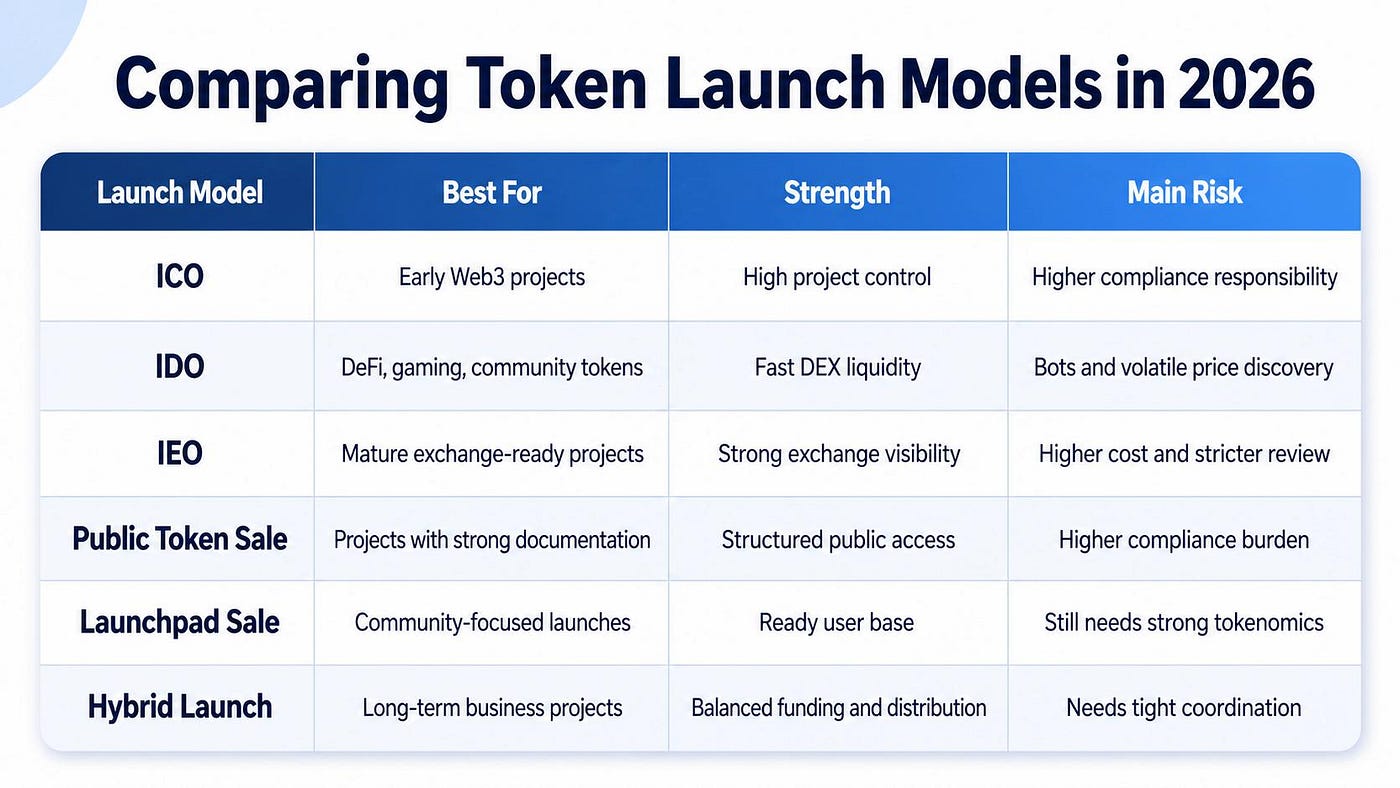
A hybrid launch often works best for business-focused tokens. It can combine private funding, public sale, community rewards, DEX access, CEX listing, staking, and ecosystem incentives in stages. This avoids placing the entire launch pressure on one event.
Conclusion
Crypto token creation in 2026 needs strategy, not just deployment. Businesses must define token purpose, design clear tokenomics, choose the right chain, build secure contracts, prepare compliance documents, plan liquidity, and support users after launch.
Recent token launches show that the market rewards clarity. Fair allocation, visible vesting, real utility, structured community participation, and strong post-launch support now matter as much as technical development.
A strong token launch is a planned market entry. The right crypto token development company can connect smart contract development, tokenomics, compliance, launch planning, listing support, and post-launch growth into one clear execution plan.
메타데이터
- post_id
- de0cdd3c8fde
- slug
- crypto-token-creation-in-2026-what-recent-token-launches-teach-you-about-launch-strategy-de0cdd3c8fde
- url
- https://medium.com/coinmonks/crypto-token-creation-in-2026-what-recent-token-launches-teach-you-about-launch-strategy-de0cdd3c8fde
- canonical_url
- https://medium.com/coinmonks/crypto-token-creation-in-2026-what-recent-token-launches-teach-you-about-launch-strategy-de0cdd3c8fde
- author_url
- https://medium.com/@vimal-joseph
- status
- ok
- fetched_at
- 2026-07-24 19:51:38