Australia’s Permanent Migration Points Test Optimisation 2026: How the New Scoring Framework Works…
By: Oghenehoro Evi Eni Wednesday, May 27, 2026 · 7 min read · Immigration & Business Law
Australia’s Permanent Migration Points Test Optimisation 2026: How the New Scoring Framework Works for Skilled Visa Applicants
By: Oghenehoro Evi Eni Wednesday, May 27, 2026 · 7 min read · Immigration & Business Law
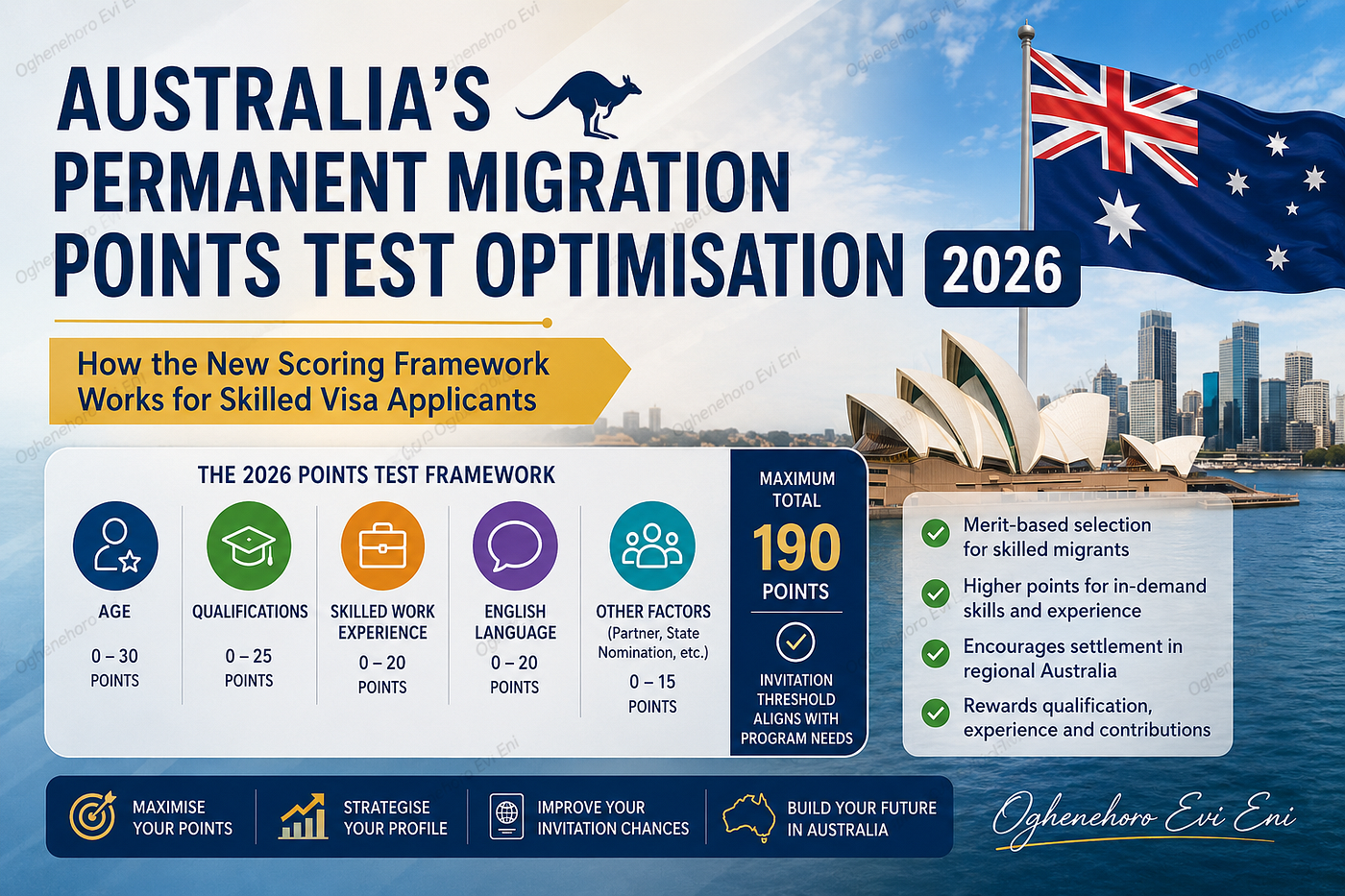
In Australia’s 2026 Federal Budget, one word carried enormous weight for skilled migrants around the world: “optimise.”
That single term signals a major recalibration of the points test used to select applicants for Australia’s General Skilled Migration (GSM) visas, Subclass 189, 190, and 491. With more than 250,000 Expressions of Interest (EOIs) sitting in SkillSelect at any given time, even modest changes to points allocation can radically alter who receives an invitation for permanent residence and who remains in the queue indefinitely.
Although the government has not yet released the full legislative text, the budget language and policy direction make one thing clear: the rules of the game are shifting.
1. The Current Points Test: Where We’re Starting From
Before optimisation, Australia’s points test rewards a familiar mix of age, English proficiency, education, and work experience.
1.1 Key points allocations (pre-optimisation)
- Age: 25–32 years = 30 points (maximum), with declining points outside this range
- English language: Proficient English (IELTS 7) = 10 points; Superior English (IELTS 8) = 20 points
- Skilled employment in Australia: Up to 20 points for extensive Australian experience
- Skilled employment overseas: Up to 15 points
- Australian study: 5 points for an Australian degree, with additional regional bonuses
- State or territory nomination: Subclass 190 = 5 points; Subclass 491 = 15 points
- Professional Year Program: 5 points
- Partner skills: Up to 10 points for a skilled partner or strong English, or for having no partner / an Australian PR or citizen partner
This framework has shaped GSM invitations for years but the government now believes it can do better.
2. What “Optimisation” Really Signals
When policymakers talk about optimising the points test, they are implicitly admitting that some high-scoring applicants are not delivering the economic outcomes Australia wants.
This mirrors similar critiques seen in other countries and suggests a shift toward predictive factors including credentials that indicate a migrant is already integrated into Australian society and the labour market.
Every points-test optimisation creates winners and losers. In almost every reform cycle, the winners are applicants with strong Australian-based credentials and the losers are those relying primarily on overseas qualifications and experience.
The reforms are being driven and implemented by Department of Home Affairs, whose stated priority is long-term economic contribution rather than paper qualifications alone.
3. Likely Direction of the 2026 Optimisation
While we await final regulations, the budget signals and policy context point to several high-probability changes.
3.1 What is likely to score higher
- Australian education: Expect stronger weighting for Australian qualifications, particularly degrees completed onshore.
- Australian skilled work experience: Applicants already working successfully in Australia are seen as lower-risk and higher-value.
- Strong English proficiency: Superior English (IELTS 8 or equivalent) remains one of the strongest predictors of earnings and employment success.
- Regional study and work: Australia’s regional migration strategy remains politically and economically important, making these incentives likely to stay or grow.
3.2 What may be de-emphasised
- Overseas-only work experience: If the aim is to privilege Australian integration, overseas experience may carry relatively less weight than before.
4. What Skilled Visa Applicants Should Do Now
With optimisation approaching, timing and preparation matter more than ever.
- Secure your skills assessment immediately: This confirms your eligible occupation and is mandatory before lodging an EOI.
- Submit your EOI as early as possible: When invitation scores are tied, earlier EOIs often win.
- Maximise your English score: Moving from Proficient to Superior English can add 10 crucial points often the difference between an invitation and silence.
- Claim Australian study correctly: If you have studied in Australia, ensure your EOI reflects this accurately, these points are likely to become more valuable.
- Consider a Professional Year Program: The 5-point bonus remains, and it pairs well with the expected emphasis on Australian education and experience.
Final Thoughts
Points test optimisation is not a neutral technical exercise, it reshapes migration outcomes in very real ways. For skilled applicants, 2026 is a year that rewards strategic positioning, not passive waiting.
Those who understand where the system is heading and act early, will be best placed to secure an invitation under the new framework.
Disclaimer
This article is for informational purposes only and does not constitute legal advice. Immigration law and policy change frequently. Always consult a qualified Australian immigration lawyer or registered migration agent for advice tailored to your circumstances.
AustraliaPR #PointsTest #SkillSelect #GeneralSkilledMigration #189Visa #190Visa #491Visa #AustraliaMigration2026 #SkilledVisa
메타데이터
- post_id
- de210396e2ac
- slug
- australias-permanent-migration-points-test-optimisation-2026-how-the-new-scoring-framework-works-de210396e2ac
- url
- https://medium.com/@enioghenehoro/australias-permanent-migration-points-test-optimisation-2026-how-the-new-scoring-framework-works-de210396e2ac
- canonical_url
- https://medium.com/@enioghenehoro/australias-permanent-migration-points-test-optimisation-2026-how-the-new-scoring-framework-works-de210396e2ac
- author_url
- https://medium.com/@enioghenehoro
- status
- ok
- fetched_at
- 2026-08-02 08:24:57