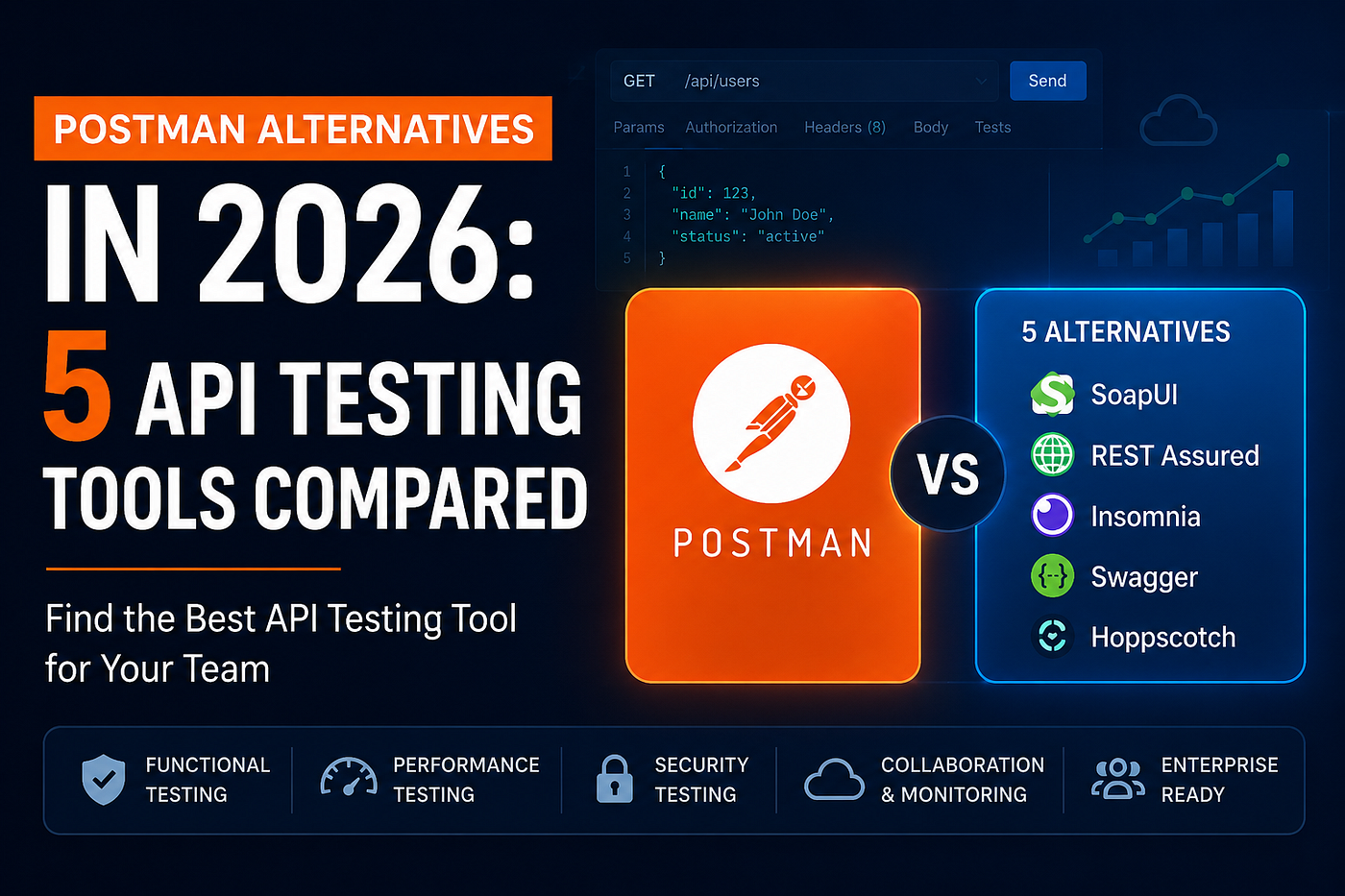
Postman Alternatives in 2026: 5 API Testing Tools Compared
1. SoapUI
Postman Alternatives in 2026: 5 API Testing Tools Compared
1. SoapUI
SoapUI is one of the longest-standing API testing tools in the market and is widely used by enterprises for functional, performance, and security testing. Unlike Postman, which is mainly centered around REST workflows and collaboration, SoapUI focuses more heavily on deep API validation across multiple protocols, including REST, SOAP, GraphQL, and JMS.
The open-source version is designed mainly for individual users or teams working in a single environment, while still offering advanced API testing capabilities beyond basic request execution. SoapUI is particularly well known for SOAP service testing, API mocking, data-driven testing, load testing, and detailed reporting, making it a stronger fit for enterprise integrations, legacy systems, and complex API environments compared to lightweight API clients.
For teams that need more advanced capabilities, the company also offers ReadyAPI, a separate commercial platform focused on advanced functional testing for REST, SOAP, and GraphQL APIs, along with deeper automation, collaboration, and enterprise testing workflows. SoapUI and ReadyAPI are often evaluated together by organizations looking for a more testing-focused alternative to Postman.
The platform is also heavily adopted in enterprise environments, with companies such as Microsoft, BMW, Apple, and Vodafone listed among its users.
Postman vs SoapUI
Features SoapUI Supports That Postman Does Not
- Native SOAP/WSDL testing support with deeper enterprise SOAP workflow compatibility
- Built-in security testing capabilities for scanning common API vulnerabilities
- Dedicated load testing functionality built directly on top of functional API tests
- Stronger API virtualization and service mocking for simulating production services
- JMS protocol support for enterprise messaging environments
- Scriptless drag-and-drop functional testing for complex API scenarios
- Better support for legacy enterprise integration environments that still rely heavily on SOAP services
- Open-source availability with full local usage flexibility without subscription requirements
Features Postman Supports That SoapUI Does Not
- More modern and beginner-friendly user experience with a simpler interface for API exploration
- Stronger collaboration workflows for teams building and shipping APIs together
- Built-in AI-powered capabilities and an AI credit system across paid plans
- Native Git workflows and collection synchronization across cloud and local environments
- Public and private API workspaces for collaborative API management
- API monitoring and production visibility capabilities
- SDK generation support in higher-tier plans
- Extensive cloud collaboration ecosystem with commenting, annotations, package sharing, and governance workflows
- More active ecosystem and community momentum based on recent user review activity
- Stronger multi-user enterprise governance features such as SCIM, audit logs, domain verification, API catalog management, and advanced RBAC
Pricing
SoapUI / ReadyAPI
- SoapUI Open Source: Free
- ReadyAPI API Test Module: starts at approximately $7,100 per license/year
- ReadyAPI API Performance Module: starts at approximately $16,700 per license/year
- ReadyAPI API Virtualization Module: starts at approximately $7,450 per license/year
Postman
- Free: $0
- Solo: $9/month
- Team: $19/user/month
- Enterprise: $49/user/month
2. REST Assured
REST Assured is a Java-based API testing library designed specifically for testing and validating REST services. Unlike Postman and other GUI-driven API platforms, REST Assured is code-first and mainly targeted at developers and QA engineers who want to build automated API tests directly inside Java testing frameworks and CI/CD pipelines.
The library is known for bringing a simpler, more readable testing style to Java, inspired by dynamic languages such as Ruby and Groovy. It allows teams to write validation logic for API responses, authentication, headers, payloads, and status codes using a fluent syntax that integrates well with frameworks like JUnit, TestNG, Spring MockMvc, and Jackson.
REST Assured is commonly used in backend-heavy Java ecosystems where API testing is tightly integrated into automated testing workflows rather than handled through standalone API clients. Compared to Postman, it is less focused on manual API exploration and collaboration, but significantly stronger for developer-driven test automation and integration into enterprise Java applications.
The project also continues to receive active updates. Recent releases include REST Assured 6.0.0 with Java 17+ support, Groovy 5 upgrades, and Spring 7 integration support, alongside continued compatibility improvements for modern Java testing environments.
Postman vs REST Assured
Features REST Assured Supports That Postman Does Not
- Native Java-based API test automation tightly integrated into Java development workflows
- Fluent DSL syntax for writing highly readable BDD-style API tests directly in code
- Strong reusable request and response specification system for large automated test suites
- Built-in JSON and XML parsing using JsonPath and XmlPath
- Automatic Java object serialization and deserialization for API requests and responses
- Better fit for CI/CD-driven automated testing inside Maven and Gradle pipelines
- Easier integration into backend unit testing and integration testing frameworks like JUnit and TestNG
- Strong code-first testing approach for developer-heavy engineering teams
- Open-source and fully free to use without licensing costs
Features Postman Supports That REST Assured Does Not
- Visual GUI-based API testing environment without requiring Java coding
- Faster manual API exploration and debugging workflows
- Team collaboration features such as shared workspaces, comments, annotations, and API governance
- Built-in API documentation publishing and API catalog capabilities
- Native cloud synchronization and workspace management
- Integrated API monitoring and production visibility features
- AI-powered workflows and Postman AI integrations across paid plans
- Mock servers, Flows automation, and SDK generation tools are built directly into the platform
- Better accessibility for non-Java developers, QA teams, and beginners
Pricing
REST Assured
Open-source and completely free to use. No licensing costs
3. Insomnia
Insomnia positions itself as an AI-native API collaboration platform built for developers who work across modern API workflows. Unlike traditional API clients focused mainly on sending requests, Insomnia combines API testing, debugging, endpoint design, and collaboration into a single platform with support for local, Git-based, and cloud workflows.
The platform supports a wide range of protocols and technologies, including HTTP, GraphQL, gRPC, Socket.io, WSS, and SSE, while also offering MCP client support and AI-powered capabilities for modern development teams. One of its biggest differentiators compared to Postman is its developer-friendly local workflow approach. Insomnia allows local testing without requiring an account and includes features such as unlimited projects, unlimited collection runners, Git Sync, and open-source access through its free tier.
Insomnia is particularly attractive for teams looking for a more lightweight, developer-centric alternative to Postman while still maintaining collaboration and workflow scalability. The platform also emphasizes security-focused API development and enterprise-scale collaboration workflows for larger organizations.
The tool is widely adopted across the industry, with companies such as Netflix, Tesla, PayPal, Nasdaq, and Red Bull listed among its users.
Postman vs Insomnia
Features Insomnia Supports That Postman Does Not
- Flexible local, Git, or cloud-based storage workflows for API collections and specs
- Native Git Sync workflows designed for developer-centric API collaboration
- Strong OpenAPI-driven design-first API development approach
- Unlimited collection runner execution without run limits
- Built-in MCP client support for testing MCP servers, tools, resources, and prompts
- Native support for dynamic API mocking from OpenAPI specs, API responses, or natural language
- Strong local-first workflow approach with no account required for local testing
- Inso CLI for building automated API linting and CI/CD testing pipelines
- More developer-focused storage and workflow flexibility across local, Git, and cloud environments
Features Postman Supports That Insomnia Does Not
- Larger collaboration and enterprise workspace ecosystem with public/private API workspaces
- Broader API governance and API catalog management capabilities
- Integrated API monitoring and production visibility features
- SDK generation capabilities in higher-tier plans
- More mature API network and API publishing ecosystem
- Shared package libraries and Postman Vault integrations
- More extensive enterprise governance features, such as audit logs, domain verification, SCIM provisioning, and advanced RBAC
- Broader collaboration tooling with comments, annotations, Flows automation, and workspace viewers
- More extensive AI pricing and an AI credit management system across subscription tiers
Pricing
Insomnia
- Essentials: Free
- Pro: $12/user/month
- Enterprise: $45/user/month
4. APIdog
APIdog is an all-in-one API development and testing platform that combines multiple stages of the API lifecycle into a single workflow. The platform positions itself as a unified alternative to using separate tools for API design, documentation, mocking, debugging, automated testing, and performance testing. In its own positioning, APIdog combines capabilities commonly associated with tools like Postman, Swagger, Stoplight, ReadMe, JMeter, SoapUI, and Mock platforms into one environment.
Unlike traditional API clients focused mainly on request testing, APIdog follows a strong design-first approach where API specifications act as the central source of truth across development, testing, mocking, and documentation workflows. The platform includes visual OpenAPI design tools, automatic response validation against API specs, reusable regression testing workflows, interactive documentation generation, mock server creation, and visual automated testing orchestration with minimal coding requirements.
APIdog also places heavy emphasis on AI-assisted API workflows. The platform includes AI-generated test cases, AI-powered documentation support, MCP integrations, and a built-in visual MCP client for testing and debugging AI-oriented workflows and integrations. For larger organizations, APIdog also includes enterprise-focused capabilities such as Git integration, branch-based collaboration, RBAC access controls, SSO authentication, encrypted credential vault integrations, and compliance support for SOC 2, GDPR, and ISO 27001 environments.
Postman vs APIdog
Features APIdog Supports That Postman Does Not
- Visual OpenAPI design workflows without manually writing YAML
- Automatic API documentation generation directly from API specifications
- Strong design-first workflow where API design, testing, mocking, and documentation stay synchronized in one workspace
- Instant mock API generation directly from API specs
- Automatic response validation against API specifications during request testing
- Built-in visual test orchestration with loops, branching, assertions, and advanced test scenarios
- IDE plugins that automatically detect endpoints and send requests directly from Java/Kotlin projects
- Ability to generate OpenAPI specs without Swagger annotations
- Docker-based self-hosted agents for scheduled testing, intranet mock APIs, and automatic spec synchronization
- Bring-your-own-LLM approach for AI-assisted API workflows and private AI model usage
- AI-generated large-scale test case generation workflows
- Native MCP inspection capabilities for viewing tools, prompts, and resources in real time
- Stronger real-time synchronization between API documentation, testing, mocking, and design workflows
Features Postman Supports That APIdog Does Not
- Larger ecosystem and stronger industry adoption across API collaboration workflows
- More mature public/private API workspace ecosystem
- Broader API governance, API catalog, and production monitoring capabilities
- Integrated API monitoring and production visibility features
- More advanced enterprise governance features, such as domain verification, advanced RBAC, SCIM provisioning, and audit compliance workflows
- Built-in Postman Flows automation ecosystem
- Shared package libraries and Postman Vault integrations
- Larger integration ecosystem with extensive API network visibility and collaboration tooling
- More established cloud collaboration and API sharing workflows across enterprise teams
Pricing
APIdog
- Free: $0/user/month
- Basic: $9/user/month
- Professional: $18/user/month
- Enterprise: $27/user/month
5. Karate Labs
Karate Labs is an AI-native test automation platform built around the open-source Karate framework, combining API testing, UI automation, mocking, and performance testing into a single unified framework. Unlike Postman, which mainly focuses on API request workflows and collaboration, Karate Labs positions itself as a broader end-to-end test automation platform designed for engineering teams that want to handle multiple testing types using one syntax and one framework.
The platform supports REST, GraphQL, and SOAP API testing with built-in JSON/XML assertions, schema validation, reusable data-driven scenarios, and integrated API mocking capabilities. One of Karate’s biggest differentiators is its ability to reuse API tests directly for performance testing through built-in Gatling integration. This reduces the need to maintain separate load testing scripts.
Karate Labs also heavily emphasizes AI-assisted testing through Karate Agent, its LLM-powered testing tool. The platform includes AI-assisted test authoring, natural language support, MCP integrations, and AI-supported UI recovery features that help automated tests survive UI changes and locator drift during frontend updates.
Another major differentiator is Karate’s simplified syntax and unified framework design. The platform promotes a low-boilerplate approach where you can manage API testing, UI automation, service mocks, and performance testing within a single framework instead of combining multiple tools together.
Karate Labs is also positioned heavily toward enterprise adoption with SSO, SAML, RBAC controls, audit logs, self-hosted deployments, SOC 2 compliance, and offline licensing support. The company states that the framework is trusted by 76 Fortune 500 companies and used by more than 650 organizations, while the open-source Karate framework itself has millions of downloads and thousands of GitHub stars.
Postman vs Karate Labs
Features Karate Labs Supports That Postman Does Not
- Unified framework for API testing, UI automation, mocking, and performance testing within the same syntax and workflow
- Native no-code and low-code API testing approach with highly readable test syntax
- Built-in JSON/XML schema validation and fuzzy matching assertions without external assertion libraries
- Built-in parallel execution for API tests without requiring additional frameworks or configuration
- Ability to reuse API tests directly for performance testing through Gatling integration
- Native built-in mock servers and stubs without relying on separate mocking tools
- Full UI automation support inside the same framework used for API testing
- Strong data-driven testing support using CSV, JSON, and inline tables
- Rich auto-generated HTML reports with request/response logs and timing details
- Open-source MIT-licensed framework with free access to core testing features
- Better support for combining API, UI, performance, and mock testing into a single testing platform
- Native CI/CD integration without relying heavily on external tooling
- Strong GraphQL and SOAP support using the same syntax as REST APIs
Features Postman Supports That Karate Labs Does Not
- Visual GUI-based API exploration and request building with lower onboarding complexity
- Stronger collaborative workspace ecosystem for distributed API teams
- Cloud-based API sharing, commenting, annotations, and governance workflows
- Built-in API documentation publishing and API network visibility
- Integrated API monitoring and production visibility capabilities
- More mature enterprise governance ecosystem with advanced RBAC, SCIM, audit logs, and domain verification
- Native Postman Flows automation workflows
- Easier onboarding for non-developers and teams without coding experience
- More mature API collaboration workflows centered around collections and shared workspaces
- Larger ecosystem for API publishing, package sharing, and cloud integrations
Pricing
Karate Labs
- Free: $0
- Pro: $640/user/year
- Enterprise: Custom pricing
메타데이터
- post_id
- de2ba11fc439
- slug
- postman-alternatives-in-2026-5-api-testing-tools-compared-de2ba11fc439
- url
- https://medium.com/@shanikaw/postman-alternatives-in-2026-5-api-testing-tools-compared-de2ba11fc439
- canonical_url
- https://medium.com/@shanikaw/postman-alternatives-in-2026-5-api-testing-tools-compared-de2ba11fc439
- author_url
- https://medium.com/@shanikaw
- status
- ok
- fetched_at
- 2026-06-29 01:02:39