Teardown Analysis of Bajaj Chetak Electric Instrument Cluster
Bajaj Chetak Instrument Cluster
Teardown Analysis of Bajaj Chetak Electric Instrument Cluster
Bajaj Chetak Instrument Cluster

With the rapid adoption of electric vehicles (EVs), instrument clusters have evolved from simple analog meters to complex embedded systems integrating display, communication, and control logic. This teardown focuses on the digital instrument cluster module used in the Bajaj Chetak electric scooter.


As electric vehicles (EVs) become more common, traditional analog meters have been replaced by smart digital displays that combine visuals, communication, and control features. Here we see both side of the instrument cluster, front side with digital odometer circuler display and a rear side mounted with multi-pin automotive connector.

The odometer module utilizes a 20-pin automotive connector, although only a limited number of pins are actively populated. The unused positions serve as dummy or reserved slots, indicating a modular connector design. The populated pins are functionally divided for noise isolation and reliability, with one group dedicated to power supply (VCC and ground) and the remaining pins used for communication, most likely via the CAN bus (CAN H and CAN L) . This design ensures reliable operation while maintaining flexibility for future enhancements or variant compatibility. And some are used as/for ignition signal, wake-up line, backlight control, diagnostic communication.


After separating the outer housing, the internal structure of the odometer module becomes clearly visible. The assembly mainly consists of a circular display unit connected to a main printed circuit board via a flexible ribbon cable.


The main PCB of the odometer module integrates all essential functional blocks, including the central microcontroller, communication interface, and power regulation circuitry. A dedicated CAN transceiver enables interaction with the vehicle network, while a flexible ribbon cable connects the PCB to the display unit. The presence of multiple passive components ensures stable and reliable operation. Additionally, exposed test points highlight potential areas for further analysis from a reverse engineering and cybersecurity perspective.
Identify CAN communication pin, Power Input Pins and Debug Ports

For testing purposes, a 24V DC supply is applied through the main connector to activate and initialize the odometer module. During testing, jumper wires were used to supply power and establish CAN communication. The remaining connector pins are used for power input and grounding. This setup enables real-time interaction with the module and provides a practical entry point for communication analysis and security testing.
Chip Analysis
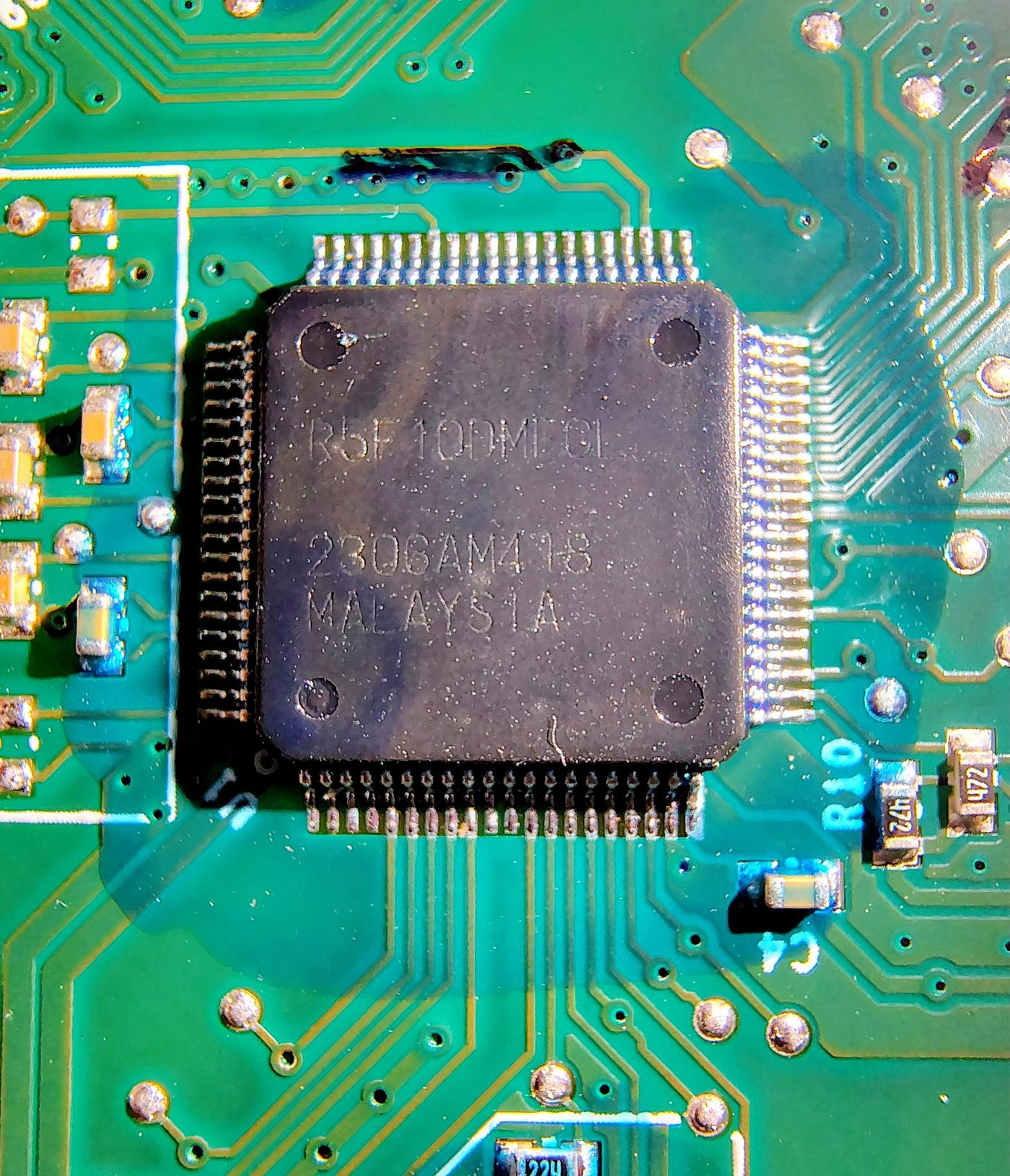


1. Renesas R5F10DMF (RL78 Family)2. NXP TJA1042 3. PCA85262TT
- Renesas R5F10DMF (RL78 Family) — Serves as the central processing unit of the odometer module. It is responsible for processing vehicle data received over the CAN bus, managing odometer calculations, and controlling the display through an external LCD driver (PCA85262)
- NXP TJA1042 — Is a high-speed CAN transceiver that provides the physical interface between the microcontroller and the vehicle’s CAN bus.
- PCA85262TT — Is a segment LCD driver IC responsible for directly controlling the odometer display. It interfaces with the main microcontroller via an I²C bus and converts digital data into the required segment and backplane drive signals.
This teardown highlights a well-structured automotive design, where the Renesas microcontroller, NXP CAN transceiver, and LCD driver work together to deliver reliable functionality. From a security standpoint, the odometer module presents multiple potential entry points, including the CAN interface, MCU firmware, and external communication pathways. While the hardware design is robust, these interfaces offer opportunities for deeper investigation into system integrity, data authenticity, and potential attack vectors.
메타데이터
- post_id
- de317eea2bde
- slug
- teardown-analysis-of-bajaj-chetak-electric-instrument-cluster-de317eea2bde
- url
- https://medium.com/@sushilchaudhari2303/teardown-analysis-of-bajaj-chetak-electric-instrument-cluster-de317eea2bde
- canonical_url
- https://medium.com/@sushilchaudhari2303/teardown-analysis-of-bajaj-chetak-electric-instrument-cluster-de317eea2bde
- author_url
- https://medium.com/@sushilchaudhari2303
- status
- ok
- fetched_at
- 2026-07-25 12:44:45


