Sales Funnel Optimization: 7-Step Framework (2026)
Most sales funnels are leaking revenue right now.
Sales Funnel Optimization: 7-Step Framework (2026)
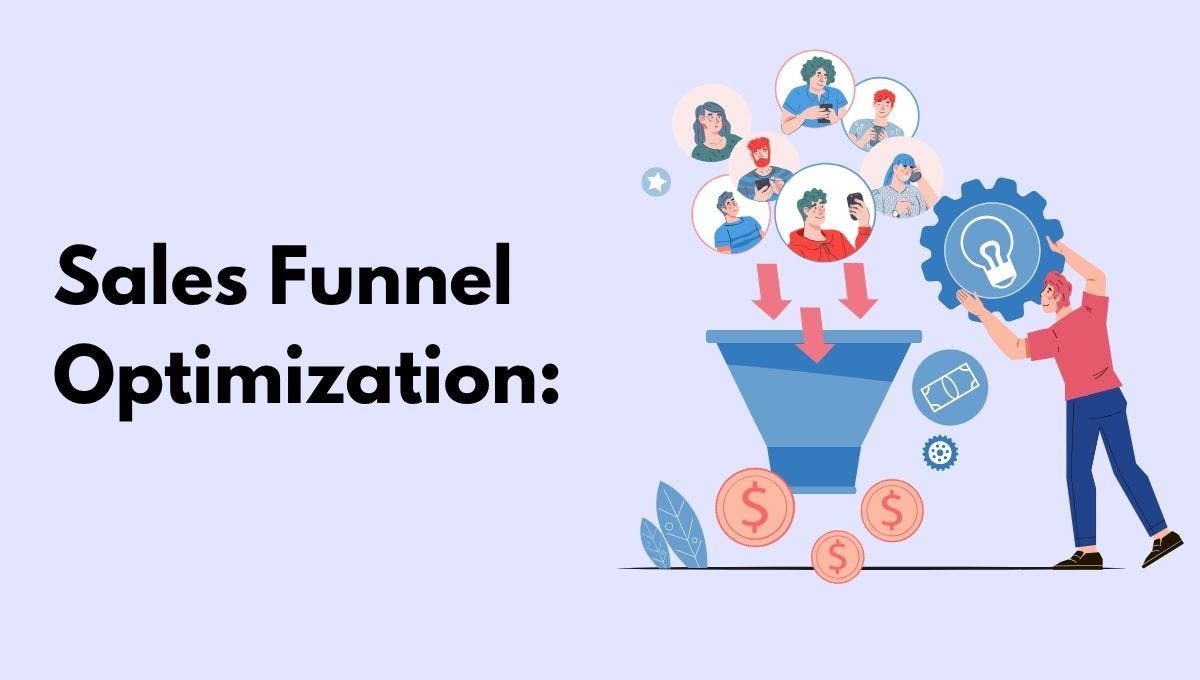
Sales Funnel Optimization: 7-Step Framework (2026)
Most sales funnels are leaking revenue right now.
Not because the product is bad. Not because the traffic is wrong. Because somewhere between visitor arrives and purchase confirmed, something breaks — and most businesses never find out exactly where or why.
Here’s what the data shows: the average business loses 68% of potential customers in the middle of the funnel. That’s not a traffic problem. That’s an optimization problem.
The good news?
Fixing it is systematic. Over the past few years, a clear 7-step framework has emerged from analyzing 300+ businesses that doubled or tripled their conversions. The companies that applied all seven steps saw an average 150% increase in revenue without spending an extra dollar on ads.
In this guide, you’ll get the complete framework, step by step. Also, you’ll learn why most sales funnels fail, and the one metric that exposes it immediately, run a funnel audit that reveals exactly where you’re losing money, 7-step framework of Sales Funnel optimization used by 300+ growing companies and more.
Table of content: -
- Why Most Sales Funnels Underperform (And How to Fix Yours)
- Step 1 — Audit Your Funnel and Find the Leak
- Step 2 — Sharpen Your Targeting and Traffic Quality
- Step 3 — Build a Landing Page That Earns the Click
- Step 4 — Nurture Leads With Precision Email Sequences
- Step 5 — Optimize Your Sales Page and Checkout Flow
- Step 6 — Add Post-Purchase Upsells and Retention Loops
- Step 7 — Measure, Test, and Iterate Continuously
- The DotcomPal Advantage: One Platform for the Full Funnel
- Frequently Asked Questions
Why Most Sales Funnels Underperform (And How to Fix Yours)
Before you can optimize, you need to understand what’s actually broken.
The biggest mistake businesses make is treating funnel optimization as a cosmetic exercise — changing button colors, tweaking headlines, running a quick A/B test. That’s not strategy. That’s guesswork.
Real funnel optimization starts with one question: at which stage is the most value being lost?
Every **sales funnel** has four core stages such as Awareness, Consideration, Intent, and Purchase. Visitors drop off at every stage. The goal isn’t to eliminate drop-off (that’s impossible).
The goal is to make the drop-off rates match industry benchmarks and then push past them.

See the gap between Average Drop-off and Optimized Drop-off? That gap is money sitting on the table. This framework is how you close it.
According to MarketingSherpa, companies with optimized funnels see 55% more leads at lower acquisition cost. The key lever? Fixing the middle of the funnel — where most businesses focus the least attention.
Here’s the 7-step framework at a glance before we go deep on each one:

Step 1 — Audit Your Funnel and Find the Leak
You can’t fix what you can’t see. The first step isn’t to build anything or change anything. It’s to measure.
A proper funnel audit maps your conversion rate at every single stage — from first click to final purchase. Most businesses only track two numbers: total traffic and total sales. Everything in between is invisible to them.
That’s like trying to fix a pipe without knowing which section has the hole.
How to run your funnel audit
- Map every stage — Write out every step a visitor takes from first touchpoint to purchase. Include your ads, landing page, lead magnet, email sequence, sales page, and checkout.
- Assign a conversion rate to each stage — What percentage of visitors move from step A to step B? Track this for every transition.
- Calculate the cumulative loss — If 1,000 people enter the top and 10 people buy, you’re converting at 1%. But where did the other 990 go? Pinpointing the stage with the highest drop-off is your highest-leverage action.
- Prioritize your fix — Don’t start at the top of the funnel. Start at the bottom. A 10% improvement in checkout conversion generates more revenue than a 10% improvement in ad click-through rate.
🚀DotcomPal in Action
DotcomPal’s Analytics dashboard gives you a complete picture across your entire funnel. You can see Funnel Analytics (visitors, conversions, conversion rate per page), Page Analytics (per-page performance), Email Analytics (opens, CTR, attributed revenue), and Video Analytics — all in one place.
No need to stitch together Google Analytics, a heatmap tool, and a CRM. The data is already connected.
Step 2 — Sharpen Your Targeting and Traffic Quality
More traffic is not always better. Unqualified traffic destroys your conversion rates and inflates your acquisition costs.
Here’s a reality check: a landing page that converts at 12% with highly targeted traffic will outperform a page converting at 3% on broad, unqualified traffic — even if the second page gets ten times more visitors.
Funnel optimization isn’t just about what happens on your pages. It starts with who arrives at them.
Three levers for improving traffic quality:
- Audience segmentation — Split your audience by intent level. Someone searching ‘best project management tool for agencies’ is far closer to buying than someone searching ‘what is project management software.’ Target bottom-of-funnel intent keywords and audiences first.
- Traffic source analysis — Break down your conversion rates by traffic source (organic, paid, social, email). In most businesses, 2–3 sources drive 80% of conversions. Double down on those and cut the underperformers.
- Customer avatar refinement — Review your last 50 buyers. What do they have in common? Job title, business size, specific problem, platform they came from? Use that profile to sharpen your targeting and your messaging.
💡 Pro Tip
Review your DotcomPal Audience Analytics data — specifically the geographic, device, and traffic source breakdowns. If mobile traffic from social converts at 0.5% while desktop organic traffic converts at 8%, that tells you exactly where to invest and where to cut.
Step 3 — Build a Landing Page That Earns the Click
Your landing page is the first moment of truth. It’s where a curious visitor decides whether to trust you enough to take the next step.
Most landing pages fail for one of three reasons: the headline doesn’t match the ad that brought the visitor, the page tries to do too many things at once, or the offer isn’t compelling enough to justify giving up an email address.
Let’s fix all three.
The anatomy of a high-converting landing page:
- Message match — The headline on your landing page should mirror the language of the ad or content that drove the click. Disrupting this pattern increases bounce rates by up to 40%.
- Single, clear CTA — Every landing page should have exactly one goal. One offer. One action. Remove navigation menus. Remove exit links. Every element should move the visitor toward that single conversion.
- Above-the-fold value proposition — Your visitor should understand exactly what they’ll get and why it matters within 5 seconds of arriving — before they scroll.
- Social proof at the point of hesitation — Place testimonials, logos, and review counts directly below your CTA, not at the bottom of the page. That’s where the doubt lives.
- A/B test your headline first — The headline drives 80% of your conversion outcome. Test two headline variations before testing anything else.
🚀 DotcomPal in Action
DotcomPal’s **landing page builder includes 300+ industry-specific templates — including CoachPal, AgencyPal, EcomPal, FreelancerPal**, and more.
AIPal, the built-in AI assistant, can generate your headline, subheadline, and benefit bullets in seconds. You can then A/B test variations directly inside the platform — no third-party tools needed.
Built-in sections for hero, features, testimonials, CTA, FAQ, and pricing mean you’re never starting from a blank page.
Step 4 — Nurture Leads With Precision Email Sequences
This is the step most businesses skip — and it’s costing them the most money.
The data is consistent: 80% of leads that don’t buy on first contact will buy within the next 90 days — if they’re nurtured properly. Most businesses either never follow up or send generic promotional emails that get ignored.
Precision nurturing is different. It delivers the right message at the right stage of the buyer’s journey.
The 3-part nurturing framework:
Part A — The Welcome Sequence (Days 1–3)
Triggered immediately when someone joins your list. Delivers your lead magnet, sets expectations for what they’ll receive, and introduces your brand story. The goal is not to sell — it’s to create connection and establish trust.
Part B — The Education Sequence (Days 4–14)
A series of 4–6 emails that address the core pain points your product solves. Each email teaches something valuable while naturally positioning your offer as the solution. Use the Pain-Agitate-Solution framework in each email.
Part C — The Conversion Sequence (Days 15–21)
A 3–5 email sequence directly selling your offer. Include your strongest testimonials, handle the top 3 objections, introduce urgency or a limited offer, and make the ask clear and frictionless.
🔑 Key Insight
The key metric to watch in your email sequences is not open rate — it’s click-to-conversion rate.
An email with a 15% open rate and 4% CTR is outperforming one with a 40% open rate and 0.5% CTR every time.
Track attributed revenue per email send inside your analytics to find your highest-value messages — then send more of them.
Step 5 — Optimize Your Sales Page and Checkout Flow
This is the highest-leverage stage in the entire funnel. A visitor who reaches your sales page or checkout is already interested. Your only job now is to not lose them.
And yet, the average checkout abandonment rate is 70%. That’s 7 out of every 10 people who were ready to buy — walking away.
Here’s what’s driving them away, and how to stop it.
Sales page optimization checklist: —
- Headline leads with the outcome, not the product name
- Benefits are listed before features — always
- Social proof (video testimonials preferred) appears above the fold and near the CTA
- The offer is framed as value stacking: show what’s included and what it’s worth
- Price is anchored — show the original price alongside the current offer
- Guarantee or risk reversal removes the final hesitation
- FAQ section pre-handles the top 5 objections
Checkout flow optimization: —
- Reduce form fields to the minimum required — every extra field drops conversion by 5–10%
- Show progress indicators on multi-step checkouts
- Add trust signals at the payment stage: SSL badges, money-back guarantee, payment iconsEnable one-click payment options where possible
- Use exit-intent popups on the checkout page with a softener offer or reassurance message
DotcomPal’s funnel builder gives you full control over every sales page element using the drag-and-drop editor.
Add countdown timers for urgency, product boxes with pricing, testimonial sections, and FAQ blocks — all without touching code.
The built-in Popups & Bars feature lets you deploy exit-intent popups on any page in your funnel with a single click.
If you are reading this in 2026, you must be need to about **How to build a sales funnel in 2026**.
Step 6 — Add Post-Purchase Upsells and Retention Loops
Most businesses obsess over acquisition. The smartest ones obsess over what happens after the first purchase.
Here’s the math: acquiring a new customer costs 5–7x more than selling to an existing one. Your post-purchase funnel is your highest-margin revenue channel — and it’s almost entirely automated once it’s built.
Three post-purchase strategies that compound revenue: —
1. Immediate Upsell / Order Bump: -
Offer a complementary product or upgrade immediately after purchase — before the buyer leaves the checkout confirmation page. This is the single highest-converting offer in any funnel because the buyer is in peak buying mode.
A well-matched order bump converts at 15–35%. If your core product sells for $37 and you offer a $27 order bump, a 25% take rate adds $6.75 per order to your average order value. At 100 sales per month, that’s $675 in pure margin.
2. Email Retention Sequence: —
New customers need to be onboarded, not abandoned. A 5-email post-purchase sequence that delivers quick wins, highlights underused features, and asks for feedback dramatically increases lifetime value and reduces refund rates.
Customers who feel successful with your product within the first 30 days are 4x more likely to repurchase and 6x more likely to refer others.
3. Re-engagement Campaign: -
Segment customers who haven’t engaged in 60–90 days and run a dedicated re-engagement sequence. Offer a new product, a loyalty discount, or simply check in. This segment converts at 5–15% — far higher than cold traffic — because trust is already established.
💡 Pro Tip Use DotcomPal’s Tags and Lists in the Audience section to segment your customers by purchase date, product purchased, and engagement level. This lets you trigger the right retention sequence for the right segment automatically — without manual management.
Step 7 — Measure, Test, and Iterate Continuously
The seven steps above are not a one-time project. They’re a continuous loop.
The businesses that see 150%+ revenue growth from funnel optimization share one common trait: they treat it as an ongoing system, not a launch event. They measure relentlessly, form specific hypotheses, test one variable at a time, and implement winners immediately.
The optimization loop: —
- Set a baseline — Document your current conversion rate at every funnel stage before making any changes.
- Form one hypothesis — ‘Changing the CTA copy from “Buy Now” to “Get Instant Access” will increase checkout clicks by 10%.’
- Run a clean A/B test — Split traffic evenly. Wait for statistical significance (minimum 100 conversions per variation). Do not stop early.
- Implement the winner — Apply the winning variation as the new control.
- Move to the next hypothesis — Repeat the process with the next variable.
The compounding effect of this process is powerful. If you improve conversion rates by just 10% across five funnel stages, your total conversion rate doesn’t increase by 50% — it increases by 61% (1.1⁵ = 1.61). Small, consistent improvements stack into transformative results.
🔑 Key Insight
The best variable to test first at each stage: Landing page → Headline Email sequence → Subject line Sales page → Hero section (headline + CTA) Checkout → Number of form fields Post-purchase → Order bump offer and price point
The DotcomPal Advantage: One Platform for the Full Funnel
Here’s the real challenge most entrepreneurs face when trying to implement this framework.
Running a fully optimized funnel typically requires 6–10 separate tools: a website builder, funnel builder, landing page tool, email marketing platform, CRM, **video hosting**, analytics suite, A/B testing tool, popup tool, and more.
The average cost of that stack? $300–$600 per month. The average time to set it up and connect everything? 40–80 hours. And it still breaks when tools don’t integrate cleanly.
DotcomPal was built specifically to solve this problem.
What DotcomPal gives you for the full 7-step funnel:
- Step 1 (Audit) — Built-in Analytics: Funnel, Page, Email, Video, Audience, and Sales reports in one dashboard
- Step 2 (Traffic) — Audience segmentation with Tags, Lists, and contact management in the CRM
- Step 3 (Landing Page) — 300+ templates, AIPal AI copy generation, drag-and-drop editor, A/B testing
- Step 4 (Email Nurturing) — Email automation with segmentation, sequences, and conversion tracking
- Step 5 (Sales Page) — Complete funnel builder with countdown timers, pricing tables, testimonial sections
- Step 6 (Retention) — Post-purchase funnels, Popups & Bars, audience tagging for re-engagement
- Step 7 (Iteration) — A/B testing and detailed analytics for every element across every step
The result: instead of managing 10 tools and 10 monthly invoices, you run your entire funnel from a single dashboard — starting at $37 one-time for the Funnel Kickstart plan, or $497/year for the full Ultimate Launchpad suite.
More importantly, because every tool is native to the same platform, your data flows seamlessly between stages. Your email analytics connect to your funnel analytics. Your CRM connects to your sales page. Your video metrics connect to your audience segments.
That kind of connected data is what makes optimization fast, accurate, and compounding
If you want to know which **10 mistakes to avoid while building a funnel**, read this blog —
Frequently Asked Questions
Question — What is sales funnel optimization?
Answer — The ongoing process of identifying where prospects drop out of your funnel and implementing targeted improvements to increase conversion rates at each stage
Question — How long does funnel optimization take?
Answer — Initial improvements can be seen in 2–4 weeks. Meaningful revenue impact from full optimization typically takes 60–90 days of consistent testing and iteration.
Question — What’s the most impactful funnel stage to optimize first?
Answer — Start where the most money is leaving. For most businesses, this is the bottom of the funnel — the sales page and checkout — because small improvements there directly affect revenue.
Question — Do I need a developer to optimize my funnel?
Answer — No, Platforms like DotcomPal let you build, A/B test, and optimize your entire funnel — landing pages, email sequences, checkout, and analytics — without any coding knowledge.
Question — What conversion rate should I aim for?
Answer — Top-of-funnel (landing pages): 10–25%. Mid-funnel (sales pages): 5–15%. Checkout: 60–80%. These benchmarks vary by industry, traffic source, and offer price.
Question — How does DotcomPal help with funnel optimization?
Answer — DotcomPal provides an all-in-one funnel builder with AIPal AI assistance, drag-and-drop page builder, built-in A/B testing, advanced analytics, CRM, email automation, and video hosting — all from one dashboard.
Conclusion: —
Sales funnel optimization isn’t a one-time fix. It’s a system.
The 7-step framework in this guide has one underlying principle: every stage of your funnel is a measurable, improvable process. When you audit relentlessly, target precisely, build with conversion psychology in mind, and iterate based on real data — the results aren’t just better. They compound.
Start with Step 1. Run your audit today. Find the stage where you’re losing the most, and fix that first. You don’t need to implement all seven steps at once — you just need to start moving through them systematically.
The businesses seeing 150% revenue growth aren’t doing anything magic. They’re just being more systematic than everyone else.
Funnels. Landing Pages. Email Automation. Analytics. CRM. Video Hosting. AIPal AI Assistant.
All in one platform. Starting at $37 one-time — no monthly fees.
→ Start Optimizing Your Funnel at DotcomPal
About DotcomPal
DotcomPal is an all-in-one online business platform for entrepreneurs, coaches, digital creators, agencies, and small businesses. Build complete sales funnels, landing pages, and websites with built-in CRM, email automation, video hosting, AI tools (AIPal), and advanced analytics — all from one dashboard. Plans start at $37 one-time.
메타데이터
- post_id
- de351a4aeae0
- slug
- sales-funnel-optimization-7-step-framework-2026-de351a4aeae0
- url
- https://medium.com/@atulprajapati9602/sales-funnel-optimization-7-step-framework-2026-de351a4aeae0
- canonical_url
- https://medium.com/@atulprajapati9602/sales-funnel-optimization-7-step-framework-2026-de351a4aeae0
- author_url
- https://medium.com/@atulprajapati9602
- status
- ok
- fetched_at
- 2026-06-09 15:37:30