The AI-Native Factory: How Smart Manufacturing Solves the $50 Billion Downtime Crisis
Why Traditional Factory Automation Is Failing — And What C-Suite Leaders Must Do Now
The AI-Native Factory: How Smart Manufacturing Solves the $50 Billion Downtime Crisis
Why Traditional Factory Automation Is Failing — And What C-Suite Leaders Must Do Now
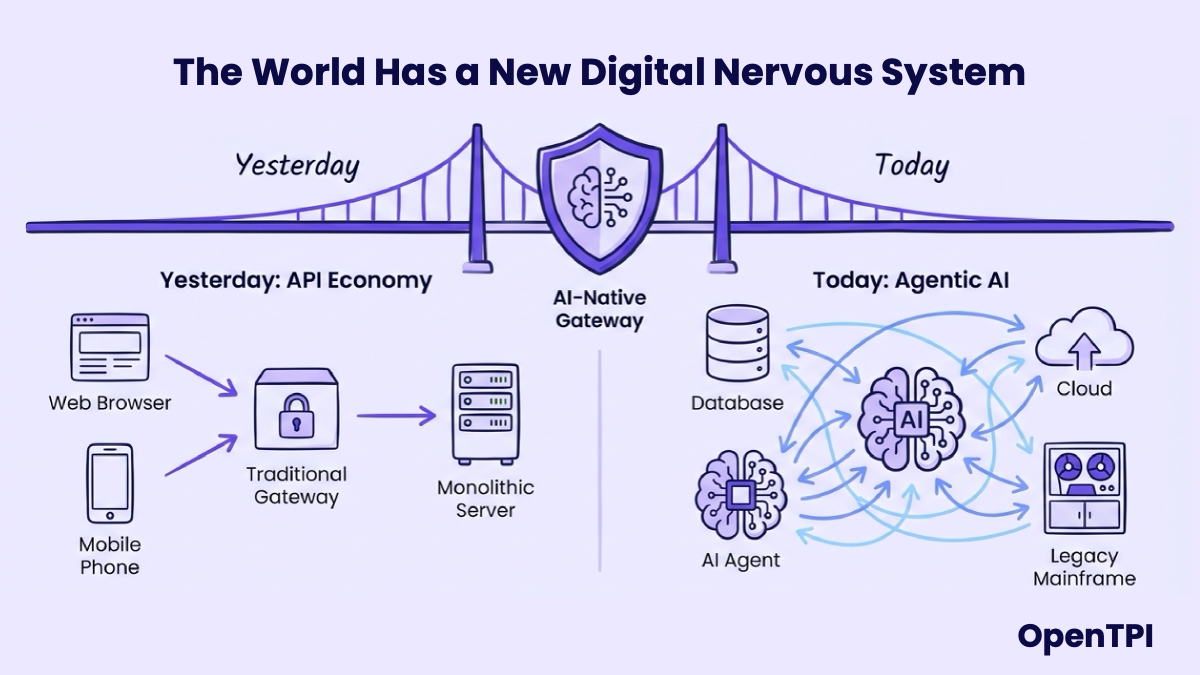
Figure 1: AI-Native Gateway bridges the API Economy to Agentic AI
The manufacturing industry faces a stark reality: despite decades of digital transformation investments, labor productivity has increased by only 25% over the past twenty years. Compare this to other technology-forward sectors where productivity has surged by 300%, and the magnitude of the problem becomes clear. Manufacturing is trapped in what experts call the “Productivity Paradox” — where IT spending increases but operational efficiency flatlines.
The financial toll is staggering. Unplanned downtime alone costs global manufacturers approximately $50 billion annually, while supply chain inefficiencies trap $1.1 trillion in excess inventory within U.S. manufacturing ecosystems. Quality defects continue to erode 15–20% of total revenue through scrap, rework, and warranty claims, while 20–30% of industrial energy consumption represents avoidable waste.
These aren’t problems that dashboards and passive monitoring can solve. The volume and velocity of factory floor data exceed human cognitive capacity. What manufacturing needs is a fundamental architectural shift — from monitoring systems that alert humans to autonomous AI agents that reason, decide, and act.
This article provides C-suite executives with a strategic blueprint for deploying the AI-Native Factory: an enterprise where autonomous AI agents serve as the central nervous system of production, orchestrated through a secure, standardized AI-Native Gateway infrastructure.
The Root Cause: Understanding the IT/OT Divide in Modern Manufacturing
Why Your Factory Can’t Talk to Your AI
The primary obstacle preventing AI adoption in manufacturing isn’t the sophistication of AI models — it’s the profound technical and cultural chasm between Information Technology (IT) and Operational Technology (OT).
Operational Technology (OT) governs the physical factory floor. It prioritizes availability and physical safety above all else. A single millisecond of latency in a Programmable Logic Controller (PLC) can cause a robot collision. A software reboot can halt a production line costing thousands of dollars per minute. OT systems rely on ancient, diverse industrial protocols like Modbus (dating from 1979), PROFINET, and OPC UA. Hardware often operates for 20–30 years, meaning modern AI must interface with controllers installed before smartphones existed. Security traditionally depended on “air gapping” — physical isolation from the internet.
Information Technology (IT) manages the digital enterprise. It prioritizes data confidentiality, integrity, and scalability. IT operates on standard internet protocols (HTTP/REST, JSON, TCP/IP), cycles hardware every 3–5 years, and implements identity-based security models like Zero Trust architecture.
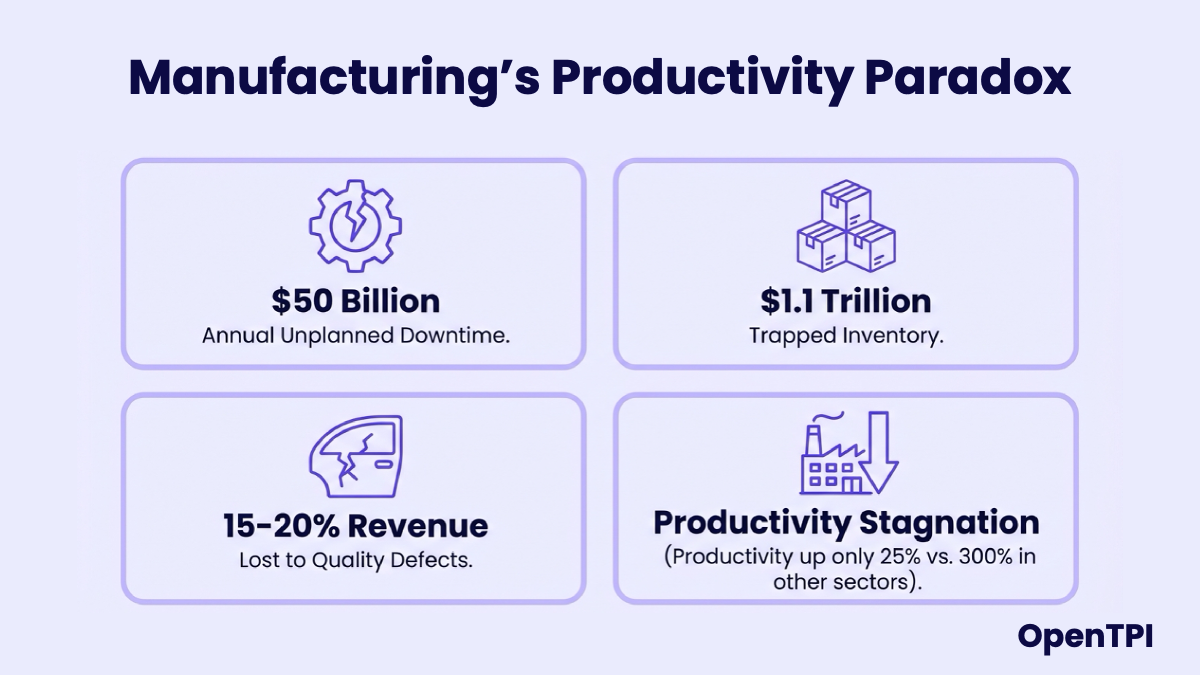
Figure 2: Manufacturing faces productivity stagnation and huge unplanned downtime costs
The IT/OT Technical Divergence
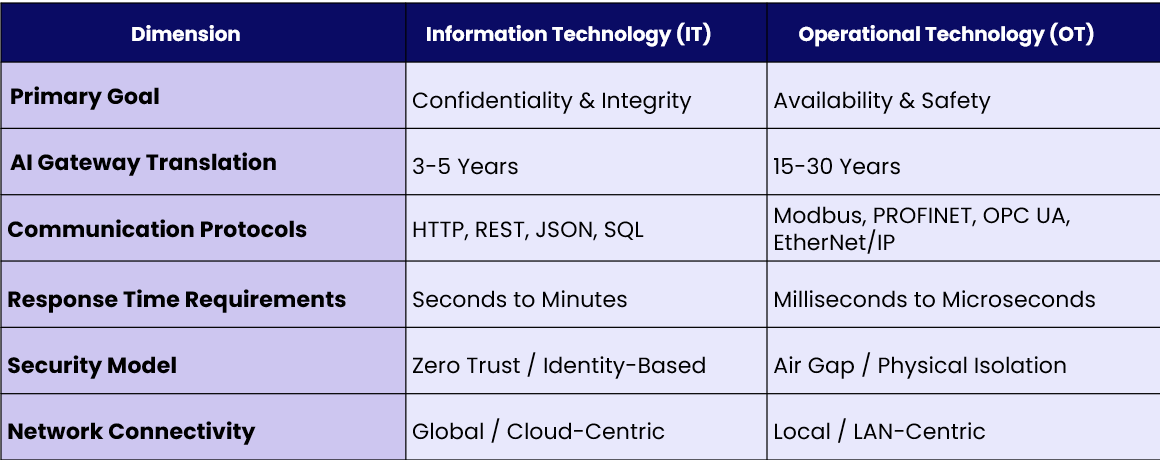
This fundamental divide creates the “Last Mile” integration gap. Modern AI models like GPT-4 or Claude speak the language of JSON and REST APIs. They cannot natively communicate with a Siemens S7 PLC speaking PROFINET or a legacy temperature controller using Modbus RTU. Without a sophisticated translation layer, AI agents remain blind to physical factory reality.
The statistics underscore this challenge: 65% of manufacturing APIs still use legacy protocols (SOAP, XML), while 40% of critical business logic remains locked in non-API systems like mainframes or batch processing jobs.
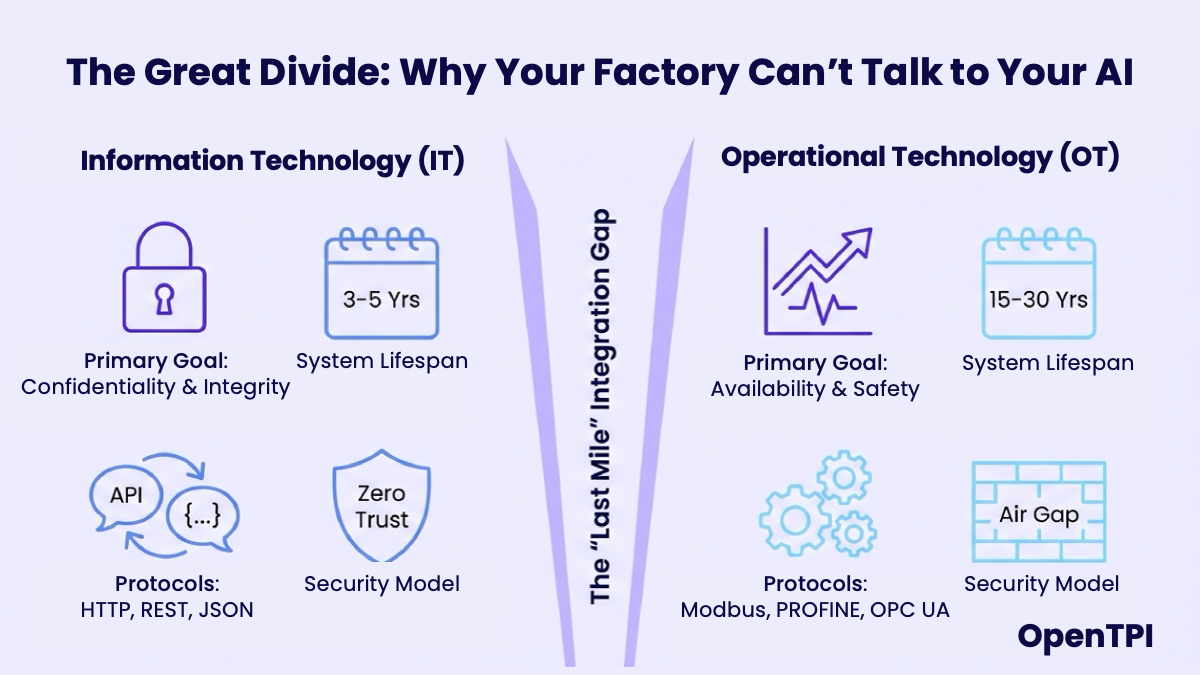
Figure 3: IT and OT systems differences cause the Last Mile Integration Gap
Pilot Purgatory: Why 95% of Manufacturing AI Projects Fail to Scale
Industry data reveals a troubling pattern: while 85% of manufacturing AI initiatives begin as pilots, only 15% successfully scale to production, and merely 5% achieve enterprise-wide deployment. This 95% failure rate represents billions in wasted investment and missed opportunity.
The Four Failure Modes
1. Operator Trust Deficit Factory workers with decades of tacit knowledge distrust “black box” AI recommendations lacking explainability. If an AI suggests reducing furnace temperature, an operator remembering a “cold heat” disaster from five years ago will override the recommendation unless the AI provides transparent reasoning.
2. Inability to Prove ROI Pilots typically focus on technical feasibility (“Can we predict this failure?”) rather than financial impact (“What dollar value does preventing this failure generate?”). Without baseline metrics for downtime costs or quality losses, transitioning from R&D budgets to operational funding fails.
3. Integration Debt Pilots often rely on “duct tape” integration — manual CSV data exports or fragile Python scripts running on laptops — that cannot withstand 24/7 production rigor. When pilots attempt production scaling, these brittle connections collapse immediately.
4. Absence of Platform Thinking Treating each AI project as bespoke custom development creates unmanageable complexity. A predictive maintenance agent for a pump requires similar data infrastructure as a quality inspection agent for a conveyor system. Rebuilding this foundation for every use case destroys economic viability.
The Escape Route: Enterprises must adopt a platform-centric approach that standardizes data access, enforces governance, and creates a unified control plane for all AI agents.
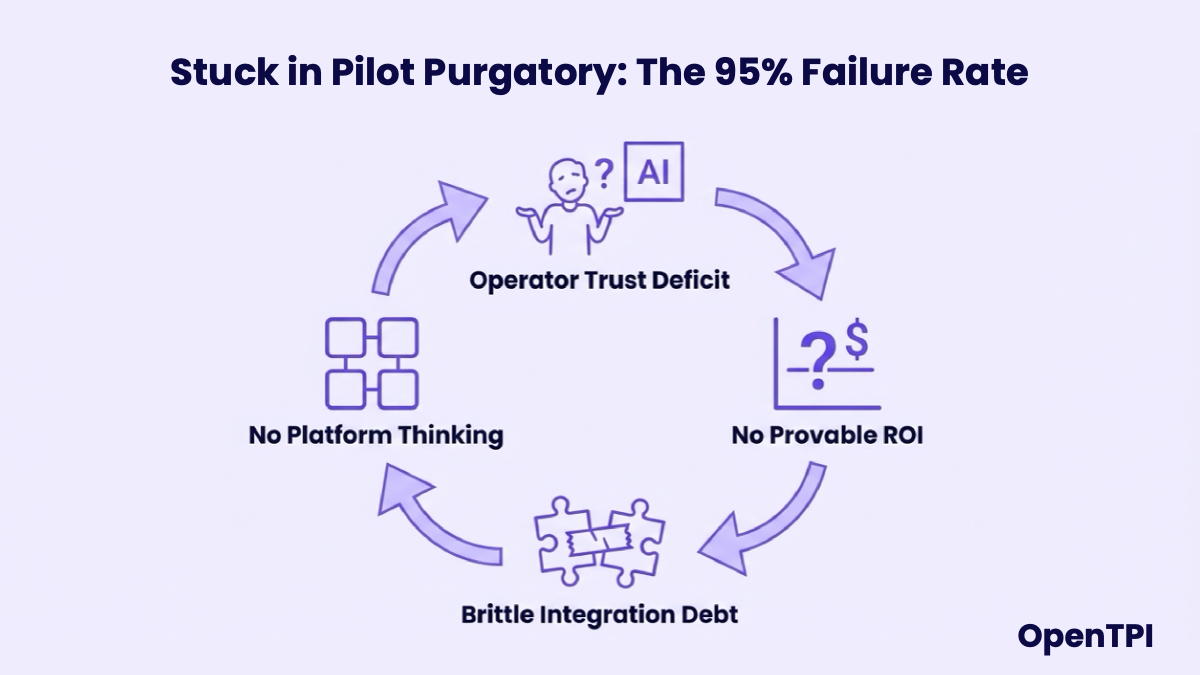
Figure 4: Industrial AI pilots fail due to integration debt and lack of ROI
The Solution: AI-Native Gateway Architecture
Introducing the “New Nexus” for Manufacturing Intelligence
The strategic solution isn’t forcing OT to become IT, nor the reverse. Instead, deploy an architectural decoupling layer: the AI-Native Gateway. This infrastructure functions as the “New Nexus” where autonomous AI agents meet industrial reality.
Unlike traditional API gateways designed for static, deterministic web traffic, an AI-Native Gateway like digiRunner is purpose-built for the probabilistic, high-volume, and semantic nature of AI workloads.
How the AI-Native Gateway Functions
The gateway serves as a bi-directional bridge with distinct responsibilities:
Northbound Interface: Presents a standardized, secure interface to AI agents, abstracting underlying factory complexity into clean, semantic tools. AI agents interact with business-level abstractions (“check equipment status”) rather than raw industrial protocols.
Southbound Interface: Acts as a universal translator, connecting to the fragmented landscape of industrial protocols (OPC UA, Modbus, MQTT, PROFINET) and enterprise systems (ERP, MES, CMMS, SCADA).
This architecture establishes a “demilitarized zone” (DMZ) for data. AI agents never directly touch PLCs; they interact with digital representations hosted on the gateway. This isolation is critical for safety — ensuring a malfunctioning or “hallucinating” agent cannot directly write unsafe values to machine controllers. The gateway enforces security policies, implements rate limiting, and validates semantic correctness before passing commands to the physical layer.

Figure 5: AI-Native Gateway connects AI Agents to Factory Systems universally
Model Context Protocol: The Universal Translator for Industrial AI
Standardizing How AI Agents Communicate with Factories
The technical linchpin of this architecture is the Model Context Protocol (MCP). Released as an open standard, MCP provides a standardized mechanism for AI models to discover and interact with external data sources and tools. It replaces chaotic, vendor-specific “function calling” implementations with a unified protocol for autonomous agent interoperability.
The MCP Transformation: Before and After
Without MCP: Developers must write custom code to establish Modbus TCP connections, query Register 40001, parse 16-bit integers, apply scaling factors, and handle connection timeouts. This code is brittle and specific to one machine type. Every different PLC requires different custom integration code.
With MCP: The gateway exposes standardized tools: get_equipment_status(asset_id=”CNC-MILL-047") . AI agents simply invoke this tool. The gateway handles protocol translation, register mapping, and error recovery transparently.
This decoupling creates a “protocol-agnostic” development environment. Data scientists can develop agents rapidly without deep industrial engineering expertise. When underlying hardware changes (replacing a Siemens PLC with an Allen-Bradley controller), only gateway configuration updates — AI agents remain unchanged.
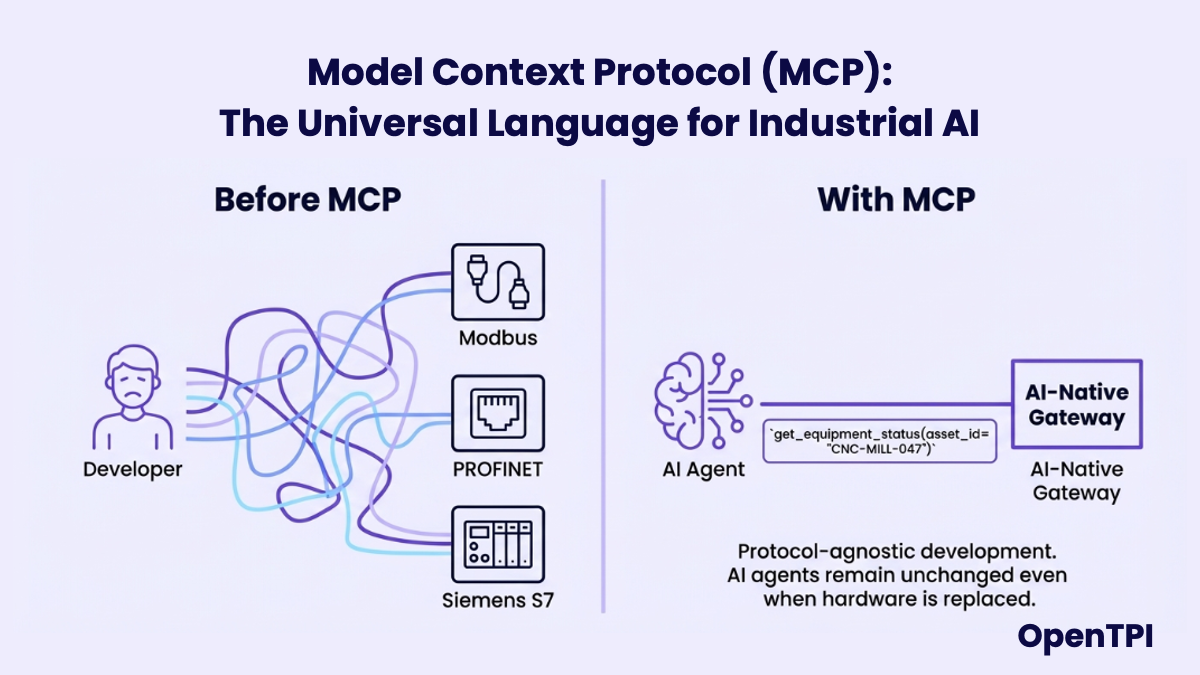
Figure 6: MCP- The universal, protocol-agnostic language for Industrial A
ISA-95 Alignment: Structuring the Neural Enterprise
To ensure scalability and prevent data swamps, architecture must align with the ISA-95 standard — the international framework for enterprise-control system integration. The AI Gateway facilitates this by respecting functional hierarchy while enabling vertical data flows required for intelligence.
Level 0–1 (Physical/Control): Gateway connects to sensors and PLCs, reading high-frequency time-series data (vibration, temperature, pressure). Crucially, AI agents at this level operate in “read-only” or “human-in-the loop” mode, providing recommendations rather than direct actuation.
Level 2 (Supervisory): Agents integrate with SCADA systems to monitor process parameters and detect anomalies across production lines, correlating alerts from multiple machines to identify systemic issues.
Level 3 (Manufacturing Operations): Agents interact with Manufacturing Execution Systems (MES) to optimize scheduling, track quality metrics, and manage maintenance work orders. The gateway ensures agents can trigger MES work orders seamlessly when predictive maintenance alerts are verified.
Level 4 (Business Planning): Agents connect with ERP systems (SAP, Oracle) to align production with supply chain realities. An agent observing high defect rates can query ERP to determine if new raw material batches from different suppliers were recently introduced, linking operational quality to supply chain sourcing decisions.
Real-World Impact: Two Transformative Use Cases
Case Study 1: KG Steel — Autonomous Furnace Optimization
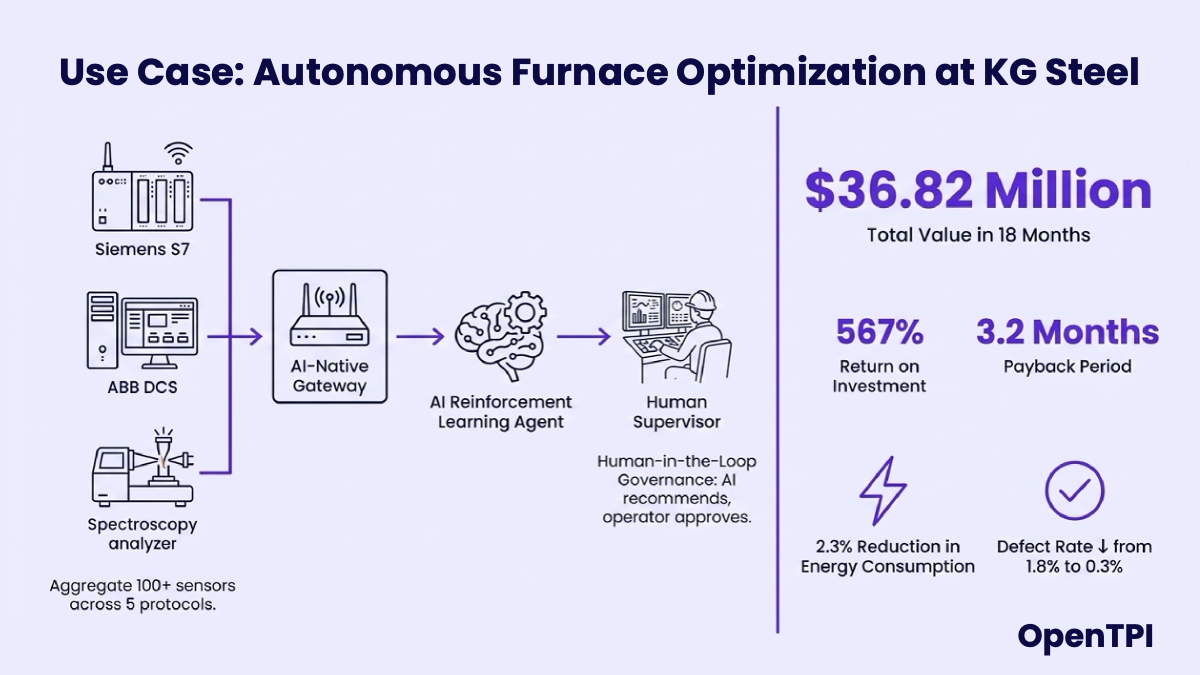
Figure 7: KG Steel reduced energy and defects with Autonomous Furnace Optimization
The Challenge: KG Steel, an integrated steel producer, faced a classic optimization problem with Electric Arc Furnaces (EAF). The EAF process consumes 40–50 MWh per batch. Operators balanced minimizing energy input (electricity and Liquid Natural Gas) against meeting strict steel chemistry quality requirements. The penalty for quality defects requiring re-melting: approximately $50,000 per batch. Risk-averse operators defaulted to conservative, energy-inefficient settings, leaving significant efficiency gains unrealized.
The AI-Native Solution: The organization deployed a “Digital Twin” powered by AI agents, orchestrated through the digiRunner gateway.
Data Integration: The gateway aggregated real-time data from over 100 sensors across five different industrial protocols, including Siemens S7 PLCs controlling electrodes, ABB DCS systems managing gas flow, and proprietary spectroscopy systems analyzing steel chemistry. This unified data stream provided AI agents with holistic furnace state visibility.
Digital Twin Simulation: Before production deployment, a physics-based simulation (Computational Fluid Dynamics + Thermochemistry) modeled furnace behavior. AI agents using Reinforcement Learning trained in this simulation, running 10,000+ virtual heats. This allowed agents to explore aggressive optimization strategies and learn process boundaries without risking physical assets or production quality.
Human-in-the-Loop Governance: In production, agents didn’t control furnaces directly. Instead, they functioned as “Super-Operators,” analyzing real-time conditions and recommending optimal settings (e.g., “Set Power to 82 MW, LNG flow to 2,400 m³”). Recommendations were presented to human supervisors via the gateway, who retained final authority to approve or reject settings.
The Financial Results:
- Energy Savings: 2.3% reduction in energy consumption per ton translated to $26.46 million in savings over 18 months
- Quality Improvement: Defect rate dropped from 1.8% to 0.3%, saving $3.36 million in scrap and rework elimination
- Throughput Increase: Optimized process cycles enabled increased production capacity worth $7.0 million in marginal profit
- Total 18-Month Value: $36.82 million
- ROI: 567% with 3.2-month payback period
- This exemplifies the AI Gateway’s power to orchestrate complex, multi-protocol data for high-value industrial optimization.
Case Study 2: Automotive Assembly — Predictive Maintenance for CNC Mills

Figure 8: Predictive Maintenance for CNC Mills cuts unplanned downtime by 63%
The Challenge: A major automotive assembly plant struggled with unexpected spindle bearing failures in CNC milling machines. These failures caused catastrophic production disruptions costing $5,000 per hour in downtime. Traditional time-based preventive maintenance replaced parts every six months regardless of condition — leading to both unnecessary replacements of healthy components and missed failures occurring before the six-month interval.
The AI-Native Solution: A Predictive Maintenance Agent was deployed to monitor 20 CNC machines, utilizing the AI Gateway to bridge machine sensors and maintenance workflows.
Edge Connectivity: The gateway connected directly to Fanuc Focas protocol on CNC machines to stream high frequency vibration and current data at millisecond intervals.
Contextual Enrichment: Raw sensor data is meaningless without context. The gateway enriched data streams with metadata — machine ID, specific part type being machined, current tool bit in use. This allowed AI agents to differentiate between vibration from heavy cuts (normal operating condition) versus vibration from failing bearings (abnormal condition requiring intervention).
Autonomous Reasoning Workflow: AI agents executed sophisticated reasoning chains beyond simple anomaly detection. Upon identifying vibration signatures indicating bearing wear, agents autonomously:
-
Queried ERP systems to check spare parts inventory for replacement bearing availability
-
Accessed MES to examine production schedules and identify next available maintenance windows 3. Checked HR systems for technician availability and certification
-
Drafted complete maintenance work orders populated with part numbers, recommended time slots, and failure diagnoses for plant manager approval
The Operational Results:
- Downtime Reduction: 63% decrease in unplanned downtime during pilot phase
- Annual Cost Savings: $272,000 for initial 20 machines, representing 85% reduction in maintenance related costs versus time-based strategy
- Cultural Transformation: Maintenance teams shifted from reactive “firefighting” to proactive strategic planning, reducing stress and overtime requirements
Implementation Roadmap: The Four-Phase Journey to AI-Native Manufacturing
Transforming legacy factories into AI-native enterprises requires phased, iterative deployment to mitigate risk and ensure value capture. “Big Bang” approaches fail consistently. The successful roadmap allows organizations to build capability, operator trust, and infrastructure progressively.
Phase 0: Foundation & Data Architecture (Months 1–5)
Objective: Establish digital bedrock and governance structures.
Key Activities:
- Comprehensive Asset Audit: Inventory all IT/OT assets, network topology, and data quality. Assess Industry 4.0 maturity level — determining if the facility operates at Level 1 (Digital Visibility) or approaching Level 2 (Connected Systems). This baseline informs integration strategy.
- Gateway Deployment: Install the digiRunner AI-Native Gateway in the network DMZ to bridge IT/OT networks securely. Establish initial “north-south” data corridors with appropriate firewalls and access controls.
- Governance Establishment: Form an “AI Governance Committee” involving IT leadership, OT engineering, plant operations, and executive sponsors. This body defines safety protocols, data standards, and “rules of engagement” for AI agent deployment.
- Investment: Approximately $1.8 million for platform setup, personnel mobilization, and infrastructure foundation.
Phase 1: The Pilot — Predictive Maintenance (Months 6–11)
Objective: Prove value with high-impact, low-risk use case that builds operator trust.
Scope: Deploy Predictive Maintenance agents on a single critical production line (CNC machining center, critical conveyor system, or bottleneck equipment).
Integration: Connect sensors and Computerized Maintenance Management System (CMMS) via the gateway. Create the first set of MCP tools for data retrieval and automated work order generation.
Target Metrics: Achieve 30–50% reduction in unplanned downtime and >75% prediction accuracy to demonstrate reliability to skeptical operators.
Outcome: This phase typically achieves financial break-even within the pilot period itself. More critically, it generates “quick wins” and success stories needed to overcome cultural resistance and secure broader organizational buy-in.
Phase 2: Expansion — Quality & Process Optimization (Months 12–17)
Objective: Scale to complex, high-value domains requiring multi-modal data analysis.
Scope: Deploy Computer Vision agents for automated quality inspection and Process Optimization agents for real-time parameter tuning.
Technical Complexity: These use cases require handling unstructured data (images from inspection cameras) and real-time process variables simultaneously. The gateway’s semantic caching and high-throughput capabilities become critical at this stage.
Target Metrics: Measurable reduction in defect rates and improvement in first-pass yield. This phase directly impacts top-line revenue by increasing sellable product output and reducing waste.
Phase 3: Supply Chain Integration (Months 18–22)
Objective: Extend intelligence beyond factory walls to the broader value chain.
Scope: Integrate production agents with ERP and supply chain management systems. Connect factory floor operations to warehouse management and procurement planning.
Strategic Function: Agents optimize inventory levels based on real-time production data and demand forecasts. The goal is transitioning from static “Just-in-Time” to dynamic “Just-in-Case” buffering based on predictive risk modeling.
Value Opportunity: Reduction in working capital trapped in excess inventory — addressing the $1.1 trillion industry-wide opportunity.
Phase 4: Enterprise Scaling (Months 23–24)
Objective: Industrialize AI capability across the global manufacturing footprint.
Scope: Roll out proven agents to all remaining plants and production lines. Leverage the “configuration-as code” capability of the gateway’s standardized architecture to accelerate deployment.
Focus Areas: Standardization of agent templates, centralized monitoring dashboards, continuous model retraining pipelines. Establish a Center of Excellence to manage the complete lifecycle of AI agents enterprise wide.
The Financial Model: Compelling ROI for Manufacturing AI

Figure 9: AI-Native ROI is 428% with a 4.1-month payback period
The economic case for AI-Native Factories is compelling, driven by the massive scale of industrial operations where fractional percentage improvements translate into millions in value. Based on comprehensive implementation roadmaps, typical enterprise deployments yield these projected financials over 24 months:
Investment and Returns
Total Investment: $13.6 million
- Platform licensing and infrastructure
- Personnel training and mobilization
- Sensor hardware and edge computing
- Professional services across all four phases
Total Value Delivered: $58.2 million
- Cost savings component: $38.4 million
- Revenue impact component: $19.8 million
Financial Performance:
- Net Benefit: $44.6 million
- Return on Investment (ROI): 428%
- Payback Period: 4.1 months
This exceptionally short payback period is characteristic of industrial AI deployments, where the cost of a single extended downtime event often exceeds the entire solution cost.
Value Distribution by Agent Type
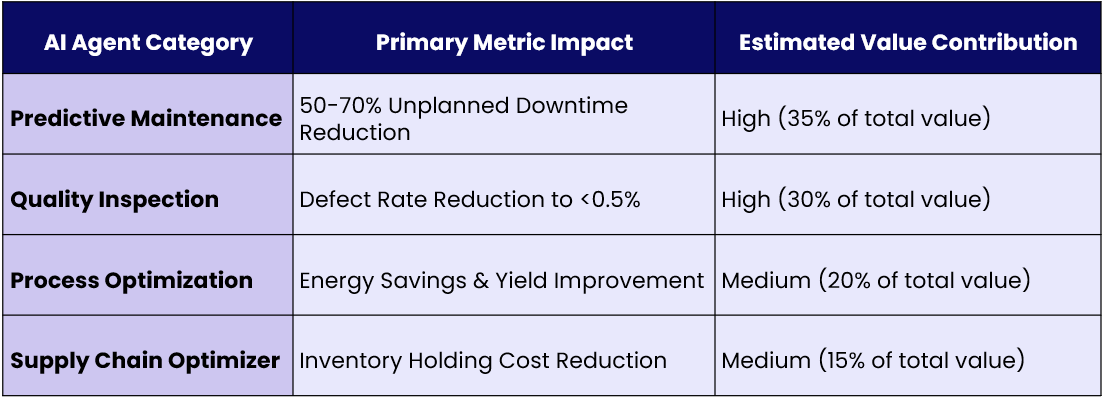
While ROI is attractive, the cost of inaction represents the more immediate strategic threat. Competitors adopting autonomous AI are resetting structural baselines for cost and quality across the industry. Failing to act not only leaves the $50 billion annual downtime cost on the table but risks rendering the enterprise competitively obsolete as the industry transitions toward autonomous operation.
In margin-sensitive manufacturing, the 15–20% efficiency gap created by AI adoption will eventually become insurmountable. Market leaders are already achieving these advantages — the window for competitive catch-up is narrowing rapidly.
Governance and Safety: The Human-in-the-Loop Imperative
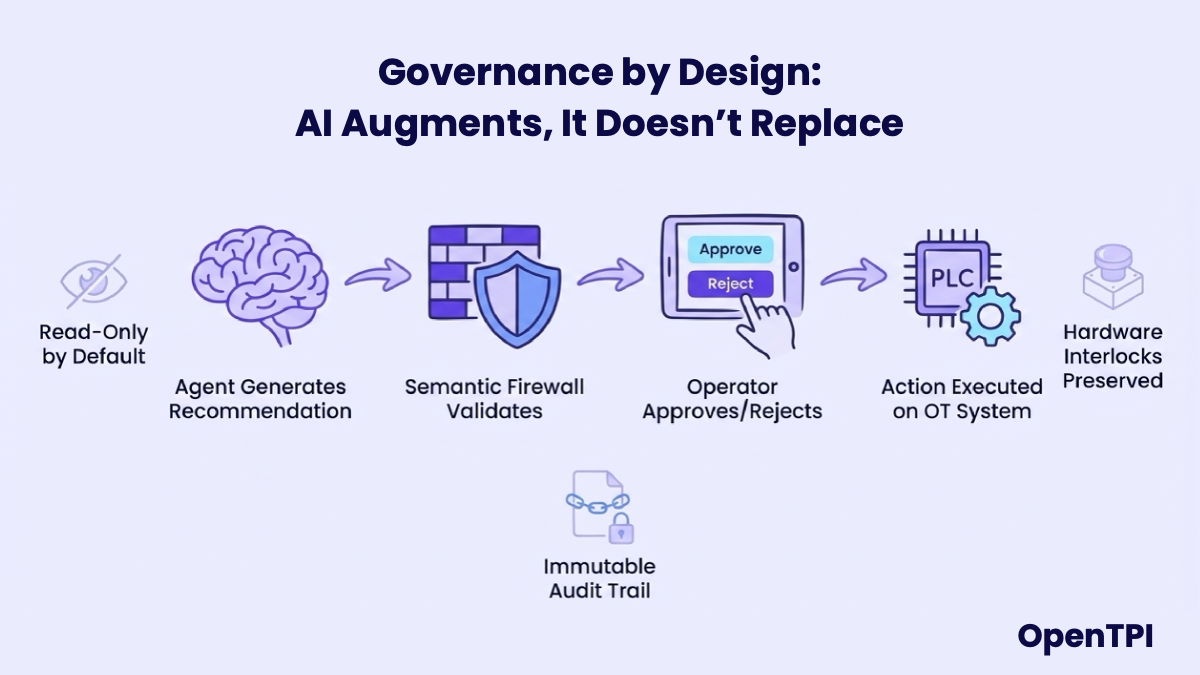
Figure 10: AI Governance workflow: Semantic Firewall and Human Operator approval
In manufacturing environments, AI “hallucination” isn’t merely a customer service embarrassment — it’s a physical safety hazard. If an agent recommends furnace settings exceeding thermal limits or directs a robot into occupied zones, consequences can be catastrophic. Therefore, governance isn’t an afterthought; it’s the primary design constraint.
The Human-in-the-Loop (HITL) Governance Model
The digiRunner architecture enforces strict Human-in-the-Loop governance for all safety-critical and high-value actions, codified in Phase 0 safety protocols.
Read-Only by Default: AI agents operate with read-only access to OT systems by default. They can analyze data streams but cannot change PLC registers or machine setpoints directly without explicit authorization and approval workflows.
Recommendation Engine Architecture: For control actions, agents generate recommendations rather than commands. Recommendations are routed to human operators or supervisors via standardized interfaces (tablet notifications, SCADA alerts, mobile apps). Operators retain final authority to approve, modify, or reject recommendations.
Physical Interlocks Preservation: Safety constraints (emergency stops, light curtains, thermal limits, pressure relief valves) remain hard-coded in the physical PLC layer. No AI command can override these hardware-level safety interlocks. AI operates strictly within the safety envelope defined by control engineering teams.
Semantic Firewalls and Policy Enforcement
The AI Gateway functions as a “Semantic Firewall,” inspecting not merely the syntax of API calls but their semantic intent and potential consequences. Traditional firewalls block traffic based on IP addresses or ports; Semantic Firewalls block traffic based on the meaning of prompts and the potential impact of tool invocations.
Token Budget Management: To prevent “runaway agents” from consuming infinite resources in reasoning loops — scenarios generating thousands of dollars in cloud computing bills within minutes — the gateway enforces strict token budgets per agent and per application context.
Contextual Access Control: An agent might be authorized to read vibration data but prohibited from accessing employee shift records or proprietary chemical formulas. The gateway enforces granular permissions at the API level, ensuring the Principle of Least Privilege applies to artificial agents identically to human users.
Audit Trail Completeness: Every agent action, recommendation, and decision is logged immutably with full context. This creates comprehensive audit trails for regulatory compliance, incident investigation, and continuous improvement of agent behavior.
The Cultural Transformation: From Replacement to Augmentation
Successful transformation requires managing the human element thoughtfully. The “Operator Trust Deficit” is overcome not by replacing workers but by augmenting them with AI superpowers.
The narrative must shift from “AI versus Human” to “AI plus Human” — empowering the workforce with 21st century tools. When operators observe AI agents correctly predicting bearing failures and preventing stressful 3 AM emergency repairs, trust develops organically. AI becomes a valued teammate rather than an existential threat.
This cultural shift is facilitated by explainability features where agents must provide “Chain of Thought” reasoning behind recommendations, allowing operators to validate AI logic against their own accumulated experience and intuition.
Strategic Imperatives for C-Suite Leadership
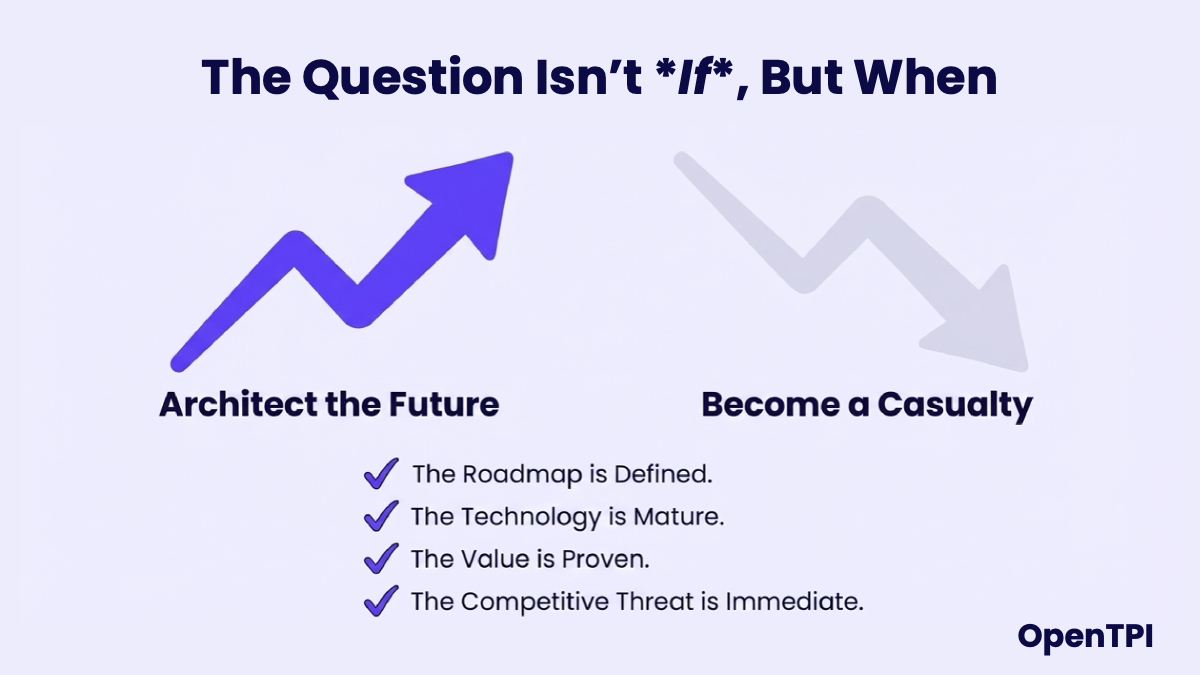
Figure 11: Architect the Future: AI adoption is when, not if
The manufacturing industry is moving inexorably toward the “Neural Factory” — an operational environment where data isn’t merely collected but actively reasoned upon by autonomous agents. This transformation offers a validated path out of current productivity stagnation, promising double-digit efficiency gains and radical reduction in industrial waste.
The financial evidence is compelling: 428% ROI and net benefits exceeding $44 million for typical enterprise deployments, with 4.1-month payback periods that are virtually unmatched in enterprise technology investments.
However, the complexity of industrial environments — “Protocol Babel,” the IT/OT divide, and the paramount importance of physical safety — demands rigorous architectural discipline. The “New Nexus” of the AI-Native Gateway provides this architecture. By unifying data access through Model Context Protocol, enforcing governance via Semantic Firewalls, and prioritizing human safety through HITL workflows, enterprises can deploy autonomous AI with confidence.
The Leadership Decision
The question for C-Suite leadership is no longer if AI agents will manage factory operations, but when — and whether their organization will architect this new reality or become a disruption casualty.
- The roadmap is defined and validated across industries
- The technology is mature and production-ready
- The value is proven through multiple case studies
- The competitive threat is immediate and growing
- The next step is decisive action.
Start Building Your AI-Native Factory Today
Transform your manufacturing operations with the secure, scalable foundation of the digiRunner AI-Native Gateway. Join leading manufacturers who are already capturing millions in value through intelligent automation.
Explore the Platform
Explore Open Source: Access the complete digiRunner platform on GitHub
https://github.com/TPIsoftwareOSPO/digiRunner-Open-Source
Technical Documentation: Review comprehensive implementation guides
Learn More: Read detailed case studies and technical deep-dives
Industry Insights: Follow our latest research and thought leadership
Connect with Us: Join the conversation on professional insights
https://www.linkedin.com/company/106457186/
The future of manufacturing is autonomous, intelligent, and secure. The architecture for this future exists today. Will you lead the transformation or watch from the sidelines as competitors capture the $50 billion opportunity?
About digiRunner
digiRunner is an open-source AI-Native Gateway platform purpose-built for industrial environments. As a no code solution, digiRunner enables enterprises to bridge the IT/OT divide, implement Model Context Protocol standardization, and deploy autonomous AI agents with enterprise-grade governance and security. Trusted by manufacturing leaders worldwide, digiRunner transforms legacy factories into AI-native enterprises through phased, risk-mitigated implementation roadmaps.
메타데이터
- post_id
- de4270f2b411
- slug
- the-ai-native-factory-how-smart-manufacturing-solves-the-50-billion-downtime-crisis-de4270f2b411
- url
- https://medium.com/@opentpi/the-ai-native-factory-how-smart-manufacturing-solves-the-50-billion-downtime-crisis-de4270f2b411
- canonical_url
- https://medium.com/@opentpi/the-ai-native-factory-how-smart-manufacturing-solves-the-50-billion-downtime-crisis-de4270f2b411
- author_url
- https://medium.com/@opentpi
- status
- ok
- fetched_at
- 2026-06-15 20:49:13





