Start in Their Landscape: Rethinking Enterprise Sales Around How Customers Really Operate
I would not describe myself as a natural risk-taker. But earlier in my career, I did something that still surprises people who know me: I…
Start in Their Landscape: Rethinking Enterprise Sales Around How Customers Really Operate
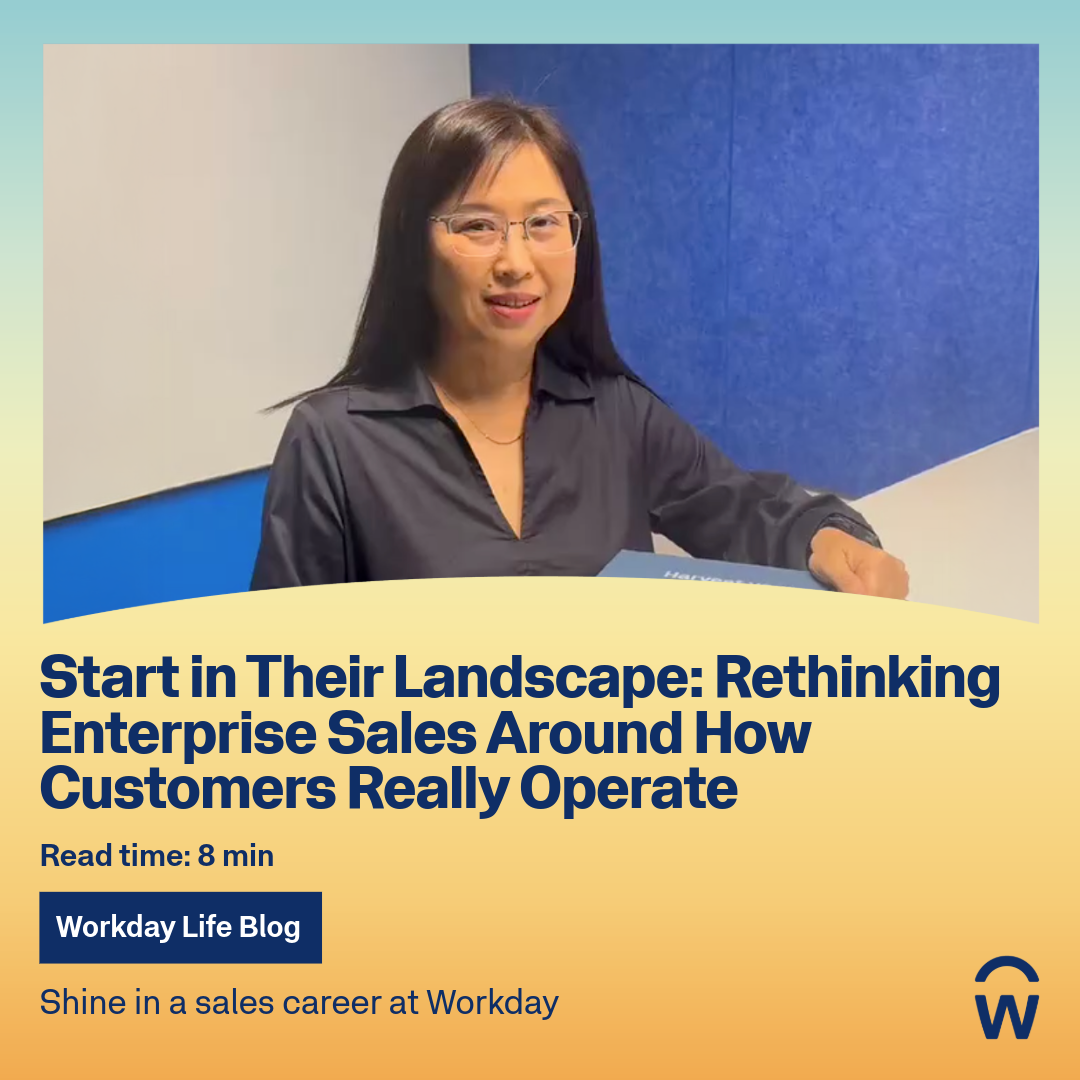
I would not describe myself as a natural risk-taker. But earlier in my career, I did something that still surprises people who know me: I trekked to Everest Base Camp in the winter.
Back then, you moved with limited visibility, trusted the people around you, and made decisions in conditions you could not fully control. That is very close to how enterprise sales feels when you walk into a new account.
“You are stepping into someone else’s landscape. Your own map is not enough. You have to learn theirs.”
Today I am an enterprise seller with Workday, based in Singapore, working with some of the region’s largest and most complex organisations. These are not simple software replacement cycles; they involve legacy platforms, multiple stakeholders, distributed workforces, cost pressure, transformation agendas, and now, inevitably, AI.
The easiest move in those conversations would be to lead with Workday’s platform. I try to do the opposite. I start by understanding how the customer’s business actually runs, because strong enterprise selling starts with the customer’s operating reality, changes how we approach AI and data conversations, and requires us to earn trust before we ever get into the product story.
I Start With the Business They Actually Run
One of the clearest lessons I have learned is that my system may be critical, but it is rarely the centre of the universe for the customer.
In some organisations I work with, the heartbeat of the business is heavy infrastructure and complex operations spread across the globe. In others, most of the workforce is scattered across remote locations, nowhere near a headquarters. HR and finance systems matter deeply in all of these cases, but they sit inside a much larger operational world.
If I understand what the customer considers mission-critical, the discussion moves out of generic discovery and into their real operating model. It becomes less about “What are you using for HR today?” and more about “How do you actually run this business day to day? Where do you feel friction? Where are you making decisions in the dark?”
When I walk in asking only about the current HR or finance system, the conversation sinks into features very quickly. When I start with how the organisation runs, where complexity shows up, and what leaders are trying to improve, the platform naturally becomes part of that story instead of the starting point.
The Product Earns Relevance from the Customer’s Context
“Enterprise sales starts in the customer’s world. The more clearly I understand that world, the more naturally Workday earns its place in the conversation.”
In large enterprises, technology problems do not stay neatly inside IT. A slow report from HR or finance is often a symptom of deeper issues. In one organisation, it took them about three weeks just to get basic workforce numbers before a leadership meeting. By the time the report landed, half the decisions had already been made on gut feel. In another, every small change to HR processes required IT to step in and code a workaround on a system that had been in place for more than 20 years.
Over time, these systems accumulate patches and satellite tools. The HR platform might be technically working, but there is a hidden cost: IT teams maintaining custom code instead of moving forward, HR teams relying on Excel to correct the system, and leaders waiting days or weeks for data they should be able to see on demand.
I have sat with customers where the HR leader proudly says, “We never say no to the business,” and the CIO, half joking, adds, “Yes, and my team never sleeps.” That is what legacy feels like from the inside.
In those moments, my job is not to list everything Workday can do, but to connect what we do to the pain they are already living with: the late reports, the manual work, the constant firefighting, the lack of trust in the numbers.
AI Has to Land Inside a Business Problem
AI now appears in almost every enterprise conversation I have. Customers ask about our AI strategy, roadmap, and safeguards, but those questions are not where the conversation becomes meaningful.
The right place to start is: “What would AI actually change for you?”
For some customers, the focus is on giving managers better insight into their teams without relying on HR to pull reports. For others, it is about reducing repetitive work so HR and finance teams can step into more advisory roles. In some cases, it is about planning more confidently across people and money, instead of guessing and then doing post-mortems later.
One customer I work with is building a new, highly-automated site where there will literally be no workers on the ground. Operations will run on engineered systems and autonomous vehicles, monitored from control rooms. When they ask me about AI, they are not looking for a flashy demo. Their question is closer to: ‘How can your AI and data help us run this next generation of our business safely, efficiently, and with the right workforce support around it?’
Even when the use case is clear, we always come back to data. For many enterprise customers, the most valuable AI discussion starts with a simple, unglamorous question: “If we switched this on tomorrow, what data would it really be learning from in our environment, and can we trust it?” In practice, it would be learning from the same core data you already use to run the business: people, finance, time and operational data in your existing systems. The real trust question is whether you believe that data today. Where it is complete and well governed, AI can safely amplify it. Where it is fragmented or heavily manual, we have to strengthen the foundation before we lean on AI for important decisions.
Legacy Systems Create More Than Technical Debt
When you have been on the same on-prem HR platform for two decades, you do not just have technical debt. You have organisational habits built around that debt.
IT builds whole careers on knowing that system’s quirks. HR teams design processes around what the system cannot do. Business leaders accept that some questions will never have quick answers. Every new request becomes another patch, another form, another manual step for someone.
When we talk about moving from that landscape to a platform like Workday, I do not position it as change for its own sake. I talk about what it would mean for that CIO whose team “never sleeps,” or for that HR team that never says no but pays for it in manual work and late nights.
Customers want more than new capability. They are trying to buy back their own capacity to change without breaking everything.
Distributed Workforces Change the Meaning of User Experience
Another common pattern in my accounts is that most employees do not sit in an office with a laptop all day. In some industries, the majority of the workforce is on the ground or in the field. They might be operating machinery, working shifts, or moving between sites. Their main device is often a shared kiosk or their personal phone.
I see this clearly with one customer in agribusiness. Most of their people spend the day in plantations, not at desks. Many do not have easy access to a laptop, and some are not very comfortable with complex apps. For them, Workday is a few taps on a phone in between shifts. If that flow is confusing, they do not log a UX ticket; they just stop using it. That is the real UX test.
In that context, when we talk about Workday Mobile, it is not a side note. It is central to whether HR processes will work at all. Simplicity and intuitiveness directly affect adoption, data quality, visibility for managers, and ultimately the trust leaders have in the system.
The same feature, mobile self-service, has a very different weight depending on whether your employees are in corporate offices or out in plantations and ports, and understanding that difference changes the conversation.
The AE Is the Orchestrator, Not the Solo Act
Big deals are team sports. I still own the account and the relationship, but the strongest conversations often need more than one perspective.
There are times when I need an enterprise architect in the room because the customer’s IT team is thinking about their entire landscape, not just HR. There are times when a solution consultant needs to show how a specific, messy process could actually work in Workday. There are times when a value manager can help frame the business case in language the CFO cares about. At times, the presence of a senior Workday leader can further underscore our commitment in the eyes of the customer.
I have also made the mistake of bringing too many people into a meeting and overwhelming the customer with voices; adding people does not automatically make a meeting more helpful. If someone joins a call, the customer should feel their presence adds clarity. Good orchestration feels like a story that is unfolding in a logical way. Poor orchestration feels like a random panel discussion.
Account leadership, for me, is not about having every answer myself. It is about seeing what the customer needs next, and then bringing the right person at the right moment for the right reason.
The Product Story Still Matters
All of this only works because I trust what I am selling; if I did not believe in the platform, I would be terrified to dig this deep into a customer’s world.
Customers still need to believe in the product. They ask hard questions about architecture, security, upgrades, data residency, extensibility, AI strategy, and long-term direction, and they should. Those questions are part of the responsibility that comes with transformation.
What I’ve learned is that the impact of the product story depends as much on where we start as on how I tell it. If I start with slides, the customer has to do the translation work into their own environment. If we start with their environment, the legacy reality, the distributed workers, the reporting delays, the change fatigue, then the Workday story can be told in their language.
That is when features stop being abstract and start sounding like levers they can actually pull.
From Product Conversation to Operating Conversation
My perspective comes from the accounts I work on every day: organisations with old systems, distributed workers, stretched IT teams, fragmented data, ambitious plans, and cautious but growing interest in AI. In that environment, saying “we have a great platform” on its own does not move anyone.
What makes a difference is whether I am willing to walk into their landscape first, to understand the real constraints, not just the RFP, to sit in the discomfort of their legacy world long enough to see it through their eyes, and to ask the awkward questions about data and process and who is really doing the work behind the scenes. If I can remember to start in their landscape, the product story usually takes care of itself.

A brighter work day is just around the corner. ☀️ Explore career opportunities here. For more #WDAYLife content, follow us on Instagram, Facebook, and LinkedIn.
메타데이터
- post_id
- de45ef6465b9
- slug
- start-in-their-landscape-rethinking-enterprise-sales-around-how-customers-really-operate-de45ef6465b9
- url
- https://medium.com/@workdaylifeblog/start-in-their-landscape-rethinking-enterprise-sales-around-how-customers-really-operate-de45ef6465b9
- canonical_url
- https://medium.com/@workdaylifeblog/start-in-their-landscape-rethinking-enterprise-sales-around-how-customers-really-operate-de45ef6465b9
- author_url
- https://medium.com/@workdaylifeblog
- status
- ok
- fetched_at
- 2026-07-10 21:10:59