The Quiet Humiliation That Saved My Retirement
I’d run organizations for forty years. It took a woman behind bulletproof glass twelve seconds to show me I had no idea who I was.
RETIREMENT • IDENTITY • SECOND ACT
The Quiet Humiliation That Saved My Retirement
I’d run organizations for forty years. It took a woman behind bulletproof glass twelve seconds to show me I had no idea who I was.
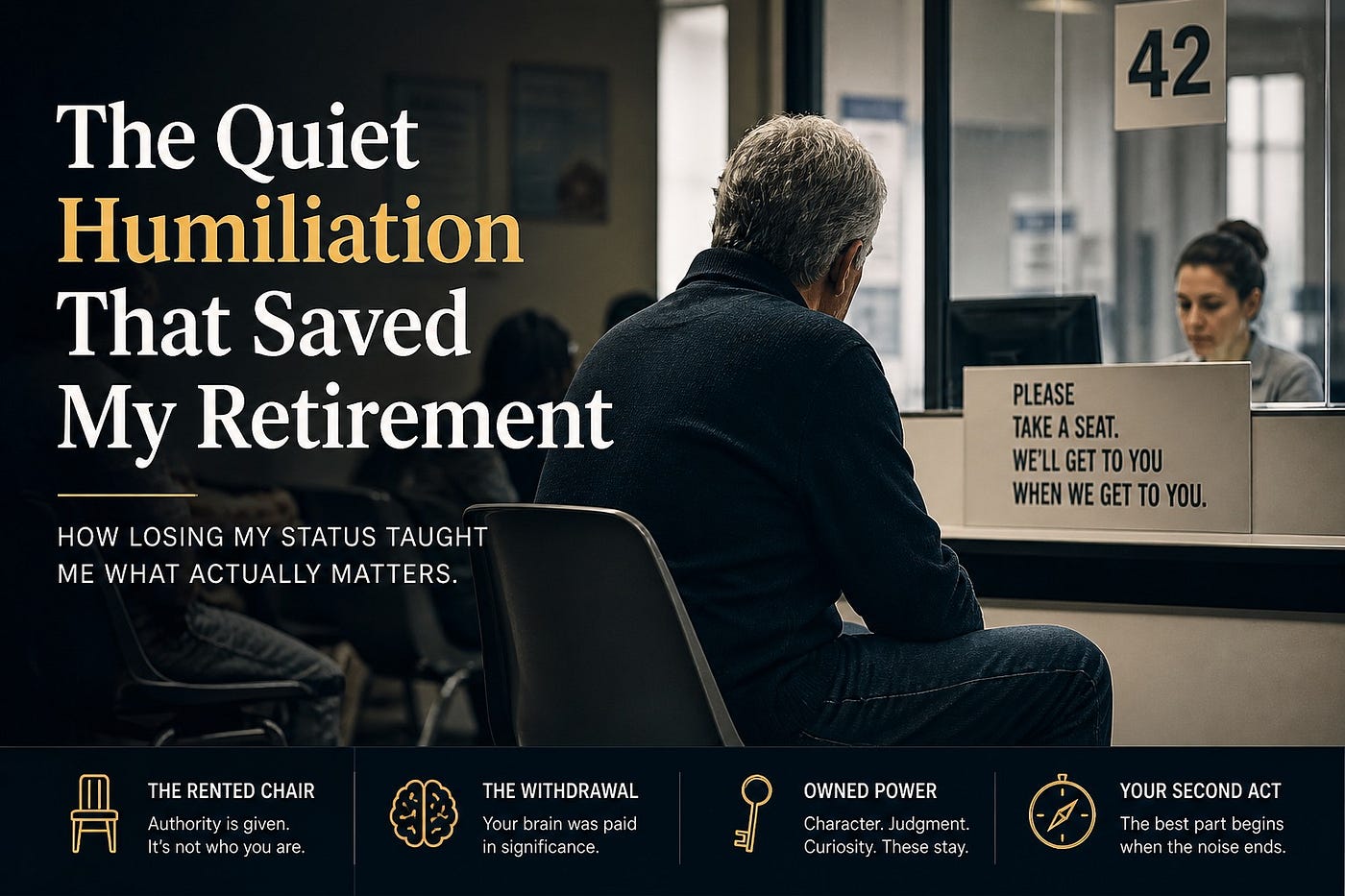
When the title disappears and the number is all that remains, you begin to discover what was yours all along. / Author Created Image using AI
It was a Tuesday at the DMV. I was three months into retirement, holding a paper ticket that said 42, standing behind a teenager in headphones and an elderly man clutching a folder of papers. When my number was finally called, I leaned in and offered the clerk a small, helpful, authoritative observation about my paperwork, the kind of frictionless suggestion that, in my old life, would have earned a nod and a thank-you. She didn’t look up.
She tapped the sign on the glass and said, “Take a seat, sir. We’ll get to you when we get to you.”
I want to tell you I handled it well.
I did not.
I went back to my plastic chair, and for a full ninety seconds, I was furious. Not at her. At the principle of it. Some part of me, the part that had spent four decades walking into rooms where the air shifted slightly when I entered, was waiting for someone to recognize that I shouldn’t be here. Not in this line. Not at this number. Not behind this teenager.
That, friends, is what I have come to call the Status Slap.
And I am here to tell you it is the single most important thing that will happen to you in the first year of retirement. The fact that I almost missed the lesson, that I almost just stayed mad at a clerk who was doing her job perfectly well, is the reason I’m writing this.
The Authority That Was Never Yours
For forty years, I told myself a flattering story. The story was that the way people listened to me reflected who I was. The deference, the speed of service, the room-quieting effect when I spoke, surely all of that was earned. Surely it was about me.
It was not. Not most of it.
Most of it belonged to the chair I sat in. The title. The budget I controlled. The signature line that could open or close a door for someone who needed something from my organization. That authority was real, but it was rented. It came with the office, and it stayed with the office the day I handed in the keys.
In my latest book, Intentional Retirement, I call this the Rented Chair. I won’t relitigate the metaphor here, except to say that the chair is the easy part to give up. It’s the dopamine that’s harder.
The Withdrawal Nobody Warned Me About
Here is what no one tells you on the way out the door.
For decades, every time someone sought your approval, your brain delivered a small chemical reward. Every problem brought to you, every meeting you ran, every email marked URGENT in your inbox, these were not just work. They were doses. You were living, without realizing it, inside a steady biochemical drip of mattering.
Then you retire.
The phone goes quiet. The inbox, which used to be a frantic scoreboard of your relevance, becomes a slow trickle of newsletters and pharmacy reminders. The calendar opens up and stays open.
This isn’t peace. Not yet. This is detox.
And the body knows. That low restlessness you feel at 10 a.m. on a Wednesday, the strange irritation I felt standing in line at the DMV, that isn’t your personality. That’s withdrawal. You weren’t just paid in dollars. You were paid in significance, and the supply has been cut off.
The healthiest thing you can do in that first year is name it. You are not depressed. You are not bored. You are weaning yourself off a drug you didn’t know you were taking.
The Question That Begins to Put You Back Together
Sitting in that plastic chair, I asked myself a question for the first time in my adult life:
What part of my power was actually mine, and what part was on loan?
Borrowed power was the ability to hire and fire, to approve a budget, to call a meeting, and to have a dozen people show up. It was the automatic respect people showed me when they needed something from me. All of that stayed at the office.
Owned power is what stands in line at the DMV with you. It is your judgment, sharpened over forty years. Your character, tested in rooms most people never see. Your curiosity. Your humor. Your capacity to listen to another human being without needing to fix them or impress them.
Borrowed power is loud. Owned power is quiet.
And here is the gift hidden inside the Status Slap: when the borrowed power is finally stripped away, you get to find out, for the first time in decades, what’s actually yours.
For most of us, the answer is more than we feared, and different from what we expected.
The Reflex That Will Cost You
There is, however, one habit from the old life that will follow you out the door and quietly sabotage your second act if you let it.
I call it the Command Reflex. And I want to tell you about Saturday morning, when it nearly cost me a friendship.
I had volunteered at a local nonprofit. They had asked me to help, and I had said yes the way I had said yes to everything for forty years, with a quiet assumption that within about six weeks, I would be running things. I showed up to my second meeting with a single-page document. I had reorganized their intake process. Color-coded. Streamlined. I had even, God help me, made a slide.
The volunteer coordinator, a woman in her thirties who had been doing this work beautifully for years before I arrived, looked at my single page. Then she looked at me. The look on her face was not anger. It was something much worse. It was the polite, practiced patience of someone who has seen many retired executives walk through that door.
“Gary,” she said, very gently, “we didn’t actually ask for this.”
I felt the heat go up the back of my neck. Not because she was wrong, but because she was so obviously, embarrassingly right.
This is the Command Reflex. It is the hardwired instinct, built over forty years of being paid to fix things, to walk into any room, whether a nonprofit board, a neighbor’s kitchen, a grandchild’s school project, and immediately start optimizing. Reorganizing. Improving. Taking charge.
In your career, this reflex was a superpower. In retirement, it is the fastest way I know to become a person other people quietly stop inviting.
The transition that has to happen, and it is a real transition, not a cosmetic one, is the move from being the Sage on the Stage to being the Guide on the Side. A guide does not give orders; a guide asks better questions. A guide does not need the credit; a guide finds genuine pleasure in someone else’s growth. A guide does not walk into a room and rearrange the furniture. A guide sits down in whatever chair is offered and gets curious about the people already in it.
This is not a downgrade. It is, in fact, the move that finally makes you useful in a way you couldn’t be when you were busy being important.
The Quiet on the Other Side
I want to tell you the truth about the Status Slap.
It stings. It stings more than you’ll want to admit, especially to anyone who knew you in your career. There is a real grief in being number 42 when you used to be the person who didn’t take a number.
But there is something on the other side of that sting that the old life could never give you, and it is this:
You finally get to find out who you are when nobody is paying attention.
You can walk into a grocery store as if you were nobody. You can stand in line at the DMV as nobody. You can sit on a park bench at three in the afternoon on a Tuesday, and discover that nobody is the same as anyone.
Nobody is just you, without the costume.
And the strange, quiet joy of the second act — the part the brochures never mention is realizing that the man under the costume was the part worth keeping all along.
So here is the question I’ll leave you with, the same one I should have asked myself the day I cleaned out my office instead of three months later in a fluorescent-lit waiting room:
When the borrowed power is gone, what do you actually have left, and is it enough?
Adapted from “Intentional Retirement: Designing the Architecture of Your Second Act” by Gary Fretwell — available now.
Further Reading to Consider:
About the Author
Gary L. Fretwell is a #1 international best-selling author and a student of “Intentional Living.” By blending the rigors of neuroscience with the timeless wisdom of Stoic philosophy, Gary helps creators and leaders build a cognitive architecture of true significance.
**Intentional Retirement, available now.** It is a definitive field guide for those ready to move from “Output” to “Influence.”
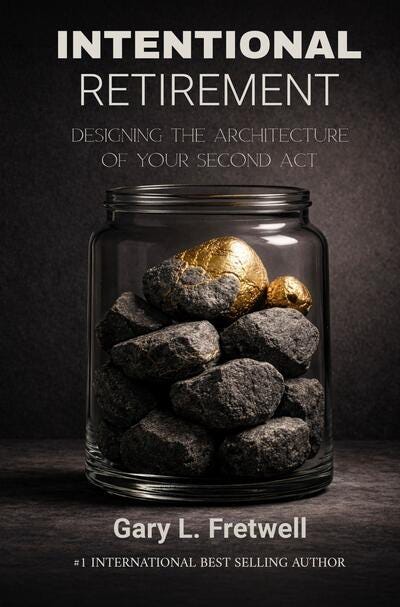
Landing page of Intentional Retirement — Official Page — ISBN: 9798223290049

landing page of Intentional Retirement
As the author of #1 International Best Seller The Magic of a Moment, Unlocking the Magic Daily Journal, and Embracing Retirement, Gary doesn’t just write about purpose — he maps the neuroscience of it. Whether he is serving as Board President for Prescott Meals on Wheels or mentoring the next generation of MBA thinkers at Western Governors University, his mission is to help you navigate the “Identity Ghost” and live an intentional life.
- Explore the Second Mile: garyfretwell.com
- Weekly Deep Dives: Subscribe to The Wise Effort on Substack.
- Latest Articles: Follow on Medium.
메타데이터
- post_id
- de4d11aaba07
- slug
- the-quiet-humiliation-that-saved-my-retirement-de4d11aaba07
- url
- https://medium.com/illumination-retirement-aging-legacy/the-quiet-humiliation-that-saved-my-retirement-de4d11aaba07
- canonical_url
- https://medium.com/illumination-retirement-aging-legacy/the-quiet-humiliation-that-saved-my-retirement-de4d11aaba07
- author_url
- https://medium.com/@gary_fretwell
- status
- ok
- fetched_at
- 2026-06-09 15:37:30