Masala Chai with a Healthy Twist: What Makes It Better Today?
Quick Answer: Traditional masala chai is made by brewing black tea with milk, sugar, and spices such as ginger, cardamom, cinnamon, and…
Masala Chai with a Healthy Twist: What Makes It Better Today?
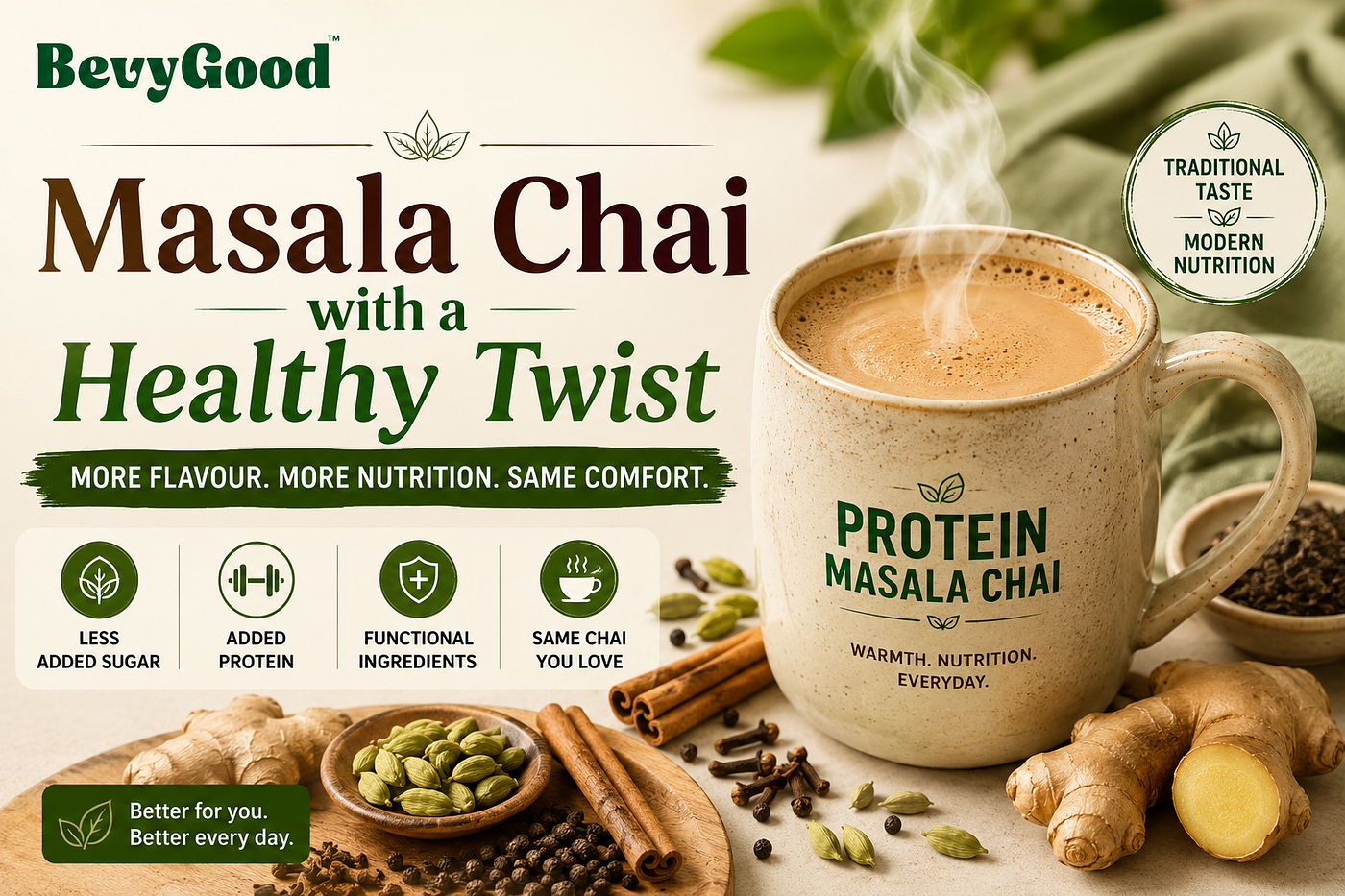
Quick Answer: Traditional masala chai is made by brewing black tea with milk, sugar, and spices such as ginger, cardamom, cinnamon, and cloves. Today, healthier versions of masala chai are reducing added sugar, incorporating functional ingredients, and even adding protein. The idea isn’t to replace traditional chai, but to make an everyday ritual more nutritionally relevant to modern lifestyles.
There are very few problems a cup of masala chai hasn’t at least attempted to solve.
Sleepy morning? Chai.
Unexpected guests? Chai.
Long meeting? Chai.
Rain? Obviously, chai.
For generations, masala chai has been one of India’s most dependable rituals. The recipe may change from one household to another, but the fundamentals remain familiar: tea, milk, spices, sugar, and a generous amount of personal preference.
But while our chai has remained largely the same, our lifestyles haven’t.
We sit more. Rush more. Snack more. Think about sugar more. Worry about protein more. And increasingly, we expect the things we consume every day to do more for us.
Which raises an interesting question:
Can masala chai become healthier without becoming less masala chai?
Turns out, it can.
What Is Masala Chai?
Masala chai is a traditional Indian beverage made by brewing black tea with milk and a combination of aromatic spices.
Common masala chai ingredients include:
- Ginger
- Cardamom
- Cinnamon
- Cloves
- Black pepper
There is, however, no single universally accepted masala chai recipe.
Some households like it ginger-heavy.
Some believe cardamom is non-negotiable.
Others have a masala dabba combination that has probably been passed down through more generations than the family jewellery.
And that’s part of masala chai’s charm.
It isn’t one recipe.
It’s a ritual people make their own.
Is Masala Chai Healthy?
The answer depends largely on how you make it.
Traditional masala chai contains ingredients that can absolutely be part of a balanced diet. Tea and spices provide flavour and plant compounds, while milk can contribute protein and other nutrients.
But then comes the sugar.
And then another spoon of sugar.
And then three more cups of chai throughout the day.
The issue with masala chai isn’t necessarily the beverage itself. It’s how frequently we consume it and what we repeatedly add to it.
A heavily sweetened chai consumed several times a day can contribute a meaningful amount of added sugar to the diet.
So perhaps the question isn’t:
Is masala chai healthy?
It’s:
Can we make the chai we already love work a little harder nutritionally?
The Healthy Masala Chai Is Changing
For years, making chai “healthier” usually meant one of three things:
Use less sugar. Use less milk. Or replace it with green tea.
Effective? Perhaps. Exciting for a lifelong masala chai drinker? Debatable.
But the modern health and nutrition industry is beginning to approach everyday beverages differently.
Instead of only asking what can be removed, brands and consumers are increasingly asking:
What can be added?
Less sugar is one part of the conversation.
More nutrition is the other. And that’s where today’s healthier masala chai begins to look very different.
1. Less Added Sugar, More Actual Chai
Sugar has traditionally done a lot of heavy lifting in beverages. It makes things instantly enjoyable.
But a good masala chai already has something working in its favour: Flavour. Lots of it.
Ginger brings warmth.Cardamom adds aroma. Cinnamon adds a perception of sweetness. Cloves and black pepper bring depth.
A thoughtfully formulated masala chai doesn’t necessarily need large amounts of added sugar to remain enjoyable.
The modern approach isn’t about removing everything that makes chai pleasurable. It’s about letting the chai itself do more of the work.
2. Masala Chai Is Becoming Functional
For decades, beverages were largely divided into two categories. The ones you enjoyed.
And the ones you consumed because they were supposedly good for you. Increasingly, that distinction is disappearing.
Consumers now expect everyday products to offer both taste and function. This has led to the growth of functional beverages: drinks designed to provide something beyond basic refreshment.
Electrolyte water. Fortified beverages. Protein coffee. And now, protein chai.
Masala chai is no longer limited to being a source of comfort. With the right formulation, it can also become an opportunity to add nutrition to the day.
3. Protein Is Finding Its Way Into Chai
For a long time, protein had a very specific aesthetic. Large tubs. Shaker bottles. Gym bags. Cold drinks.
Masala chai was nowhere in the picture. But the way people think about protein is changing.
Protein is increasingly recognised as an essential everyday nutrient rather than something exclusively meant for athletes.
The challenge is consistency. Knowing that protein matters is easy. Finding convenient ways to consume enough of it every day is considerably harder.
And that creates an interesting opportunity. Millions of people already drink chai every day.
Some drink it more than once.
Instead of creating an entirely new nutrition habit, what if an existing habit could simply contribute a little more?
That’s the idea behind protein masala chai.
What Is Protein Masala Chai?
Protein masala chai combines the familiar flavour profile of traditional masala chai with added protein.
The idea is fairly simple: Masala chai first. Protein included.
A well-formulated protein chai shouldn’t feel like someone poured protein powder into your tea and hoped for the best.
It should still deliver what people come to masala chai for: Warmth. Spice. Creaminess. Comfort.
The protein simply adds another nutritional dimension.
Traditional Masala Chai vs Healthier Masala Chai

The difference isn’t about making old chai obsolete.
It’s about asking more from the cup.
Why Protein and Masala Chai Make Sense Together
At first, protein chai can sound unusual. Mostly because we’ve been trained to imagine protein in cold formats.
But behaviourally, the combination makes a lot of sense. Protein is something many people want to consume more consistently.
Chai is something millions of people already consume consistently. One requires building a habit. The other already is one.
Bringing the two together reduces one of the biggest challenges in nutrition:friction.
You don’t have to remember another supplement.
Prepare another snack. Carry another shaker.
Or force yourself to enjoy another artificially flavoured protein shake. You simply get more from a ritual that was already part of your day.
Does Adding Protein Make Masala Chai Healthier?
It can make masala chai more nutritionally useful, but the complete formulation matters. Simply adding protein to any beverage doesn’t automatically make it “healthy.”
A better protein masala chai should be evaluated on factors such as:
- Amount and quality of protein
- Protein source
- Added sugar
- Overall ingredient list
- Calories per serving
- Taste and texture
This is an important distinction.
The future of healthy beverages isn’t about adding one fashionable ingredient to an otherwise poorly formulated product.
It’s about designing the entire beverage more thoughtfully.
But Can Protein Actually Work in Hot Chai?
This is where things become scientifically interesting. Most traditional protein powders are designed for cold water or milk.
When certain proteins, particularly whey, are exposed to heat, their structures can unfold and interact with one another. This process is known as protein denaturation.
The protein isn’t necessarily nutritionally destroyed.
But it may:
- Clump
- Become grainy
- Thicken
- Lose its smooth mouthfeel
That’s why creating protein chai isn’t as simple as mixing a scoop of whey into hot tea.
Protein source, ratio, quantity, processing, temperature, and preparation method can all influence the final beverage.
The challenge isn’t just getting protein into masala chai.
It’s getting it there without ruining the masala chai.
Convenience Is Part of the Health Conversation Too
Health advice often ignores one inconvenient fact: People are busy.
A homemade masala chai can require tea, milk, spices, sugar, a saucepan, and a few minutes of attention.
That’s perfectly manageable sometimes.
At 8:47 AM before a 9 AM meeting? Perhaps less so.
Modern instant masala chai formulations can make the ritual easier to maintain. And when convenience is combined with thoughtful nutrition, something interesting happens.
The healthier choice becomes the easier choice. That’s important because good nutrition doesn’t only depend on knowing what to consume.
It depends on whether you can consume it consistently.
So, What Makes Masala Chai Better Today?
Not one ingredient. And certainly not one health trend.
What makes today’s masala chai interesting is the opportunity to rethink the entire cup.Less dependence on added sugar. More attention to ingredient quality.
The possibility of additional protein. Faster preparation. Better formulation.
And, ideally, no compromise on the reason people drink masala chai in the first place: because it tastes like masala chai.
The Bigger Shift: From Removing to Improving
For a long time, healthy eating advice was built around subtraction.
Remove sugar. Remove fat. Remove calories. Remove the things you enjoy.
But consumers are increasingly looking for a different approach. They don’t only want less of the things they’re trying to avoid. They want more from the things they’re already consuming.
More protein. More convenience. More function. More nutritional value. Masala chai with a healthy twist represents that shift perfectly.
It doesn’t ask you to abandon a lifelong ritual in pursuit of better nutrition. It asks whether the ritual itself can evolve.
Final Thoughts: Masala Chai Didn’t Need Replacing. It Needed Rethinking.
Perhaps the most interesting thing about healthier masala chai is that the chai itself hasn’t fundamentally changed.
The ginger can still be warming. The cardamom can still be aromatic. The spices can still hit exactly where they’re supposed to. And the first sip can still make a bad morning marginally more tolerable.
What’s changing is what we expect from that cup.
Today’s consumers increasingly want everyday food and beverages to balance taste, nutrition, and convenience.
And masala chai is evolving to meet that expectation. Not by becoming less indulgent. Not by pretending to be green tea. And certainly not by abandoning everything that made people love it in the first place.
But by becoming a little more thoughtful about sugar.A little more ambitious about nutrition. And, with innovations like protein chai, a little more useful to the person drinking it.
Because the future of healthy eating may not lie in constantly creating new habits.
It may simply lie in making our oldest ones work better.
메타데이터
- post_id
- de6379d46fc4
- slug
- masala-chai-with-a-healthy-twist-what-makes-it-better-today-de6379d46fc4
- url
- https://medium.com/@marketingbevy01/masala-chai-with-a-healthy-twist-what-makes-it-better-today-de6379d46fc4
- canonical_url
- https://medium.com/@marketingbevy01/masala-chai-with-a-healthy-twist-what-makes-it-better-today-de6379d46fc4
- author_url
- https://medium.com/@marketingbevy01
- status
- ok
- fetched_at
- 2026-07-27 10:37:48