Another End-of-Year Extra Credit Project
This one is designed with the Battleship Iowa Museum and all middle school and high school US History classes in mind
Another End-of-Year Extra Credit Project
This one is designed with the Battleship Iowa Museum and all middle school and high school US History classes in mind
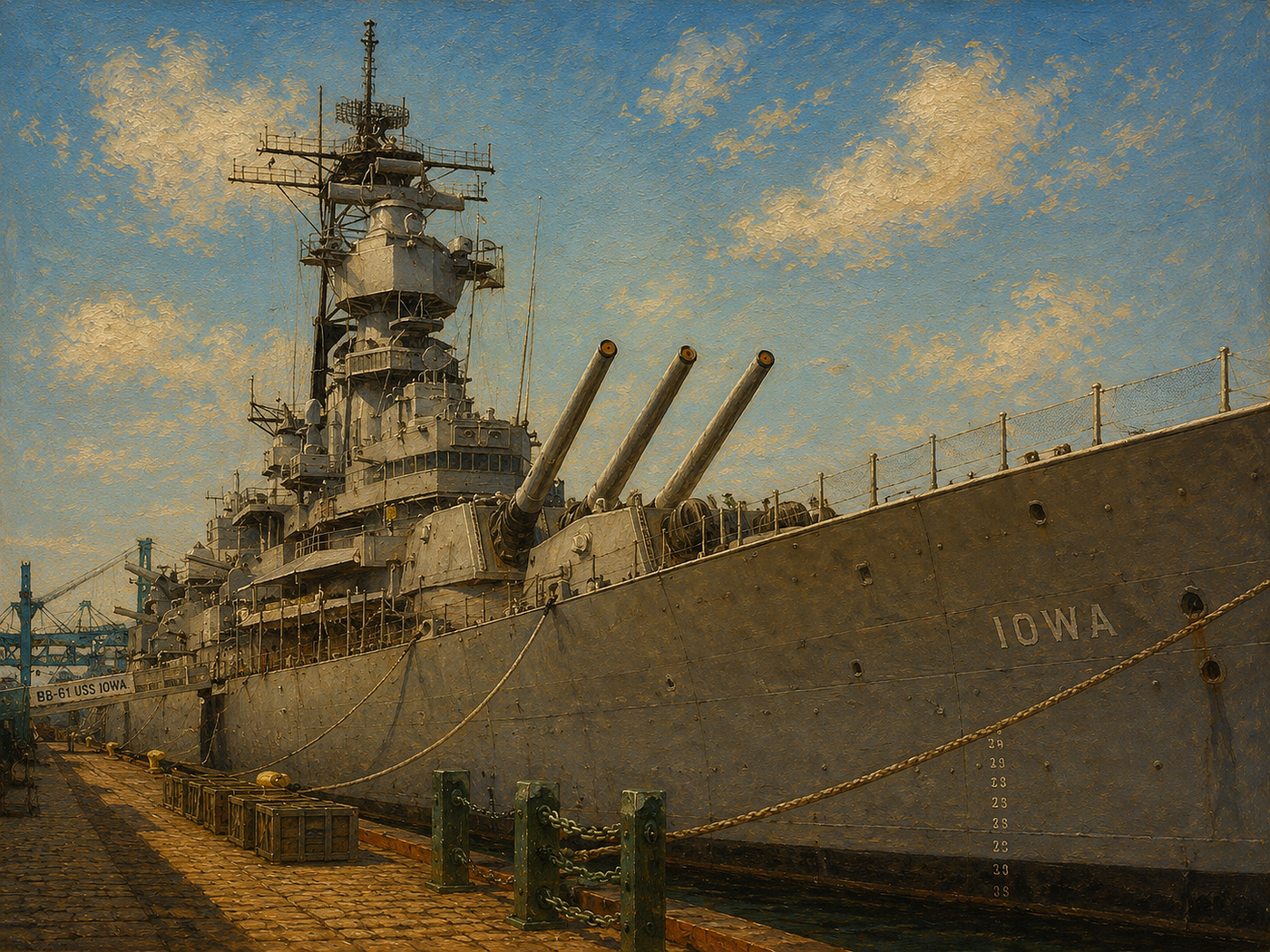
The Battleship Iowa Museum:
- Is located in San Pedro, California, along the Los Angeles waterfront.
- Centers on the history of the USS Iowa (BB-61), one of the most famous battleships in United States naval history.
- Helps tell stories connected to World War II, the Cold War, the Korean War, military technology, naval life, presidential history, American power in the twentieth century, and the experiences of sailors who served aboard the ship.
- Includes preserved crew spaces, command centers, gun turrets, officer areas, engine-related exhibits, and interactive displays designed to help visitors understand both the technology and human experience of life aboard a battleship.
For this project, students are to assume that the Battleship Iowa Museum wishes to create a living history experience for museum visitors. To do so, the museum plans to hire qualified individuals to serve as living history interpreters stationed in different parts of the ship.
Students will select one historical interpreter role connected to the history of the USS Iowa and prepare to answer questions from museum visitors.
If I were assigning this project, I would tell students that they may use any resources they want to prepare, including books, class notes, websites, documentaries, museum materials, interviews, and generative AI tools such as ChatGPT. There would be no restrictions and no limits on AI use during the preparation phase. The goal would be for students to use every available tool to prepare themselves to answer questions accurately, thoughtfully, and in historical context.
Your call, though. If you choose not to allow unlimited AI use, the same basic project could still work with whatever preparation rules or limits make sense for your classroom.
On the due date, the teacher will take on the role of a museum visitor. The student will assume that they are standing at their assigned station aboard the USS Iowa. At each station, there would be a sign identifying the student’s role, the year, the student’s age, and a few basic details about the historical character being represented.
The teacher, as the visitor, will ask questions. Extra credit points will be awarded based on how well the student responds in character, explains the historical setting, and demonstrates understanding of the larger historical themes connected to the USS Iowa and twentieth-century American history.
Students choose one of the following historical interpreter roles:
Choice 1–1944
- Assigned Museum Location: Main gun turret area
- Interpreter Role: U.S. Navy sailor, age 19
- Especially prepared to discuss life aboard the ship during World War II, naval routines, Pacific Theater operations, training, combat readiness, and the role of battleships in wartime.
Choice 2–1945
- Assigned Museum Location: Crew sleeping quarters
- Interpreter Role: Enlisted sailor returning from Pacific operations, age 22
- Especially prepared to discuss the cramped living conditions, friendships aboard ship, military discipline, homesickness, and the emotional impact of war.
Choice 3–1952
- Assigned Museum Location: Combat information center
- Interpreter Role: Radar operator during the Korean War, age 24
- Especially prepared to discuss: the Cold War tensions, naval bombardment missions, military technology, radar systems, and the role of the U.S. Navy during Korea.
Choice 4–1984
- Assigned Museum Location: Missile and modern weapons exhibit
- Interpreter Role: Cold War Navy technician, age 27
- Especially prepared to discuss Ronald Reagan’s military buildup, modernization of the USS Iowa, missile technology, Cold War strategy, and tensions with the Soviet Union.
Choice 5–1944
- Assigned Museum Location: Ship galley (kitchen area)
- Interpreter Role: Navy cook, age 31
- Especially prepared to discuss the feeding of hundreds of sailors, rationing, food preparation aboard ship, morale, and daily life at sea.
Choice 6–1987
- Assigned Museum Location: Officer command area
- Interpreter Role: Naval officer, age 42
- Especially prepared to discuss leadership aboard the ship, military hierarchy, command decisions, Cold War naval strategy, and American global power.
Choice 7–1945
- Assigned Museum Location: Anti-aircraft gun station
- Interpreter Role: Gun crew member, age 20
- Especially prepared to discuss defending the ship from air attacks, teamwork during combat, fear during battle, and technological changes in naval warfare.
Choice 8–1989
- Assigned Museum Location: Memorial/exhibit connected to the turret explosion
- Interpreter Role: Sailor serving aboard the USS Iowa during the 1989 turret explosion, age 23
- Especially prepared to discuss the tragedy itself, investigations, military life during peacetime, media attention, and how the event affected the Navy community.
Choice 9–1943
- Assigned Museum Location: Recruitment or training exhibit
- Interpreter Role: Newly enlisted sailor, age 18
- Especially prepared to discuss why young Americans joined the military during World War II, patriotism, propaganda, economic opportunity, and training.
Choice 10–1991
- Assigned Museum Location: Deck overlooking the harbor
- Interpreter Role: Former crew member revisiting the USS Iowa after retirement, age 65
- Especially prepared to discuss memory, historical preservation, changing military technology, and why preserving historical sites matters.
Side Note #1
The key idea is that students are not simply turning in a written report. Instead, they are using AI and other resources to prepare for a live, face-to-face historical interpretation task. They will need to know enough about their assigned year, location, identity, and historical context to answer questions from a visitor in a way that is historically accurate and convincing.
Side Note #2
To be clear, the Battleship Iowa Museum does not currently have this specific living history interpreter program. This is a project idea built around the ship’s history, exhibits, and setting. The premise is that students are preparing as if the museum were creating this kind of living history experience.
Side Note #3
Later today, I will be meeting with representatives from the Battleship Iowa Museum to discuss this post, the larger concept behind it, and the possibility of students preparing for this kind of live historical interpretation experience using both traditional research methods and generative AI tools.
Side Note #4
The goal is not for students to “simply have AI produce answers for them.” The goal is for students to use every available tool to prepare themselves to answer questions thoughtfully, accurately, and in historical context during a live, face-to-face historical interpretation experience.
Side Note #5
Some teachers may look at a project like this and immediately think: “There’s no way I have enough time to individually develop questions for and assess 30–40 students in this format at the end of the year.”
That concern is completely understandable.
One possible response would be to use generative AI to help create the historical interpretation questions themselves.
Teachers could provide AI with the student’s assigned role, year, museum location, and historical themes, then ask the AI to generate realistic museum visitor questions designed to test historical understanding, contextual thinking, and the ability to respond thoughtfully in character.
In other words, AI could help reduce some of the teacher workload connected to question creation while still preserving the live, face-to-face assessment portion of the project itself.
Teachers could also provide students with class time over multiple days to research, prepare, practice, and refine their historical interpreter roles. In many cases, teachers would likely begin identifying long before the final due date which students truly understand the material, can think historically, and are prepared to succeed in the live interpretation setting.
Those students could then effectively be given a “pass” prior to the final assessment and told that, if they wish, they have already earned full extra credit points. They could then be invited to help assess, question, interact with, or provide feedback to other students during the live historical interpretation process itself, thereby helping share some of the teacher workload while also deepening the collaborative and discussion-based nature of the project.
There is also no reason the project must be structured entirely around individual performances. Teachers could easily allow students to work in pairs or small groups of 2–3, particularly for larger classes or shorter end-of-year schedules.
The larger point is that projects like this do not necessarily require a teacher to formally interrogate 35–40 students one-by-one in a rigid or identical manner in order for meaningful historical learning to take place.
Side Note #6
After sharing the above Side Note #5 with the paid version of ChatGPT and asking for additional ideas teachers might consider for managing the assessment workload connected to a project like this, the following additional suggestions were generated:
- Teachers could require students to submit a short AI-generated “question bank” ahead of time based on their assigned role.
- Teachers could use rotating stations so only a portion of students are formally assessed each day.
- Teachers could use simple scoring categories rather than detailed written rubrics.
- Teachers could invite volunteers, parents, administrators, or museum staff to participate as museum visitors during the questioning process.
- Teachers could incorporate gallery walks, peer questioning, or collaborative stations rather than relying entirely on one-on-one teacher questioning.
Side Note #7
A week from Friday, I’ll be visiting the Battleship Iowa Museum. My goal is to discuss the learning opportunity raised in this blog post with various individuals connected to the museum. I’m especially interested in hearing their thoughts on the idea of students using AI, historical research, and real-time questioning to prepare for and carry out museum-style historical interpretation work connected to the ship and its exhibits.
This will not be the first time I’ve worked with individuals connected to the museum. Years ago, I met with the person then in charge of the education department, and together we developed a remote internship-style project in which my students researched and produced a lengthy document proposing an exhibit connected to the seaplanes that were once launched from the Iowa.
I honestly have no idea what ever became of the proposal after the students pitched it, but I do know that they loved the learning experience. It also became something I featured in my application for a Henry Ford Innovative Teacher of the Year award. The program recognized ten first-place teachers and ten second-place teachers nationwide, and I was honored to be selected as one of the second-place recipients. For helping make that opportunity possible, I owe a big thanks to the Iowa and the individuals connected to the museum who supported the project.
메타데이터
- post_id
- de69dce3fc64
- slug
- another-end-of-year-extra-credit-project-designed-de69dce3fc64
- url
- https://medium.com/@ppaccone/another-end-of-year-extra-credit-project-designed-de69dce3fc64
- canonical_url
- https://medium.com/@ppaccone/another-end-of-year-extra-credit-project-designed-de69dce3fc64
- author_url
- https://medium.com/@ppaccone
- status
- ok
- fetched_at
- 2026-06-24 23:31:39





