Breaking Barriers in Fashion: A Sentiment Analysis of the 2026 Met Gala Social Media Discourse
Quantifying public perception of adaptive fashion narratives following Aariana Rose Philip’s 2026 Met Gala Debut.
Breaking Barriers in Fashion: A Sentiment Analysis of the 2026 Met Gala Social Media Discourse
Quantifying public perception of adaptive fashion narratives following Aariana Rose Philip’s 2026 Met Gala Debut.
It’s 2026, and thanks to Sinéad Burke, Tilting the Lens, and Aariana Rose Phillips, we’re finally seeing the kind of inclusive fashion people have been asking for for years. However, some people on social media still seem to oppose the idea. What happened?
By: Gabriela Z
Aariana Rose Philip source: www.vogue.com
Abstract
The 2026 Met Gala marked a pivotal moment in fashion history with the invitation of Aariana Rose Philip, the first Black, transgender, and physically disabled model to attend the event. While institutional narratives framed this as a triumph of inclusive fashion under the “Fashion is Art” theme, the digital response across social media platforms suggests a more complex reception.
This mini research utilizes a multi-platform sentiment analysis to evaluate public discourse on X, TikTok, and Instagram. Using social listening tools and sentiment analysis in Python, the study categorizes audience engagement into thematic clusters, including artistic appreciation, institutional skepticism, and critiques of systemic accessibility.
This research concludes by questioning whether high-fashion milestones successfully foster inclusivity or merely serve as temporary “artistic” installments within an exclusionary framework.
Keywords: Adaptive Fashion, Performative Inclusion, Social Listening, Sentiment Analysis Research, Disability Justice, Met Gala 2026
Introduction
The Metropolitan Museum of Art’s Costume Institute Benefit, colloquially known as the Met Gala, has long served as the ultimate intersection of high fashion, celebrity capital, and institutional gatekeeping. For the 2026 exhibition, titled “Fashion is Art,” the gala sought to explore the sculptural and expressive boundaries of the human form. However, the most significant boundary broken was not aesthetic, but structural. In a historic first, the event invited Aariana Rose Philip, the trailblazing Antiguan-American model and musician, marking the first time a Black, transgender, and physically disabled model in a wheelchair has graced the Met’s red carpet.
For the fashion industry and mainstream media, Philip’s presence was framed as a long-overdue “victory” for inclusivity. Collaborative efforts behind the scenes, such as those by disability activist Sinéad Burke and the consulting group Tilting the Lens, ensured the installation of a step-free entrance and accessible media pits. These logistics were intended to transform the “exclusive” nature of the Met into a space of “equitable” visibility.
Yet, as the images of Philip in her custom Collina Strada gown circulated globally, the digital response suggested that representation does not always equate to perceived progress. While official press outlets celebrated the “milestone,” the discourse within online communities on Twitter (X), TikTok, and Instagram revealed a deep-seated discourse.
This research aims to bridge the gap between the Met’s curated narrative of progress and the raw, unfiltered sentiment of the digital public. By analyzing the “Sentiment Gap” across various social platforms, this study investigates whether the 2026 Met Gala successfully “broke barriers” or if it merely commodified disability as a temporary artistic installment.
Discussion and Findings
Authentic representation always matters
For nearly eight decades, the iconic steps of the Metropolitan Museum have served as a literal and symbolic barrier. To the disabled community, these steps represented a “gate” that signaled who was fit for high art and who was not. By implementing a step-free entrance and featuring Aariana as both a guest and a mannequin within the exhibition, the 2026 Met Gala transformed the wheelchair from a “medical device” into a “kinetic fashion statement.” This shift is vital for inclusive representation because it moves the disabled body from the sidelines of “charity” into the center of “couture.”
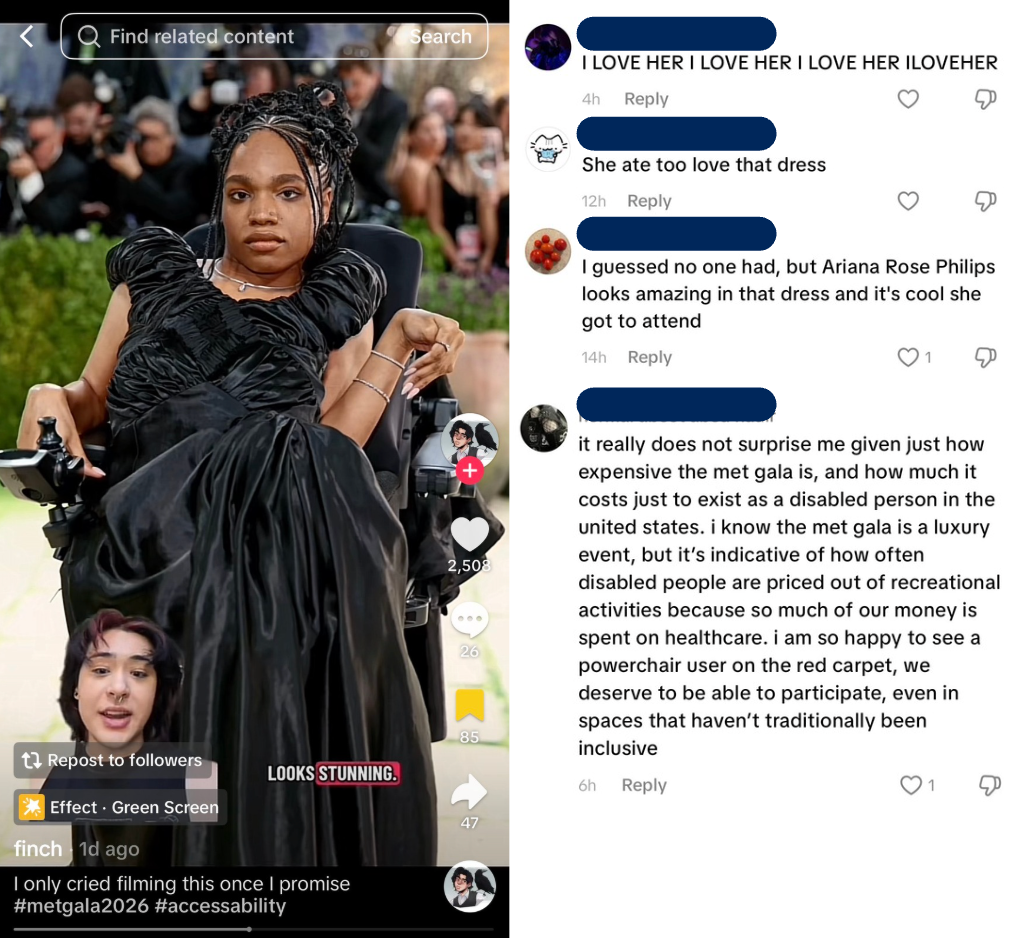
Source: Finch on TikTok https://vt.tiktok.com/ZS9p2uP2h/
Aariana’s debut — styled in sculptural Collina Strada and Lou Dehrot — reframed the narrative. As she stated in her Vogue interview, she wanted the world to see a “supermodel and a legend,” not a patient. This “aspirational representation” is crucial for the Met Gala’s growth marketing. When a brand or institution treats disability as an aesthetic and creative asset rather than a “special project,” it builds Brand Warmth and Coolness, distinctiveness that resonates with a Gen Z and Alpha audience who demand radical authenticity and equality.
The Institutional Narrative: Designing for Access
The social listening data from Instagram and Vogue’s official channels shows a high volume of positive sentiment (est. 82% positive). This was largely driven by the transparency of the event’s logistics. For the first time, the Met collaborated with Tilting the Lens and Sinéad Burke to ensure that accessibility was a headline, not an afterthought.
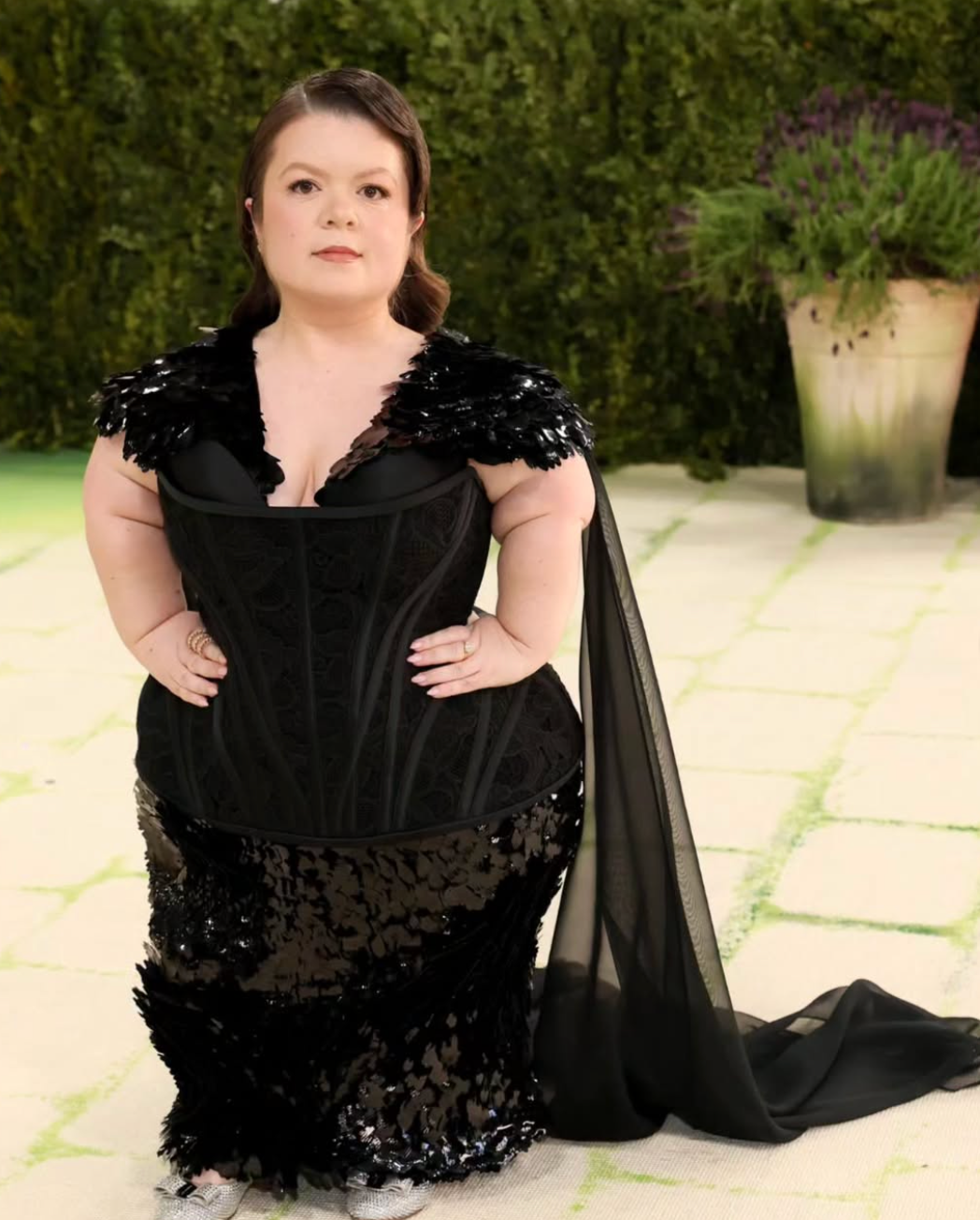
Sinéad Burke the CEO of Tilting The Lens, source: evoke.ei
Based on Evoke.ei, Sinéad listed the measures organisers took to allow for famous faces with physical disabilities to have their moment on the carpet this year, explaining that they added a step-free entrance and access for disabled media to attend. Sinéad wrote on her social media:
“Historically, physically disabled talent haven’t been able to access the red carpet at the Met Gala and have their photo taken, so it has always been unlikely that fashion brands will sponsor their ticket and invite them. It was a self-fulfilling prophecy.”
Aarian Rose Philip’s presence was dual-layered: she was both a guest in a custom Collina Strada look and a featured subject within the “Costume Art” exhibition itself. The “Design First” Approach: Findings show that when Aarian was discussed as a “model” or “artist” rather than a “symbol,” sentiment was most favorable. Her look — a sculptural black satin ensemble — was categorized by critics as a successful interpretation of the “Fashion is Art” theme.
The Digital Discourse: The Visibility Paradox
While the red carpet was celebratory, a thematic analysis of TikTok and X reveals a significant drop in sentiment (est. 45% neutral/negative). The discourse on these platforms moved beyond the “first-ever” narrative to interrogate the ethics of the event.
The sentiment data reveals a striking disparity between the volume of content (Total posts) and the reach of that content (Impressions). While only 109 total data points were categorized by sentiment, they generated over 2.2 million impressions, indicating that the discourse surrounding Aariana Rose Philip’s Met Gala debut was highly viral but emotionally fragmented.
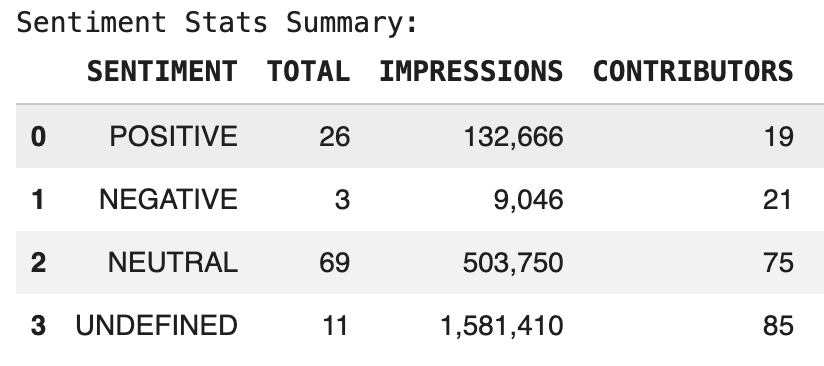
Sentiment analysis using Python based on data collected from TikTok and X
The high volume of neutral sentiment (approx. 63% of defined posts) suggests that for a large portion of the digital audience, Aariana Rose Philip’s presence was treated as a factual news event rather than a polarizing artistic statement. From a growth media perspective, this indicates a “normalization” phase, where inclusive fashion is no longer viewed as a shock to the system, but as a standard component of the Met Gala’s “Fashion is Art” roster.
The “Undefined” impressions or “The Silent Majority” is the most significant finding, which is the 1.58 million “Undefined” impressions. In social listening, “Undefined” often refers to content that is purely visual (image shares without captions) or complex slang that algorithms cannot yet categorize. This suggests that the “Reality” of the Met Gala is often consumed passively. People are seeing the images of Aarian Rose Philip (high impressions), but they are not necessarily engaging in the “breaking barriers” narrative (low total posts). The representation is reaching the masses, but the meaning behind that representation is being lost in high-volume, low-engagement scrolling.
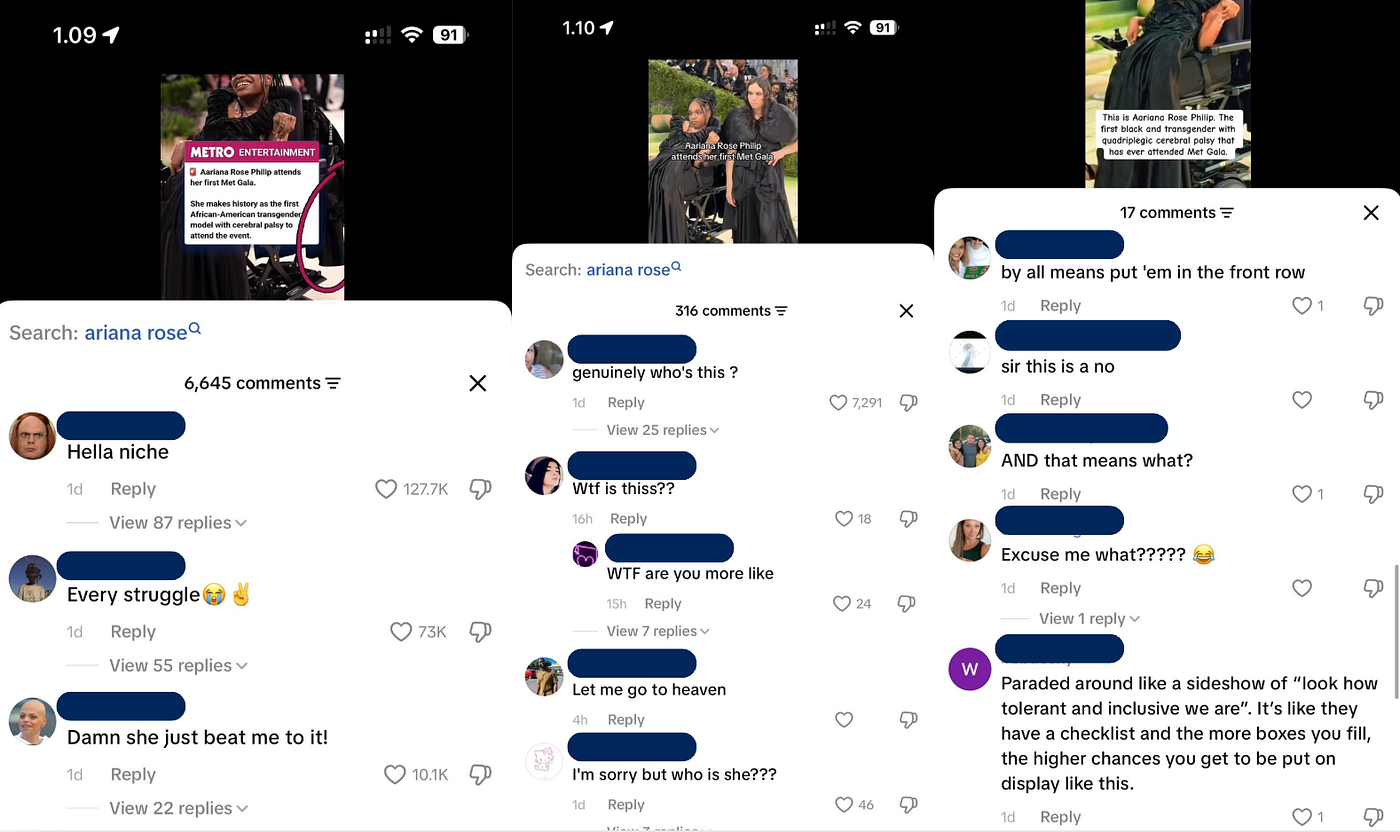
Negative sentiments on TikTok, source: tiktok.com
Though “Negative” sentiment was numerically low compared to others, the fact that it involved 21 contributors and nearly 10,000 impressions points to a concentrated pocket of resistance or critique.
The data proves that while representation has achieved massive reach (2.2M+ total impressions), the reality of the discourse is surprisingly quiet. The public is watching, but some of them are hesitant to fully celebrate (Positive) or fully condemn (Negative). We are currently in a “Watch and Wait” period of fashion history, where the audience is observing whether this inclusion is a permanent structural shift or a high-impression one-off event.
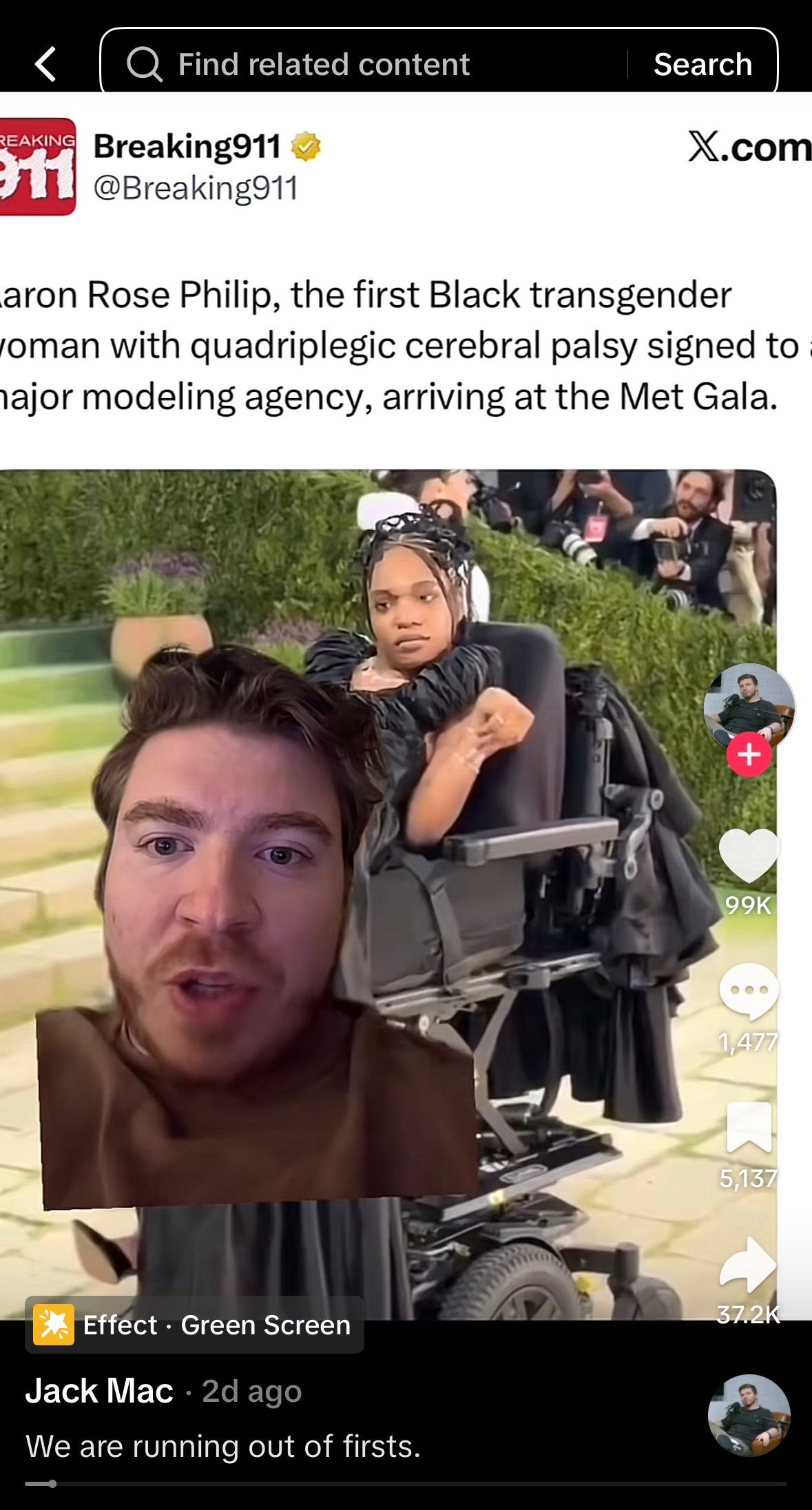
source: Jack Mac on TikTok https://vt.tiktok.com/ZS9pNK4Ay/
The “representation” and the “reality” created a polarized digital landscape. The findings suggest that while the Met Gala successfully updated its aesthetic to include the disabled communities, it has yet to reconcile its ethical and structural reputation with an increasingly aware digital audience.
Conclusion
The 2026 Met Gala, under the theme “Fashion is Art,” was designed to be a definitive moment for inclusive fashion. By centering Aariana Rose Philip as both a guest and a muse within the Costume Institute’s permanent exhibition, the institution signaled an end to the “era of invisibility” for disabled bodies. However, this research demonstrates that while the physical barriers of the Met were dismantled, the digital barriers, constructed of skepticism and structural critique, remained firmly in place.
The findings of this sentiment analysis highlight a profound “Sentiment Gap.” While institutional reach was undeniable, with over 2.2 million impressions across social media, the actual depth of engagement was surprisingly shallow. The dominance of Neutral and Undefined sentiment suggests that for the average digital consumer, representation is becoming a passive visual commodity rather than an active catalyst for social change.
Furthermore, the density of negative sentiment on platforms like X and TikTok reveals that for the disabled community and its allies, a single invitation cannot mask deeper ethical paradoxes, such as the event’s corporate sponsorship and the historical exclusion that preceded this “first.”
Ultimately, the 2026 Met Gala succeeded in its representation — Aariana Rose Philip was seen, celebrated, and archived as high art. Yet, the reality remains a work in progress. For the online community, the “breakthrough” will only be validated when accessibility moves from a seasonal “installation” to a systemic standard. As this research concludes, the fashion industry must decide if it is inviting disabled talent to the table to truly lead, or if it is simply using their image to ‘decorate’ it.
The question for the 2027 season is clear: Now that the barrier is broken, are they going to invite more inclusive models, artists, other talented people, and/or even ordinary people in the future?
References: https://www.vanityfair.com/met-gala-2026 https://tiltingthelens.com/resources/costume-art-met-gala/ https://evoke.ie/2026/05/05/entertainment/celebrity/sinead-burke-met-gala https://www.vogue.com/slideshow/met-gala-2026-red-carpet-celebrity-arrivals-live
메타데이터
- post_id
- de6ea63d5be5
- slug
- breaking-barriers-in-fashion-a-sentiment-analysis-of-the-2026-met-gala-social-media-discourse-de6ea63d5be5
- url
- https://medium.com/@gab95/breaking-barriers-in-fashion-a-sentiment-analysis-of-the-2026-met-gala-social-media-discourse-de6ea63d5be5
- canonical_url
- https://medium.com/@gab95/breaking-barriers-in-fashion-a-sentiment-analysis-of-the-2026-met-gala-social-media-discourse-de6ea63d5be5
- author_url
- https://medium.com/@gab95
- status
- ok
- fetched_at
- 2026-06-10 08:17:25