Microsoft’s Phi-4-Reasoning-Vision-15B: The AI That Knows When to Think and When to Just Answer
There’s something genuinely interesting happening at Microsoft right now, and it’s not about building the world’s biggest AI. It’s actually…
Microsoft’s Phi-4-Reasoning-Vision-15B: The AI That Knows When to Think and When to Just Answer
There’s something genuinely interesting happening at Microsoft right now, and it’s not about building the world’s biggest AI. It’s actually the opposite.
On March 4, 2026, Microsoft quietly dropped a model called Phi-4-reasoning-vision-15B. Fifteen billion parameters. Not 671 billion. Not even close. But the team behind it is making a bold claim: this smaller model can compete with, and in some areas outperform, systems that are many times its size.
That’s a big claim. And the way they built it is worth understanding.
What Is Phi-4-Reasoning-Vision and Why Does It Matter?
Before we get into the technical stuff, let’s set the scene.
Most people think that bigger AI models are always better. More parameters, more data, more compute, better results. That’s been the dominant thinking in the industry for years. OpenAI, Google, Meta, and others have poured billions into scaling up their models.
Microsoft is betting that this logic has a ceiling.
Phi-4-reasoning-vision-15B is a multimodal AI model, which means it can process both images and text at the same time. You can show it a photo, a chart, a screenshot, or a math problem written on paper, and it can reason through it, describe it, or answer questions about it.
The model is available right now through Microsoft Foundry, Hugging Face, and GitHub under a permissive open license, meaning developers can download it, use it, fine-tune it, and build on top of it for free.
That openness is a deliberate move. More on that later.
The Training Data Problem That Everyone Is Ignoring
Here’s the number that should catch your attention: Phi-4-reasoning-vision was trained on roughly 200 billion tokens of multimodal data.
Now compare that to its competitors:
- Alibaba’s Qwen 2.5 VL and 3 VL: over 1 trillion tokens
- Moonshot AI’s Kimi-VL: over 1 trillion tokens
- SenseTime’s InternVL series: over 1 trillion tokens
- Google’s Gemma3: over 1 trillion tokens
That’s roughly five times more data used by every major competitor, and Microsoft still managed to build something that performs in the same league.
How? The answer isn’t magic. It’s obsessive attention to data quality.
The Team Actually Read Their Own Training Data
Most AI teams use automated filters to clean their training datasets. Microsoft’s researchers took a different approach. They manually reviewed samples from each dataset, spending five to ten minutes per batch classifying whether the data was good, bad, or somewhere in the middle.
When they found samples with wrong answers, they regenerated the answers using GPT-4o and o4-mini. When an image was high quality but the question attached to it was garbage, they repurposed the image entirely and created new captions or visual question-answering data from scratch.
What they found in the process was uncomfortable: a surprisingly high number of formatting and logical errors across widely used open-source datasets. Datasets that other companies are almost certainly using to train their own models.
This isn’t just a footnote. It’s a quiet indictment of how the industry has been building AI systems. If the data foundation is shaky, no amount of scale fixes that.
The Core Idea: Not Everything Needs Deep Thinking
Here’s the part of this model that is genuinely clever, and it’s worth taking time to understand it properly.
In the last year or two, a category of AI models called reasoning models has become extremely popular. These are systems that, instead of immediately generating an answer, first “think through” the problem step by step, working out the logic before producing a response. OpenAI’s o-series and DeepSeek’s R1 are famous examples of this approach.
Reasoning models are great at hard problems: complex math, multi-step science questions, logic puzzles. The extra thinking time leads to better answers.
But here’s the catch. Not every task needs that kind of deep reasoning.
If you ask an AI to caption a photo, or to recognize text in an image, or to describe what’s in a screenshot, making the model “think out loud” first doesn’t help. It actually makes things worse. The output becomes unnecessarily long, the response takes longer, and the quality often drops because the model introduces extra steps where none were needed.
The 20/80 Rule That Microsoft Baked Into the Model
Microsoft’s team built what they call a “mixed reasoning and non-reasoning model.”
Here’s how it works under the hood:
- About 20% of the training samples included explicit chain-of-thought reasoning, wrapped in
<think>...</think>tags - The other 80% were labeled for direct response using a
<nothink>token
The model learned through this training process to recognize which situations call for deep reasoning and which situations just need a fast, clean answer. You can also override the default yourself by explicitly prompting the model with <think> or <nothink> tokens if you want to force a specific behavior.
This design is practical in a way that a lot of AI research isn’t. It reflects how humans actually think. You don’t mentally simulate every step of tying your shoes. But you do work through a math problem step by step. The model learned to do the same thing.
How the Visual Side Actually Works
Most AI models that process images use one of two main architectural approaches: early fusion or mid fusion.
In early fusion, images and text are processed together from the very beginning in a single system. This gives richer results but costs a lot more compute, memory, and data to pull off.
In mid fusion, a separate vision encoder first converts the image into tokens (chunks of information the model can read), and then those tokens are fed into the language model. It’s less resource-intensive, which made it the right call for a team working with a leaner dataset.
Why Screenshot Resolution Actually Matters
One of the less obvious engineering challenges the team tackled was image resolution, specifically around reading dense screenshots and small interface elements.
They tested four different methods for handling image resolution:
- Dynamic S
- Multi-crop
- Multi-crop with S
- Dynamic resolution using SigLIP-2’s Naflex variant
The fourth approach won out. The team landed on the SigLIP-2 Naflex variant with a maximum of 3,600 tokens per image, which roughly corresponds to native 720p resolution. This turned out to be particularly important for high-resolution benchmarks like ScreenSpot-Pro, which tests whether a model can identify and locate specific interface elements like buttons, menus, and text fields.
Why does that matter in the real world? Because this model is being designed to power computer-using agents. These are AI systems that can navigate real desktop and mobile interfaces autonomously. To do that, the AI needs to actually see what’s on the screen clearly enough to click the right button or fill in the right form.
What the Benchmarks Actually Show
Let’s look at the numbers honestly, because the Microsoft team ran their own evaluations rather than quoting from leaderboards.
Here’s how Phi-4-reasoning-vision-15B scored across ten benchmarks:
BenchmarkPhi-4-Vision-15BQwen3-VL-32BAI2D (science diagrams)84.885.0ChartQA83.384.0MathVista75.281.8ScreenSpot v288.293.9MMMU54.370.6
The comparison to Qwen3-VL-32B is telling. That’s a 32-billion-parameter model, more than twice the size of Phi-4-reasoning-vision. On most benchmarks, the performance gap is small. On some, it’s more noticeable.
But the real story isn’t in any single benchmark number. It’s in the relationship between accuracy and speed.
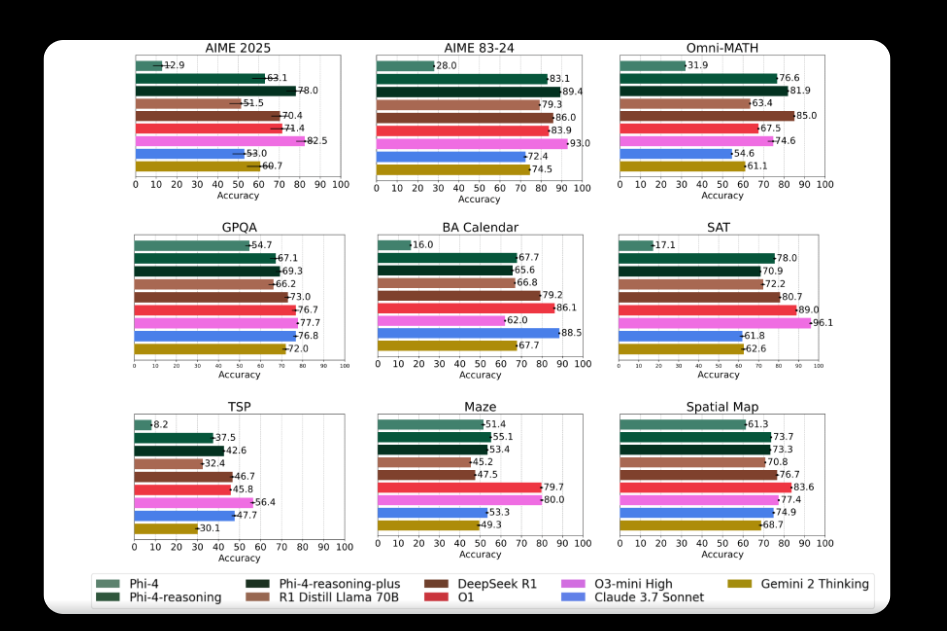
When the Microsoft team plotted accuracy against compute time and output token count, Phi-4-reasoning-vision-15B sat at what they call the Pareto frontier: the set of models that are both fast and accurate, where you can’t improve one without sacrificing the other. It delivers competitive results in a fraction of the time required by much larger systems.
For developers building real products, that tradeoff matters enormously.
The team also made a transparency commitment that’s worth highlighting: they ran all evaluations at temperature=0.0, used greedy decoding, and set a 4,096 maximum output token limit with no custom prompting or parameter tuning. They also committed to releasing all evaluation logs publicly, which lets independent researchers verify the numbers. That’s still uncommon in this industry, and it’s a good sign.
The Phi Family Is Bigger Than You Think
Phi-4-reasoning-vision doesn’t exist on its own. It’s the newest member of a growing model family that Microsoft has been building out over the past year or so.
Here’s a quick timeline:
- Late 2024: Microsoft released Phi-4, a 14-billion-parameter language model built around synthetic data and careful curation
- April 2025: Phi-4 mini reasoning (3.8B parameters), Phi-4 reasoning (14B), and Phi-4 reasoning plus launched. That last one reportedly approached the performance of DeepSeek’s R1, a model with 671 billion parameters
- 2025 (ongoing): Phi Silica, a version optimized for on-device inference on Copilot+ PCs
- 2025: Phi-4-mini was optimized for MediaTek’s NPU hardware, running at over 800 tokens per second on the Dimensity 9400 chip
- 2026: Phi-4-reasoning-vision-15B, the subject of this article
And then there’s the one that’s genuinely surprising.
Rho-Alpha: The Robotics Angle
Microsoft announced something called Rho-alpha (ρα), described as the company’s first robotics model built from the Phi series. According to Microsoft Research, it translates natural language commands into control signals for robotic systems, with a focus on bimanual manipulation tasks, which means robots that use two arms to handle objects.
The model adds tactile sensing to the perception stack and targets dual-arm setups and humanoid robots.
This is a significant pivot. Phi started as a language model research project. It’s now the foundation for systems that could control physical robots. The same design philosophy, small models trained on high-quality curated data, is being extended into hardware.
What This Actually Means for People Building Things
Let’s step back from the benchmark tables and think about why any of this matters for someone who wants to build something with AI.
The fundamental problem with the largest frontier AI models is that they’re expensive, slow, and resource-heavy. Running a 671-billion-parameter model in a product requires serious infrastructure, long response times, and ongoing costs that compound with every single request. For many real-world applications, especially anything that needs to respond in real time or run on limited hardware, that’s just not practical.
A 15-billion-parameter model that delivers 80 to 90 percent of a frontier model’s accuracy at a much lower inference cost changes the math on what’s deployable.
Think about:
- Edge devices: AI that runs on-device without needing a cloud connection
- Mobile apps: Fast, low-latency responses on smartphones
- Desktop software: AI that runs on a regular laptop without sending data to external servers
- Interactive tools: Real-time AI assistants that can respond quickly enough to feel natural
- Agents: AI that can navigate and interact with software interfaces autonomously
All of these use cases benefit from a model that is not the biggest or most capable thing on the market, but the most efficient and practical one for the job.
The open-weight release is also significant here. By making the model freely downloadable and well-documented through Hugging Face and GitHub, Microsoft is inviting the developer community to experiment, fine-tune, and build on top of it. The company benefits from this too, since many of those downstream applications will end up running on Azure or integrating with Microsoft’s other tools, but the open access is genuinely useful for independent developers who don’t have the budget for paid API access.
The Honest Limitations
It’s worth being clear about where this model doesn’t lead the pack.
On mathematical reasoning, specifically the MathVerse benchmark, Qwen3-VL-32B-Thinking-40K scored 78.2 compared to 53.1 for Phi-4-reasoning-vision with forced thinking. That’s a real gap.
On general multimodal understanding (MMMU), the scores are 72.2 versus 55.0. Again, a clear difference.
The 20/80 reasoning-to-non-reasoning data split that the team built around is, by their own admission, a heuristic. It may not be optimal for all task types or deployment situations. And the model’s ability to correctly decide on its own when to reason and when to respond directly is still, in the team’s own words, “an open problem.”
So this isn’t a claim that Phi-4-reasoning-vision is the best model in existence. It’s a claim that for many practical use cases, it’s the smartest tradeoff available in its class.
The Bigger Picture: Small Models Are a Real Strategy, Not a Consolation Prize
The most interesting thing about the Phi series isn’t any single model. It’s the argument it makes about how AI should be built.
For the past two years, the dominant story in AI has been that scale wins. More parameters, more data, more compute, better results. That story isn’t wrong. But it’s incomplete.
Microsoft’s work with Phi suggests that careful engineering of data quality, training methodology, and model architecture can substitute for brute-force scale in ways that matter for real deployment. Organizations running AI in edge environments, on limited hardware, or in latency-sensitive applications simply can’t afford to run the biggest models. A smaller, well-designed system that performs nearly as well changes what’s possible for those teams.
The model’s open-weight status, combined with the release of fine-tuning code and benchmark logs, is part of this strategy. Microsoft is positioning Phi as a foundation that developers can build on, which in turn builds an ecosystem that strengthens Microsoft’s broader platform position, including Microsoft Foundry as a deployment hub.
Whether this approach ultimately competes with the frontier at the highest levels of performance remains to be seen. But for the majority of real-world AI applications, the question has never been “who has the most powerful model?” It’s been “who has the most practical one?”
Phi-4-reasoning-vision-15B is Microsoft’s clearest answer yet to that question.
Final Thoughts
There’s a useful analogy buried somewhere in all of this. The smartest person in the room isn’t always the one who thinks the longest before speaking. Sometimes it’s the one who instantly knows the difference between a question worth deliberating on and one that just needs a direct answer.
That’s what Microsoft built here. A model that learned when deep reasoning helps and when it just gets in the way.
Whether you’re a developer looking to build something on top of it, a student trying to understand where AI is heading, or just someone curious about why “smaller but smarter” keeps showing up in the conversation, this release is worth paying attention to.
The model is live. The code is open. The benchmark logs are public. What happens next depends on what builders do with it.
Want to explore Phi-4-reasoning-vision-15B yourself? You can access it through Microsoft Foundry, download it from Hugging Face, or explore the code on GitHub. For the full technical breakdown from the research team, read the official Microsoft Research announcement.
메타데이터
- post_id
- de6f2a83bb9b
- slug
- microsofts-phi-4-reasoning-vision-15b-the-ai-that-knows-when-to-think-and-when-to-just-answer-de6f2a83bb9b
- url
- https://medium.com/@mealermed/microsofts-phi-4-reasoning-vision-15b-the-ai-that-knows-when-to-think-and-when-to-just-answer-de6f2a83bb9b
- canonical_url
- https://medium.com/@mealermed/microsofts-phi-4-reasoning-vision-15b-the-ai-that-knows-when-to-think-and-when-to-just-answer-de6f2a83bb9b
- author_url
- https://medium.com/@mealermed
- status
- ok
- fetched_at
- 2026-06-09 15:37:30