Why RAG Systems Fail Without Explainability (and How to Fix It)
RAG is Not Broken It’s Incomplete
Explainable RAG: Why Modern AI Systems Need More Than Just Retrieval
RAG is Not Broken It’s Incomplete
Today’s AI systems can retrieve information and generate answers but they cannot explain themselves.
Retrieval-Augmented Generation (RAG) has become the backbone of modern AI applications. It improves factual grounding by combining external knowledge retrieval with large language models.
But in high-stakes domains like finance, healthcare, or legal systems, an answer alone is not enough.
- Why was this answer generated?
- Which sources influenced it?
- Can we trust it?
Without these answers, RAG is not just limited it is risky.
The Core Idea of RAG (In One Minute)
A typical RAG system consists of three components:
-
Retriever – Fetches relevant documents (FAISS, BM25)
-
Knowledge Base – External data (documents, APIs, databases)
-
Generator (LLM) – Produces the final response
This architecture improves accuracy but does not guarantee transparency or trust.
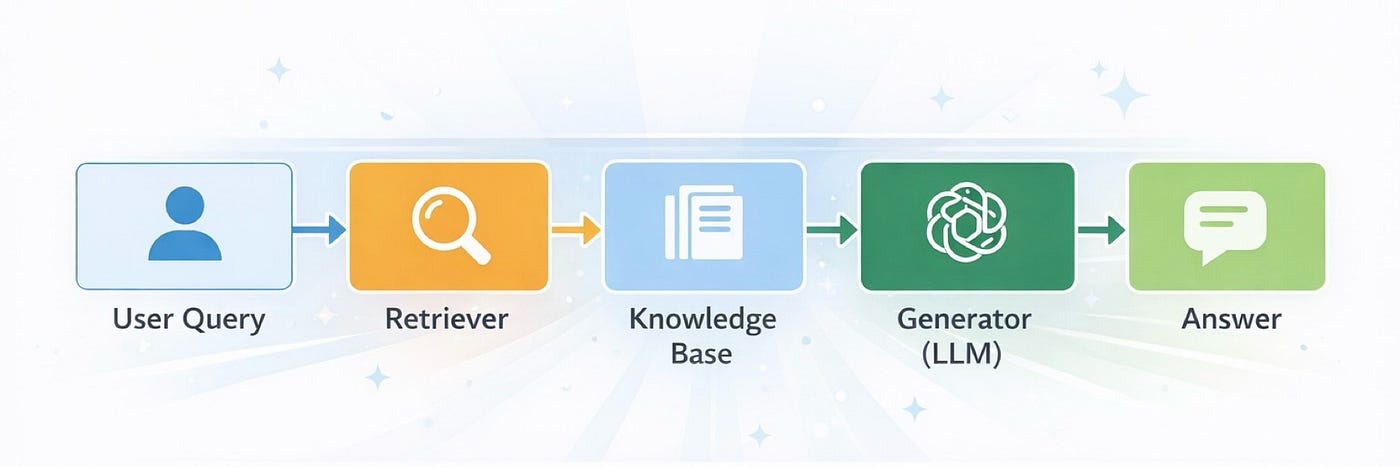
Figure: Basic Retrieval-Augmented Generation (RAG) pipeline illustrating query processing, retrieval, and response generation.
Where RAG Systems Fail
RAG systems are widely adopted but fundamentally flawed in ways that matter.
1.Retrieval Noise
The retriever often returns partially relevant or irrelevant documents.
The LLM still uses them leading to distorted outputs.
2. No Source Attribution
Most implementations do not clearly indicate which documents actually influenced the answer.
3. Hidden Reasoning
The reasoning process remains opaque. Users cannot verify whether the logic is correct.
4. Overconfident Outputs
Even when uncertain, LLMs produce confident responses creating false trust.
A Simple but Dangerous Example
Consider a financial assistant answering:
“Is this company safe for investment?”
The system retrieves mixed reports some positive, some negative The LLM produces a confident “Yes.”
But:
- Which sources were prioritized?
- Were critical risks ignored?
- Was the reasoning valid?
The real problem is not hallucination – it’s the absence of verifiable reasoning.
Explainability is the Missing Layer
Explainable AI (XAI) introduces mechanisms to make AI systems interpretable and trustworthy.
In a RAG system, explainability can provide:
- Source Attribution → Which documents contributed to the answer
- Trust Scoring → Confidence based on source quality
- Token-Level Importance → Which parts of input influenced output
- NLI Verification → Whether the answer logically follows from retrieved data
XAI does not replace RAG it completes it.
The Fix: Explainable RAG Stack (X-RAG)
To address these limitations, we need to rethink the RAG pipeline as a multi-layered system.
I call this approach: Explainable RAG Stack (X-RAG Stack)
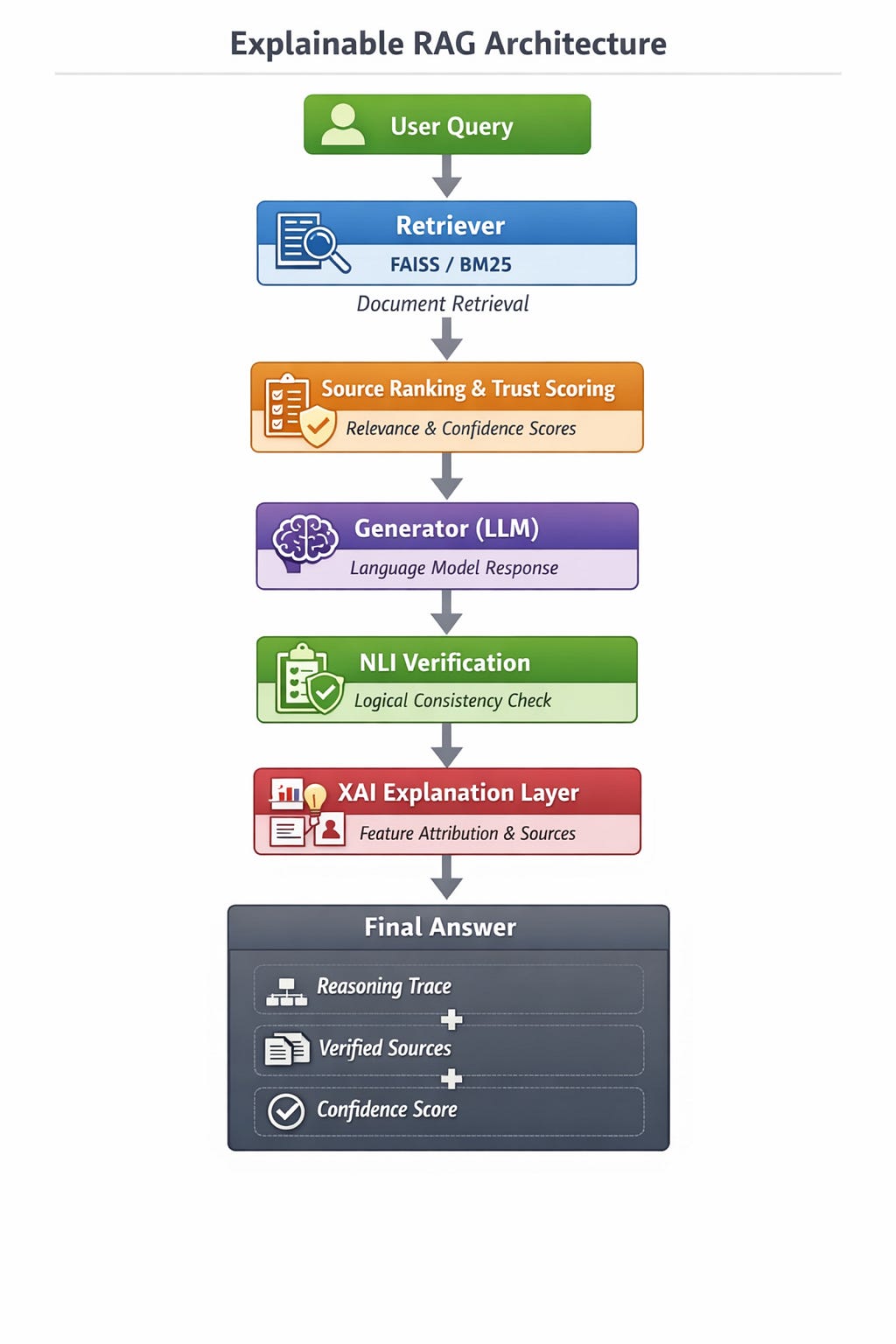
Figure: Explainable RAG Stack (X-RAG) integrating retrieval, verification, and explainability layers.
What Changes?
- Retrieval becomes trust-aware, not just similarity-based
- Outputs are validated, not blindly generated
- Responses are explained, not just delivered
This transforms RAG from a black-box pipeline into a trustworthy AI system.
From Black-Box to Explainable: Implementation Perspective
A typical RAG system is easy to build but difficult to trust.
To understand the gap, let’s compare a baseline implementation with an explainable extension.
1. Standard RAG Pipeline (Baseline)
from langchain.vectorstores import FAISS
from langchain.embeddings import OpenAIEmbeddings
from langchain.chat_models import ChatOpenAI
from langchain.chains import RetrievalQA

# Load embeddings and vector store
embeddings = OpenAIEmbeddings()
db = FAISS.load_local("vector_store", embeddings)

# Create retriever
retriever = db.as_retriever(search_kwargs={"k": 3})

# Initialize LLM
llm = ChatOpenAI(model="gpt-4o-mini")

# Build RAG pipeline
qa_chain = RetrievalQA.from_chain_type(
    llm=llm,
    retriever=retriever
)

query = "Is this company financially stable?"
response = qa_chain.run(query)

print("Answer:", response)
This pipeline retrieves relevant documents and generates an answer.
But it has critical limitations:
- No visibility into source usage
- No reasoning trace
- No validation of correctness
It produces answers but not trust.
2. Explainable RAG (X-RAG Style)
Now let’s extend the same pipeline with explainability.
from langchain.vectorstores import FAISS
from langchain.embeddings import OpenAIEmbeddings
from langchain.chat_models import ChatOpenAI
from langchain.prompts import PromptTemplate

# Load vector store
embeddings = OpenAIEmbeddings()
db = FAISS.load_local("vector_store", embeddings)
retriever = db.as_retriever(search_kwargs={"k": 3})

llm = ChatOpenAI(model="gpt-4o-mini")

# Step 1: Retrieve documents
query = "Is this company financially stable?"
docs = retriever.get_relevant_documents(query)

# Step 2: Assign simple trust scores
scored_docs = [(doc.page_content, doc.metadata.get("score", 0.5)) for doc in docs]

# Step 3: Build context with source information
context = "\n\n".join([f"Source (score={score}): {text}" for text, score in scored_docs])

# Step 4: Prompt with explanation requirement
prompt = PromptTemplate(
    input_variables=["context", "question"],
    template="""
You are an explainable AI system.

Answer the question using the context below.
Also provide:
1. Reasoning
2. Sources used
3. Confidence level (High/Medium/Low)

Context:
{context}

Question:
{question}
"""
)

final_prompt = prompt.format(context=context, question=query)

# Step 5: Generate explainable response
response = llm.predict(final_prompt)

print(response)
This version introduces:
- Source visibility → Explicit document references
- Structured reasoning → Step-level explanation
- Confidence estimation → Trust-aware output
The system now generates not just answers but justified answers.
Comparing Standard RAG vs Explainable RAG
The difference between the two approaches is not incremental it is fundamental.
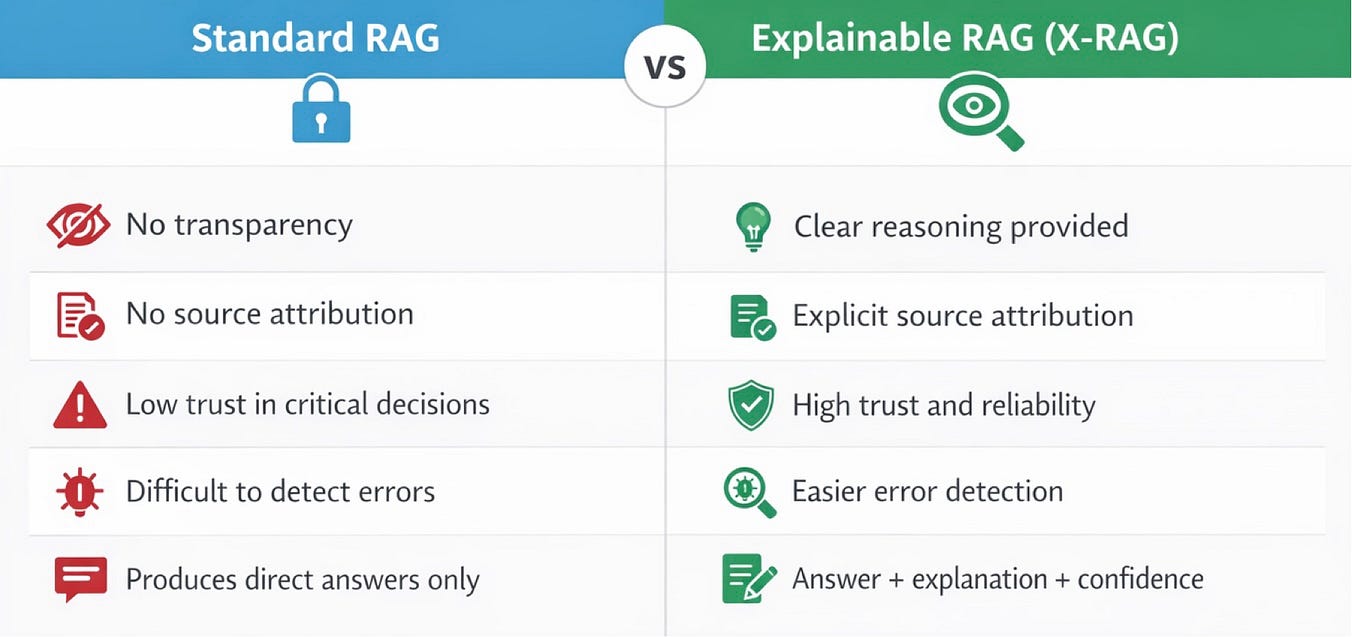
Example Output Comparison
1. Standard RAG Output
Yes, the company appears financially stable based on recent reports.No reasoning. No sources. No verification.
2. Explainable RAG Output
Answer: The company shows moderate financial stability.

Reasoning:
- Revenue has grown consistently over the last three quarters
- However, the debt ratio has increased

Sources Used:
- Q3 Financial Report (score=0.89)
- Analyst Summary (score=0.82)

Confidence: Medium
This output is:
- Interpretable
- Verifiable
- Actionable
Why This Matters in Real Systems
In production environments especially finance AI systems must be accountable.
- A loan approval system must justify decisions
- A fraud detection model must explain anomalies
- A risk assessment tool must provide traceable logic
Black-box outputs are not acceptable in such settings.
Explainable RAG transforms AI systems from:
“Answer generators” → “Decision-support systems”
Final Thoughts
RAG improves access to knowledge but without explainability, it remains incomplete.
The real shift is not from retrieval to generation but from generation to justification.
The future of AI will not be defined by how well it answers – but by how well it can justify those answers.
Explainable RAG is not an enhancement it is the missing layer of modern AI systems.
Acknowledgment
I would like to express my sincere gratitude to my guide, Dr. Umesh B. Chavan, for his invaluable guidance, insightful discussions, and continuous support throughout the development of this work on Explainable RAG systems. His expertise and direction significantly contributed to shaping the ideas and structure presented in this article.
About the Author
Sahil Nadaf is a postgraduate student in Data Science with a strong interest in artificial intelligence, machine learning, and building reliable, real-world AI systems. His work focuses on developing intelligent solutions that are not only accurate but also interpretable and trustworthy.
He actively explores areas such as explainable AI, retrieval-augmented systems, and advanced machine learning techniques, while maintaining a broader focus on solving practical problems using AI.
Connect with him on LinkedIn:
메타데이터
- post_id
- de8dec9f9ccf
- slug
- why-rag-systems-fail-without-explainability-and-how-to-fix-it-de8dec9f9ccf
- url
- https://medium.com/@sahil.nadaf/why-rag-systems-fail-without-explainability-and-how-to-fix-it-de8dec9f9ccf
- canonical_url
- https://medium.com/@sahil.nadaf/why-rag-systems-fail-without-explainability-and-how-to-fix-it-de8dec9f9ccf
- author_url
- https://medium.com/@sahil.nadaf
- status
- ok
- fetched_at
- 2026-06-12 18:14:10




