India’s Big Bond Bang What the $25 Billion Bloomberg Moment Means for Every Indian Investor
India just exempted foreign investors from tax on government bonds. It’s a small policy move with potentially massive consequences for the…
India’s Big Bond Bang What the $25 Billion Bloomberg Moment Means for Every Indian Investor
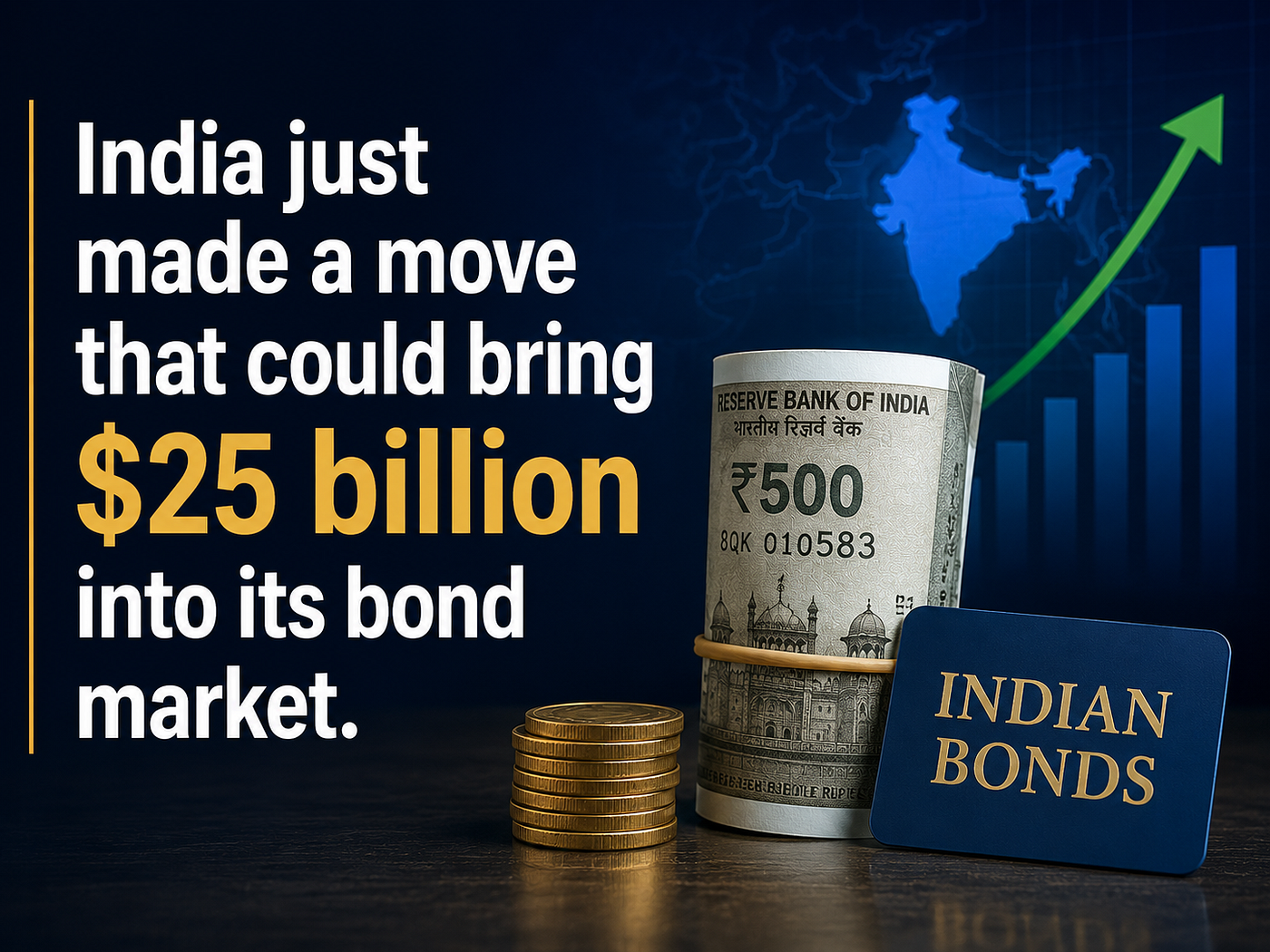
India just exempted foreign investors from tax on government bonds. It’s a small policy move with potentially massive consequences for the world’s fastest-growing bond market.
Something significant happened in India’s financial markets last week and it barelymade it past the business pages.
The Indian government exempted Foreign Portfolio Investors (FPIs) from income tax on interest and capital gains earned from Government Securities, commonly known as G-Secs. On the surface, it sounds like a dry regulatory update. But underneath, it’s one of the most consequential moves India has made for its bond market in years.
The reason: it’s almost certainly aimed at one outcome getting Indian government bonds included in Bloomberg’s Global Aggregate Index, the world’s most widely tracked bond benchmark. The review is scheduled for mid-June 2026. And this time, India might actually make the cut.
First, Let’s Understand What We’re Talking About
Government Securities, or G-Secs, are bonds issued by the Government of India to raise money from the market. When the government needs funds for infrastructure, welfare schemes, or fiscal management it doesn’t just print money. It borrows from investors, both domestic and foreign, by issuing these bonds.
A G-Sec is essentially a loan you give to the Indian government. In return, you receive fixed interest payments over the bond’s tenure and get your full principal back at maturity. Because the borrower is the government itself, these are considered the safest bonds in the country default risk is virtually zero.
For decades, G-Secs were the exclusive domain of banks, insurance companies, and institutional investors. Retail participation was minimal. But that’s changing rapidly and the Bloomberg story is at the heart of why.
The Bloomberg Global Aggregate Index Why It Matters
The Bloomberg Global Aggregate Index is one of the most important benchmarks in global finance. It tracks investment-grade bonds from governments and corporations across the world. Trillions of dollars in global funds are benchmarked against it meaning fund.
managers around the world are effectively obligated to hold bonds that are part of this index.
If India’s G-Secs get included, fund managers globally would need to buy Indian government bonds to match their benchmark. That’s not speculative demand it’s structural, mandatory inflow.
Here’s what the numbers look like:
~1% India’s expected index weighting
$25 billion Estimated foreign inflows that 1% weighting would trigger
~10 months Period over which inflows are expected, starting April 2027
FY28 When actual large-scale capital movement is projected to begin
₹37,620 crore Current FPI holdings in G-Secs via the Fully Accessible Route (FAR)
That 1% weighting sounds small. The $25 billion consequence is anything but
How We Got Here A Brief Timeline
2020–2023: India opens the Fully Accessible Route (FAR) RBI and SEBI allow foreign investors to buy select G-Secs without investment limits via the FAR route a foundational step toward global index eligibility.
March 2024: JP Morgan includes India in its EM Bond Index India gets added to JPMorgan’s GBI-EM Global Diversified Index the first major global bond index inclusion for Indian G-Secs. Billions in FPI inflows follow.
January 2026: Bloomberg defers its decision Bloomberg declines to include India in its Global Aggregate Index, citing concerns around operational infrastructure and market access. A setback but not a rejection.
June 2026: India responds with a bold tax reform FPIs are exempted from income tax on G-Sec interest income and capital gains. The reform directly addresses Bloomberg’s concerns around market competitiveness. The index review is rescheduled for mid-June2026.
What This Means If India Gets Included
The immediate impact of the announcement itself even before formal inclusion — is a significant boost in sentiment. Global fund managers tracking India will read this as a clear signal of intent. And capital tends to follow strong signals.
If India is formally included after Bloomberg’s mid-June review, the effects would ripple across the entire bond market:
📈 Rising G-Sec prices
As demand from global funds increases, bond prices rise and yields moderate making government borrowing cheaper and reducing fiscal pressure.
💧 Deeper market liquidity
More participants means easier buying and selling. A more liquid bond market benefits every investor — domestic and foreign alike.
🌍 Global credibility
India sitting inside Bloomberg’s flagship index would place it along side the US, UK, Japan, and Germany. That’s not just a financial milestone — it’s a statement of economic maturity.
🏦 Lower government borrowing costs
Higher demand for G-Secs lets the government raise money at lower interest rates savings that flow back into fiscal management and public spending.
👨💼 Better options for retail investors
A globally integrated bond market creates tighter pricing, more products, and easier access for everyday Indian investors who have long been locked out.
“The tax reforms were initiated with the primary aim of creating a more competitive framework for foreign investment deepening the sovereign bond market and strengthening India’s case for global index inclusion.”
What About Retail Indian Investors?
Here’s the part nobody is talking about in mainstream coverage of this story.
The Bloomberg narrative is framed entirely around FPIs foreign portfolio investors managing billions of dollars. But what about the Indian retail investor who has never bought a single government bond?
The truth is, as India’s bond market becomes more globally integrated, it becomes better for domestic retail investors too. More liquidity means tighter spreads. More transparency means better pricing. More institutional participation means stronger secondary markets so if you buy a G-Sec today and need to sell it in two years, there will be buyers waiting.
India is building the infrastructure for a bond market that works not just for global funds, but for a salaried professional in Jaipur, a business owner in Surat, or a retiree in Chennai who simply wants safe, predictable returns from their savings.
That infrastructure is being laid right now. The Bloomberg inclusion, if it happens, will accelerate it significantly.
The Bigger Picture India’s Bond Market Is Finally Growing Up
India’s bond market has long been described as underdeveloped relative to the size of its
economy. The equity market consistently attracted retail attention and media coverage. Bonds stayed in the shadows the preserve of banks, mutual funds, and the wealthy.
That narrative is shifting.
JP Morgan’s inclusion in 2024 started the process. Bloomberg’s potential inclusion in 2026would deepen it. SEBI’s ongoing reforms to lower minimum investment thresholds are opening the door to retail investors. New platforms are making it possible to buy high-quality bonds with as little as ₹10,000.
India’s bond market is not just growing. It’s finally growing up.
And the global money is starting to notice.
The question worth asking is: are Indian retail investors paying attention too?
Follow this page for more clear, jargon-free content on India’s bond market from thebasics to the big picture.
메타데이터
- post_id
- de9078a819d9
- slug
- indias-big-bond-bang-what-the-25-billion-bloomberg-moment-means-for-every-indian-investor-de9078a819d9
- url
- https://medium.com/@stakehubs/indias-big-bond-bang-what-the-25-billion-bloomberg-moment-means-for-every-indian-investor-de9078a819d9
- canonical_url
- https://medium.com/@stakehubs/indias-big-bond-bang-what-the-25-billion-bloomberg-moment-means-for-every-indian-investor-de9078a819d9
- author_url
- https://medium.com/@stakehubs
- status
- ok
- fetched_at
- 2026-06-23 17:05:31