Why Computer Vision Development Is Becoming a Core Business Strategy in 2026
A few years ago, computer vision was considered an experimental AI branch reserved for research labs and tech giants. Today, it is powering…
Why Computer Vision Development Is Becoming a Core Business Strategy in 2026
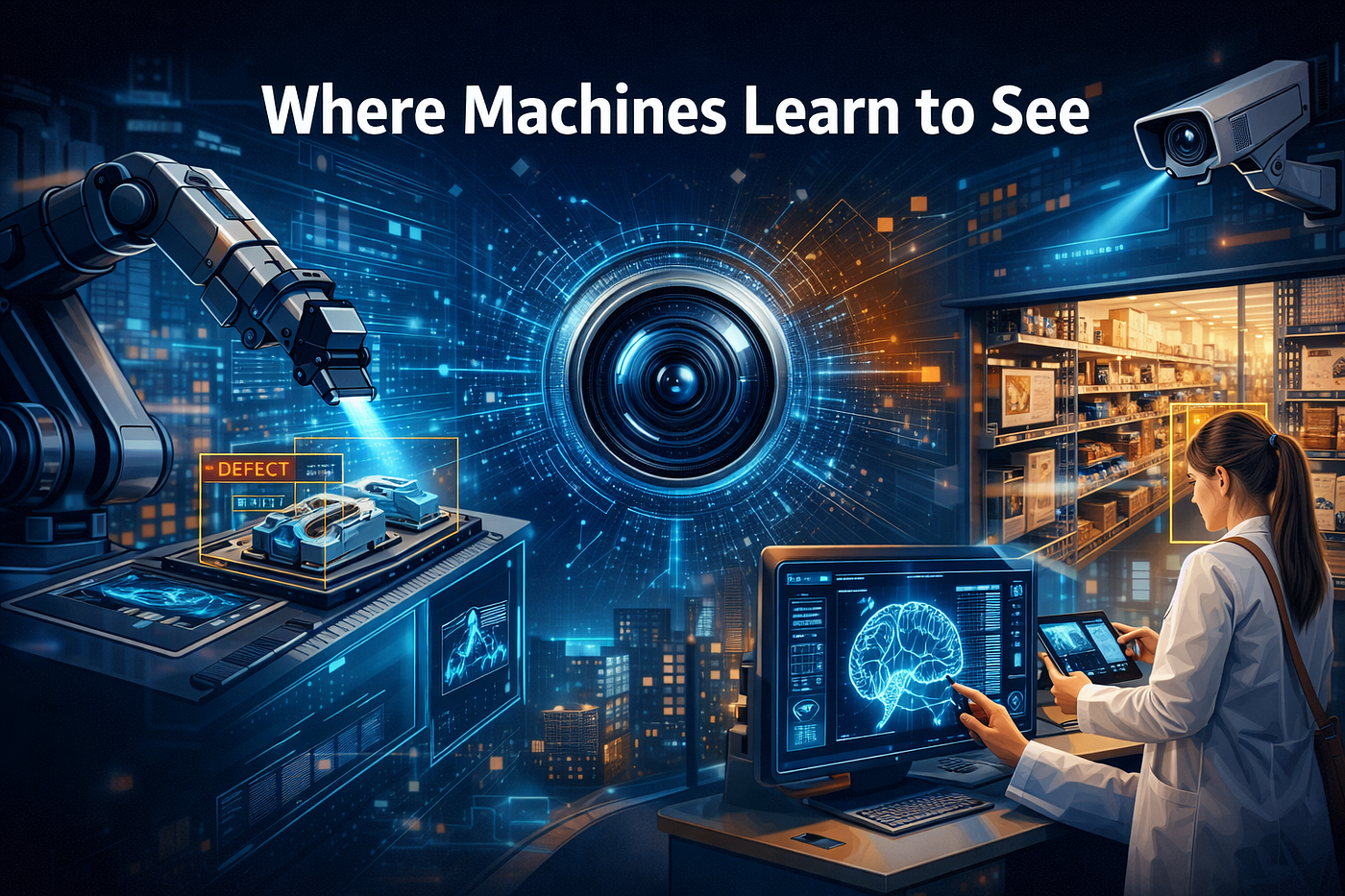
A few years ago, computer vision was considered an experimental AI branch reserved for research labs and tech giants. Today, it is powering factory floors, hospital diagnostics, retail intelligence systems, robotics platforms, and smart cities.
The shift is not gradual anymore. It is strategic.
Businesses are no longer asking, “What is computer vision?” They are asking, “How fast can we implement computer vision development into our operations?”
In this article, we’ll explore what modern **computer vision development** really involves, why it matters beyond hype, how enterprises are implementing it successfully, and what decision-makers must know before investing.
The Real Meaning of Computer Vision Development
At its core, computer vision development is about enabling machines to see, interpret, and respond to visual information just like humans do, but at a scale and speed that humans cannot match.
It goes beyond basic image recognition.
Modern computer vision systems can:
- Detect and classify objects in milliseconds
- Analyze behavior patterns
- Identify anomalies
- Track movement in real time
- Extract text from images
- Power autonomous robots
Unlike traditional rule-based image processing, today’s computer vision development relies on deep learning architectures trained on large datasets. These models improve over time, adapt to new environments, and can be deployed across industries.
But building these systems requires more than just training a neural network.
It requires strategy.
Why Businesses Are Investing Heavily in Computer Vision Development
Visual data is exploding.
Cameras are everywhere:
- Manufacturing units
- Warehouses
- Retail stores
- Hospitals
- Offices
- Public infrastructure
Most organizations already collect visual data. The problem is that they do not extract value from it.
Computer vision development turns passive visual data into actionable intelligence.
Here is why enterprises are prioritizing it:
1. Operational Efficiency
Manual inspections are expensive and inconsistent. AI-powered vision systems operate 24/7 with consistent accuracy.
2. Cost Reduction
Automation reduces dependency on repetitive human tasks.
3. Real-Time Decision Making
Instead of analyzing reports after damage occurs, companies can detect issues instantly.
4. Competitive Differentiation
Businesses that leverage visual AI outperform those relying solely on manual oversight.
In many industries, computer vision development is no longer optional. It is becoming foundational infrastructure.
Inside the Computer Vision Development Lifecycle
From my experience working with AI-focused technology companies, one misconception stands out: people think computer vision development is just model training.
In reality, it is a structured lifecycle.
Let’s break it down.
Step 1: Defining the Business Objective
Before selecting frameworks or datasets, you must answer the following:
- What business problem are we solving?
- What is the measurable outcome?
- What level of accuracy is acceptable?
- What happens if the system makes an error?
For example:
Detecting defective parts in manufacturing requires near-perfect accuracy. Tracking footfall in retail may tolerate slight variance.
The clarity at this stage determines long-term success.
Step 2: Data Strategy and Annotation
No model performs better than its data.
Computer vision development demands:
- Diverse image datasets
- Various lighting conditions
- Multiple object angles
- Edge case scenarios
- High-quality labeling
Annotation is not just marking bounding boxes. It involves semantic segmentation, classification tagging, and contextual labeling depending on the use case.
Data quality directly impacts model reliability.
Step 3: Model Architecture Selection
The choice of model depends on use case:
- Object detection
- Image classification
- Facial recognition
- Pose estimation
- Optical character recognition
- Semantic segmentation
Each problem requires a tailored architecture.
An experienced computer vision development team balances the following:
- Accuracy
- Latency
- Hardware constraints
- Scalability
Sometimes a slightly less accurate but faster model performs better in production environments.
Step 4: Training and Optimization
Training is where the intelligence is shaped.
Key processes include the following:
- Transfer learning
- Hyperparameter tuning
- Data augmentation
- Model pruning
- Quantization for edge deployment
Optimization ensures that models do not just perform well in lab environments but also in real-world unpredictable conditions.
Step 5: Deployment Strategy
Deployment is often underestimated.
Where will the model run?
- Cloud servers
- On-premise infrastructure
- Edge devices
- Embedded robotics systems
Each environment affects performance, latency, and security considerations.
Scalable computer vision development requires infrastructure planning from day one.
Step 6: Monitoring and Continuous Learning
Real-world environments evolve.
Lighting changes. Product designs change. Human behavior changes.
Without continuous monitoring and retraining, models degrade over time.
Sustainable computer vision development includes feedback loops and performance analytics.
Industry Applications Driving Real ROI
Let’s look at how industries are leveraging computer vision strategically.
Manufacturing
- Automated defect detection
- Safety compliance monitoring
- Production line tracking
- Inventory accuracy
Vision-powered systems reduce downtime and increase precision.
Healthcare
- Radiology image analysis
- Tumor detection
- Patient movement monitoring
- Surgical guidance assistance
Accuracy and compliance are critical in healthcare computer vision development.
Retail
- Shelf stock monitoring
- Theft detection
- Customer behavior analysis
- Automated checkout
Retail intelligence powered by vision improves margins and customer experience simultaneously.
Robotics and Automation
Computer vision development plays a crucial role in robotics:
- Autonomous navigation
- Obstacle avoidance
- Object picking and placement
- Human-robot collaboration
Robotics companies increasingly rely on vision-based AI to enhance machine autonomy.
The Hidden Challenges Companies Face
Despite its promise, computer vision development is complex.
Here are common hurdles:
Data Privacy Regulations
Facial recognition and surveillance systems must comply with local and international laws.
Infrastructure Costs
Training deep learning models requires GPUs and scalable infrastructure.
Accuracy Expectations
Stakeholders often expect 100 percent precision, which is rarely realistic initially.
Scalability Across Locations
A model trained in one factory may underperform in another with different lighting conditions.
Talent Gap
Experienced AI engineers and computer vision specialists are limited.
This is why many companies either struggle with in-house implementation or seek specialized development partners.
Build Internally or Partner With Experts?
This decision depends on long-term strategy.
In-House Development Works Best When:
- AI is core to your product
- You have strong internal engineering talent
- You are building proprietary intellectual property
Partnering Works Best When:
- You need faster deployment
- You lack AI infrastructure
- You want proven frameworks
- You aim to reduce experimentation risk
For organizations evaluating the complete computer vision development process in depth, referencing a structured implementation guide can significantly reduce strategic mistakes.
Emerging Trends Shaping Computer Vision Development
The future is moving fast.
Here are trends reshaping the landscape:
Edge AI Adoption
Processing visual data directly on devices reduces latency and improves privacy.
Synthetic Data Generation
AI-generated training images reduce data collection costs.
Multimodal AI Systems
Combining vision with text, audio, and sensor inputs improves contextual intelligence.
3D Vision and Spatial Computing
AR, VR, and robotics are benefiting from advanced spatial awareness systems.
Real-Time Analytics Dashboards
Businesses now demand live insights instead of delayed reports.
Organizations that invest early in scalable computer vision development frameworks will dominate their sectors.
Measuring Business Impact
Every executive ultimately asks one question:
What is the return on investment?
Here are measurable indicators:
- Reduced labor costs
- Fewer defects and recalls
- Improved compliance
- Faster processing time
- Higher customer satisfaction
- Enhanced operational transparency
Computer vision development is not just about automation. It is about measurable performance improvement.
Final Thoughts
We are entering an era where machines do not just compute. They observe, interpret, and act.
Computer vision development sits at the center of this transformation.
It is redefining:
- Manufacturing precision
- Healthcare diagnostics
- Retail intelligence
- Robotics autonomy
- Security systems
The businesses that treat visual AI as a strategic investment rather than a technical experiment will lead the next decade of innovation.
If you are considering implementing AI-powered visual systems, the key is not just building a model. It is building a scalable, monitored, and business-aligned computer vision development strategy.
Because in 2026 and beyond, the companies that can see intelligently will operate intelligently.
메타데이터
- post_id
- de9b64a9653e
- slug
- why-computer-vision-development-is-becoming-a-core-business-strategy-in-2026-de9b64a9653e
- url
- https://medium.com/@dipam777/why-computer-vision-development-is-becoming-a-core-business-strategy-in-2026-de9b64a9653e
- canonical_url
- https://medium.com/@dipam777/why-computer-vision-development-is-becoming-a-core-business-strategy-in-2026-de9b64a9653e
- author_url
- https://medium.com/@dipam777
- status
- ok
- fetched_at
- 2026-06-20 20:29:01