The Accountability Gap: Why AI Fails When Nobody Owns the Outcome
Enterprise AI programs are not failing because the models are weak. They are failing because responsibility disappears the moment decisions…
The Accountability Gap: Why AI Fails When Nobody Owns the Outcome
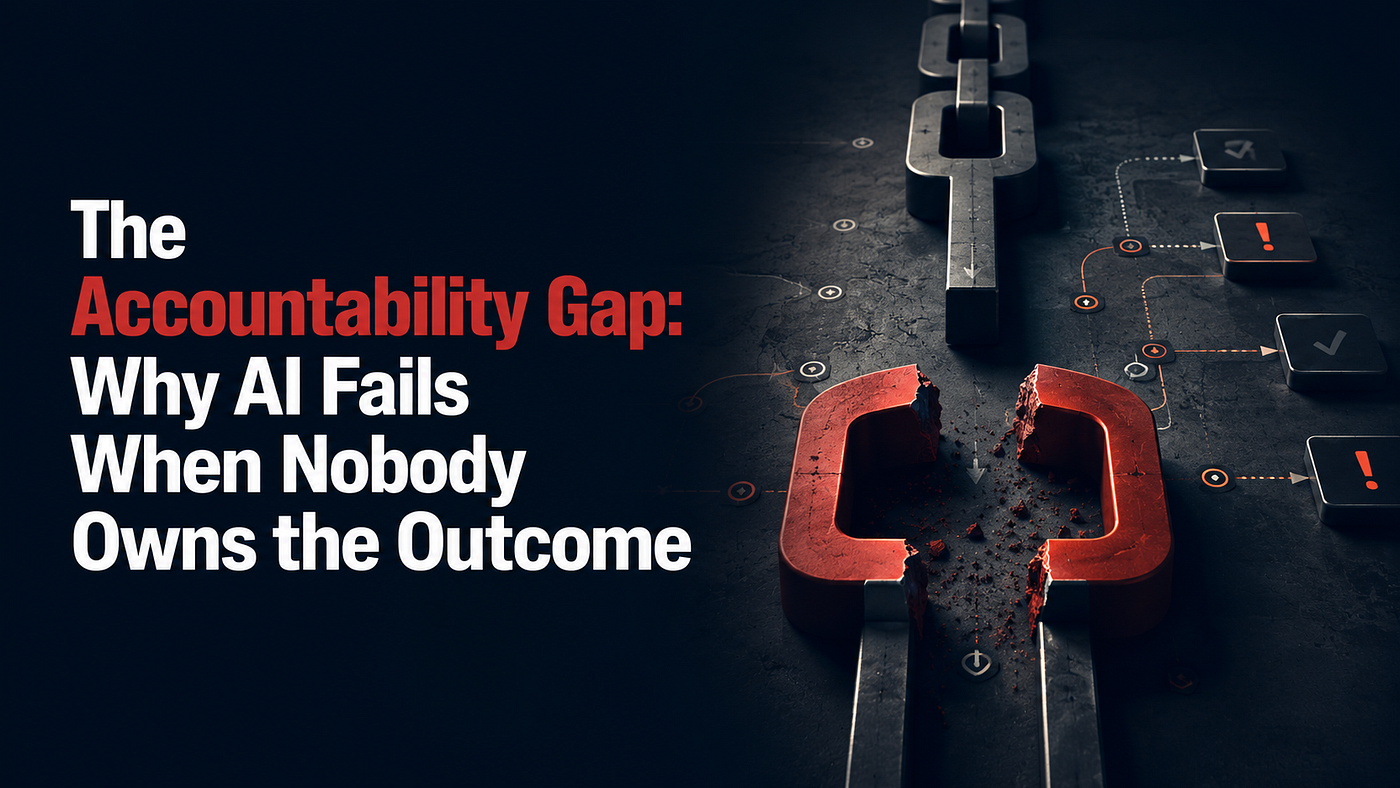
Enterprise AI programs are not failing because the models are weak. They are failing because responsibility disappears the moment decisions become automated.
That is the contradiction most leadership teams are now confronting. AI pilots can generate impressive demos, summarize documents in seconds, and automate fragments of workflow. Yet once those systems are connected to production operations, nobody can clearly answer a basic operational question: who owns the outcome when the system is wrong?
That assumption no longer holds.
For years, enterprise software operated under a relatively stable accountability structure. Product owners defined requirements. Engineers built systems. Operations teams maintained reliability. Business leaders approved process changes. AI disrupts that structure because probabilistic systems behave differently from deterministic software. Outputs vary. Context matters. Decisions evolve over time. Failures become difficult to trace.
The result is an expanding accountability gap across enterprises adopting generative and agentic AI.
The industry data already reflects this tension. According to Deloitte’s State of Generative AI in the Enterprise report, more than two-thirds of organizations expect 30% or fewer of their AI experiments to scale successfully in the near term. Governance, trust, and operational readiness remain the primary blockers, not model capability.
Meanwhile, ~35% of teams report running parallel workflows due to AI distrust. That behavior tells you everything about enterprise confidence levels. Teams are not replacing processes. They are shadowing them because they do not trust the accountability chain yet.
AI Governance Is Not Keeping Pace With AI Deployment
Most enterprises adopted AI faster than they redesigned decision ownership.
That is only part of the story.
The deeper issue is structural. AI systems now operate across organizational boundaries that were previously isolated. A customer service copilot touches CRM data, compliance rules, identity systems, and knowledge repositories simultaneously. An autonomous procurement agent can trigger downstream financial consequences without any single team fully understanding the execution path.
Traditional governance models were not designed for that level of interconnected autonomy.
Recent reporting from Axios found that nearly 80% of executives believe their organizations would fail an AI governance audit despite widespread AI deployment. The operational reality is becoming clear: enterprises accelerated implementation before establishing enforceable oversight.
In practice, this becomes the real bottleneck.
Most organizations still treat AI governance as a policy exercise rather than an operational discipline. They create review committees, publish ethical principles, and draft acceptable use guidelines. Those controls matter, but they do not solve runtime accountability.
When an AI system makes a flawed recommendation, several questions immediately surface:
- Who approved the workflow logic?
- Who validated the training data?
- Who monitors model drift?
- Who owns escalation during failure?
- Who has authority to disable the system?
Many enterprises cannot answer those questions cleanly because ownership is fragmented across architecture, security, legal, data science, and business operations.
That fragmentation creates operational paralysis.
The Real Failure Point Is Decision Ownership
Most AI incidents inside enterprises do not begin as catastrophic failures. They begin as ambiguous decisions nobody fully owns.
A procurement model approves a supplier outside policy thresholds. A support agent fabricates an escalation response. A forecasting engine amplifies biased assumptions already present in historical data. The immediate technical issue is often manageable. The governance failure is not.
Research from MIT-linked analysis found that 95% of enterprise generative AI initiatives produced no measurable P&L impact, largely due to flawed integration into operational workflows rather than model limitations.
The pattern repeats across industries because enterprises continue assigning AI accountability indirectly.
1. Engineering Owns Reliability, Not Business Consequences
Infrastructure teams can ensure uptime, observability, and latency targets. That does not mean they should own downstream business decisions generated by models.
The distinction matters because AI failures are often context failures, not system failures.
2. Business Teams Own Outcomes, But Not System Behavior
Business leaders increasingly approve AI deployment without understanding model boundaries, hallucination risk, or confidence calibration. That creates dangerous asymmetry between operational accountability and technical visibility.
3. Legal and Compliance Arrive Late
In many organizations, governance reviews happen after deployment pressure has already accelerated timelines. Compliance becomes reactive instead of embedded into system design.
4. Vendors Cannot Absorb Enterprise Accountability
Enterprises still attempt to externalize responsibility to AI vendors. That position is collapsing quickly. Regulators and customers ultimately hold the deploying organization accountable, not the model provider.
5. Autonomous Agents Escalate the Problem
Agentic systems introduce compound accountability issues because they chain actions together dynamically. A single execution path may involve retrieval systems, APIs, internal tools, and external services simultaneously.
Observability alone is insufficient. Enterprises need execution-level accountability.
Research evaluating governance across AI agent systems recently concluded that most implementations provide logging visibility without enforceable runtime accountability controls.
Enterprises Need Operational Accountability Architecture
The next phase of enterprise AI maturity will not be defined by larger models. It will be defined by accountability infrastructure.
That shift is already underway.
Leading organizations are moving away from generalized “responsible AI” messaging and toward operational governance layers integrated directly into deployment pipelines, access systems, and workflow orchestration.
Three changes are becoming standard among mature AI programs:
- Decision traceability tied to business ownership
- Human override mechanisms embedded into workflows
- Runtime policy enforcement instead of static governance documentation
This mirrors what happened in cybersecurity over the past decade. Security evolved from compliance paperwork into continuous operational enforcement. AI governance is heading toward the same model.
Importantly, governance maturity now correlates directly with scalability. Research repeatedly identifies trust, governance, and organizational readiness as primary determinants of successful scaling.
The discussion is shifting away from experimentation metrics toward operational survivability. Boards increasingly want evidence that AI systems can be audited, interrupted, and governed under production conditions.
The issue is no longer whether enterprises will adopt AI aggressively. They already are.
The real dividing line will be whether enterprises can build accountability systems strong enough to absorb autonomous decision-making at scale.
The Next Enterprise Advantage Will Be Governed Autonomy
The industry still talks about AI primarily as a productivity layer. That framing is incomplete.
AI is becoming a decision infrastructure layer inside enterprises. Once that happens, governance stops being a legal concern and becomes a core operational capability.
The organizations that scale AI successfully over the next five years will not necessarily have the most advanced models. They will have the clearest ownership structures, the strongest runtime controls, and the fastest escalation mechanisms when systems fail.
That is where enterprise AI is heading now: not toward full autonomy, but toward governed autonomy.
The companies that understand the difference early will move faster precisely because they know where responsibility begins and where it ends.
메타데이터
- post_id
- deb63313f7a6
- slug
- the-accountability-gap-why-ai-fails-when-nobody-owns-the-outcome-deb63313f7a6
- url
- https://medium.com/@OlwaysOnline/the-accountability-gap-why-ai-fails-when-nobody-owns-the-outcome-deb63313f7a6
- canonical_url
- https://medium.com/@OlwaysOnline/the-accountability-gap-why-ai-fails-when-nobody-owns-the-outcome-deb63313f7a6
- author_url
- https://medium.com/@OlwaysOnline
- status
- ok
- fetched_at
- 2026-07-17 04:42:44